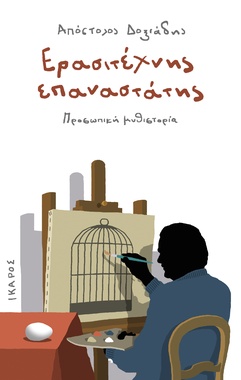
Amateur revolutionary - Personal fiction
The ‘Amateur Revolutionary’ is a confessional coming-of-age story and a gripping adventure. At the same time, however, it is a reflection on the recent history of the country, the nature of extreme situations and the radical politics they foster, as well as on the fate of the generation shaped during the years of the dictatorship, a generation that continues to leave its mark on the present day.
‘I called my narrative a “myth-story” because, as I wrote, I realised that the reconstruction of the past relies not only on memory, but also on imagination—an active imagination that can dredge up emotions without, however, distorting the facts.’
Apostolos Doxiadis recounts his life from his early childhood through to adulthood. At the heart of the narrative he places politics, observation, lived experience and, later, action. In an environment that is constantly changing for the worse, a child tries to understand what the adults around him are experiencing as an unstable parliamentary democracy, shaping his character and ideas through constant interaction with events. The coup of April 1967 brings dramatic changes to the country and to the narrator’s family. The height of the student movement finds him actively involved in the resistance against the dictatorship, within a Left characterised by grand visions and endless disputes, engaged in a struggle that at times seems thrilling and at others hopeless, yet always necessary and dangerous.
Author:
Apostolos Doxiadis
Text editing:
Maria Simeonidou
Cover:
Dimitris Hatzopoulos
Date of publication:
10/12/2018
Pages:
1064
Dimensions:
15 x 24 εκ.
ISBN:
978-960-572-267-8
Publication:
2018
Categories:
Books, Biographies & Personal Narratives, Essays & Thought, Biographies, Δοκίμιο
"...I felt a deep sense of envy whilst reading the book. I envied and marvelled at the way Apostolos Doxiadis took me by the hand and did not let go until I had finished the book. I was angry with him, because the end of the book left me feeling very lonely. However much I told myself there wouldn’t be a happy ending (after all, only fairy tales have happy endings, not novels), deep down a part of my soul is probably with the sort of person who believes the cherries will ripen early this year."
– Eirini Agapidaki, Athens Voice"...I am reading Apostolos Doxiadis’s excellent book *Amateur Revolutionary*. It is the personal story of an exceptionally talented child who managed to gain entry to the renowned Columbia University at the age of just 16, whilst still a pupil at secondary school, to study mathematics as a ‘child prodigy’. [...] I haven’t yet reached the part where Apostolos Doxiadis becomes actively involved in the resistance against the junta, through Rigas Feraios, which I hear from others (more well-read than myself) is fascinating. I’m eagerly awaiting the rest. I am certain that, apart from nostalgia, romanticism and standard suspense, it will also be deeply moving."
– Manolis Kapsis, Capital.gr"...The book is a gripping read – you simply cannot put it down! It is personally moving – many of us find in its pages similar experiences during the dictatorship and afterwards. It makes us think and re-evaluate much of what happened and what we had come to think of in a certain way. It is a book that teaches you without being didactic. It is delightful, sensitive, and insightful. It is a Bildungsroman of the author, his generation and his country, with great depth and successive layers of analysis. A vast amount of material that, thanks to the author’s mastery, flows kaleidoscopically and effortlessly. It offers the warmth and enjoyment of a great book, both literally (it is 1,056 pages long) and figuratively. I believe it will serve as a point of reference for an entire generation, as well as for anyone who might later wish to study the period, much as Theotokas’s *Argo* is for its own era."
– Vaso Kinti, Athens Voice"...Reading Apostolos Doxiadis’s book, I realised that I had, in a figurative sense, the stages of grief, not, of course, in the linear order in which they are usually presented—which gives the impression that we must deal with loss in a linear manner—but in a disorderly, more human and down-to-earth way. For the sake of brevity, however, I shall retain the linearity of the stages, which are: Denial, Anger, Bargaining, Depression, Acceptance. These emotional reactions, as well as the thoughts they sparked in me, suggest that, whilst reading the book, I was confronted with a loss. But what was lost, and for whom? Was I perhaps swept away by Apostolos Doxiadis’s narrative skill and identified with the protagonists and their own losses?"
– Eirini Agapidaki, Athens Voice"...In his extensive yet accessible text, Doxiadis, moving beyond the microcosm of students in America and Paris, highlights some lesser-known aspects of the conflict within the world of left-wing ideas, for example, the harsh ostracism of Stratis Tsirkas when he deviated from the party line by writing *The Ungoverned States*, in which he criticised the rigid mindset of the Stalinist communists in Egypt – incidentally, his critique of Tsirkas’s classic work is very interesting and apt."
– Apostolos Spyrakis, Diastixo.grSo what was the Polytechnic? Apostolos Doxiadis, a few days before the anniversary of the Polytechnic, and prompted by the relevant chapter from his book _Amateur Revolutionary_, publishes his thoughts on the subject on Protagon.gr.
– Protagon.gr"I read it in one go with great interest and learnt a lot about the micro-history of the resistance, the archaeology of the KKE’s internal workings, and the Polytechnic uprising. More than anything, however, I was moved by the coming-of-age story of a young man who wandered through the left with intellectual curiosity about its ideas and a great willingness to contribute, only to ultimately reject communism and embrace the solid liberal humanist values his father had instilled in him from childhood."
– Pantelis Kapsis, Skai.gr"...The heroes who fought the dictatorship did so so that we might all live with justice and dignity, so that we might have the freedom to find ourselves alongside the people we love. This, I think, shows us one of the possible interpretations of _The Amateur Revolutionary_. Perhaps with fewer adventures, and certainly with fewer dangers than under the junta, the struggle for our true values does not end. It continues with every passing day."
– Pavlos Eleftheriadis, Liberal.gr"...Apostolos Doxiadis does not merely write a chronicle of those years with an emphasis on historical truth, but rather a literary account, where everything is articulated through the narrative ‘I’. And this allows for subjectivity, personal thoughts and objections, hesitations, discussions and conflicting views to intersect in his consciousness, as he sought ways to become politically active, but also to understand the chessboard on which he happened to find himself, as both an active and an active pawn. In this way, the entire narrative takes on the characteristics of a coming-of-age novel, as the young boy who left for America and then France comes of age through politics, which offered him a goal beyond his own individuality, he was forged in the background of the persecuted Left, whilst deep down he always remained a young man of the Centre, and he matured by acquiring self-awareness, intellectual and political wisdom."
– Giorgos Perantonakis, Bookpress.gr"...The book features an excellent detective—or rather, espionage—narrative (it is a blend of the espionage story of the English communist master spy, Philby, and a left-wing political-police film). It is gripping whether viewed as a political thriller or a psychological thriller. But first and foremost, it is a political essay."
– Theodoros Soumas, Bookpress"...The personal memoir of Apostolos Doxiadis, from childhood through to adulthood and his entry into active politics. A journey spanning key milestones in modern history. True events blended into the magical broth of imagination, for only thus can they find their truth. Observation, experience, and action within a volatile political environment. A reflective journey through personal struggles to understand the world."
– Nikos Kourmoulis, Ta Nea
"Every book is a surprise, and for me, *The Amateur Revolutionary* proved to be not just a surprise, but a major revelation. In this ‘personal novel’, as the author himself describes it, the reader follows the story through the eyes of a child, and it is certain that every reader will find elements with which they can identify. Within the pages of books, truths unfold that we may have been searching for for years. And this particular book will make those who avoid reading, viewing it as a waste of time, reconsider."
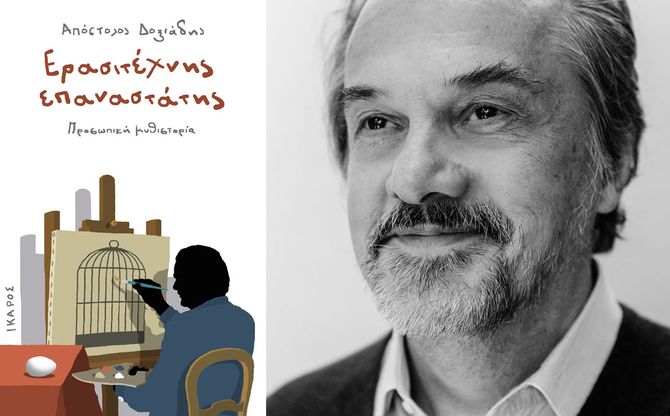
– Anastasia Kotanidou, In.grApostolos Doxiadis
Apostolos Doxiadis was born in Australia to Greek parents and grew up in Athens. He studied mathematics at Columbia University in New York and continued his postgraduate studies in Paris. Returning to Greece, he directed for the theatre and cinema. His second feature film, Terirem, won the International Confederation of Art Cinemas Award at the Berlin Film Festival in 1988.
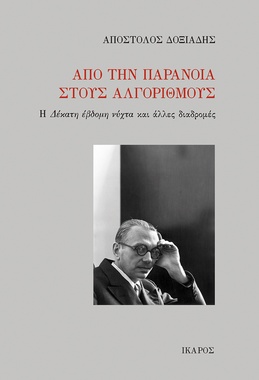
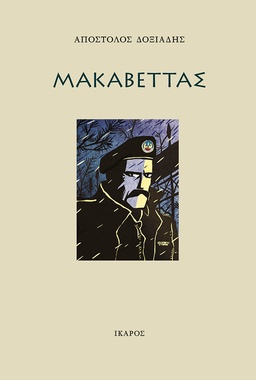
He wrote the short stories Parallel Life (Agra, 1985), Makavettas (Estia, 1988, revised edition Ikaros, 2010), Uncle Peter and Goldbach’s Conjecture (Kastaniotis, 1993, revised edition 2001), The Three Little Men (Kastaniotis, 1998), as well as the play The Seventeenth Night, which was published alongside the essay From Insanity to Algorithms in the book of the same title (Ikaros, 2006).
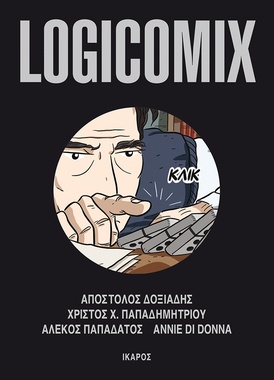
In 2008, Ikaros published the highly successful graphic novel Logicomix, in collaboration with Christos Papadimitriou, Alekos Papadatos, and Annie Di Donna, following five years of work. The book, which was first published in Greek, received rave reviews from readers and critics alike, and was soon followed by its publication in 22 countries around the world, turning it into a publishing phenomenon.