Saying it over and over again - Literature, the enigmatic Patroklos Giatras, and the transformations of ‘The Deserted Country’
-
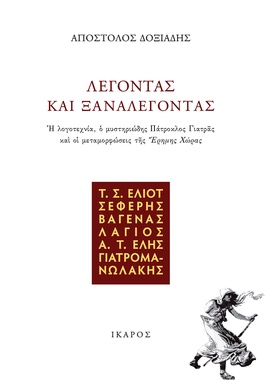
Apostolos Doxiadis, writing about the history of Nasos Vagenas’s short story ‘Patroklos Giatras and the Greek translations of The Waste Land’, its background and influence, he explores the central theme of repetition in literature.
T. S. Eliot’s great poem The Waste Land (1922) gave rise to George Seferis’s The Waste Land (1936), which, together with an idea by Borges, gave rise to Nasos Vagenas’s short story (1972). This gave rise to The Desolate Earth (1984), Ilias Lagios’s fictional reconstruction of the epic poem that Giatras never managed to write, and this, together with the preceding works, gave rise to A. T. Elís’s The Ready Land (2016) by A. T. Elis, which demystifies the previous visions, setting its scene in present-day Greece...
The book includes an essay by Apostolos Doxiadis and the four texts it discusses: the short story by Nasos Vagenas, The Deserted Country in Seferis’s translation, The Deserted Land by Lagios, and The Ready Country by Elies. The volume is rounded off with Giorgos Giatromanolakis’s afterword, ‘Writers: agents of the mind or a horde of enthusiasts’, which, amongst other things, summarises the profound relevance and coherence of these texts.
Author:
Apostolos Doxiadis
Appendix:
Giorgis Giatromanolakis
Pages:
240
Dimensions:
14 x 21 εκ.
ISBN:
978-960-572-153-4
Publication:
2017
Categories:
Books, Essays & Thought, Δοκίμιο
"...The whole book is, in my opinion, a multi-layered joke with Elie and Etoimi Chora at its heart. A joke about the pure joy we can find in playing with language."
– Stefanos Kasimatis, KathimeriniOn the occasion of the anniversary of the death of Jorge Luis Borges, Andro recalls Nasos Vagenas’s unexpected encounter with Borges in the centre of Athens in 1983.
– Andro.gr"...This line of argument (I say and repeat the same thing, I write and rewrite the same thing – and yet something different emerges) is developed in greater detail for the reader by A. Doxiadis in his introductory text and G. Giatromanolakis in a post-literary epilogue. The whole is a good exercise in comparative reading."
– Lizzie Tsirimokou, To Vima"...The Elian Flevas, who had appeared as Aris Velouchiotis, now returns as a comrade of Lafazanis. The original ‘chess’, having passed through ‘backgammon’, evolved into ‘prefa’, and The Waste Land, which began as a tragedy or at least a symptom of bourgeois indigestion (Eliot), was transformed into a communist epic (Giatrás), became a dream-drama (Lagios) and ended up as a ‘comedy’ (Elís). Thus, by saying and saying again, the world, the text and its symbolism continue.”
– Anthoula Daniel, Diastixo.gr"...However playful (and at the same time extremely serious) Doxiadis’s study is, the publication that hosts it proves to be just as playful. By including in its pages the ‘original’ translation by Seferis and the three ‘tinkered-with’ ‘archetypes’, it transforms Doxiadis’s study into an ‘archetype’ as well, placing it in the foremost position (i.e. first), to be followed by a final (now fifth) ‘archetype’, which is none other than Giorgos Giatromanolakis’s commentary on what has gone before. A crown in full bloom and, by its very nature, open to those who may wish to thicken its lines in the future."
– Vangelis Hatzivassiliou, To Vima"...Doxiadis’s critical eye allows us – given his sharpness of speech – to discern glimmers of light through the cracks in his approach. In particular, the comparison of Eliot’s ‘wasteland’ and Lagiou’s ‘desolate land’, accompanied by the essayist’s detailed interpretative comments, reveals a profound study of the two works. Moreover, the three Greek works built upon the ‘wasteland’ encompass the entire political history of the second half of the 20th century, with its exiles and imprisonments (Vagenas) and the division that remains unhealed even today (Lagios, Elissavet)."
– Dimos Chloptsioudis, Tvxs.grApostolos Doxiadis
Apostolos Doxiadis was born in Australia to Greek parents and grew up in Athens. He studied mathematics at Columbia University in New York and continued his postgraduate studies in Paris. Returning to Greece, he directed for the theatre and cinema. His second feature film, Terirem, won the International Confederation of Art Cinemas Award at the Berlin Film Festival in 1988.
He wrote the short stories Parallel Life (Agra, 1985), Makavettas (Estia, 1988, revised edition Ikaros, 2010), Uncle Peter and Goldbach’s Conjecture (Kastaniotis, 1993, revised edition 2001), The Three Little Men (Kastaniotis, 1998), as well as the play The Seventeenth Night, which was published alongside the essay From Insanity to Algorithms in the book of the same title (Ikaros, 2006).
In 2008, Ikaros published the highly successful graphic novel Logicomix, in collaboration with Christos Papadimitriou, Alekos Papadatos, and Annie Di Donna, following five years of work. The book, which was first published in Greek, received rave reviews from readers and critics alike, and was soon followed by its publication in 22 countries around the world, turning it into a publishing phenomenon.