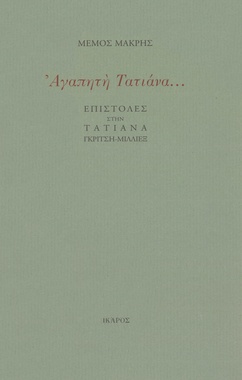
These are two letters sent by Memos Makris to Tatiana Gritsi Milliex in 1947, which are of great interest. Through them, aspects of the great sculptor’s personality are revealed. His sensitivity, his subtle humour, his openness to new ideas, his love of clay, and his concerns not only for his own artistic future but also for that of his homeland.
At the same time, the letters shed light on the life and work of Roger and Tatiana Milliex. Their activities during the years of the German occupation and in the period that followed are hinted at. At the same time, the letters of Memos Makris bear witness to a critical era for Greece. Through the artist’s eyes, the intellectual and artistic life of France is presented, whilst the post-war atmosphere in Germany and Czechoslovakia at the time is sketched out.
In addition to the letters, the book includes 18 photographs that complement the charming atmosphere of the correspondence, a brief biography of Memos Makris and Tatiana Gritsi Milliex, and a foreword and notes by the editor for each letter.
Author:
Tatiana Milliex, Memos Makris
Edited by:
Georgia Kakourou-Chroni
Pages:
62
Dimensions:
19,5 x 12,5
ISBN:
978-960-7721-87-7
Publication:
2003
Categories:
Books, Biographies & Personal Narratives, Αλληλογραφία
Memos Makris
Memos Makris (Agamemnon Makris), (Patras, 1 April 1913 – Athens, 26 May 1993) was a 20th-century Greek sculptor. He was born and spent his childhood in Patras. In 1919, his family moved to Athens. He studied at the Athens School of Fine Arts under Michalis Tombros, Epam. Thomopoulos and K. Dimitriadis. He quickly became involved in the artistic and cultural life of the 1930s.
During the German occupation, Makris played an active role in the National Resistance. After the liberation, he continued his studies in Paris. He was expelled from France in 1950 due to his left-wing political beliefs and found political asylum in Hungary. In Hungary, he was actively involved in the country’s artistic, political and cultural movements, where he established himself as one of the sculptors who expressed the state’s official aesthetic through works in the spirit of socialist realism.
In 1964, he was stripped of his Greek citizenship, which he regained in 1975 following the restoration of democracy in Greece. In 1978, his first retrospective exhibition in Greece was held at the National Gallery.
Tatiana Milliex
Tatiana Gritsi-Milliex was born in Athens in 1920. The daughter of Michalis Gritsis and Eleni Salari, she completed her secondary education through home tuition, whilst she was briefly involved in dance. In 1942, she enrolled at the University of Athens but soon abandoned her studies and turned to the French Institute of Athens to learn French. At the same time, she took voice lessons at the Hellenic Conservatoire. In 1939, she married the French scholar and philhellene Roger Milliex, who had been her teacher at the French Institute and with whom she had two children.
During the German occupation, she joined the National Liberation Front and also volunteered for the Greek Red Cross. From 1945 to 1975, she travelled to France, Cyprus and Italy. In France (1945–1946), the Milliex couple continued their work in support of Greece, and Tatiana attended courses in Art History and Aesthetics at the Louvre. In Paris, she took part in the First International Women’s Conference, presenting on the resistance activities of Greek women. In 1947, she returned to Athens because her husband had taken over as director of studies at the French Institute of Athens, where he remained until 1959. During this period, Milliex worked at the Centre for Asia Minor Studies, took part in various art exhibitions across Greece and devoted herself intensively to her writing. From 1959 to 1971, the couple moved to Cyprus, where Roger worked at the French Cultural Centre whilst Tatiana was involved in the cultural development of the region. After Cyprus, they moved to Genoa in Italy, where they worked to establish a department of Modern Greek studies at the university. From Genoa, they campaigned against the dictatorship of G. Papadopoulos, who had stripped Tatiana of her Greek citizenship. In 1974, following the political transition, they returned to Greece. Between 1974–1975 and 1983–1984, Milliex worked at the National Radio Foundation, and from 1984–1985 at ERT2 as a programme manager. As a journalist and critic, she contributed to the newspapers ‘Anexartitos Typos’ (1957–1959), ‘Anendotos’ (1964–1965), ‘Avgi’ (1974–1977), "Kyriakatiki Eleftherotypia" (1976–1984), "Ta Nea" (Cyprus – 1964–1970), "Dimokratiki" (Cyprus) and others, as well as with numerous magazines.
He was a member of the Académie Racine in Paris and, from 1981, president of the "House of Fine Arts and Letters". [1], a founding member of the Society of Writers, a member of the Society of Greek Writers, the Pen Club, the Hellenic Literary and Historical Archive, the Society of Critics and Visual Arts, and the House of Fine Arts and Letters, of which he was president from 1981 to 1986. She was honoured with the State Short Story Prize, the Dodecans Prize, the State Novel Prize and the Academy of Athens Prize. She made her first official literary appearance in 1945 with the publication of her short stories in the magazine "Elefthera Grammata". During the Occupation, she had illegally published a translation of Jean Brillet-Vercoeur’s work "The Silence of the Sea", whilst also working on theatrical translations. In 1947, her first book, entitled "Thiseio Square", was published. In 1973, Kedros published her book entitled "Fragments", which forms part of her archive that was saved from confiscation by the dictatorship.
She died in Athens on 13 February 2005.