News
News List, News Categories, Events
-
On the occasion of Zisimos Lorentzatos’s birthday
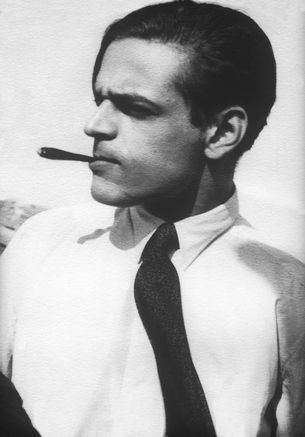
Zisimos Lorentzatos, son of the philologist and professor Panagiotis Lorentzatos, was born on this day, 25 June 1915, in Athens. He was involved in critical study, translation and poetry. He was a man of a particularly low profile, whose personality left a profound intellectual mark on Greek literature, far surpassing his own era.To mark the centenary of his birth, N.D. Triantafyllopoulos has dedicated, as a token of affection, 16 texts to Zisimos Lorentzatos, previously published in the journals Akti (Nicosia), Anti, Nea Estia and Poiesis. This is the book *For Zissimos Lorentzatos. One Hundred Years Since His Birth*, published a few months ago by Ikaros Publications.A summary of his works published by Ikaros: Translations: (1st edition: 2014) This volume brings together the published poetic translations of Zisimos Lorentzatos. These are translations of works by: Ezra Pound, W. Blake, Friedrich Hölderlin, W.B. Yeats, Eugenio Montale, Wisława Szymborska and W.H. Auden – poets whom Lorentzatos admired for their personality, originality and the depth of their spirituality. In addition to the poems, the book includes introductory notes by Zisimos Lorentzatos and an appendix presenting Edgar Allan Poe’s essays ‘The Philosophy of Composition’, The Poetic Principle and Eureka, as well as a prose translation of Gerard Manley Hopkins’s poem, Felix Randal, which is an excerpt from Z. Lorentzatos’s study A Tribute to E.A. Blair (George Orwell).The translator’s personal copies were used in the preparation of this edition.A quatrain by Hölderlin (1st edition: 2006) The book’s wonderful, short text was read as a speech at the Macedonian Artistic Society ‘The Art’ in Thessaloniki in 1967. It was published by Ikaros in 2006 with a handwritten postscript by the author. The quatrain to which the text refers is called ‘The Unforgivable’ and reads as follows:To forget friends, to mock the craftsman, And to dismiss the deepest mind as small and insignificant, God forgives it – just do not disturb The peace of your loved ones. Lorenzatos writes characteristically of the poem: ‘I have the preliminary impression that we must lift quite a few veils before we reach the inner sanctum; the place to which this tiny poem ultimately seeks to lead us by the hand. I have always had the same impression. Over the years, I have come to realise that Hölderlin’s ‘The Unforgiven’ is an unexpected poem, like all true poems...”.Poems (1st edition: 2006) Poems is the collected edition of the poems of Zisimos Lorentzatos. The book includes the collections: Small Syrtis, Alphabet and Collection. A Detailed Study of Cavafy (1st edition: 1977) Texts by Zisimos Lorentzatos on C.P. Cavafy. As he himself has said, regarding his essays on the Alexandrian poet and also on D. Solomos: ‘those who set out on the adventure of art must know that “the history of beauty has been completed”, it does not wait for those who will rescue it—and what its devotees always do is nothing but a struggle to rediscover what was lost, rediscovered, and lost again under favourable or adverse circumstances, a struggle that is difficult and unceasing”. Greek Critical Thought (1st edition: 1976)An anthology by Z. Lorentzatos which marked a significant milestone for its time. Among other things, it brings together texts on Solomos, Palamas, Dragoumis and Seferis.Two Texts (1st edition: 1972) The book includes the texts: Paul Valéry and the Limits of Logic, and Wittgenstein’s ‘Tractatus’ and ‘He who does not know the oracle...’, with a foreword by the author.Learn more
-

Presentation of Kiki Dimoula’s poetry anthology, translated into Swedish, in Stockholm.
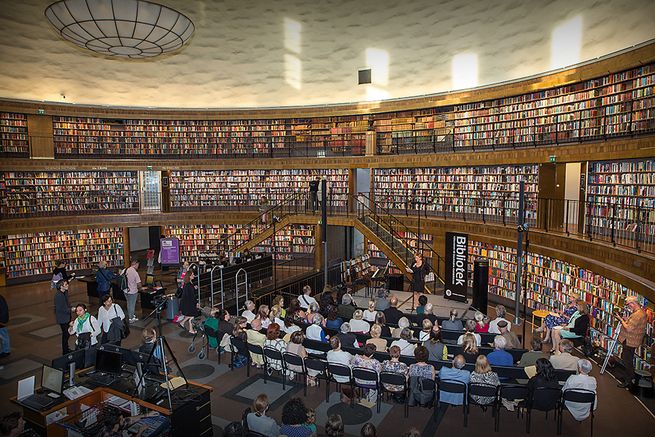
A very special event for Kiki Dimoula took place in Sweden last week (1 June): in the packed hall of the National Library of Stockholm, the poetry anthology by the poet and academic, entitled I kroppens främmande land (In the Foreign Land of the Body), published by Ellerströms, was presented. The anthology comprises 90 poems in Swedish, translated by Jan Henrik Swahn and Rea Ann-Margaret Mellberg, and spans all of Kiki Dimoula’s poetry collections. Photograph: Spyros Vangelakis The presentation of the anthology was organised by the National Library of Stockholm, the Greek Embassy and Ellerströms Publishers. The popular Swedish actress Stina Ekblad read poems by Kiki Dimoula from the new edition, and Elsi Dimoula, the author’s daughter, read two of her poems in Greek. Pianist Johan Sandback provided musical accompaniment for the event.Among those present at the launch were the Greek Ambassador to Sweden, Dimitrios Touloupas, and the translator of Kiki Dimoula’s anthology of poems into English, Cecil Inglesis-Mariello. Photo: Spyros Vangelakis Photo: Spyros Vangelakis Photo: Spyros VangelakisIt is worth noting that Swedish Radio decided in the autumn to broadcast one poem by Kiki Dimoula each week for six weeks, read by Stina Ekblad, a fact that demonstrates the significant recognition of the poet’s work in the Scandinavian country, and fills us with optimism and pride.Learn more
-
With my congratulations: ‘the little yellow book that everyone finishing school should read’.
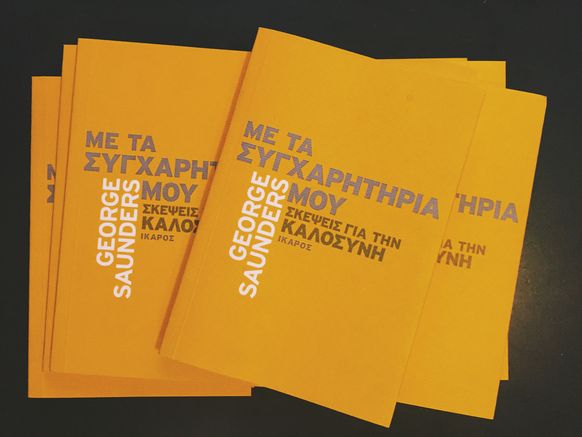
The essay *With My Best Wishes: Thoughts on Kindness* is George Saunders’ speech at the Syracuse University graduation ceremony in 2013. Three months after it was delivered, it was published by the New York Times, and subsequently shared and republished across the internet over a million times. It is the best gift for any graduate, a book capable of inspiring every young person, particularly at this significant personal moment when they need to believe in their own strengths and perhaps redefine their outlook on life. He states at the beginning of his speech: ‘For centuries now, a tradition has been developing for this kind of lecture: some old codger, whose best years are behind him, and who has made a whole host of terrible mistakes in the course of his life (that’s me), offers moving advice to a group of brilliant, energetic young people, bursting with life, and who have their best years ahead of them (that is you). I intend to honour this tradition.” George Saunders’ speech, author of the short story collection ‘December 10th’ (Ikaros Publications, 2015), a text that is both powerful and wise, describes kindness as a fundamental philosophy of life, as the ultimate goal for fulfilment in our lives, far removed from our natural tendency to act self-centrically.Above all, however, he reminds us that good literature and art in general can ‘awaken’ us with simple and true words. ‘For goodness, it seems, is a tough business — it begins with smiles and sweetness and expands to encompass... Yes, indeed, everything, the sky with its stars.’ Graduating from university is a significant milestone in people’s lives, as it is the moment when they are called upon to take stock of their strengths, goals and resources. After all, the knowledge students acquire during their studies does not guarantee their success but serves as a means to pursue the virtues of life, such as kindness and generosity.‘The sweetest people, as they grow older, become less selfish and more loving.’ Read an excerpt from the book here. Learn more
-
Eftychia Giannaki presents her new crime novel: ‘In the Back Seat’.
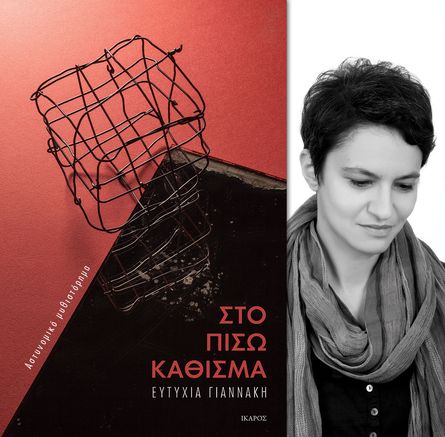
Eftychia Giannaki, author of the new crime novel In the Back Seat, due to be published in June by Ikaros Publications, introduces herself to us with a text full of reflections on the writing of crime fiction. She describes her own relationship with writing and shares her view on the influence of the evolution of Western society on the flourishing of this particular literary genre.I think I was twenty when, following an accident, I realised that all my organs are perishable. Until then, I had no physical sense of myself. When I confessed how much this realisation had unsettled me to a nurse who struck up a conversation with me during my hospital stay, she reassured me that, generally speaking, there is nothing in me that is not mortal, and she gave me many examples of patients around me who were preparing to prove the mortality of the matter, whilst I was temporarily safe.Since then I have been writing because, among the few things I am capable of, writing always acts like that reassuring nurse who reminds me of the words of E.A. Poe, that fear, and particularly the fear of death, is an emotion that people like to feel when they are certain they are safe.As I write these lines, a lady is sitting next to me enjoying a cold chocolate. She even asked for a bar of chocolate, which she’s been nibbling at for some time now. Chocolate with chocolate, then. A short while ago, a group sat down amongst us, talking about a crime, about a car that had run over, killed and abandoned an acquaintance of theirs who was riding a motorbike. The group, despite the grim tale, ordered coffees, and the lady who heard it all didn’t feel her enjoyment of a large bite of cake diminished in the slightest once the account of the events had finished.What am I getting at? A detective story is precisely this kind of narrative within our everyday lives, a mirror reflecting what we avoid seeing just before we turn back to our pleasant habits. Many wonder whether such a narrative carries any particular weight. I agree with those who believe that this narrative has value, particularly as it has evolved in recent years, reflecting the social and psychological implications of the story in question.Antiquity lived with the hope of overcoming pain and death, with Epicurus going so far as to say that death does not exist for us. Christianity proceeded with its glorification of it, and the Western world in recent decades with its denial of it. In Europe during the second half of the twentieth century, euphoria and excessive optimism were cultivated through images that erased the public expression of pain and, even more so, of death. Were it not for the recent economic turmoil and terrorism, we would undoubtedly be talking mainly about the weather.It is no coincidence, then, that crime fiction—and more recently crime series and films—has flourished, particularly in countries where euphoria has long prevailed. It stems from the need to cast our eyes upon what is concealed.The past, the shared secret, the cover-up, the violence that goes round in circles, the superficiality, the simplicity of everyday things, even humour in the face of the abhorrent, the huge bite of a chocolate bar after a painful narrative, the city’s inhabitants, their conversations, and Athens as a microcosm of the artificial euphoria of a few years and a subsequent resounding fall—these are the themes that preoccupy me in my first crime novel.Now, as I write these lines, I realise that when the accident I began with happened, I was sitting in the back seat. Perhaps if it hadn’t happened, this story wouldn’t exist. Since then, I’ve enjoyed creating situations of fear so that I don’t feel afraid; that is the pleasure of the crime novel. And that pleasure is the same whether you’re writing it or reading it.Brief biography: Eftychia Giannaki was born and raised in Athens. She studied computer science, music technology and communication, and worked for several years in secondary education. In the past, another of her novels, entitled Hardcore, was published under a pseudonym and adapted for the cinema. You can find out more about her at www.giannaki.com Learn more