New Release
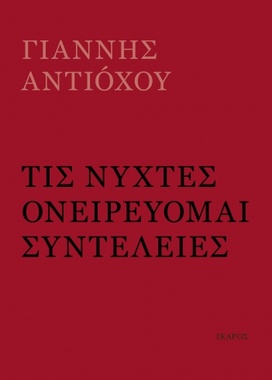
At night I dream of endings
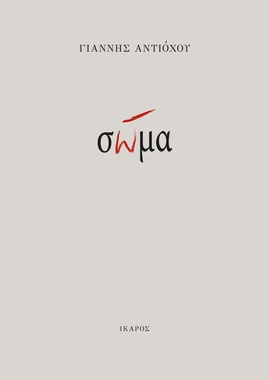
Following his award-winning *He, the Lower Sky*, Yannis Antiochos returns with a work that refracts the world as a post-war landscape. A realm not literal, but existential, historical, spiritual and thus linguistic. Poetry that offers no solace but functions as a black box of human finitude. Scenes of war, fragments of memory, digital traces, theological fissures, bodies in disarray. A dense archive of fragments that moves on the fringes of language and faith. A poetics of the end that seeks not understanding but inclusion in the bewilderment of the present.
Author:
Yiannis Antiochou
Inner frontispiece:
Leda Kontogiannopoulou
Edited by:
Dimitris Athenakis
Date of publication:
04/05/2026
Pages:
88
Dimensions:
16,8 x 24 εκ.
ISBN:
978-960-572-836-6
Publication:
2026
Categories:
Literature, Books, Poetry
The collection constantly returns to the fundamental anxiety: what does it mean to remember? And even more, what does it mean to survive within what you remember? And ultimately, perhaps this is the most disturbing yet also the most truthful element of the collection: that the apocalypses we dream of do not belong to the end of the world, but to the way we are already experiencing it.
– Irini Vakalopoulou, Fractal...this poetry does not function as a simple observation, but as a violent physical process that sweeps the reader along. Yiannis Antiochos's collection is, indeed, "a sea full of verses/ it is never a metaphor/ it swells, returns, and drowns you/ incessantly." The verses transform into waves of truth, swelling to drown illusions and nights plunged into the apocalypse.
– Katerina Yiannakopoulou, Diastixo.grThe work seeks no certainties nor offers comfort. It creates a dark space where the personal meets the collective and the present converses with the traumas of the past. A poetry about the world after the catastrophe (or just before) and about what persists among the ruins.
– Professor Quercus, Chronika Dytikis Makedonias
Yiannis Antioχου has managed to create his own poetic universe by founding each successive book on the immediate predecessor. [...] In the composition “At Night I Dream of Apocalypses”, he re-examines the question of God, revealing first and foremost the passions of humanity, without ever bypassing the passion of the one and only human being. [...] With what truth and mastery does the poet ironize both the poetic object of the previous book and us readers—himself included...
– Eirini Papakyriakou, ChartisShifts in tone, many overt and less overt references, existential a thrill, confession, and reflectivity characterize his poetry.
– Kostas Katsoularis, Book PressThis collection adds to the significant body of work produced by Yiannis Antiochou. His images, original as ever, reveal the bloody world of the present—a modern apocalypse whose roots, however, lie in the past. His intertextual readings of Seferis, Eliot, Hart Crane, Paul Celan, Rimbaud, and many others form part of the poet's cosmology, while remaining thoroughly genuine, deeply personal, and brilliantly assimilated poetically."
– To Vima
Giannis Antiochou may experiment with his verses, form, intertextuality, and ideas—not because he needs to impress, but because he is a very capable poet, "comfortable" with his material.
– K MagazineA key characteristic of these poems is that they are permeated by a sense of cultural decay, a prevailing mood of subversion, and a kind of nostalgia for a lost homeland—not in the narrow sense of a paternal place, which is betrayed by references to the past. Yet, this current fixation on and coddling of a nightmare is humanly impossible; for while certain images of resignation—ranging from moral decadence to psychological illusion—are symptoms of personal slippage, they are, at the same time, connected to the broader external climate that prevails.
– Eirini Karagiannidou, Neo Planodion...the collection successfully accomplishes a difficult endeavor. It unites lyricism with contemplation without diminishing either. [...] Upon finishing the reading, I was left primarily with the sense that I had read a collection which treats poetic discourse as a space of continuous testing—a space where every image, every rhythmic choice, and every cultural reference undertakes to illuminate man's fragile position in the face of history and the power of language itself.
– Antonis MarkakisYiannis Antiochou
Yannis Antiochou is a poet and translator. He was born in Athens in 1969. He grew up and lives in Piraeus. He holds an MBA and an MSc from the Medical School of the University of Athens, specialising in Intensive Care Units.
With Ikaros, he has published the poetry collections *He, the Lower Sky* (2019) [2020 State Poetry Prize], *Dissolution* (2017), *Exhalations* (2014) and *Inhalations* (2009).
He has translated works by T. S. Eliot, Ted Hughes, Sylvia Plath, Ann Sexton and Anna Akhmatova, and has contributed to various literary journals, publishing poems, essays and translations (ANTI, Index, Poetry, Dekata, Delear, Mandragoras, Poetix).