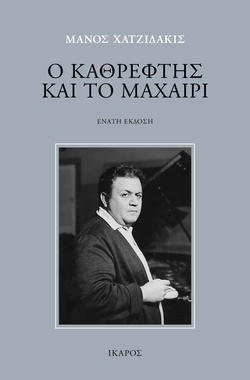
The Mirror and the Knife
This volume brings together thirty-six texts by Manos Hadjidakis, published in print or broadcast on radio programmes, as well as rare photographs accompanied by the composer’s unique commentary. Due to their style, linguistic atmosphere, sincerity and insight, these texts take on the character of a multifaceted ‘autobiography’, shedding light on the personality of a great man and creator. At the same time, they resemble a thoroughly personal essay on Political Consciousness, Humanism, Creation and Art, or even a valuable guide to life from the most authentic and, in essence, revolutionary of men.
Author:
Manos Hatzidakis
Text editing:
Eudoxia Binopoulou
Cover photograph:
Archive T. Pananidis
Date of publication:
13/11/2023
Pages:
270
Dimensions:
13.5 x 20.5 εκ.
ISBN:
978-960-7233-78-3
Publication:
2023
Categories:
Books, Essays & Thought, Δοκίμιο
"Thirty-five years after the book’s first publication, readers have the opportunity to reconnect with Manos Hadjidakis’s writings. […] The reissue of the book comes at this juncture to shed light on Manos Hadjidakis’s thinking as a whole, which was far from popular in its day."
– Emy Dourou, Documento
"The book’s author, Manos Hadjidakis, beloved by all Greeks, never ceased to look his country’s ills squarely in the face, nor did he stop driving the knife deep into the bone of a society that, from the Restoration to the present day, has been trying to find its footing, taking many steps forward and, at the same time, quite a few backwards. After all, this is the role of great creators: to be driven by the need to see their dream of an ideal society become a reality."
– Kyriaki Beioğlu, Efsyn"Hatzidakis is a kind of teacher, a kind of companion who teaches you to think. If any of us have not delved deeply enough into his thought, the volume *The Mirror and the Knife* is a very good place to start."
– Giorgos Florakis, Athens Voice"Today, 25 years on, Ikaros Publications is once again bringing the book to the public, in its ninth edition, with a new cover and layout. Yet as you turn each page of the new edition, the emotion, the surprise and that whisper in your head that you admire and envy the twists and turns of the mind, and with them Hatzidakis’s clarity, remain there. Fresh, as if his ink has not yet dried. The fainting of words in five lines – we (re)read Manos Hatzidakis’s ‘The Mirror and the Knife’."
– Katerina Anesti, IefimeridaManos Hatzidakis
Manos Hadjidakis was born in Xanthi on 23 October 1925. From the age of four he began studying the piano, whilst from 1940–43 he studied advanced music theory with Menelaos Pallantios, a leading figure at the Greek National School of Music. At the same time, he studied philosophy at the University of Athens, whilst being nurtured by artists and intellectuals of the interwar generation (Seferis, Gatsos, Sikelianos). From 1945, working mainly with the National Theatre and the Art Theatre, he wrote music for many ancient tragedies and comedies, as well as for works from the contemporary repertoire: "The Oresteia" (1950), "Medea" (1956), "The Assemblywomen" (1956), "Lysistrata" (1957), "The Cyclops" (1959), "The Birds" (1959), "A Streetcar Named Desire" (1948), "Blood Wedding" (1948), "The Sweet Bird of Youth" (1960), "The Little Plant" (1989) and others. In 1948, he wrote a play about a small white mussel, a work he himself singled out as a highlight of his entire oeuvre. In 1949, with his famous lecture on rebetiko (1949), he stirred up a storm of reactions in conservative bourgeois society. He revolutionised Greek song, charting a course towards new musical horizons.
Alongside his theatre work, from 1946 onwards Manos Hadjidakis composed music for 80 Greek and foreign films: "Stella" (1955), "The Dragon" (1956), "America-America" (1963). In 1960, he was awarded a prize for the song "The Children of Piraeus" from the film "Never on a Sunday". Two years later, he staged "Odos Oneiron" in Athens, a landmark production for Greek musical theatre, starring Dimitris Horn. Between 1966 and 1972 he lived in New York, where he wrote some of his most important works: "Rhythmology" (a piece for piano), "The Great Lover" (a song cycle based on ancient and modern poems); it was there that he also began work on "The Age of Melissanthi", a musical story with autobiographical elements, set shortly after the end of the Second World War.
Manos Hadjidakis, a multifaceted and multidimensional figure, was involved in other artistic activities besides composition. He founded and directed the Athens Experimental Orchestra (1964–67), the Polytropon (café-theatre, 1972), the Music Festivals in Anogia, Crete (1978, music festival), the Music Competitions in Corfu (1981), Seirios (record label, 1985) and the Orchestra of Colours (symphony orchestra, 1989); finally, he directed the state radio station (Third Programme, 1975–81), which he transformed into a benchmark for quality and ideas. From the very beginning of his presence on the Greek music scene, he was a constant presence on the recording scene with albums now considered classics: ‘The Smile of Joconda’ (1964), ‘Athanasia’ (1975), ‘Dark Mother’ (1985), "The Songs of Sin" (1992), and others. He also published four books of poetry and commentary: "Mythology", "Mythology II", "The Third’s Comments", "The Mirror and the Knife". On the afternoon of 15 June 1994, Manos Hadjidakis "began his journey to the stars"....