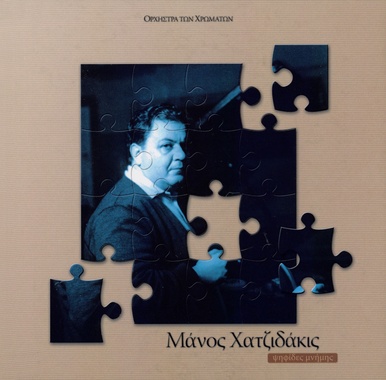
This is an album published by the Orchestra of Colours, featuring texts, photographs and interviews that seek to reconstruct a portrait of Manos Hadjidakis.
The material was selected from articles published in magazines and the daily press from 1966 to 2004. They are presented here, brought together in a single volume to create a contrasting tapestry of voices, revealing the sharp and subversive spirit of the great composer.
Author:
Manos Hatzidakis
Pages:
180
Dimensions:
21 x 21
ISBN:
0000000000093
Publication:
2004
Categories:
Books, Illustrated, Albums & Art Books
Manos Hatzidakis
Manos Hadjidakis was born in Xanthi on 23 October 1925. From the age of four he began studying the piano, whilst from 1940–43 he studied advanced music theory with Menelaos Pallantios, a leading figure at the Greek National School of Music. At the same time, he studied philosophy at the University of Athens, whilst being nurtured by artists and intellectuals of the interwar generation (Seferis, Gatsos, Sikelianos). From 1945, working mainly with the National Theatre and the Art Theatre, he wrote music for many ancient tragedies and comedies, as well as for works from the contemporary repertoire: "The Oresteia" (1950), "Medea" (1956), "The Assemblywomen" (1956), "Lysistrata" (1957), "The Cyclops" (1959), "The Birds" (1959), "A Streetcar Named Desire" (1948), "Blood Wedding" (1948), "The Sweet Bird of Youth" (1960), "The Little Plant" (1989) and others. In 1948, he wrote a play about a small white mussel, a work he himself singled out as a highlight of his entire oeuvre. In 1949, with his famous lecture on rebetiko (1949), he stirred up a storm of reactions in conservative bourgeois society. He revolutionised Greek song, charting a course towards new musical horizons.
Alongside his theatre work, from 1946 onwards Manos Hadjidakis composed music for 80 Greek and foreign films: "Stella" (1955), "The Dragon" (1956), "America-America" (1963). In 1960, he was awarded a prize for the song "The Children of Piraeus" from the film "Never on a Sunday". Two years later, he staged "Odos Oneiron" in Athens, a landmark production for Greek musical theatre, starring Dimitris Horn. Between 1966 and 1972 he lived in New York, where he wrote some of his most important works: "Rhythmology" (a piece for piano), "The Great Lover" (a song cycle based on ancient and modern poems); it was there that he also began work on "The Age of Melissanthi", a musical story with autobiographical elements, set shortly after the end of the Second World War.
Manos Hadjidakis, a multifaceted and multidimensional figure, was involved in other artistic activities besides composition. He founded and directed the Athens Experimental Orchestra (1964–67), the Polytropon (café-theatre, 1972), the Music Festivals in Anogia, Crete (1978, music festival), the Music Competitions in Corfu (1981), Seirios (record label, 1985) and the Orchestra of Colours (symphony orchestra, 1989); finally, he directed the state radio station (Third Programme, 1975–81), which he transformed into a benchmark for quality and ideas. From the very beginning of his presence on the Greek music scene, he was a constant presence on the recording scene with albums now considered classics: ‘The Smile of Joconda’ (1964), ‘Athanasia’ (1975), ‘Dark Mother’ (1985), "The Songs of Sin" (1992), and others. He also published four books of poetry and commentary: "Mythology", "Mythology II", "The Third’s Comments", "The Mirror and the Knife". On the afternoon of 15 June 1994, Manos Hadjidakis "began his journey to the stars"....