News
News List, News Categories, Events
-
Public Book Awards 2018: Three books from Ikaros Publications on the shortlists for the best of the year!
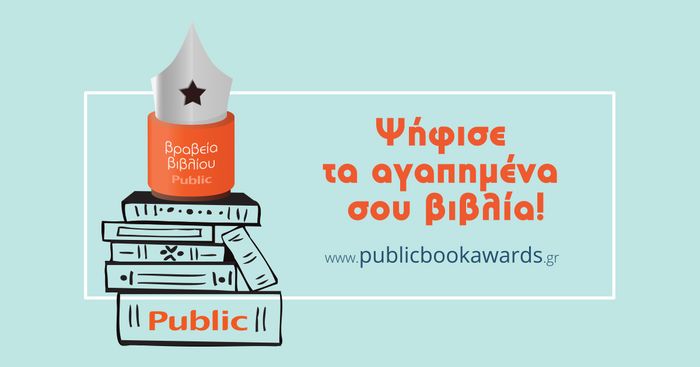
The first phase of voting for the 2018 Public Book Awards, during which readers selected their favourite books from 10 different categories, has been completed.Three books by Ikaros have made it onto the shortlists for the best books of the year!See the nominations for our books (by category) along with the links for each one and vote for them as the top books of the year by Sunday 20 May! Greek novel:Eftychia Giannaki – Halcyon Days: http://bit.ly/AkyonidesMeres18 Translated novel: George Saunders – Oblivion and Lincoln (translation: Giorgos-Ikaros Babasakis): http://bit.ly/LithiKaiLinkoln18 Contemporary Greek Poetry: Giorgos K. Psaltis – You: http://bit.ly/Esena18Learn more
-

Ikaros Publications at the Thessaloniki International Book Fair, 2018.
The Thessaloniki International Book Fair, one of the most important annual events in the book world, opens its doors for the 15th year running, welcoming Greek and international authors from 3 to 6 May, at the Thessaloniki International Exhibition & Conference Centre. This year, the fair is dedicated to the Francophone world, with the participation of leading international authors as well as 44 French publishing houses. The four main themes are as follows: Democracy in the 21st Century, Literature and Memory, Books and Performance, Refugees. Further information can be found here: www.thessalonikibookfair.gr/ Ikaros Publications is taking part in this major book festival with three events: On Friday 4 May at 19:00 (the ‘Nikos-Gabriel Pentzikis’ Hall – Stand 15), Eftychia Giannaki’s new crime novel, City in the Light, will be presented, concluding the Athens Trilogy featuring Inspector Haris Kokkinos.Journalist Evi Karkiti and the author will discuss the book. On Saturday 5 May at 21:00 (Mataroa Hall - Stand 13), Gra-Grou, the graphic novel by Tassos Zafeiradis, Yiannis Palavos and Thanasis Petrou, with music by Michalis Siganidis, will be presented.The authors Ilias Papamoschos and Nondas Tsigas, along with the creators of Gra-Grou, will be speaking.Gra-Grou was honoured with the Best Comic & Best Script awards at the 2018 Greek Comics Awards. On Saturday 5 May at 18:00 (Children’s Corner – Hall 2 - Stand 14), Silan’s Box will be presented, the tender fairy tale by Alkistis Halikia, illustrated by Daniela Stamatia.Come and meet Alkistis Halikia in person and find out what Silan has safely tucked away in his box! For any further information, you can find us at stand 15 (booth 45) at the fair.Learn more
-
Two major accolades for the graphic novel ‘Gra-Grou’ from the 2018 Greek Comics Awards.
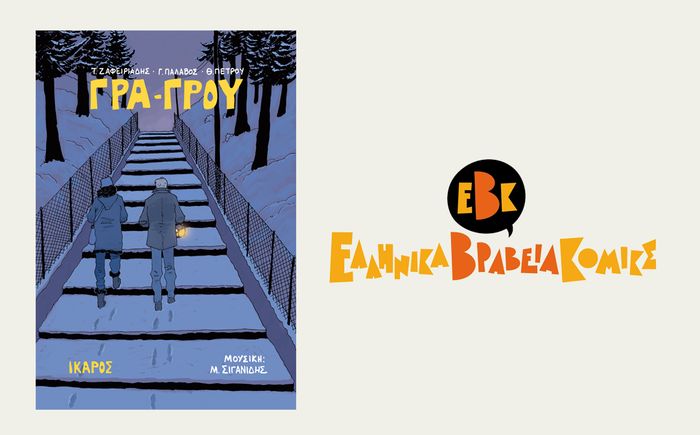
Gra-Grou, the atmospheric graphic novel by Tassos Zafeiradis, Yannis Palavos and Thanasis Petrou, with music by Michalis Siganidis, was the big winner at the 2018 Greek Comics Awards, taking home two major prizes: ‘Best Comic’ and ‘Best Script’!The awards ceremony took place on Friday 20 April in the amphitheatre of the French Institute of Athens, as part of Comicdom Con Athens 2018, Greece’s biggest celebration of comics. The evening was hosted by the ‘Stenos Korse’ team.The book, now in its second edition, continues to receive rave reviews from readers and critics alike. Set against the backdrop of the eponymous restaurant, a landmark in Northern Greece for an entire era, Gra-Grou crafts a charming gallery of characters just before each of them chooses the ‘big Yes or the big No’. The publication includes original music composed by Michalis Siganidis, available via a QR code.Many thanks to the creators of Gra-Grou for entrusting Ikaros Publications with its publication, and to the Academy for singling it out!Learn more
-
Interviews
Alexia Vernikou: ‘The most important thing is to raise resilient children’.
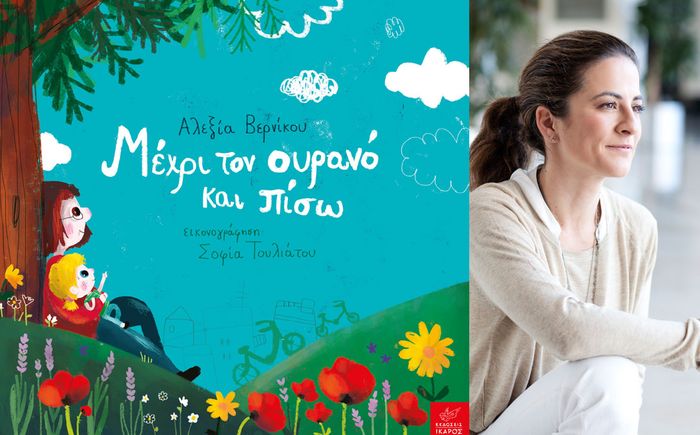
At what age do children start to think about death? When do they ask their first questions? Can a book influence children’s attitude and approach to such important issues? And if so, how?Two questions from the excellent interview given by Alexia Vernikou to elniplex.com and Aneza Kolomvou on the occasion of the publication of the fairy tale ‘Up to the Sky and Back’ (illustrated by Sofia Touliatou).You can read it below: What drew you to writing? What was the experience like? Ever since I was little, I’ve enjoyed writing down my thoughts, both real and imaginary, so this book came as a natural progression. As an experience, it was enjoyable, painless, therapeutic and very creative. What is your favourite book or author? If I had to pick one book, it would be Mitch Albom’s Tuesdays with Morrie, which I have read over and over again at various stages of my life. I’ve just finished Hanya Yanagihara’s *A Little Life*, though, which I found absolutely brilliant. I couldn’t put it down, and despite its length, I didn’t want it to end. In your first book, you tackle a sensitive and unique subject: death. How did you come to choose such a subject? Death and loss are subjects that affect me both personally and professionally. Personally, because they are so difficult and painful; professionally, because the questions parents ask me on this subject are almost a daily occurrence. Questions their children ask them, which they find difficult to answer. At this tender age of 4–5 years, is it right to confront children with the most unpleasant aspects of life? Children have already encountered death through their fairy tales and games, and questions about it have usually already begun. Snow White and Cinderella, games involving weapons, battles and killings start very early on and are part of their lives. The difference with children of these ages is that they do not understand the finality of death or the pain that follows. So they can cope with the subject, and it is not as distressing for them as it is for us adults.At what age do children start to think about death? When do they ask their first questions? As early as three years old, many children start asking questions about death. When do we die? Why do we die? Will you die too, Mummy? Will I die too? Where has Grandad gone now that he’s died? If I eat all my fish, will I live forever? These are just a few of the questions they have and the queries they ask. Direct and honest questions that require equally direct and honest answers. Can a book influence children’s attitudes and approach to such important issues? And if so, how? Certainly it can, because children of this age learn through books. They identify with the characters and use them as examples and points of reference in their own lives. The aim of this book is for children to understand that death happens to adults after many years, once they have grown old and their hearts have stopped beating. And when someone dies, we can no longer hug them, but we can keep them forever in our thoughts and our hearts as our most precious treasure. In fairy tales, death often claims the wicked… whilst the good escape it or are resurrected… If only it were like that in real life… The phrase ‘… he became a star in the sky and is watching over us from up there’ is now widely used to avoid causing trauma to a child’s soul. Does this have any long-term consequences? When talking to children about death, it is important to focus on the cessation of bodily functions; in other words, we die because the heart stops beating. That is as far as the body is concerned. As for the soul and the metaphysical explanations we wish to offer—‘the little star in the sky’—this can be used to provide comfort provided the parent believes in it and explains to the child the difference between body and soul. However, we cannot stop there, because there will be many questions and we won’t be able to avoid them… In your experience, do Greek parents visit a specialist psychologist in the event of the loss of a loved one or for any other problems they observe in their children, or do they avoid doing so? As with all issues they face with their children, some parents choose to seek a psychologist’s opinion, whilst others refuse. In this particular case, it would be advisable for them to do so, because children perceive death differently from us; they grieve in their own way and come to terms with their loss at various stages of their lives, giving it new meaning.Recently, teachers have been dealing with an ever-increasing number of children with speech and behavioural problems. Or have they ‘put the children under the microscope’, as is often said? What have you noticed? Do you agree with this view? And if so, what do you think is causing this increase? Unfortunately, it is something I have noticed too when I compare the children I used to meet in my work 10 years ago with the children I meet today. I believe it is due to both biological and environmental factors. The environment and the family can be worked on, improved and developed if there is a willingness to do so. Then we see striking changes in the child’s behaviour as well. Clearly, the stress and insecurity brought on by the economic crisis, anger, the prevailing competition, the lack of boundaries and the influences from the internet have certainly played their part. At the same time, there is the ‘microscope’, and here we need to be careful about who we address and why. What do we do about childhood anxiety? When does it cease to be creative? I would not want to characterise childhood anxiety as creative. Clearly, like all emotions, it is permissible, but it is not pleasant and often becomes an obstacle to our children’s daily lives and functioning. In this age of rapid and multifaceted information and development, everyone is rushing to cover ground and fill gaps. Today, what are the essentials of child-rearing that we need to address in order to raise healthy, well-rounded and responsible individuals? I would say that the most important thing is to raise resilient children. Children who can cope with and respond to these fast-paced and demanding times and the constant flow of information. To achieve this and foster healthy personalities, we need to spend time with our children, listen to what they tell us, set boundaries, stick to them, and tell them the truth. What would you suggest to parents as a creative way to engage their children? I would suggest that every parent finds something they enjoy doing with their children and does it. Whatever that may be… painting, cooking, going for a walk, reading books, cycling. Only if they’re having a good time will their child enjoy it too, and they’ll manage to make it part of their relationship and routine. Is writing books one of your next goals? Of course! I have plenty of ideas, both for children’s books and for a book for parents, always with the child as the theme!Learn more