News
News List, News Categories, Events
-
Interviews
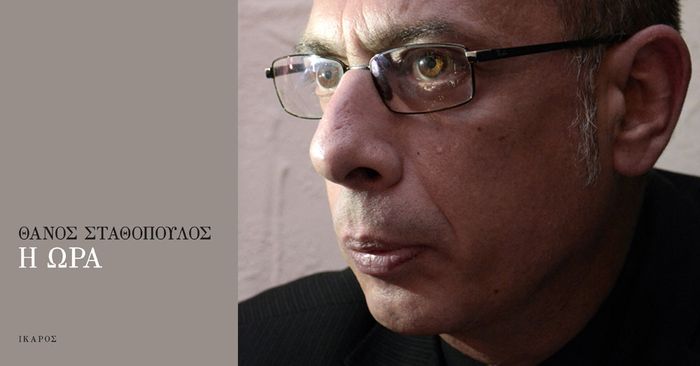
Thanos Stathopoulos: ‘Literature is a space where everything acquires meaning through metaphor.’
Thanos Stathopoulos talks to Lina Rokou on Popaganda about *The Hour*, his latest book. You can read the interview below: *The Hour* as a title. Why? And what role does time play in your writing? Book titles always elude me. I would say, however: Time at the heart of things. The time at which things happen. It is the moment or the duration. Every hour. The flow of time. The present and the past. Now or then. (When?) It is what we tear away and what tears us away. It is the merging. Time and the spiritual centre – a deep, concentrated feeling. All writing is connected to time. In my own writing, the tyranny of time is perhaps excessive. What is your earliest memory? Sitting on a little chair with a toy. Perhaps in 1965, I don’t know. A memory of myself, that is. Like a photograph. This connects me to something in the book: ‘And then the question returns: what is art? And art is what an artist does: sitting in a chair in his studio’. What is the artist’s studio? Life? Memory? Imagination? None of these? The connection takes me by surprise. You’re referring to a passage from a text by Bruce Nauman, which I quote in the book. The artist’s studio is an open field of action: it contains everything. I would say that its existence is of paramount importance. Everything happens there. By ‘studio’, of course, we must mean an expanded state. A space that extends. A spiritual state, certainly. This, after all, is the central theme of the book: space as a studio. Not just the artist’s, but everyone’s. The poetics of space and human expression. Everything can serve as material for processing. Everything you mention is raw material, but it does not constitute the artist’s workshop. The studio is the personal space the artist constructs and the intellectual atmosphere they need in order to exist. And beyond the intellectual space? What about space in its realistic dimension? Where do you prefer to write? Where do you imagine yourself writing? What is the most unusual place you have written in or found yourself writing in? I always write in my studio – the space where I live and work. I have rarely written anywhere else. I often take notes in cafés, which I then immediately transfer to my computer to edit. I’ve never imagined writing anywhere. Under the right circumstances, of course, I could write anywhere. The writing process involves a lot of work, anxiety and tension. You want to write. You wake up in the morning and write, or try to write. Sometimes you manage it, sometimes you don’t. Probably, most of the time you don’t. But you have to persevere. I can’t recall any paradoxical passage I’ve written; obviously, there isn’t one. The only paradox lies in the nature of what I write. What is paradoxical to you? Anything that clashes with common sense.Is ‘The Hour’ a puzzle of time, events, dreams, desires, thoughts, repressed feelings, influences? What is ‘The Hour’? If we exclude the repressed feelings, it is everything you mention. And more. It is a puzzle. Traces, fragments, readings, annotations, quotations. It can be read as a fragmentary text, interpreted as a dream or as a feeling. You hover in space and time. There are the other texts—that is, the borrowed texts—which I present either on their own or by commenting on them, in which I participate. They are the events and details from the lives of others. They are memory, of course. A personal archive of events concerning the poetics of space and the psychological centre, with a nod to what we call ‘architectural or architectured space’, where the body, actions and human expression take centre stage. It is the personal space we construct and the way we exist within it. In other words, what I mentioned earlier regarding the concept of the workshop. How and to what extent does your writing style resemble or differ from your way of life? The way I write embodies the way I live to the same extent that it eludes it. I don’t know if it could be any other way. I am not referring solely to the fragmentary and disjointed nature of what I write. The autobiographical elements in my texts often dictate the style: emphatic, declarative, revealing. Someone who knows me might recognise me by reading my work. Literature, however, is a space where everything acquires meaning through metaphor. The statement functions simultaneously as a metaphor. Readings, references and quotations are indirect experiences. My way of life can sometimes be channelled into my references to artists and writers from whom I quote passages, either from their work or from their lives: a mediated biography, one might say. We are always the others as well.A quote from a favourite writer or artist that expresses better than any other how you feel about writing? ‘I asked her if there was any way I could eat a wild carrot from time to time. ‘A wild carrot!’ she cried, as if I’d expressed a desire to taste a Jewish baby. I told her that the season for wild carrots was coming to an end and that, if until then she could give me only wild carrots to eat, I’d be grateful. ‘Only wild carrots!’ she cried. Wild carrots have a violet flavour, to me. I like wild carrots because they have a violet flavour, and violets because they have the scent of wild carrots. If there were no wild carrots on earth, I wouldn’t love violets, and if there were no violets, wild carrots would be just as uninteresting to me as turnips or radishes. But even in their present state of flora, I mean in this world where wild carrots and violets find a way to coexist, I could very easily do without them.” Samuel Beckett, First Love, trans. Achilleas Alexandrou. Has a woman ever fallen in love with you because of something you wrote? What was it? As far as I know, no. A quote from a favourite writer or artist who expresses better than anyone else how you feel about love? Oh, what can I say… There are many. Each one expresses a truth. I could, however, mention Baudelaire’s text *Consolations on Love*. Among many other aphorisms: ‘One must therefore choose one’s loves. – Beware of the moon and the stars, beware of the Venus of Milos, of lakes, guitars, rope ladders and all novels. – But love the one you love deeply, steadfastly, boldly, fiercely; let your love, having grasped the meaning of harmony, not torment the love of another. – Because every woman is a fragment of the essential woman, because love is the only thing for which it is worth composing a sonnet and donning fine lingerie. I don’t know if it expresses how I feel about love better than any other, but it is a text I have come to love very much. What do you love about everyday life and what can’t you stand about it? I like taking long walks around the city: walking, observing people and the city’s landmarks. I really like cafés – I’ve been a regular at cafés for over thirty years. It’s like a ritual. I like meeting friends there or sitting on my own. I like the quiet hours of the afternoon in my studio. Those are the hours when I can concentrate completely. I always read every afternoon. I like to have a few drinks in the evening. Often I can’t stand my daily routine – it always happens when I’m not feeling well. I can’t stand anything that’s compulsory. I can’t stand it, so to speak, as long as I’m forced to endure the day’s constraints. Learn more
-

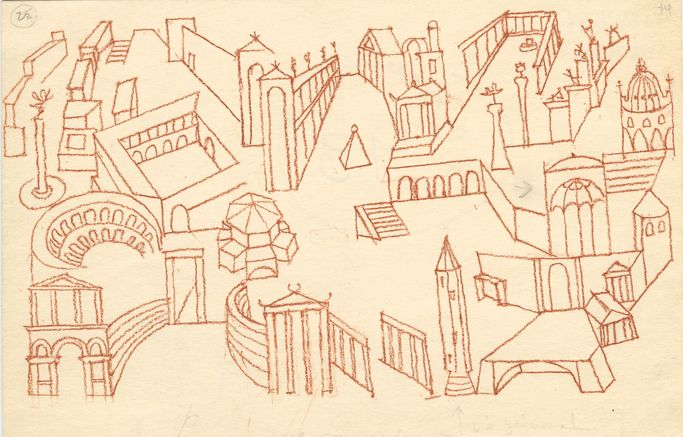
The Benaki Museum presents the illustrated work of Nikos Hadjikyriakos-Ghika.
The exhibition ‘Nikos Hadjikyriakos-Gikas. Painting for Books’ will open on Wednesday 18 April at the Gikas Gallery of the Benaki Museum, as part of the events for ‘Athens – World Book Capital 2018’. ‘...Our gatherings at Ikaros were once interrupted, towards the end, our dear Alekos Patsifas, and then Katsimbalis would drag us off to a table at Zonar, where we would drink the nectar provided by Nikos Karidis’s bookshop,” writes N. Hatzikyriakos-Gikas in his piece on the 50th anniversary of Ikaros.The books illustrated by the great painter are now classics and reflect the relationships between the creators, as well as the atmosphere of that era. Nikos Hatzikyriakos – Gikas was systematically involved in illustrating texts from 1937 to 1992. He produced book covers, frontispieces and illustrations, mainly for works of poetry. Literary magazines such as ‘Nea Estia’, "Morphes" and "Aixoni" were published with works by Gikas as their cover or frontispiece, whilst he fully illustrated "The Poems of Cavafy", Kazantzakis’s "The Odyssey", Loggos’s *Daphne and Chloe*, and Nikos Gatsos’s *Amorgos*. Added to these are many individual covers and frontispieces for books and poetry collections, such as those by Odysseas Elytis, Lito Katakouzino, Margarita Lyberaki and others. The exhibition offers the public the opportunity to engage with both painting and literature, whilst also providing an opportunity to study older editions and discover the rich body of illustrative work by the great Greek painter, Nikos Hadjikyriakos-Ghika. Curated by: Ioanna Moraiti Exhibition design: Pavlos Thanopoulos Exhibition dates: 19/04/2018 – 21/07/2018 Gika Gallery | 3 Kriezotou Street, 106 71 Athens Further information at http://bit.ly/2pQnMRULearn more
-
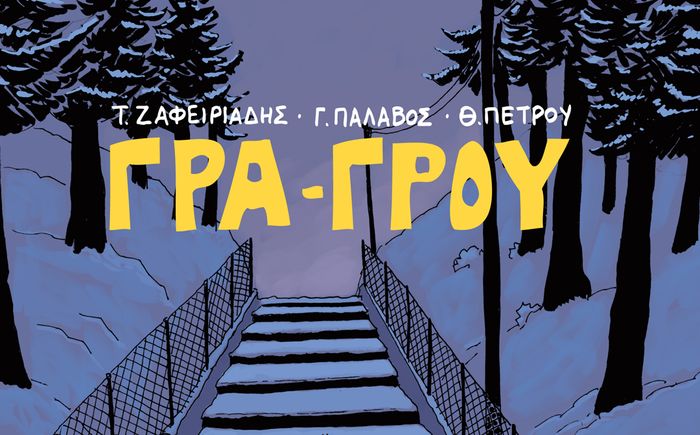
5 nominations for the graphic novel ‘Gra-Grou’ from the 2018 Greek Comics Awards.
The Academy of the Greek Comics Awards has announced the nominations for this year’s awards, and Gra-Grou, the unique graphic novel by Tassos Zafeiradis, Yannis Palavos and Thanasis Petrou, with music by Michalis Siganidis, has secured five nominations: Best Comic, Best Script, Best Artwork, Best Cover and Best Art Direction! Gra-Grou unfolds an atmospheric story, where tradition intersects with the present and the realistic narrative is undermined by elements of the fantastical. Set against the backdrop of the eponymous restaurant, a landmark in Northern Greece for an entire era, the book crafts a charming gallery of characters just before each of them chooses the ‘big Yes or the big No’.The book is now in its second edition and continues to receive rave reviews from readers and critics alike.The award ceremony will take place on Friday 20 April at 9.00 pm in the Auditorium of the French Institute of Greece. Read more about the book here.Learn more
-
Ikaros Books at the 2018 Public Book Awards.
The Public Book Awards welcome readers for the fifth year running! The first phase of voting has already begun and will conclude on 20 April.Last year, Kiki Dimoula won the Award for Best Poetry Collection (Anoteleia), and Eftychia Giannaki the Award for Best Greek Novel (Sto pisw katisima).This year’s event marks a landmark year for Greece, given Athens’ designation as UNESCO World Book Capital for 2018.Readers are invited to highlight the books that stood out from the 2017 literary output, choosing from eleven different award categories.In addition to these, there will also be three special awards, in which readers do not participate by voting (Best Illustration in a Children’s Book Award, Publishing Imprint Award, and Public Bookshops Award).Books published by Ikaros are nominated in five different award categories. View our nominations (by category) along with the links for each one and vote for your favourite books: Greek novel:Eftychia Giannaki – Halcyon Days: http://bit.ly/AkyonidesMeres18Ισμήνη Kapantaï – Townhouse in Halandri: http://bit.ly/AstikiOikiaStoChalandri18Κυριάκος Margaritis – Kronaka: http://bit.ly/Kronaka18Δημήτρης Nollas – The Garden in Flames: http://bit.ly/OKiposStisFloges18 Translated novel: Vicente Alfonso – The Remains of Saint Lawrence (translation: Maria Palaiologou): http://bit.ly/TaLeipsanaTouAgiouLaurentiou18Jean Echenoz – Special Envoy (translation: Achilleas Kyriakidis): http://bit.ly/EidikiApestalmeni18Neil Gaiman – Neverwhere (translation: Maria Angelidou): http://bit.ly/PotekaiPouthena18Hannah Kent – The Good People (translation: Maria Angelidou): http://bit.ly/OiKaloi18George Saunders – Oblivion and Lincoln (translation: Giorgos-Ikaros Babasakis): http://bit.ly/LithiKaiLinkoln18Enrique Vila-Matas – In Kassel There Is No Logic (translation: Nanna Papanikolaou): http://bit.ly/StoKaselDenYparxeiLogiki18Alejandro Zambra – The Private Life of Trees (translation: Achilleas Kyriakidis): http://bit.ly/IdiotikiZoiTonDentron18 Greek non-fiction: Athanasios Alexandridis – Childhood Loves: http://bit.ly/PaidikoiErotes18Χρήστος Giannaras – Fall-Crisis-Hell: http://bit.ly/PtosiKrisiKolasi18Απόστολος Doxiadis – Saying and Saying Again: http://bit.ly/LegontasKaiKsanalegontas18Αλέξανδρος Kostopoulos – Bridges of Cooperation – The Marshall Plan and Greece: http://bit.ly/GefiresSinergasias18Τάκης Pappas – On a tightrope: http://bit.ly/SeTentomenoSkoini18Έφη Sapouna-Sakellaraki – When time spoke: http://bit.ly/OtanMiliseOChronos18 Contemporary Greek Poetry: Yannis Antiochos – Dissolution: http://bit.ly/Dialisis18Γιάννης Metaxas – But afterwards, afterwards...: http://bit.ly/MetaOmosMeta18Κυριάκος Charalambidis – Of the Sun and the Moon: http://bit.ly/IliouKaiSelinisAlos18Γιώργος K. Psaltis – You: http://bit.ly/Esena18 Greek Children’s Literature: Alexia Vernikou – All the Way to the Sky and Back (illustrations: Sofia Touliatou): http://bit.ly/MexriTonOuranoKaiPiso18Ιουλίτα Iliopoulou – But when will this Wizard arrive? (illustrations: Yannis Kottis – music: Giorgos Kouroupos): http://bit.ly/MaPoteThaFthaseiAytosOMagos18Μιχάλης Moulakis – A yellow leaf (illustrations: Filippos Fotiadis): http://bit.ly/EnaKitrinoFyllo18Θοδωρής Papaioannou – Silouani (illustrations: Daniela Stamatia): http://bit.ly/Silouani18Άλκηστη Halikia – Silan’s Box (illustrations: Daniela Stamatia): http://bit.ly/ToKoutiTouSilan18Learn more