News
News List, News Categories, Events
-
Interviews
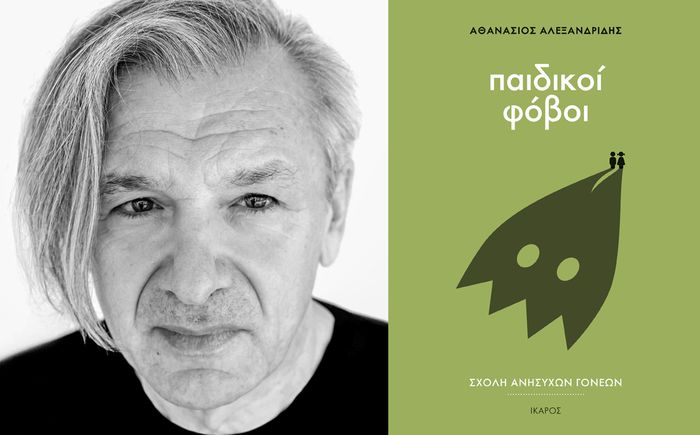
Athanasios Alexandridis: ‘I believe in children’s creativity. With a little help, they can achieve a great deal.’
Read the fascinating interview given by Athanasios Alexandridis to clinical psychologist Magdalini Georgiakou for PsychologyNow.gr, on the occasion of his new book *Children’s Fears*, the second in his series ‘School for Anxious Parents’. MG: Your new book is titled ‘Children’s Fears’. How did ‘Children’s Fears’ come about after ‘Children’s Loves’? AA: A year after the publication of ‘Children’s Loves’ comes the companion volume, ‘Children’s Fears’. If one considers that Love—the life force according to psychoanalysts, or Friendship according to the ancient Greek philosophers—unites the things of this world, it was necessary, after Love, to examine the action of aggression, which aims to unite them by force or to separate and destroy them when they resist. When, in the mixture of Love and hostility, Neikos according to the ancient Greeks, the latter prevails, then all the phenomena of fear are created, from terror and panic to fear itself or anxiety. MG: When we talk about ‘childhood fears’, what are we referring to? What ages do they correspond to? AA: The book attempts an extensive description of children’s fears, but also of parents’ fears regarding their children’s development. It follows the developmental trajectory and so, after an introduction to the concept of fear, it examines chronic and situational fears, bullying within and outside the family, the fear of loss and death, existential fear, separation anxiety, fear of camp, addiction to digital media, and the fear of difference, politicisation and terrorism.In a way, we could say that the narrative begins with the fears of the very young child—those we psychoanalytically refer to as primal anxieties—which concern the question of existence in the world ‘in life or in death’ —which we experience very early on, though it will take many years before we understand it—and moves on to the fears associated with having discovered the other person as someone I need or desire, and so I fear being abandoned by them, their anger, their rejection, the withdrawal of their love from me.The book examines the involvement of parents in these fears, which are quite complex because they often recall or even reproduce their own childhood or long-standing fears. Throughout the book, a constant concern is the intrusion of the social sphere into the family, which, in the form of roles, rules or prejudices, is always present, compelling and, depending on the family’s ability to integrate it, either constructive or disruptive. MG: How do you think the times and society in which we live influence parents in their role and in managing their children’s fears? AA: This era of ongoing and global social crisis greatly influences parents in managing their children’s psychological issues. Professional and financial insecurity, along with the relative unreliability of institutions, have stirred up fears in most parents and adults, as well as the long-standing childhood and adolescent fears they carry within them.Consequently, they have less tolerance for difficulties, whether these stem from the environment or from their children. If we accept that most people wish to be good parents and often feel guilty at the thought that they are not meeting their children’s needs, their children’s fears serve as a strong signal that they have not sufficiently established themselves in their children’s psyche as capable of protecting them. This is also consistent with the anxiety caused by unpredictable social instability. MG: When should parents be concerned about their children’s fears? AA: Whenever they become concerned! What I’m saying may sound funny, but it isn’t. The fact that they are worried is a clear sign that something is happening which the child, the parents themselves and the family system cannot organise or, in psychoanalytic terms, metabolise. Of course, with your question, you are asking to find out what symptoms might indirectly manifest children’s fears, apart from their direct and explicit expression.Because they can manifest indirectly through all manner of symptoms at the level of physical dysfunction, behavioural disturbance and psychological distress – and because I do not wish for parents to ‘play at being psychologists’– that is why I have set the psychodynamic criterion of parental concern as sufficient grounds for seeking a specialist’s opinion. Sometimes just a few appointments are enough to resolve a problem. At other times, fear can be an early symptom that allows for timely diagnosis and the start of monitoring or treatment. MG: What about parents’ fears? To what extent can these fears affect their children’s lives? AA: Unfortunately, there are fears held by parents, or even the parents of the parents, which can be passed on to the child. These are what we call ‘intergenerational traumas’. Unfortunately, we do not have the space here to explore such a serious topic in depth. However, a child’s fear may bring such a trauma to the surface and lead the ‘bearer’ of the trauma, e.g. the father or mother, to seek therapy. In closing this answer, however, I would like to emphasise my belief in children’s creativity and the fact that, often, with just a little help, they can achieve a great deal. MG: In the twelve chapters of the book, you provide a detailed account of various forms of childhood fears, such as timeless fears (fear of death, illness, abandonment) and contemporary fears such as the fear of dependence on electronics, fear of school bullying, etc. How, if at all, are these two categories of fears connected? AA: Your question already implies the answer! It naturally stems from the common psychoanalytic foundation of our thinking. To put it simply for readers: timeless fears form the psychological substrate. On top of these, the specific fears of each era manifest themselves, such as so-called school bullying, but also the fear of social stigma and exclusion. I believe that the fundamental work regarding these timeless fears must be carried out by the family and the school, with the main focus being on recognising the child, from a very young age, as a trustworthy partner in making and keeping agreements!MG: Won’t children feel that such an approach places an excessive burden on them? AA: No, not if the contracts and their requirements are appropriate to their age. On the contrary, they feel more self-confidence when an adult regards them as trustworthy individuals. And there is no greater shield against fears than feeling self-confidence. Look at folk tales: usually, the protagonist starts out as a small child who finds themselves in a difficult situation and is afraid. But when an adult, for example a genie, shows them trust, or a group of companions appoints them as leader, then that trust enables them to overcome their fears and put their mind—or rather, the psychomental programme of their development—into action.MG: Have we made the news? Am I to assume you’re working on a book about fairy tales? AA: I’m not afraid to admit it! But I do have some fear about whether I’ll manage it. MG: After all the books you’ve published, can you still have such fears? AA: As I say in my book, fear, if it is excessive, becomes disruptive; if it is manageable, it proves useful and motivating because it spurs our diligence and ingenuity. MG: I’d like to conclude with the issue of violence and terrorism, which are very much present in our times and are discussed at length in your book. The fear of terrorist attacks or violent clashes often drives parents to restrict their children. To what extent should this fear determine parents’ decisions regarding their children’s present and future? AA: If I had to summarise it in two sentences, I would say: a) restriction is not the solution; b) the solution lies in developing children’s political thinking and fostering a sense that they are citizens in the making from a very young age. The main areas for developing this fundamental quality are the family and school. The third volume of the series, which will focus on School and Society, will be devoted to these topics.Learn more
-

Anagnostis Literary Awards 2018: ‘Silouani’ by Thodoris Papaioannou won the Children’s Literature Award.
Silouani, the most subversive young adult holiday book, by Thodoris Papaioannou and illustrated by Daniela Stamatia, was honoured on Tuesday 12 June in the packed auditorium of the Benaki Museum with the ‘Children’s Literature Book Award’ from the 2018 Anagnostis Literary Awards.The judging panel of the Anagnostis Awards singled out Silouani, a book that has received rave reviews from critics and has been much loved by young readers. Thodoris Papaioannou states:Silouani is my first novel for children and teenagers. It all began with a letter given to me by my pupil Silouani on her last day at primary school. ‘This, sir, is for you,’ she said, looking me straight in the eye. I don’t know how many times I read it. And then I began wandering around the mountains near Edessa and Panagitsa, searching for answers to those wonderful questions children ask whenever they put their thoughts down on paper. And so the story of Silouani and the ‘children of the mountain’ was born; they may be imaginary heroes, but they live in places that are entirely real.We would like to thank Theodoros Papaioannou very much for his trust, and also Daniela Stamatia for her wonderful illustrations, which blend seamlessly with the text. Silouani is a book that enchants with the simplicity and pedagogical clarity with which it approaches nature, the relationships between children, children and adults, play, the conflicts that are themselves transformed into play, and their collaboration with the English scientist studying a young bear in the mountains. Nature is friendly when you live with it lightly. Even the fears of the city-dwelling mother fade away gently… In short, everything comes naturally. Without didactic grandstanding. Mariza Decastro, The ReaderThodoris Papaioannou’s first book for older children is a fantastic journey through nature and the mountains of Edessa, inspired by a letter given to him at the end of a school year by one of his pupils, Silouani. A dreamlike read, an introduction to nature and the unfamiliar. Red Fox Silouani is a wonderful story that speaks to children about the magic of nature, its benefits, and how beneficial our connection with it is. For nature, if you allow yourself to listen to it with your whole being, it will repay you by revealing the most intoxicating scents, the most fairy-tale-like images and the most evocative sounds.A delightful, lyrical novel with beautiful black-and-white sketches that bring scenes from children’s everyday lives to life.Dora Andreadaki, parents24.gr Find out more about Thodoris Papaioannou here: https://ikarosbooks.gr/authors/papaioannoy-thodorisLearn more
-
Four books published by Ikaros are shortlisted for the 2018 ‘O Anagnostis’ Literary Awards.
The judging panels of the literary magazine ‘O Anagnostis’ announced today, 10 May, the shortlisted books for the magazine’s Literary Awards, the ceremony for which will take place on Tuesday 12 June at 8.00 pm at the Benaki Museum (138 Piraeus Street).We were delighted to see four books published by Ikaros included among the nominees in four of the eleven award categories: Gra-Grou, by T. Zafeiradis, G. Palavou, Th. Petrou – Category: Novel; Esena, by Giorgos K. Psaltis – Category: Poetry; Silouani, by Thodoris Papaioannou, illustrated by Daniela Stamatia – Category: Children’s LiteratureSilas’s Box, by Alkistis Chalikia, illustrated by Daniela Stamatia – Category: Children’s book with illustrations Find out more about the Anagnostis Awards, as well as the comprehensive list of nominated books and authors, here.Learn more
-
Interviews
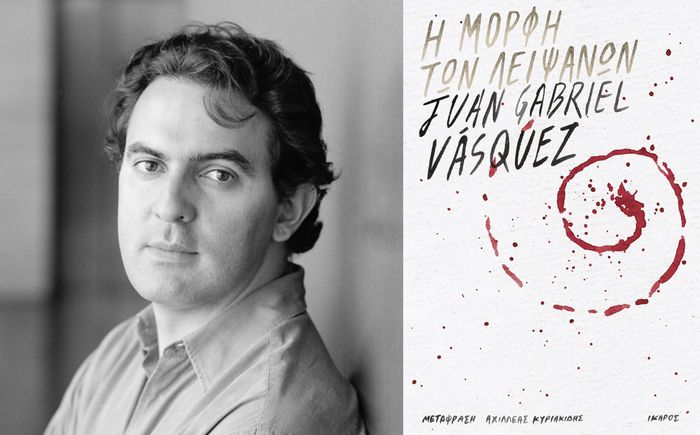
Interview with Juan Gabriel Vásquez in Kathimerini’s ‘K’ section.
Read below the exclusive interview given by Juan Gabriel Vásquez to Athos Dimoulas for the magazine K of Kathimerini, on the occasion of the release of his latest book The Shape of the Remains (translated by Achilleas Kyriakidis). It is 7.30 in the morning in Bogotá and Juan Gabriel Vásquez is sitting at his desk. This is how his daily routine begins. He writes until midday. In the afternoon, he reads, writes articles and spends time with his family. The 45-year-old author returned a few years ago to the Colombian capital and his hometown, after fifteen years in Europe. The Bogotá he had left behind, the Bogotá of his childhood and youth, was a city ravaged by the relentless war with the drug cartels. A terrifying and dangerous place, full of explosions, gunfire and despair. Is there a sense of security today? I ask him. Have the ghosts of the past gone? ‘Oh, ghosts never go away,’ he replies. His own generation, he believes, will carry the scars of that period forever, and no one will ever feel truly safe. Vazquez gained worldwide attention a few years ago with the multi-award-winning bestseller The Sound of Things Falling (published by Ikaros), transporting us to the era of Pablo Escobar’s omnipotence, when he had turned the country into a battlefield. Today he returns with *The Shape of Remains* (published by Ikaros, translated by Achilleas Kyriakidis), a voluminous and ambitious novel, dense and satisfying, in which he examines the nature of conspiracy theories and how they define our relationship with the truth. The narrator (who is the author himself) meets a very unusual man who believes that ‘they are hiding something from us’ regarding the assassination of the popular politician Jorge Eliezer Gaitán in 1948. What gives rise to conspiracy theories? ‘Human nature,’ replies Vázquez. ‘We understand the world and ourselves through stories; without stories to interpret our experiences, we are orphans, living in a void. So, whenever the official narrative fails to provide us with a convincing account of significant events, we fill in the gaps with our own invented stories. Of course, this also happens when the available accounts, though true, simply do not satisfy us.’ Through his book, as with his previous ones, Vásquez delves into the history of his homeland – I should mention that everything I know about Colombia I have learnt from Márquez’s books, from films about Escobar and from his own novels. Does the novelist have a responsibility to convey the truth? Or at least a truth? ‘A truth, more accurately. I wouldn’t write novels just to say exactly what anyone can find in history books or on Wikipedia. Literature explores a different kind of truth: in my novels I try to say (to use Kundera’s words) what only novels can say. With that in mind, yes, I want to help my readers understand the history of my country, the continent and modern life. At one point in the book, the narrator/author reads the comments following one of his articles in the digital edition of the newspaper El Espectador (Vásquez does indeed write for this particular newspaper), in which, he writes, ‘highlighted everything that afflicted my poor country: intellectual poverty, self-satisfied mediocrity, unpunished defamation, but also, above all, verbal terrorism, the schoolyard bullying to which the participants devoted themselves with unimaginable enthusiasm, the cowardice of those who hurled abuse under pseudonyms and would never repeat their insults out loud.” I ask him if he holds the same view regarding social media: “No, no, social media is even worse. I don’t have any kind of profile on them, and I believe that’s the best decision I’ve ever made. For a decade now, I’ve been saying that Facebook and Twitter are destroying political dialogue, hindering our democratic expression and undermining our freedoms rather than strengthening them.” Today, Vázquez is one of the leading figures of this fascinating new generation of Latin American literature, which includes (to name but a few who have been translated into Greek) the Chilean Alejandro Sabra, the Peruvian Santiago Roncagliolo, the Argentine Andrés Neumann, the Mexican Jorge Volpi and, of course, many others. Vázquez believes that Latin American literature is experiencing a new golden age, but he says there is nothing that unites him with his fellow Latin American writers, in the way that their forebears were united by a common political stance regarding the Cuban crisis. Nor are they united by their writing style, although one commonality we might identify is that they have moved beyond the influence of magical realism, which (somewhat simplistically) came to be identified with the tradition of Latin American literature. Specifically, Vázquez has often remarked that the aura of the fantastical has created a false perception of his continent, in whose modern history there is nothing ‘magical’, but, on the contrary, there is a series of tragic events that literature must address with realism. He always makes a point of clarifying, however, that had he not read Márquez in his adolescence, he would never have become a writer. ‘Finding your own literary voice, especially when you come from a strong literary tradition, is by no means easy, but personally I never wanted to break away from that tradition,’ he says. “It would be foolish to want to run away from a language that gave birth to the stories of Borges, *One Hundred Years of Solitude* (by Márquez) and *The War of the End of the World* (by Llosa).” Writing gamesA little writing trick, if I may call it that, or a routine, if you will, which Vazquez reveals during our conversation is this: he chooses a book and reads it alongside the novel he is currently writing. Thirty minutes of reading before he starts writing. It works, he tells me, like the tuner musicians use for their instruments. It tunes him in. Even if the book he is writing and the one he is reading have nothing to do with each other. For *The Shape of Remains*, he used *Crime and Punishment* as his ‘tuner’. Another ‘trick’ he employs is the one already mentioned: the narrator’s complete identification with himself. His protagonist is called Juan Gabriel Vásquez; he is a writer who lived in Europe, wrote a book called The Sound of Things Falling, returned to Colombia, and so on. As he explained to me, he chose this approach because many of the events he describes actually happened to him, and he felt that their impact would be diminished if he spent time constructing a fictional character. In other words, he did indeed meet (for those who have read the book) a doctor who had inherited the remains of a murdered politician, at precisely the time his twin daughters were being born. This identification with the narrator allowed him to express himself more freely in certain places regarding his role as a writer. At one point he writes that ‘the writer tries to bridge the gap between what he does not know and what he can learn’, and then describes how some books constitute a ‘struggle’ for the writer with the world and with himself, and then states: ‘One writes a book like the one I am writing now and has blind faith that the book might matter to someone else too.’ I ask him whether writing The Form of the Relics was indeed a struggle for him. “It was the biggest and hardest battle I’ve ever fought as a writer. It was an incredibly difficult novel to write, and I’m very proud of the result.” And rightly so. The Shape of the Remains is one of the most compelling and best-written novels of recent years. ■Learn more