Ways of Returning Home
“Alejandro Zambra’s books are like a phone call in the middle of the night from an old, good friend.” Nicole Krauss
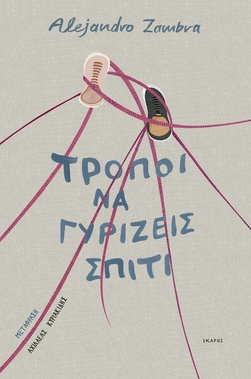
The book begins with an earthquake, seen through the eyes of an unnamed nine-year-old boy living in a middle-class housing estate in Maipu, Chile. In the second part, the protagonist is the author of the first part of the novel. His father is a man of few words who, whilst claiming not to be interested in politics, silently sides with the Pinochet regime. The narrative alternates between the author and the protagonist, the past and the present, portraying with melancholy and anger the history of a nation and a generation – who, as the author says, learnt to read and write whilst their parents became collaborators or victims of the dictatorship. This is the most personal novel by Alejandro Zambra (author of ‘Bonsai’), who is perhaps the most important Chilean writer since Roberto Bolaño. ‘…Once, I got lost. I must have been six or seven years old. I’d wandered off and, suddenly, I couldn’t see my parents anymore. I was scared, but I found my way straight away and got home first – they’d been searching for me all along, desperately, but I thought they’d got lost; that I knew how to get home and they didn’t. ‘You came by a different route,’ my mother said later, her eyes still tearful. ‘You came by a different route,’ I thought, but I didn’t say it…’ writes Zambra in the book, and the translator Achilleas Kyriakidis notes: Alejandro Zambra said this later, whilst writing this marvellous novel of nostalgia for childhood, lost innocence and the guilt of that loss. The concept of loss dominates the narrative, the tale of an endless, imaginary return, where the crumbs of Kontorevithoulis have long since been eaten… Reviews ‘In this novel, Zambra employs a magnificent language, in the shadow of Carver: precision, melancholy, harshness, tenderness.’ Joaquín Arnáiz, La Razón ‘The metafictional and autobiographical interplay is reminiscent of Coetzee at his best.’ Ignacio Echevarría, El Mercurio ‘With precision and melancholy, Zambra reflects on Chile’s past and present. Ways of Returning Home is the most personal novel by one of the finest storytellers of the new generation.” Patricia Espinosa, Las Últimas Noticias “Ways of Returning Home places Zambra at the forefront of new Chilean literature, alongside other Latin American writers such as the Colombian Juan Gabriel Vásquez, who tackle the continent’s most delicate historical issues in the most compelling way.” Mina Holland, The Observer “Alejandro Zambra’s books are like a phone call in the middle of the night from an old, good friend.” Nicole Krauss
Author:
Alejandro Zambra
Translation:
Achilles Kyriakidis
Cover design/illustration:
Christos Kourtoglou
Pages:
176
Dimensions:
13,3 x 20,5 εκ.
ISBN:
978-960-572-100-8
Publication:
2016
Categories:
Literature, Books, Foreign Literature
"...Sambra puts his narrative techniques at the service of a multi-layered and dense novel—with many autobiographical elements—and manages to tackle serious issues concerning the trajectory of an entire country—he manages to tell ‘the story of his generation’—but also to speak to the reader’s heart, whilst allowing them to draw their own conclusions’...”
– Eugenia Boyanou, Avgi‘Ways of Returning Home’, a ‘silent’ prose piece on the Chilean tragedy.
– Kostas Mardas, Athens News Agency – Macedonian News Agency."...The author manages to stand simultaneously in the literal and the metaphorical, delivering a book of personal confession [perhaps], with tenderness and sensitivity that never forces emotion at any point..."
– Nicholas Kyriakou, Parathyro.com"...For Zambra, everything is memory, a constant effort to shed light on the past through personal recollections, a search for people who will reveal the other side of the story, photographs..."
– Stavros Strigkas, Popaganda"...Imaginary and real footsteps traverse the pages of the book ‘Ways to Return Home’. Past and present, truth and lies intertwine sweetly, creating in the reader a sense of nostalgia for the irretrievably lost innocence of childhood..."
– Manto Hantzi, Debop.gr"...A ‘true’ book, viewed in this light, is nothing more than the reverse version of another, ‘great’ and obscure book that we read by betraying its silences. The book we hold in our hands and the other—the reference book—resemble communicating vessels, the final composition of which constitutes a meta-literary contemplation of the human condition, haunted by an anxiety of a moral nature: how, in a political culture of concealment and ‘disappearance’, the writer will manage, with precision and sensitivity, to compose a literary ‘lie’ and, at the same time, be ‘truly’ present within its frame...”
– Nikos Xenios, Bookpress"...We are talking, among other things, of a literature that does not expand precisely because it is capable of condensing not only the narrative but also the meaning, of merging these two within the form itself, something that tends to satisfy even the Borgesian criteria..."
– Grigoris Bekos, To Vima"...Sambra plays with time and characters with a skill that ranks him among the leading representatives of the new generation of Latin American writers..."
– Athos Dimoulas, Kathimerini
"...A small masterpiece. The world through the kaleidoscopic gaze of a nine-year-old. Anxiety, illusions, innocence, Pinochet. The world through the gaze of a writer who is now an adult. Love, memories, a story—whether invented or not. A deeply human elegy on loss and inspiration..."
– Kyriakos Gialenios, Parallaximag.gr"...The book is deeply melancholic and nostalgic; it explores the ways in which a child transitions from innocence to adulthood and the ways in which adults learn to cope with loss, whether metaphorical or literal..."
– Eva Pliakou, K-lab"...a text whose density of meaning in certain passages made me feel as though I were reading poetry..."
– StatusUpdate.gr"...With a nostalgia for the past so palpable as to be perhaps dangerous, because memories are a powerful anaesthetic in the quest for complete adulthood, the author carries out his desire to forget with absolute and ruthless precision. The facts are set in stone, racing through his mind which never stops, and he, at the mercy of his memory, relives in every detail the past and the innocence that accompanies it, a past full of allusions and doubts..."
– Yannis Antoniadis, culturenow.gr“A marvellous novel of nostalgia for childhood, lost innocence and the guilt of losing that innocence.”
– Maria Liontou, Mommy Jammi"...Sambra’s text doesn’t start off strongly, and generally speaking I’d say it doesn’t reach a climax. From a certain point onwards, however, the rediscovery of the past, the political dimension it takes on, the connection between the individual (love) and the collective (politics), combined with the quality of the writing, make the reader pay closer attention to its literary value..."
– Patriarch Photios, Book Café"...His literary mastery is summed up in the unpretentious yet so apt way he manages to make us participants and fellow travellers on this journey, leaving the final word to us..."
– Aphrodite Katsia, Artcoremagazine.gr"...This largely autobiographical work is expressed for the most part as a novel within a novel, as the central character dredges up, perhaps with difficulty, fragments of memory from his childhood to piece together the framework of his narrative."
– Antonis N. Fragos, Toperiodiko.grAmong the 20 best books of 2016 according to Culturenow.gr
– Culturenow.gr"...The Chilean Alejandro Zambra (born in Santiago in 1975) chooses in his latest novel to return to the past, to the endless realm of childhood and teenage memories, those we all keep carefully tucked away inside us, often hesitating to admit just how much they define us."
– Aphrodite Dimopoulou, Diavasame.gr"...If one had to use just three words to characterise the literary output of the Chilean writer Alejandro Zambra that has been translated into Greek to date, one might choose the following: memory, guilt, anguish. His works, brief and concise, revolve around these three central themes, whether they deal with individual issues or focus on collective responsibility."
– Aphrodite Dimopoulou, diavasame.gr"...Everything is a way of coming home. And writing is a clear way of expressing that. Alejandro Sabra, with courage, artistry and emotional intelligence, expresses this again and again. We return with him too. In the family’s old car, children in the back seat, songs on the cassette player, gliding along the sunlit road lined with oleanders, searching for the sea, when we couldn’t even imagine that no matter how far we travelled, sooner or later, the only thing we would long for more than anything would be to go home. One way or another, we will always go home."
– Theda Kaidoglou, Vakxikon.gr"..._Ways of Returning Home_ is a very personal novel by the Chilean author Alejandro Zambra and confirms the idea that we write best about what we know best of all: our own lives and experiences. And Alejandro Zambra writes brilliantly about what he knows best."
– Loukia Mitsakou, loukini.gr"...Sambra’s novel is an ark of memory. It does not record, with chronological precision, what happened when it happened. Memory is a treacherous beast – it does not give you everything, whilst taking more from you. Each chapter is a tiny pebble from the past, which has been shaped by the present. But the reverse is also true: the present refracts through the past, ultimately creating a timelessness that the writer must transform into a novel. Time is a fluid entity, and just as fluid are the experiences a person has lived through within it..."
– Dionysis Marinos, fractalart.gr"...An exceptional book that highlights the need to return to childhood memories and the places where they were born, penned by Alejandro Zambra and featuring the unparalleled—once again—translation by Mr Achilleas Kyriakidis..."
– Kalliopi Kritikou, Literary Alleys"...A beautiful novel dominated by loss. The loss of childhood, of the innocence of love, but also of that eternal return... The steps form a dance, back and forth, back and forth. The story of others that ultimately becomes your own..."
– Lola Read"Sabra’s writing is vivid and confessional, direct yet composed; without tension and at a calm pace, taking the reader on this melancholic journey into the memories of people who have left your life and whom you neglected or didn’t manage to ask certain things—important or otherwise—that would have shaped your life."
– Librofilo, Librofilo.blogspot.gr"...Through the unravelling of his narrative, which artfully interweaves his own personal life within a unique structure, Zambra chronicles, on a subtextual level, with clarity, harshness, melancholy and tenderness, the tragic history of Chile during the years of Pinochet’s brutal dictatorship and later, under Piñera’s ‘democracy’—devoid of any hope for meaningful change...”
– Jenny Manaki, FractalAlejandro Zambra
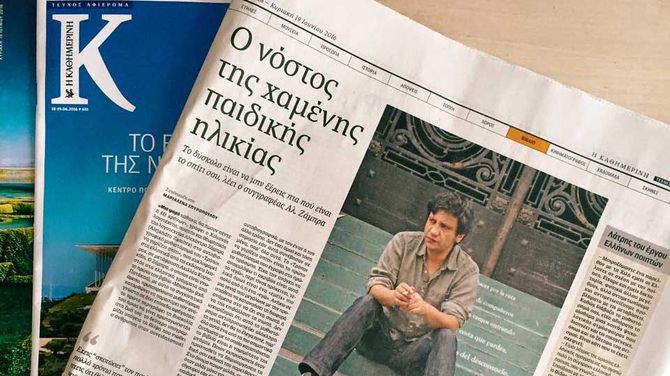
Alejandro Zambra was born in Santiago, Chile, in 1975. He has published two collections of poetry, a collection of short stories, two collections of essays and five novels, which have been translated into more than twenty languages. His short stories have appeared in numerous anthologies of Latin American literature, as well as in magazines such as The New Yorker, The Paris Review, Granta, Harper’s and others.
In 2010, the literary magazine Granta ranked him among the best Spanish-language writers of the younger generation.
Among other honours, he has received the English Pen Award, the Prince Claus Award and the O. Henry Award.
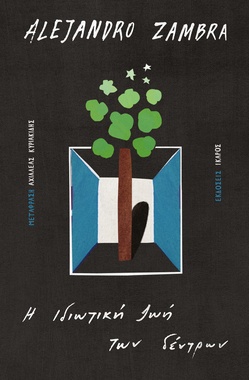
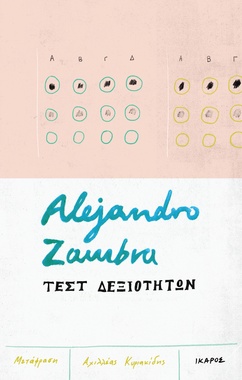
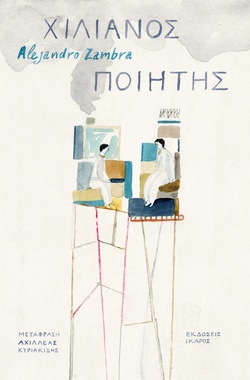
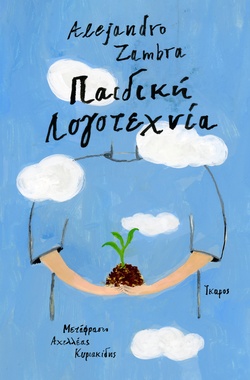
Ikaros Publications has released his works Ways of Returning Home (2016), The Private Life of Trees (2017), Skills Test (2018), Chilean Poet (2021) and Children’s Literature (2026).