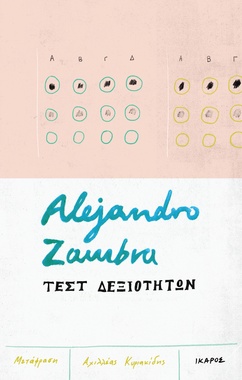
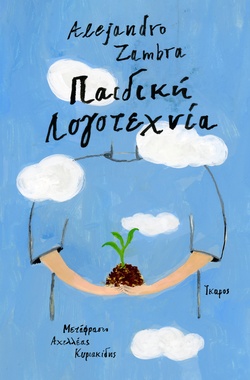
The Skills Test
In ‘The Skills Test’, the Chilean author’s innovative book, linguistic exercises coexist with literary texts, inviting readers to reflect on and respond to key ethical issues of our time.
To say that The Skills Test is a novel is just as risky as saying that it is not. Perhaps it is better simply to say that it is a book by Alejandro Zambra, because the style and themes that have made him a significant voice in Latin American literature are unfolded here in a substantial and intense manner.
Taking as his starting point the structure of the university entrance examination system implemented in Chile from 1967 to 2002, the author creates an unexpected work in which stories coexist with literary excerpts and linguistic exercises that are, in essence, moral dilemmas: the need to lie in order to be validated by others, the desire to form bonds despite mistrust in love and family, the difficulty of navigating a minefield of secrets, the desperate conviction that, rather than learning to think, we have been trained to obey and repeat.
Alejandro Zambra’s enchanting prose is a thrilling path to exploration. Imaginative and original, Zambra is a master of the short form. I adore his incredible audacity.
—Enrique Vila-Matas
Author:
Alejandro Zambra
Translation:
Achilles Kyriakidis
Cover design/illustration:
Christos Kourtoglou
Date of publication:
07/03/2018
Pages:
112
Dimensions:
13.3 x 20,5 εκ.
ISBN:
978-960-572-221-0
Publication:
2018
Categories:
Books, Literature, Foreign Literature
"...Adopting the structure of the university entrance exams used in Chile between 1967 and 2002, Alejandro Zambra poses to the reader a series of questions of increasing difficulty about life, our relationships with ourselves and those close to us, whilst constantly maintaining a sense of irony towards everything that prepares us for real life and how spectacularly it fails."
– Sofia Papageorgiou, Pote-pote on Sunday"...The book’s unconventional structure, orchestrated through exercises that invite the reader to engage with the text through their own personal lens, will captivate."
– Athens Voice"...A book with a distinctive and unique format consisting of multiple-choice exercises, texts and comprehension questions, which functions interactively, as each reader is invited to delve into the depths of the words, discover their own interpretation of the text and its content, and with striking naturalness ascertain, observe and recognise the existence of different interpretations."
– Evi Vassiliou, Cue Magazine"The ‘Skills Test’ is undoubtedly a morphological innovation, which cannot fail to influence the content. Drawing on the university entrance examination system that was in force in Chile from 1967 to 2002, Sabra creates a peculiar, mischievous literary work that I prefer to leave unclassified."
– Euthymia Giossa, Avgi"...The ingenious framework devised by the forty-five-year-old Alejandro Sabra, involving the reader in the very processes of creation, compels them to feel responsible for what is written. It compels them to care about it and what it expresses, triggering yet another form of identification, different from the one we are accustomed to. Here one will discover stories that move us through the tragic everyday lives they describe and, as is well known, we all have a share in tragedy."
– Dimitris Mavros, slpress.gr"...This book offers a contemporary perspective on the country’s past, a past that has irreparably scarred two generations. A paradoxical book brimming with irony but also with a heavy dose of national self-criticism, by the 43-year-old Chilean who, by no means coincidentally, has been ranked by the respected literary magazine Granta among the best Spanish-language writers of the younger generation."
– Vivian Avraamidou-Ploumpi, Amagi"...Returning to the original question: how might we describe this book? I don’t think its classification matters particularly; what matters is its content. However you read it, what makes it special is the author’s ability to highlight the unbreakable bond between Language and History, or even more so between the Word and the Historical Event. And in our own language, Alejandro Sabra’s work has been fortunate enough to be translated by Mr Achilleas Kyriakidis."
– Aphrodite Dimopoulou, Diavasame.grAlejandro Zambra
Alejandro Zambra was born in Santiago, Chile, in 1975. He has published two collections of poetry, a collection of short stories, two collections of essays and five novels, which have been translated into more than twenty languages. His short stories have appeared in numerous anthologies of Latin American literature, as well as in magazines such as The New Yorker, The Paris Review, Granta, Harper’s and others.
In 2010, the literary magazine Granta ranked him among the best Spanish-language writers of the younger generation.
Among other honours, he has received the English Pen Award, the Prince Claus Award and the O. Henry Award.
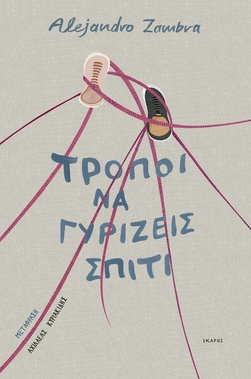
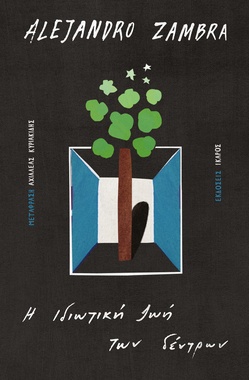
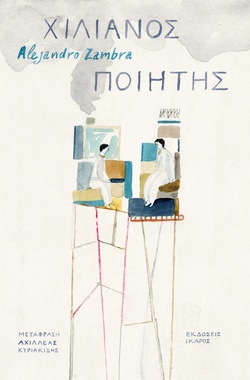
Ikaros Publications has released his works Ways of Returning Home (2016), The Private Life of Trees (2017), Skills Test (2018), Chilean Poet (2021) and Children’s Literature (2026).