The latest poetry collection by the great surrealist artist and poet Nikos Engonopoulos (1st State Poetry Prize 1979).
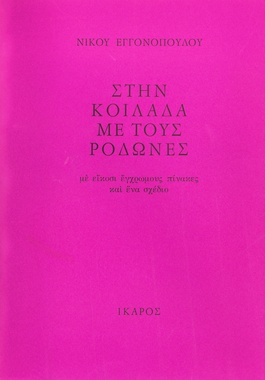
Nikos Engonopoulos included in The Valley of the Roses more than 50 of his poems written in Greek and French, along with twenty colour paintings and a drawing.
‘These are the poems of a twenty-year period, along with a few others. They are presented in the chronological order in which they were written. They were written, so to speak, because I was never a systematic writer, a systematic man of letters, a litterateur. My great love in life was painting alone. Every hour I do not devote to painting is a wasted hour. But a painting does not, of course, constantly demand the absolute devotion of mind and heart. There are moments when the hand, I might say, moves of its own accord. But the mind is always at work. And then I take advantage of the time to ponder various things, or, more often than not, to compose songs. After finishing my work, if I put these songs down on paper, so much the better; otherwise, I forget them. The same goes for translations. While I’m working, sometimes I recite Greek and foreign poems to myself. The ones I really liked, and have read many times, I’ve now memorised. I’ve adapted a few foreign ones, just for fun, into our language.”
Author:
Nikos Eggonopoulos
Pages:
232
Dimensions:
24 x 17
ISBN:
978-960-7233-03-5
Publication:
1978
Categories:
Literature, Books, Poetry
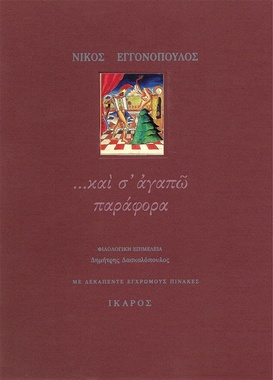
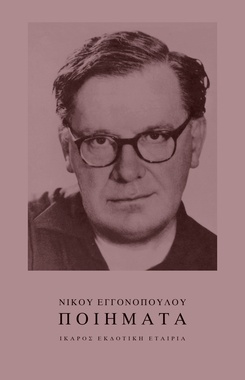
Nikos Eggonopoulos
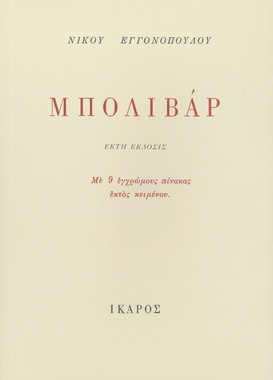
He was born on 21 October 1907 in Athens. His father, Panagiotis, was from Constantinople and worked as a merchant. From 1923 (at the age of 12) until 1927, he was a boarder at a secondary school in Paris. There he was taught classical French poetry. In 1924, André Breton’s manifesto would also influence him. In 1927, he returned to Greece to do his military service. He initially worked as a cover designer for magazines and, in 1932, enrolled at the Athens School of Fine Arts, where his teacher was Konstantinos Parthenis. At the same time, alongside Yannis Tsarouchis, he also attended the art studio of Fotis Kontoglou. Around the same time, he began publishing his first collections of poetry (initially influenced by Solomos and Baudelaire). From then on, his poetry began to be widely criticised. Many magazines and newspapers, both Greek and foreign, parodied his poems with derisive comments at the end. In 1939, he organised the first exhibition of his paintings at Nikos Kalamaris’s home. From 1940, his personal ordeal began. Upon conscription, he was sent straight to the front line of the Albanian front. The Metaxas regime kept him on the front line, without respite, until the end of the war. He was eventually captured by the Germans on 13 April 1941, following a bloody battle by the Army of Central Macedonia, and was illegally sent to a “prisoner of war labour camp”, from which he escaped and returned to Athens on foot. He never stopped writing poems in whatever way he could. In free Greece, he became involved in a host of artistic initiatives, founding associations in which he played an active role, without ever ceasing to paint or write. In 1967, he became a lecturer in freehand drawing at the National Technical University of Athens. From 1967 until August 1973 (when he retired), he would have a significant influence on student life both within and outside the Polytechnic. On 31 October 1985, he passed away in Athens. His works include: - "Do Not Speak to the Driver", 1938 - "The Harps of Silence", 1939 - "Seven Poems", 1944 - "Bolívar", 1944 - “The Return of the Birds”, 1946 - “Eleusis”, 1948 - “The Atlantic” (reprint from the journal “Anglo-Hellenic Review”), 1954 - “In the Flowering Greek Language”, 1957 (1st State Poetry Prize, 1958) - “Poems”, Vol. A, Ikaros, 1966 (collected edition of the collections “Do Not Speak to the Driver’ and ‘The Keyboards of Silence’) – ‘Greek Houses’, 1972 – ‘Poems’, Vol. II, Ikaros, 1977 (collected edition of the collections “Bolivar”, “The Return of the Birds”, “Eleusis”, “The Atlantic”, “In the Flowering Greek Language”) - "In the Valley with the Rodones", 1978 (1st State Poetry Prize, 1979) - "Karagiozis, a Greek shadow theatre", Ypsilon, 1980, After his death, the following books were published: - “Prose Texts” (collected edition), Ikaros, 1987 - “... and I love you madly: Letters to Lena 1959–1967” (ed. Dimitris Daskalopoulos), Ikaros, 1993 - “The Angels in Paradise Speak Greek... (interviews, comments and opinions, ed. Giorgos Kentrotis)”, Ypsilon, 1999 - “The Measure, Man: Five Poems and Ten Paintings”, Ypsilon, 2005 - “The Beauty of a Greek: Poems” (bilingual edition, in an anthology, translated and edited by David Connolly), Ypsilon, 2007 He also translated many works by foreign poets. A profoundly intellectual man, Nikos Engonopoulos was not only a painter and poet, but also a true thinker. Passionate about surrealism, he bequeathed to us a timeless body of work with an atmosphere entirely his own. Engonopoulos’s work faced negative reactions that bordered on mockery and vilification. His sole supporter was Empeirikos, also a surrealist. In painting, his teachers were Konstantinos Parthenis and Fotis Kontoglou, men to whom Engonopoulos always referred with admiration. He himself said: “As I am a painter by profession, I regard poetry as a wholly personal matter.”