-
Author:
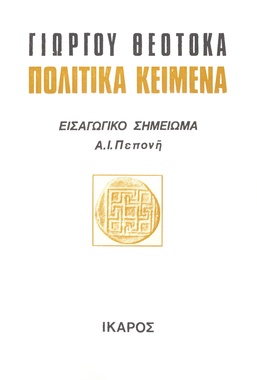
George Theotokas
Pages:
231
Dimensions:
21 x 14,5
ISBN:
0000000000028
Publication:
1976
Categories:
Books, Essays & Thought, Δοκίμιο
George Theotokas
Giorgos Theotokas (1905–1966) was born in Constantinople, the son of the lawyer Michael Theotokas and Androniki, née Nomikos. He completed his secondary education at the Greek-French Lycée in Constantinople and in 1922 settled with his family in Athens, where he enrolled at the University’s Law School. In 1925, he was elected General Secretary of the demoticist organisation ‘Student Society’ (his activities nearly led to his expulsion from the University in 1926) and welcomed Yannis Psycharis to Chios. After graduating (1927), he spent three years in Paris and London. In London, he wrote his first book, *Free Spirit*, which was regarded as the manifesto of the Generation of the Thirties (published in Athens in 1929). In 1929 he returned to Athens, where he worked as a lawyer and published many of his writings in the daily and periodical press. In 1940, he volunteered for the army and fought in Albania. In 1948, he married the philologist Nausica Stergiou, who died in 1959. In 1952 he travelled to America; in 1955 he stood as a candidate in the parliamentary elections in the prefecture of Chios, without success. In 1966 he married the poet Koralia Andreadi. He died that same year in Athens.
He contributed to many literary magazines and the newspaper "To Vima", whilst also serving on the editorial board of the magazine "Epoches". He was a co-founder of the magazine "Nea Grammata" (1935). He served as director of the National Theatre (1945–1946 and 1951–1952) and chairman of the Board of Directors of the K.T.B.E. He represented Greece at the international meetings in Geneva and at the International Conference in Edinburgh. He travelled to many countries and his works were translated into many foreign languages. He was honoured with the Academy of Athens Prose Prize (1939 for the novel ‘The Daemon’) and the First State Essay Prize (1957 for his work ‘The Problems of Our Time’). Giorgos Theotokas is associated with the Generation of the 1930s, of which he was one of the most prolific figures. He was active in prose, theatre, poetry, essays, criticism and travel literature. Through his work, he laid the foundations for his generation’s theory of Hellenicity, which draws both from Greek tradition (ancient Greek, Byzantine, folk culture) and from European tradition and contemporary reality. His narrative style was strongly influenced by 19th-century Greek prose. Among his works, we note as landmarks ‘Leonis’, ‘The Sick and the Wayfarers’, ‘The Demon’ and ‘The Argo’.