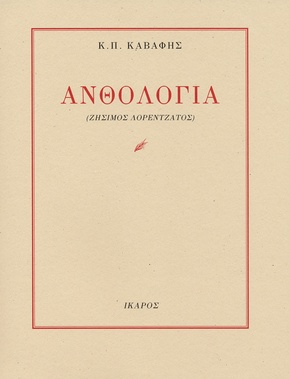
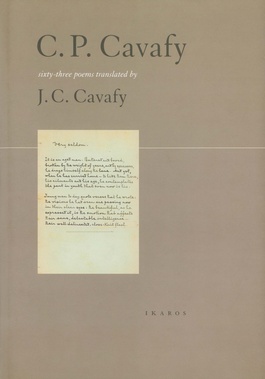
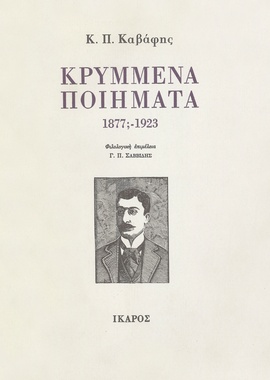
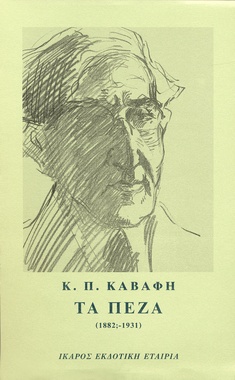
It is based on the standard edition of C.P. Cavafy’s poems, edited by G.P. Savvidis, and features illustrations by N. Hatzikyriakou-Gika created especially for this book.
Author:
K.P. Kavafis
Illustrations:
N. Hatzikyriakos Gikas
Pages:
216
Dimensions:
29,5 x 22
ISBN:
978-960-7721-92-1
Publication:
1966
Categories:
Books, Illustrated, Albums & Art Books
K.P. Kavafis
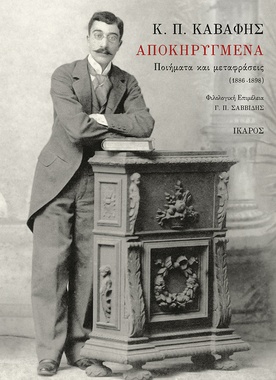
Kostis Petrou Fotiadis Cavafy, son of Petrou-Ioannis Ioannou Cavafy and Charikleia Georgaki Fotiadis, was born in Alexandria, Egypt, on 29 April 1863. His parents were from Constantinople, and Constantine took pride in his ancestry and his distinguished forebears. His Phanariot great-grandfather, Petros Kavafis (1740–1804) served as Secretary of the Ecumenical Patriarchate, whilst his great-great-grandfather, Ioannis Kavafis (1701–1762), also a Phanariot, served as governor of Iasi. His great-grandfather Michael Skarlatos Pantzos (brother of Meletios, Patriarch of Alexandria) also served as governor of Iasi, whilst his great-great-great-grandfather Theodosius Fotiadis (brother of Cyril, Bishop of Caesarea Philippi) served as an official in the Ottoman government. A true cosmopolitan from the cradle, then, as his family roots stretched from Constantinople to Alexandria and from Trebizond to London (as well as Chios, Trieste, Venice and Vienna), Cavafy was the youngest of a large family: he had six older brothers, whilst two further siblings (a boy and the only girl) died in infancy in Alexandria. His father, Petros-Ioannis, was the fourth child of the family (he had two brothers and two sisters), and proved to be a highly capable merchant (his own father was also a merchant and landowner). He had acquired dual citizenship, Greek and British. After Constantinople, London and Liverpool, he chose to settle in Alexandria, where he was one of the founders of the Greek Community. The Cavafy family enjoyed considerable financial and social comfort there, but the death of Petros-Ioannis in 1870, combined with difficult economic circumstances, forced Charikleia to leave Alexandria with her children in 1872, when Constantine was nine years old, to settle in Britain. His mother, Charikleia, was a practical woman. Her father was a gemstone merchant, and Charikleia had seven siblings, all younger than her (six girls and one boy). She married young, at around fourteen, and spent the first two years of her marriage at her mother-in-law’s house in Constantinople, whilst Petros-Ioannis was away on business. They subsequently settled together in England, where her husband arranged for tutors to be hired for her home education. Following the death of Peter-John, Charikleia returned to this environment so that she could be close to the family of George Cavafy, the deceased’s brother and business partner. Charikleia stayed in Liverpool for almost two years, then in London for about two years, and then for less than a year back in Liverpool. Were these moves directly related to the family’s financial situation? The firm ‘Kavafis & Co.’ was dissolved around 1876, and in 1877 Charikleia and the younger children returned to Alexandria, no longer to a house but to a flat. We do not know much about the five years Constantine spent in Britain, from the age of nine to fourteen, apart from the fact that he went to school and spent his summers in Dover. We do know, however, that in Alexandria he attended the commercial school ‘Hermes’, where he made his first friends (Mikes Rallis, Ioannis Rodokanakis and Stefanos Skylitsis), that he used the public libraries and that at the age of eighteen he had begun compiling a historical dictionary. Cavafy’s second stay in Alexandria was abruptly cut short before five years had passed, due to the unrest that followed a nationalist military movement. Chariclea, seeing that intervention by foreign powers was imminent, gathered her children once more and fled to her father’s home in Constantinople. The family set sail fifteen days before the British fleet bombarded Alexandria. In the fire that followed, the family home was destroyed along with all their possessions, including Constantine’s books and manuscripts. Thus, his first surviving manuscript is the travel diary to Constantinople, and his first poem is ‘Leaving Therapia’, written in English and dated by him at 2.30 pm on 16 July 1882, when the family was leaving the hotel where they had been staying in Therapia to move to Georgakis Fotiadis’s country house in Nichori. In Constantinople, which he was seeing for the first time, the nineteen-year-old Constantine found not only his numerous relatives but also the legendary City of the Emperors. There and then, as was only natural, he began to explore his origins and his own identity, and to situate himself within the broader context of Hellenism, as he prepared to come of age and participate in public life, pursuing a career as a politician or journalist. It was also there and then, according to one account, that he had his first same-sex encounter. ‘Amidst the dissolute life of my youth, the seeds of my poetry were taking shape, the scope of my art was being mapped out,’ he would write many years later. Most of his siblings had, in the meantime, returned to Alexandria to work and support the family. Chariclea and Constantine (who had begun writing poems and articles) remained in Constantinople, awaiting compensation from the insurance company for their destroyed home. However much he enjoyed life in Constantinople, Constantine was eager to return home. The compensation arrived in September 1885 and the following month the Kavafis family returned permanently to Alexandria, but where his house had stood, Constantine found only ruins. That same month, the treaty between the British and Ottoman Empires was signed, appointing British and Ottoman commissioners in Egypt, and Constantine renounced the British citizenship he had inherited from both his parents, retaining only his Greek citizenship. This act was not without consequences for the British Protectorate of Egypt: when Constantine succeeded in 1892 in securing a post in the Third Irrigation Division of the Egyptian Ministry of Public Works, he was appointed as a temporary employee, as he held neither Egyptian nor British citizenship. As a methodical and conscientious employee, however, he retained this temporary post (and the financial security it provided) for thirty years. Financial matters preoccupied Cavafy greatly; he remembered the splendours of his childhood and did not wish to fall any further. He began working at the Alexandria Stock Exchange at an early age and was a registered stockbroker from 1894 to 1902. At the same time, he gambled, keeping ‘gambling records’ until 1909. This side activity allowed him to live in relative comfort until his death. The other side activity he began in Alexandria was the publication of poems and prose: his first publication was the article ‘The Coral from a Mythological Perspective’ in the newspaper Konstantinoupolis, on 3 January 1886. On 27 March of the same year, he published his first poem, entitled ‘Bacchikon’, in the Leipzig-based magazine Esperos. Around the same time, a series of deaths began that left a lasting mark on him: in April 1886 his friend Stefanos Skylitsis died, in 1889 his friend Mikis Rallis, in 1891 his brother Petros-Ioannis and his uncle Georgios Kavafis, in 1896 his grandfather Georgakis Fotiadis, in 1899 his mother, in 1900 his brother Georgios, in 1902 his brother Aristides, and in 1905 his brother Alexandros. Cavafy rarely left his beloved Alexandria: he went on excursions and short leisure trips within Egypt (particularly to Cairo in the winter, as his father had done), but we know that he travelled abroad only five times. In 1897 he travelled with his brother Ioannis-Konstantinos to London and Paris; in 1901 and 1903 he travelled with his brother Alexander to Athens, where he returned in 1905 following Alexander’s illness and death. His next (and final) trip was twenty-seven years later, with Alekos and Rika Segopoulou, once again to Athens due to illness, but this time his own. In Alexandria, Constantine lived with his mother and his brothers Paul and John-Constantine. They were the two closest to Constantine, and not only in terms of age: Pavlos was known in Alexandria as the homosexual Cavafy, and Ioannis-Constantine as the poet Cavafy (in the English language). After Charikleia’s death in 1899, he remained with his two brothers until 1904, when Ioannis-Constantine moved to Cairo. He continued to live with Pavlos, and in 1907 the two brothers moved into the flat on Lepsius Street. The following year, Pavlos left on a trip abroad and never returned to Egypt. Thus Constantine was left alone for the first time in 1908, at the age of 45. His life changed radically from then on: he gradually reduced his social appearances and devoted himself to poetry. He had now found his own poetic voice, and was certain of its worth. Apart from his two nieces, Charikleia Aristides Cavafy and Eleni-Angeliki-Loukia Alexandrou Cavafy, Constantine showed a particular fondness for Alekos Segopoulos, the son of the Greek seamstress Eleni Segopoulou, who was in the service of Charikleia Cavafy. Cavafy’s unusual care for Segopoulos (his future heir), as well as their widely acknowledged physical resemblance, led many to conclude that Segopoulos was Cavafy’s son, a possibility that cannot be ruled out, since (according to Segopoulos’s first wife, Rika) Constantine was not exclusively homosexual. Equally likely is the possibility that Alekos was the illegitimate son of one of Cavafy’s brothers, which would explain why the two men never spoke of their special relationship. Whatever his personal life may have been, Cavafy made a clear distinction between his professional and private lives, which became the subject of speculation and scandal from the moment his poetry began to gain recognition. Above all, however, he was a poet (in his last passport, in 1932, he entered the word ‘Poet’ as his ‘Occupation’) and wished to be remembered as a poet and nothing else, with no other qualifiers, save for ‘Greek’. Thus he took care to live cautiously, giving no cause for offence to Alexandrian society or the Athenian establishment, which, as early as 1903, had recognised the threat that this idiosyncratic expatriate posed to the poetic order in Greece, as embodied by the native Kostis Palamas. The confrontation between the followers of Cavafy and Palamas first flared up in 1918 and reached its peak in Athens in 1924, effectively coming to an end that same year when Palamas made a brief but sober assessment of Cavafy’s work. In 1926, during the Pangalos dictatorship, the Greek State recognised Cavafy’s contribution to Greek literature, honouring him with the Silver Medal of the Order of the Phoenix. Cavafy’s interests in his later years were many and varied, as evidenced by his papers and his anonymous notes in the journal Alexandrian Art, which Cavafy had founded and essentially maintained, with the help of Alekos and Rika Segopoulou (with whom he lived in the same building on Lepsius Street, where the magazine’s offices were also located). In 1932, however, he began to experience discomfort in his larynx, and in June doctors in Alexandria diagnosed cancer. Cavafy travelled to Athens for treatment, which proved unsuccessful. The tracheotomy he underwent left him unable to speak, and he communicated in writing, using ‘hospital notes’. He returned to Alexandria to die a few months later in the Greek hospital near his home (when he had moved there, he had said prophetically, ‘Where could I live better? Below me, the brothel satisfies the needs of the flesh. And there is the church where sins are forgiven. And further down, the hospital where we die”). The publishing practice Cavafy followed was unprecedented. He never published his poems in book form, and indeed turned down two offers made to him, one for a Greek edition and one for an English translation of his poems. He preferred to publish his poems in newspapers, magazines and almanacs, and to print them privately as single sheets, subsequently compiling improvised collections which he distributed to those interested. Thus, the first collection containing the 154 poems of Cavafy’s ‘Canon’ (the poet had disowned 27 of his early works) was published posthumously in Alexandria, edited by Pika Segopoulou. In Greece, this collection was first published in 1948 by the ‘Ikaros’ publishing house, run by Nikos Karydis, Alekos Patsifas and Marios Ploritis. The same publishing house released the affordable two-volume ‘popular’ edition of the poems for the first time in 1963, edited and annotated by G.P. Savvidis, through which Cavafy was definitively re-established in the consciousness of the Greek public. The poet left behind a well-organised archive which passed into Savvidis’s possession in 1969, following the death of Segopoulos. Parts of the Cavafy Archive were utilised and published by many researchers, but the most significant publications (all by Ikaros Publications) were the “Unpublished” (1968) or “Krymmena” (1992) poems, edited by Savvidis, and the “Ateli” (1994) poems, edited by Renata Lavagnini, whilst these had been preceded by the “Apokirygmena” (1983) poems. Thus was completed the publication of all Cavafy’s poetic remnants, which complemented and shed light on his recognised work, and in 2003 the first volume of “Prose” was published, edited by Michalis Pieris, whilst the publication of Cavafy’s Commentaries on his poems, edited by Diana Haas, is forthcoming. As regards the study of Cavafy, the first “Draft Chronography of His Life”, published by Stratis Tsirkas in the Art Review in 1963, remains the unsurpassed guide, and was supplemented by the Cavafy Album 1863–1910 (1983), edited by Lena Savvidi and published by ‘Hermes’, and The Life and Work of C.P. Cavafy (2001) by Dimitris Daskalopoulos and Maria Stasinopoulou, published by ‘Metaixmio’, whilst in 2003 the Bibliography of C.P. Cavafy 1886–2000 by Dimitris Daskalopoulos was published by the Centre for the Greek Language. The international resonance of Cavafy’s poetry, as evidenced by the numerous translations of his work into foreign languages, would not have surprised him in the least. Constantine Cavafy may have died from complications of laryngeal cancer at the Greek hospital in his hometown of Alexandria in the early hours of his seventieth birthday, on 29 April 1933, but as a man he had long since ceased to exist: Kostakis, son of Petros-Ioannis Kavafis and Charikleia Fotiadi, through his open mind, his broad education, his methodical work and the strength and uniqueness of his personality, had become the poet C.P. Kavafis. The rest was a matter of time.