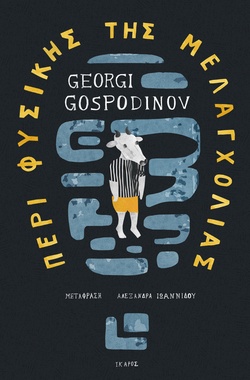
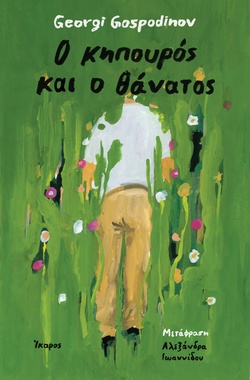
On the nature of melancholy
‘This is such a special novel that you’d want everyone to read it. Don’t ask any questions, just read it.’
Herman Koch, author of *The Dinner*
Herman Koch, author of *The Dinner*


Having been shortlisted for the Strega Europeo (Rome, 2014) and Gregor von Rezzori (Florence, 2014) and honoured with the full set of literary awards in Bulgaria, the novel On the Physics of Melancholy ranks Georgi Gospodinov among Europe’s most inventive and daring writers.
Using the myth of the Minotaur as his central image, the book’s narrator (the author’s alter ego) weaves a labyrinth of stories about his family, jumping between different eras and perspectives, exploring the mindset and dead ends of Eastern Europeans.
An incredibly moving yet humorous book about human anxieties, empathy and its loss, which sheds light on issues such as abandonment and isolation. Its original structure and stunning narrative captivated international critics, who hailed it as one of the finest European postmodern novels.
Author:
Georgi Gospodinov
Edited by:
Yiannis Antonopoulos
Translation:
Alexandra Ioannidou
Cover design/illustration:
Christos Kourtoglou
Date of publication:
25/04/2018
Pages:
336
Dimensions:
13,3 x 20,5 εκ.
ISBN:
978-960-572-224-1
Publication:
2018
Categories:
Literature, eBooks, Foreign Literature
"...In the first person, with the raw material of lived intensity, and in the third person, with an observer’s detachment, the elements of modern labyrinths are recorded and catalogued using the materials of the novel. The process of childhood’s coming of age, the need to retell the myth of the world anew—pervasive throughout the novel—gives the investigation its dimensions and scope. Complex and labyrinthine, it vividly examines the world and studies the two-way vital sensation of entering and exiting the labyrinth of generations, systems, politics and culture within the natural tendency of the melancholy of thought."
– Angela Mantziou, cityculture.gr"...With the myth of the Minotaur as his central point of reference – as we learnt it at school but also in imaginative, contemporary variations – Gospodinov weaves a multifaceted labyrinth of stories, exploring the mindset, the frustrations and dead ends of our neighbours, both during and after the fall of the Eastern Bloc."
– Stavroula Papaspyrou, LIFO"...The hero, as the author’s alter ego, structures his thinking around the myth of the Minotaur. We may all have learnt about him at school, but we probably never considered the innocence of this creature; rather, we stood as his accusers, offering no mitigating circumstances for his actions. The hero sets up an imaginary, realistic court aimed at proving his innocence. A point here is necessary for you to understand the hero’s motive; he suffers from ‘pathological empathy’."
– Toperiodiko.gr"...In this unique work of introspection, the mundane details of everyday life are combined with the search for the meaning of life in the great myths, the history of the place, the evolution of language, the resilience of memory – everything that makes up our narrative identity: the fragments of the self that together constitute who we are."
– Eva Stamou, Athens Voice"...The past is a labyrinth of dark underground passages. Gospodinov, with the melancholic gaze of a man who ‘has exhausted every personal reserve of meaning’, original, profound, groundbreaking and at the same time a model of postmodern narrative, hints at the human void that stems from the uncertainty of History’s capriciousness. A void created by a peculiar nostalgia and the unbearable certainty that everything that happened was wrong."
– Eugenia Boyanou, Avgi"...Perhaps one of the most important books of the year, both in terms of subject matter and, above all, in terms of development and structure..."
– Yannis Baskozos, The Reader"...A time-capsule novel, in which Gospodinov, through an inventive use of myth, seeks a way out of the labyrinth of the past and constructs a treatise on life, death, memory and, ultimately, the very process of storytelling."
– Eleni Georgostathi, The Reader"...I am not one of those readers who particularly love fragmentation, nor navel-gazing. But Gospodonov does it so well, so effortlessly, that one cannot help but acknowledge his immense narrative talent, the sort one rarely encounters these days."
– Katerina Malakate, Reading"...We are talking here of a labyrinthine narrative, expressed in stutters and incomplete sentences. Some ‘side rooms’ of this labyrinth, some narratives, remain playful and anecdotal, or are absorbed into others; at times they overlap in a ‘bricolage’ of narrative construction or, finally, they return to their source, become disoriented and backtrack, whilst the narrative voices often lack focus, being centrifugal and elliptical. The apotheosis of postmodernism: the concept of the ‘archive’ in this book is identified with the aggregated records of the diverse narratives of the individual and the collective."
– Nikos Xenios, Bookpress"...‘‘The past differs from the present in one respect – it never flows in a single direction.’ It is in this past that the Bulgarian author chooses to live and relive, in one of the most delightfully translated novels of the year. Can two different narrative threads be woven into a single story with loose joints but solid foundations? The first is the literary vindication of the Minotaur, a mythological figure who, with the exception of Borges and in particular his famous ‘House of the Star’, has been wronged in all the arts. The second is his autobiography combined with the biography of a state and a nation, particularly in the 1970s and 1980s."
– pandoxeio.com"...we could say that the entire novel is a well-designed labyrinth. However, to traverse it and finally find the exit, you do not need to slay the Minotaur, but rather the stereotypes that have accumulated over the years in our minds, rendering us incapable of seeing that there are other paths."
– Sofia Papageorgiou, Pote-pote on Sunday"...A compilation of dozens of micro-stories, *On the Nature of Melancholy* by the Bulgarian author Georgi Gospodinov appears to have been written in fragments, through a process reminiscent of collage-making; yet the final result possesses coherence and logic in its construction, whilst also possessing a sentiment that demands reading in order to be understood, experienced and ultimately celebrated by the ecstatic reader."
– NO14me"...The author’s alter-ego protagonist experiences the before and after of the fall of the Eastern Bloc, except that Gospodinov chooses a labyrinthine narrative motif, partly experimental and partly postmodern, elaborate and riveting."
– Athos Dimoulas, K Magazine"...Gospodinov’s book ultimately offers a personal perspective on the region’s recent history, as well as a response to the way others view Bulgaria: ‘If you turn to the back pages of a European newspaper you are reading, there, on the weather forecast map, there is a gap – between Istanbul, Vienna and Budapest. ‘The saddest place in the world,’ wrote The Economist in December 2010.” This description of Bulgaria as ‘the saddest place in the world’ was the catalyst for Gospodinov to launch a multi-layered, captivating discussion on the arduous personal and collective paths that have been carved out in recent years ‘in these parts [where] life is short, but the day lasts for centuries’."
– Kostas Athanasiou, The Era"...And what is Gospodinov’s literature? A postmodern novel? An autobiography with a dramatic tone? He himself speaks somewhere of ‘an atomic novel made up of story fragments adrift in the void’. [...] Gospondinov sought lost time, ‘freed from the claim of the particular’, and entered, in literary terms, a labyrinth without the exits of certainties, but full of collateral possibilities."
– Christos Vasmatzidis, Eφημερίδα των ΣυντακτώνGeorgi Gospodinov
Georgi Gospodinov was born in 1968. He is one of the most widely translated Bulgarian authors since 1989 and is considered one of Europe’s most inventive and daring writers.
His first book, A Natural Novel (Ikaros, 2020), was published in 1999, became an international bestseller, was translated into 24 languages and was described by The New Yorker as an ‘anarchic-experimental debut’. His second novel, On the Physics of Melancholy (Ikaros, 2018), has won numerous literary awards, including the State Novel Prize in Bulgaria (2013), the Swiss Jan Michalski Prize (2016) and the Polish Angelus Award (2019). It has been translated into more than 15 languages. His third novel, Chrono-Refuge (Ikaros, 2021), was published in 2020. It was honoured with the State Novel Prize in Bulgaria (2021) as well as the Strega Europeo Prize (2021).
He has taught on the Creative Writing Programme at Humboldt University in Berlin and worked as a visiting writer at the DAAD’s Berliner Künstlerprogramm and the Wissenschaftskolleg zu Berlin.