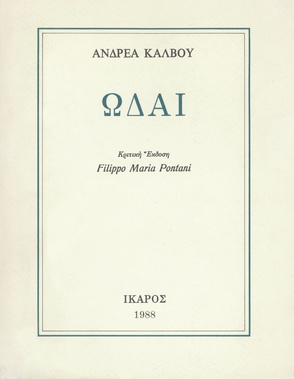
‘Twenty odes in two collections, one published in Geneva in 1824 under the title "The Lyre" and the other in Paris in 1826 under the title "Lyric", constitute the Greek poetic output of Andreas Kalvos (1792–1869). The manuscript, the poet’s autograph, of the first collection, namely “Odes I–X”, survives. In 1960, an excerpt from an unknown and unfinished early Greek ode of his (to Napoleon?) from 1811 was discovered and published in Italy. It is unlikely that an anonymous ‘Hymn to the Olive Tree’, found in a single-sheet printed in 1830 and which appears to be the work of an imitator of his style and metre, belongs to Kalvos. Some fifteen editions of the two collections were published in Greece, with alterations and changes that altered the orthographic and morphological character of the text, so that G. Seferis’s wish for them to be printed in a single volume “in Greek with Kalvos’s spelling and punctuation”, since “what matters is that we have Kalvos as unadulterated as possible and without the interference of third parties’ idiosyncrasies”. It is this wish that my edition seeks to fulfil, following preliminary studies and a careful examination of previous editions.
Excerpt from the introduction by Filippo Maria Pontani.
Author:
Andreas Kalvos
Edited by:
Filippo Maria Pontani
Introduction:
K. Th. Dimaras
Pages:
236
Dimensions:
23 x 18
ISBN:
978-960-7721-53-2
Publication:
1970
Categories:
Literature, Books, Poetry
Andreas Kalvos
He was born in Zakynthos in 1792. His mother’s name was Adrianne. His father, Ioannis Kalvos, was a volunteer and an officer in the Venetian mercenary army. Ioannis had been married twice, and this had a negative influence on Andreas, consequently affecting his dramatic poems. From the autumn of 1813, whilst in Italy, he met Ugo Foscolo and later entered his service as a secretary and copyist. At the same time, he studied ancient texts and, in particular, Neoclassical Italian literature. Kalvos had a turbulent and unstable love life. Finally, in 1819, he married the Englishwoman Maria Theresa Thomas and had a daughter. However, both his wife and daughter died soon afterwards, and so, leaving England in 1820, Andreas Kalvos moved between Florence, Switzerland and France. In 1826, he settled in Paris and met many Philhellenes and Orientalists. After many journeys, he left Nafplio and went to Corfu in August 1826. There he obtained a doctorate in philosophy and taught comparative literature until 1828 as a temporary lecturer. In late 1852 he left for London, where in early 1853 he married the teacher Carlotta Augusta Wadams. They settled in Louth, Lincolnshire. His wife founded a girls’ school there, and it was there that Andreas Kalvos taught mathematics and foreign languages. He died in 1867 and was buried in Kedington. The remains of Kalvos and his wife were transferred to Zakynthos in 1960.