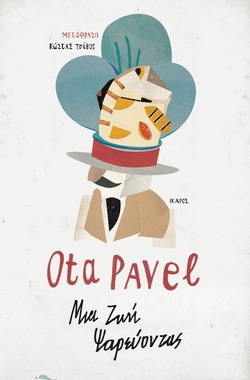
A life spent fishing
A 10-year-old boy takes on the responsibility of his family when his father and brothers are sent to concentration camps during the German occupation of Czechoslovakia. He hunts and fishes and looks after his beloved mother.
Fishing is the ultimate freedom. Wandering up and down, waiting for a fish to bite and quenching your thirst at the springs. Being completely alone for an hour, for a few days, for a few weeks – that is what I have always sought in life… That, I believe, is what freedom is.
A 10-year-old boy takes on the responsibility of his family when his father and brothers are sent to concentration camps during the German occupation of Czechoslovakia. He hunts and fishes and looks after his beloved mother.
Like a free bird, like that eel in the short story “The Great Water Tramp”, which slips from its bonds to take refuge in the freedom of the river, so too does little Ota Pavel, like another Tom Sawyer of Central Europe, run up and down rivers, lakes and meadows, because he is in a hurry to grow up and escape from a difficult period that Europe was going through, and which showed signs of not being the last.
Author:
Ota Pavel
Edited by:
Dimitris Nollas
Translation:
Kostas Tsivos
Cover design/illustration:
Christos Kourtoglou
Pages:
152
ISBN:
978-960-572-018-6
Publication:
2014
Categories:
Books, Literature, Foreign Literature
Written in the spirit of the great tradition of Czech satirists – Jaroslav Hašek winks at us on every page – Ota Pavel’s multi-character (and what characters!) ethnography certainly seems, on first reading, a recollection of innocent moments of an obsession, of fishing, a gathering of memories from that fleeting and ever-recallable gift that is childhood bliss in nature, by one’s father’s side, alongside friends, or in the sacred, liberating solitude
– Katerina Schina, Kathimerini"...Pavel’s writing is charmingly disarming, direct, at times satirical and at times realistic, true to life. The author creates such beautiful images, rendered almost like paintings, that you can almost hear the birdsong and the song of his beloved rivers."
– Elniplex.comThe charm of Pavel’s text lies more in the secret, unspoken life of the protagonist, Nature, who stands as a silent witness to human tragedy and reflects the crushing mechanisms in her rivers and forests.
– Nikos Xenios, bookpress.grIn Pavel’s short stories, the call to return to nature coincides with the desire to return to childhood, to the years of innocence and carefreeness, when, as a young explorer, he discovered the flora and fauna of his native land, and even the watery element—springs, rivers, lakes—within which he felt immortal.
– Nikos Davetas, KathimeriniOta Pavel
1930–1973. A Czech prose writer who wrote autobiographical short stories that primarily highlight his childhood experiences.
The third son of the Jewish peddler Leo Popper, he was born in Prague. During the Second World War, his father and his two older brothers, Jirka and Hugo, were imprisoned in concentration camps, whilst he remained throughout the Occupation with his Christian mother, Hermina, in the village of Bustehrad. At the end of the war, his father and brothers returned alive but ‘scarred’ by their time in the camps.
After the war, Ota graduated from the Workers’ School and for a time worked in the Kládno coal mines whilst also coaching the Sparta ‘Cik’ ice hockey team.
From 1949 to 1956, he worked as a sports editor for Czechoslovak state radio and subsequently for the magazines Stadion and Czechoslovak Soldier. His first short stories, influenced mainly by the sporting world, were published in these magazines.
In his role as an editor, he had the opportunity to travel abroad regularly to cover various sporting events and missions.
During the Winter Olympics in Innsbruck, Austria (1964), he exhibited symptoms of manic depression and attempted to set fire to a farmhouse on the outskirts of Innsbruck. Due to his illness, he retired on disability in 1966. He spent the last years of his life in various psychiatric clinics, dying prematurely in 1974 at the age of just 43.
In the Czech Republic, he is now regarded as one of the greatest post-war short story writers, and his works have been translated into many foreign languages.
His collections ‘How I Met the Fish’ and ‘The Death of the Beautiful Gazelles’ have seen the most reprints, with the latter having been adapted for the cinema.