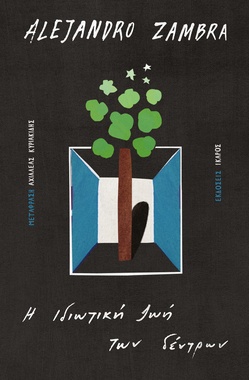
The Private Life of Trees
‘You love so that you may cease to love, and you cease to love so that you may begin to love others, or so that you may remain alone, for a while or forever. That is the doctrine. The only doctrine.’


Every Sunday, Julián devotes time to writing a novel. And every evening, he improvises and tells his adopted daughter, Daniela, original stories about trees just before she goes to sleep. But tonight is not like any other: Verónica, Julián’s wife and Daniela’s mother, is inexplicably late coming home. And as the night wears on and Verónica does not return, Julián reflects on their life and imagines what thoughts Daniela might have about his novel as she grows up… without a mother.
A novel imbued with a unique sense of nostalgia and melancholy, which confirms Alejandro Zambra as one of the leading figures of the new generation of Latin American writers.
It is rare to find a story—even rarer a short story—that offers such pleasure and manages to remain in the reader’s mind as an unsolved mystery… as captivating as the finest daydream.
The Second Pass
Author:
Alejandro Zambra
Translation:
Achilles Kyriakidis
Cover design/illustration:
Christos Kourtoglou
Pages:
96
Dimensions:
13,3 x 20,5 εκ.
ISBN:
978-960-572-159-6
Publication:
2017
Categories:
Literature, eBooks, Foreign Literature
"...a story of charismatic daydreaming and confessions. [...] Here, the author demonstrates a command of his narrative rhythm; this is not a hybrid of contemporary prose but contemporary literature aimed at readers across the globe."
– Maria Liakou, Fractalart.gr"...No one speaks in grand terms in this quiet book. The most ‘grandiloquent’ phrase in the book is Julián’s promise that he will take his foster daughter Daniela to see the snow (a promise that is utterly heart-wrenching despite its simplicity). What is remarkable about the characters is precisely that there is nothing remarkable about them: they are ordinary, everyday people, but this aspect of them is never emphasised (which would have made the book banal). There is no pretension of any kind here, which gives the book a tremendously authentic feel. A book that, as you read it, makes you feel that it encompasses you, that you could live within it."
– Christos Grammatidis, elculture.gr"...Related works include ‘The Private Life of Trees’ and ‘Ways of Returning Home’, not only because of the author’s habit—or rather innate tendency—to write simply and economically, but mainly because of how central to his fiction are the themes of absence/loss, the sense of uprooting, memory and, at the same time, the need for stories as the sole antidote to give some meaningful shape to our chaotic lives, full of unexpected pain."
– Ilias Maglinis, Kathimerini"...Sabra’s writing style is certainly enviable: the way he manages to tell a grand story in fragments within a minimal space, implying more than he states, stripping away the superfluous, allowing the personal – or the suggestion of the personal – to seep in, to scatter intertextual references in its wake, to flirt with realism and poetry, nostalgia and anticipation, sorrow and emotion, harshness and tenderness; a stylist of our times in yet another work of art."
– Yannis Kalogeropoulos, Chaniotika Nea"...Another gem from the Chilean author, Maître Achille, the inspired Christos, and Ikaros Publications! Imagination and precision in a mini (but thoroughly satisfying) novel of high postmodernism."
– George-Ikaros Babasakis
"...In _The Private Life of Trees_, the image of the tiny plant returns, taking an organic place in the narrative of yet another novella that retains the duality of its character: it is prose with poetic elements, or poetry that employs the techniques of prose."
– Dionysis Marinos, fractalart.gr"...Alejandro Zambra penetrates Julian’s mind with conviction and manages to convey, in an almost spine-chilling way, the melancholy of loss, of the night and of silence. That which lies in every rustle of the private life of trees."
– Marilena Pappa, Dreamers & Co."...Overall, Zambra presents us with a literary endeavour that transforms the tradition of magical realism among Latin American writers into a reflectively dramatised introspection of the writer as a (clandestine?) subject who has lived through it."
– Eirini Stamatopoulou, The Reader"...Alejandro Zambra’s wonderful, short novel explores the mental journey we undertake until we come to terms with an unexpected turn of events, an unpleasant piece of news that upends the normality of our lives."
– Xenia Georgiadou, Gynaika Magazine
"...This book, this tiny gem, is imbued with an inner rhythm, like the pulse of a heart beating in anticipation, distracted and deceived by itself, yet in the silence it resounds just as deafeningly."
– Sotiria Georganti, Literature.gr"...The author is tormented by the age-old goal of every realist: how to complete that (in any case unfinished) novel which will encompass the truth of an entire life, avoiding the artificiality and aestheticism of the specific form and introducing a new version of realism."
– Nikos Xenios, Bookpress.gr"...The book, full of inventiveness, with interspersed narratives of many stories that intersect at points, is permeated by a subtle observation of life, a melancholic whirlwind of thoughts and a distinct, idiosyncratic humour."
– Angela Mantziou, cityculture.gr"...Despite its short length, the nostalgic tone and magical atmosphere with which it handles realistic themes is something that captivates from the very first pages, whilst at the same time the work manages to unfold, developing in the reader’s mind as time passes until it finally becomes a bittersweet memory, full of nostalgia for places they have never seen...”
– Nikos Giakoumelos, The magazine"...Anxiety, tenderness and insecurities find their place in the writing of a novel. A novel capable of playing an important role in the future."
– Kalliopi Kritikou, Huffingtonpost.gr"...Melancholic, nostalgic, tender and unadorned. It is as if the author wrote a five-hundred-page novel and then began to strip it down until only the essence remained. And that is where the reader comes in to fill in the gaps, to continue the different versions of the story of Julián and Daniela and, why not, perhaps even of Verónica."
– Proust & Kraken Blog"...Zambra invites us into his literary workshop and, before our very eyes, sifts through his writings, wrestling with his pages with humour, tenderness and bitter irony, and once again offers us a miniature bonsai book, following Borges’s advice: to write as if summarising a book that has already been written."
– Elena Maroutsou, Eφημερίδα των Συντακτών"...It is a very sweet book overall. It leaves something within you, especially if you have found yourself in a similar situation. That is, a situation where you need fairy tales to be able to understand and cope with everyday life. This need is more common in childhood, but it is also something we never stop seeking as we grow older."
– Style Rive Gauche"...How do you tackle big themes in a small book? How do you fit emotions such as boundless love and abandonment into just a few pages? And yet, Alejandro Zambra’s much-read *The Private Life of Trees* manages to do just that. To speak of great things with few, well-chosen words."
– Sofia Krokida, tetartopress.gr"...Zambra crafts a small, elegant work of art, weaving elements of magical realism into the fabric of his contemplative narrative. The translation is by the highly experienced Achilleas Kyriakidis."
– Christos Vasmatzidis, Freat"...As for whether the book in question is a ‘great work’, one of those which, according to Rodin, take a long time to create, just like ‘great feelings, great thoughts’, but also ‘great trees’, the reader will likely arrive at a diplomatic yet honest assessment: this is a particularly interesting fictional experiment, featuring, moreover, some very profound and exceptionally well-articulated psychological portrayals."
– Stavroula Tsouprou, Avgi"...If one had to use just three words to characterise the literary output of the Chilean writer Alejandro Zambra that has been translated into Greek to date, one might choose the following: memory, guilt, anguish. His works, brief and concise, revolve around these three central themes, whether they deal with individual issues or focus on collective responsibility."
– Aphrodite Dimopoulou, diavasame.gr"...And if in *Ways of Returning Home* the family hearth becomes the path through which the narrator returns to a collective past that hurts, in *The Private Life of Trees* it is the starting point from which the protagonist, Julián, ventures into his personal past and possible future."
– Aphrodite Dimopoulou, Diavasame.gr"...Alejandro Zambra conveys in a unique way this evening in the protagonist’s life, an evening in which the silence and the absence of the other person create such a dense atmosphere that the reader feels they are about to hear its first crack at any moment. The way in which the author highlights Veronica’s presence throughout the novel through her very absence, whilst maintaining his own expressive ‘calm’, is exceptional.”
– Georgia Souvatzis, Debop"...Life, in Sabra’s work, resembles literature. His literature resembles life. He himself has stated that literature always deals with an illusion of truth and that literature is not the opposite of truth but a way of seeking it. Perhaps, in the end, his books should bear the collective title: ‘Ways of Seeking the Truth’."
– Dailythess.gr"...Alejandro Zambra’s book is both short and long. In reality, it is no more than 80 pages, but if one attempts to count the pages, one will find there are more, and if one digs a little deeper, they might stumble upon the skeleton of a conventional novel, although the Chilean author seems indifferent to convention or, at the very least, appears to prefer to leave the remains – the flesh, the fat, the marrow—for some other novel, which he may never write."
– Konstantinos Hatzinikolaou, Kathimerini"...A book that carries strong elements of nostalgia and melancholy, yet in an original way, as is customary for the Chilean author Alejandro Zambra, faithfully following the tradition of Latin American literature, which knows how to tell a story that will sweep you away into the charm of its fairy tale."
– Tina Mandilara, Lifo"...A playful interplay between yesterday, today and the future. Prompted by a simple event, the protagonist struggles not to be swept away by his fears, to offer comfort and security to Daniela, to record his innermost thoughts with clarity, and to keep hope alive."
– Literary Alleys"...Zambra, however, like his contemporaries—the Colombian Juan Gabriel Vásquez, the Peruvian Santiago Roncagliolo, and the slightly older Colombian Santiago Gabo, are the chosen representatives of the new generation of Latin American writers with at least one common trait: they do not deny the heavy political past of their countries, but look to the future whilst coming to terms with the present. That is why *The Private Life of Trees* ends with the protagonist, correcting himself, saying lovingly to little Daniela: ‘We’ll have to learn English.’"
– Marilia Papathanassiou, Eleftheria tou Typou
"...The text, cryptic and elliptical, is imbued with a sense of mystery, which at certain points prepares you for a twist of a detective or crime-related nature, yet constantly pulls the rug out from under your feet and brings you back to what it truly is: a novella of elegant and subtle prose, with flashes of sarcasm but also poetic sensitivity, polished yet not without soul and emotional depth – all elements that are highlighted and shine through in Greek, thanks to Achilleas Kyriakidis’s translation."
– Christos Armanto Gezos, Apoikia.gr"...The Private Life of Trees is one of those novels that demand and insist on being discussed, because life, however simple it may seem, can become just as complex. Ultimately, what is loss and how does one deal with it? And ultimately, to what extent is the literature encapsulated here within the author’s own literary framework inextricably linked and interwoven with life itself? To what extent do our thoughts provoke what we will later experience, and to what extent does the imaginary become strangely entangled with the real?"
– Yannis Antoniadis, culturenow.grAlejandro Zambra
Alejandro Zambra was born in Santiago, Chile, in 1975. He has published two collections of poetry, a collection of short stories, two collections of essays and five novels, which have been translated into more than twenty languages. His short stories have appeared in numerous anthologies of Latin American literature, as well as in magazines such as The New Yorker, The Paris Review, Granta, Harper’s and others.
In 2010, the literary magazine Granta ranked him among the best Spanish-language writers of the younger generation.
Among other honours, he has received the English Pen Award, the Prince Claus Award and the O. Henry Award.
Ikaros Publications has released his works Ways of Returning Home (2016), The Private Life of Trees (2017), Skills Test (2018), Chilean Poet (2021) and Children’s Literature (2026).