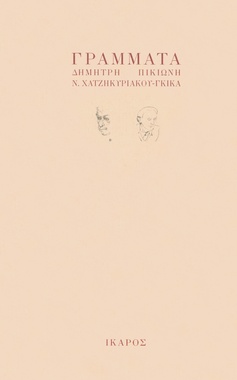
The fifteen letters, drawn from the Benaki Museum archive and the Pikionis archive, bring together the complete surviving correspondence between the great architect and thinker and the leading painter. Through these letters, the bonds of friendship that united the two friends and collaborators for 40 years are sketched out, and their views on the artistic issues of the time are captured.
Author:
Nikos Hatzikyriakos-Gikas, Dimitris Th. Pikionis
Pages:
88
Dimensions:
19,5 x 12,5
ISBN:
978-960-7721-10-5
Publication:
1996
Categories:
Books, Biographies & Personal Narratives, Αλληλογραφία
Dimitris Th. Pikionis
Born in 1887 in Piraeus. In 1906, he became the first student of K. Parthenis, and in 1908 he obtained his degree in Civil Engineering from the National Technical University of Athens. He left for Munich and then for Paris, where he studied drawing and painting at the Académie de la Grande Chaumière. At the same time, he joined the studio of the architect G. Chifflot and attended the course on architectural composition at the École des Beaux-Arts. In 1912, he returned to Greece and began his first studies on the architecture of the modern Greek tradition. In 1921, he was appointed Assistant to Professor A. Orlandos for the course in Architectural Morphology and Rhythmology, a position he held until mid-1923. In 1925, he was appointed Adjunct Professor at the National Technical University of Athens (NTUA) in the Department of Decorative Arts. In 1930, he was appointed to a permanent post in the same department. He retired in 1958. In 1966, he was elected a full member of the Academy of Athens (Class of Letters and Arts) in the Chair of Architecture. He died in August 1968.
Among his best-known works are the Karamanos House in Athens (1925), the Primary School in Pefkania (1931–32), the Experimental School in Thessaloniki (1933–37), the Xenia Hotel in Delphi (1951–55), the Potamianos House in Filothei (1953–55), the landscaping of the area around the Acropolis and Philopappos Hill (1954–57), and the Filothei Children’s Playground (1961–65). In addition to his architectural work, Dimitris Pikionis has also left behind a very significant body of written work
Nikos Hatzikyriakos-Gikas
Nikos Hatzikyriakos-Gikas was born in Athens on 26 February 1906. From a young age, he showed a particular aptitude for drawing and so, whilst still a schoolboy, he took painting lessons from Konstantinos Parthenis.
In 1922, he went to Paris, where, alongside his studies in French Literature and Aesthetics at the Sorbonne, he attended painting and engraving classes at the Académie Ranson, under the tutelage of Bissière and D. Galanis.
He held his first exhibition in Paris in 1923, at the Salon des Tuileries and the Salon des Surindépendants, and subsequently took part in numerous group exhibitions.
His first solo exhibition was organised in Paris in 1927 at the Galerie Percier, whilst his first exhibition in Athens, at the Stratigopoulou Hall in 1928, was held alongside the works of the sculptor Michalis Tompros.
Already an established artist by 1934, he left Paris and settled in Athens.
Between 1935 and 1937, Gikas collaborated with the architect D. Pikionis, the poet T. Papatzonis and the director D. Karantinos on the publication of the magazine ‘To Trito Mati’.
In 1937, he renovated the Gikas family home on Hydra, where he painted his first works in which he finally found his artistic voice, combining the principles of Cubism with the nature, light and architecture of Greece.
In 1941, he was appointed professor of the Department of Design at the School of Architecture of the National Technical University of Athens, where he taught until 1958.
In 1972, he was elected a full member of the Academy of Athens and, in 1986, an honorary member of the Royal Academy of Arts in London. He was awarded an honorary doctorate by the Department of Architecture of the Polytechnic School of the University of Thessaloniki (1982) and an honorary doctorate by the Faculty of Philosophy of the University of Athens (1991).
More than 50 exhibitions of the artist’s work have been organised over the years in Athens, Paris, London, Geneva, Berlin and New York.
His works are held in many private collections in Greece, Western Europe and the United States, as well as in numerous museums, such as the Musée d’art moderne in Paris, the Tate Gallery in London, the Metropolitan Museum of Art in New York and the National Gallery in Athens.
In addition to painting, sculpture and printmaking, Hatzikyriakos-Gikas was also involved in stage design, creating sets and costumes for several theatrical productions, such as Aristophanes’ ‘The Clouds’ (National Theatre 1951, Comédie Française 1952), and A. Gide’s ballet ‘Persephone’ with music by I. Stravinsky (Covent Garden 1961). He also illustrated a variety of books, including N. Kazantzakis’s ‘The Odyssey’, Loggos’s ‘Daphne and Chloe’, C. Cavafy’s “Poems”, and wrote books, studies and articles on architecture and aesthetics, as well as essays on Greek art.
The artist died on 3 September 1994.