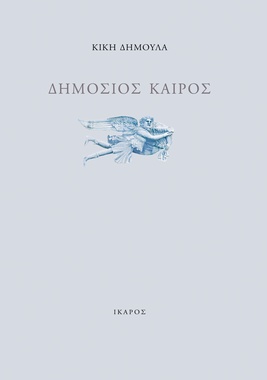
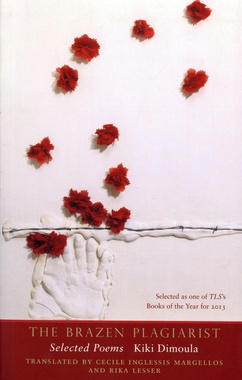
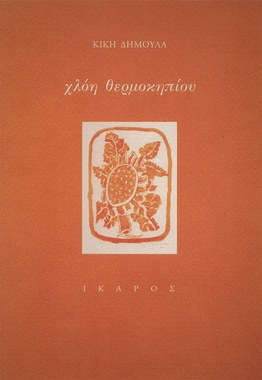
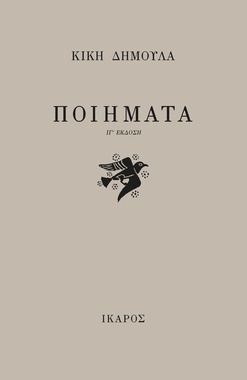
I MUST I keep, Duty, to the best of my ability, your commands the difficult things you require. My thoughts show obedience but I take no oath since they have the freedom to transgress in secret. But my actions, how can I tame them? They go out into the world, encounter neighbours and temptations— how can they not falter? But your commands are to blame too; they are neither complete nor clear. For example: Must love be faithful? And if it isn’t, what are we to do? With our hands tied behind our backs, are we to love?
Author:
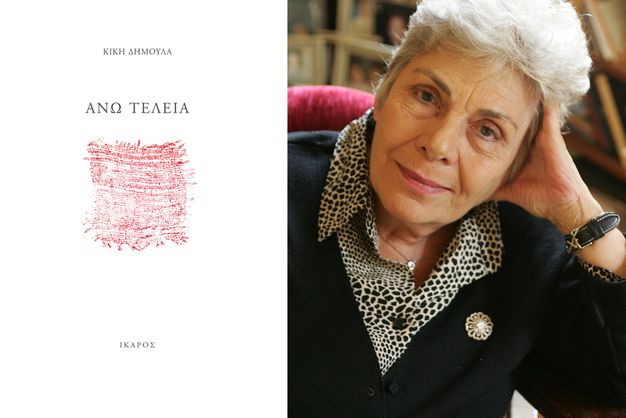
Kiki Dimoula
Cover artwork:
Sotiris Sorogas
Pages:
48
Dimensions:
17 x 24,5
ISBN:
978-960-572-131-2
Publication:
2016
Categories:
Literature, Books, Poetry
"...The poems, then, are all distillations of experience blended with the knowledge of a rich intertextuality. The poet knows her ancestors well and honours them. She strikes the right chords in others, listens intently to the voices she has internalised, and adds her own voice to the chorus of those who, in turn, have gone through the process. Knowledge of the past enriches every younger generation with what it has learnt along the way..."
– Anthoula Daniel, Diastixo.gr"...Kiki Dimoula, with her ‘Semicolon’, brings this poetic year to a close with yet another rich collection. Giving voice and substance to an inner wandering, the great poet, with metaphysical irony, highlights and expands on signpost words such as: ‘I want’, ‘perhaps’, ‘I exist’."
– Petros Golitsis, The Editors’ Newspaper"...This achievement by Kiki Dimoula establishes her as the absolute steward of the soul’s affairs, as a place where truth finally flourishes unhindered."
– Giorgos Veis, Bookpress.gr"...Kiki Dimoula speaks and writes with words, but she knows that their form and sound are always to be transcended, so that the unspeakable may be embraced by the command of silence, so that the words may fall silent within their own sound and emerge into the light of day without the burden of their usage."
– Vasilis K. Kalamaras, Open Library"...In her recent poetic ‘offspring’, Kiki Dimoula, ‘Anotelia’—a poet who, alongside other recognisable and entirely personal expressive building blocks, frequently expands her poems with a wise and, as such, traumatic and unhealed proverbial reflection, resorting to ‘axioms’, as the dense, instantaneous philosophical poetic discourse was also known internationally..."
– Kostas Georgousopoulos, Ta Nea Bibliodromio"...The autonomous, dynamic, unruly words capture, in this collection too, both enduring and fleeting psychological moments, giving form to the existential anguish that characterises the subject of her work throughout her poetic output."
– Despoina Papastathi, oanagnostis.gr"...Almost in a single word, without writing volumes upon volumes, Kiki Dimoula’s poetry combines stories, modes of exposition, pasts, memories, a complete history. She takes on the poetic responsibility of speaking to us. It could not be any clearer, with any greater clarity or precision. It possesses the virtue of narrative development, maintains the sense of the poem’s structure, and, when you read it, you feel that this vessel of poetry which you thought was sailing rudderless has the most suitable helmsman: narrative and structural explanations of life. Always with the tension between temporal and spatial relationships determining the writer’s question."
– Dimitra Pavlakou, Avgi
"...This achievement by Kiki Dimoula establishes her as the absolute steward of the soul’s affairs, as a place where truth finally flourishes unhindered."
– Giorgos Veis, Poetics Magazine
"...Although Dimoula does not write about current affairs, her poetry is nevertheless as relevant as ever. Although she appears to be writing about herself, her poetry concerns us all, transporting us from the personal to the collective: she gathers silences, losses, joys, despair and ambiguities, awakening within us the heavy burden of the human condition. Oblivion and memory do battle. It drains oblivion and brings forth memory. Oblivion abandons memory for the sake of time, which passes relentlessly over it. "
– Dinos Siotis, Kathimerini
"...Dimoula, as wise and lucid as ever, knows that our strength lies in our weakness, that a whisper is our howl, that without a silencer our cry is a hollow melodrama, that by undermining poeticism you serve Poetry, that the spirit dwells in matter, that Nothing contains Everything, that if you do not long to be absent you have no presence..."
– Giorgos-Ikaros Babasakis, LIFO"...One need only read the poem ‘Problem’ and many others from her latest collection of poetry, ‘Full Stop’ – which constitutes a birth with all the characteristics of a firstborn child —to realise the extent to which it summarises her previous poetic output, whilst in such an unexpected way leaving open all possibilities for a continuation as revelatory as the sixty-odd years of her past in poetry. To the extent that another punctuation mark—namely the exclamation mark—takes the place of the semicolon for the reader."
– Thanasis Th. Niarchos, Bibliodromio
"...Borrowing one of her earlier verses, I wrote some time ago that ‘the melancholic wind of life’ runs through all of Dimoula’s poetry. This collection confirms her straightforward maturity."
– Dimitris Daskalopoulos, Eφημερίδα των Συντακτών"...In her latest collection of poetry, ‘Anoteleia’, the poet once again brings personal pain to the fore through a poetic mourning. One of the most distinctive features of Dimoula’s poetry is the poet’s focus on ‘insignificant’ objects and events, which she takes as her starting point and transforms into symbols of life and fate."
– Dimos Chloptsioudis, Tvxs.gr"...Dimoula’s poetry is now a poetry of words, as they are effortlessly expressed, simple words, that is, those that are actually used. So you often find yourself searching within the poem – not just at the end – for a riveting interlude, which often fails to materialise. Perhaps, however, the poet does indeed wish to direct our attention now simply to the words, since, as we read at the end of the collection, word and existence are equated, and we can pronounce the word ‘existence’ ‘slowly, very slowly / as if its syllables were endless’."
– Konstantina Theofanopoulou, Culturenow.gr"...For the _Semicolon_ in Dimoula’s poetry is her own Dantean ‘Divine Comedy’, with Hell, Purgatory and Paradise. Without grandiloquence and with humble materials, without grandiose gestures but breathing. Is this not how life goes on? An everyday Poetry that breathes amidst the established Chaos."
– Eleni Gika, Fractalart.gr"...Thank you for choosing, in these strange times we live in, to express with honesty and clarity, in a simple, unadorned and meaningful way, everything that concerns us. You give us strength, as you still manage to string words together to form phrases full of meaning, which highlight the vagueness of the rules we are often called upon to follow."
– Mary Tsorteki, Artharbour.grKiki Dimoula
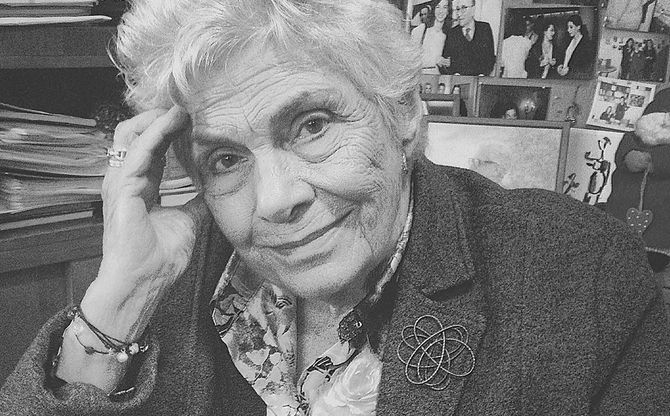
She was born and lived in Athens (1931–2020). She married the civil engineer and poet Athos Dimoulas, with whom she had two children. She worked as a clerk at the Bank of Greece for 25 years. In 2002, she was elected a full member of the Academy of Athens. In 1964, she received an honourable mention from the Group of Twelve for her collection *In the Footsteps*. In 1972, she was awarded the Second State Poetry Prize for the collection *The Little of the World*, in 1989 with the First State Poetry Prize for the collection *Rejoice Never*, and in 1995 with the Academy of Athens’ Ouranis Prize for the collection *The Adolescence of Oblivion*. In 2001, she was awarded the Academy of Athens’ Prize for Excellence in Literature for her entire body of work, and the Golden Cross of the Order of Honour by the President of the Republic, Konstantinos Stefanopoulos. In March 2010, the Association Capitale Européenne des Littératures awarded her the European Prize for Literature as part of the fifth European Literature Meeting. In the same year, she was honoured for her entire body of work with the Grand State Prize for Literature. In 2015, she was awarded an honorary doctorate in Theology from Aristotle University of Thessaloniki. Her poems have been translated into English, French, Spanish, Italian, Polish, Bulgarian, German and Swedish.