News
News List, News Categories, Events
-
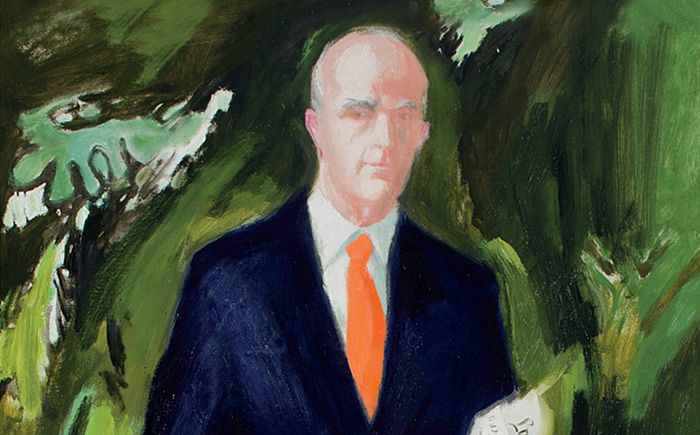
Konstantinos Svolopoulos: Karamanlis 1907–1998 – A Political Biography
The speech by Nikolaos I. Mertzos at the launch of Konstantinos Svolopoulos’s book, "Konstantinos Karamanlis 1907–1998: A Political Biography", which took place on Saturday 26 May 2012, as part of the 9th Thessaloniki International Book Fair. Over the last 35 years, numerous books by many – generally distinguished – authors have been published, dedicated specifically to Constantine Karamanlis and his politics, as well as proceedings of academic conferences and, in twelve volumes, his Archives. Moreover, the Macedonian National Leader features prominently in at least as many hundreds of books and other publications that refer to the public life of the Greeks and the state of Greece between 1955 and 1995. He features sometimes positively and sometimes negatively, depending, of course, on the author’s perspective and the specific time period. One might therefore ask why, after all this and four years after his death, ‘Ikaros’ has published yet another book on Karamanlis this year. The reasons are obvious: in these difficult times, Constantine G. Karamanlis is more relevant and more popular than ever. He is the towering figure of the statesman whom we so desperately need today and whom we so desperately miss. And, because our leadership as a whole has lacked his example, the foundations of the Earth, of our Fatherland, have been shaken, and the very existence of Hellenism is already hanging in the balance. Everything that the Greek people built under his leadership is crumbling.His ethos and his prestige, his frugality and his determination, his integrity and his efficiency, his foresight and his steadfastness, its patriotism and its wisdom are certainly rare virtues, and it is a utopian hope that it would ever be possible for our future political leaders to embody them all with such intensity.Not everyone can be like him. Nevertheless, they undoubtedly constitute a School of Politics that one would reasonably expect today’s politicians to strive, if only to strive, to follow. And, if they could not advance them even a single step in any direction, they had a duty at least not to betray them. For these are not the virtues of a single man. They are the virtues that Greek civilisation has taught us for thousands of years, they are the values our forefathers won with their blood, they are the worldview handed down to us by the Greek centuries, and they are the fundamental principles of the Greek Constitution that politicians swore to uphold faithfully.Times are so dark today, circumstances so erratic, and the Greeks so wounded, so bewildered and so justifiably angry that, it seems, we have forgotten what kind of Greece we built, how and with whom, what we went through, how high we have risen, where we belong, who threatens us and who helps us. What Logic dictates to us. The great merit of this book is that it scientifically X-rays precisely what we have forgotten, what we urgently need, and what, in our bewilderment and anger, we are now gambling away.The title of the book is Karamanlis 1907–1998: A Political Biography. In reality, however, it is an X-ray of a pivotal era that the Great Macedonian National Leader shaped through his actions. It is the era that defined the lives of the Greeks. Karamanlis developed the economy and organised a cohesive society, established a genuine democracy, deepened trans-Balkan cooperation whilst resolutely defending Macedonia, impressively promoted Greek culture, enhanced the quality of tourism, built the country’s strategic infrastructure and integrated Greece into Europe, ensuring the prosperity of the people and national security. The book’s merit is, of course, due to its author. Konstantinos Svolopoulos possesses unique qualifications in this regard: 1. He is a professor of history and has distinguished himself through his work to such an extent that he was elected a member and President of the Academy of Athens. 2. He has been dedicated to historical research since his youth, with a fruitful tenure as director of the Hersonissos Foundation for Research. 3. Young, yet already scientifically mature, he was personally selected by Karamanlis from among many researchers to organise the Karamanlis Archive, a task he carried out in an exemplary manner. For many years, he studied, evaluated and cross-referenced tens of thousands of documents, publishing the most important ones in twelve voluminous, well-structured volumes.4. He founded and directs the Karamanlis Foundation, which also houses the archives of other statesmen, complementing the picture of this eminent statesman and his era.5. By nature, he is gentle, level-headed, moderate and extremely sparing in his descriptions. He does not interpret events: he documents and narrates them calmly. Even more importantly: he recounts the events in their actual, specific historical context so that the reader can assess them in relation to the specific conditions that prevailed at that time – and not later.6. Finally, he lived alongside Karamanlis almost daily for the last 25 years, from 1974 to 1998. He is perhaps the only historian who, before writing his biography, got to know the leader in question and his archives at close quarters. Almost every day he would talk to him, ask him questions, and seek – and obtain – crucial details, explanations and interpretations. He learned first-hand how the protagonist of this book personally explained events to him, interpreted intentions, assessed other key figures, friends, opponents and third parties, and how he himself judged certain initiatives of his, both at the time and later in hindsight. However, Karamanlis’s biography is not an interview with Karamanlis, nor does it uncritically endorse Karamanlis’s views. It is History. And History is not written by the subject of the history. It is written by the historian. These are the reasons why, in this book, Professor K. Svolopoulos records so much and so much of significance in so few pages—a mere 236. A further 30 pages cover the references to sources and the index. This is a remarkable achievement: it requires intense intellectual labour, a complete grasp of the historical era and an in-depth knowledge of the subject being studied.There is a well-known expression: ‘Forgive me for writing so much. I am in a hurry.’ The historian is neither in a hurry nor does he rush history. He works and researches it. This is what K. Svolopoulos did. He did so as objectively as possible and, moreover, wrote it vividly. His narrative flows so pleasantly that the reader cannot put the book down until they reach the very last page. The plot is gripping because it is true and, above all, revealing. And, as you follow it, you feel as though you are actually in an operating theatre where, with a scalpel—his words—the professor makes incisions page by page: He dissects the era, the circumstances, the people, the major interests, the international environment, the politicians, the military, the institutions, the Palace and, of course, Karamanlis himself.The book is so dense and its internal logic so vivid that a brief summary would do its content an injustice and obscure the historical reality. Let us, therefore, briefly touch upon certain key milestones in Karamanlis’s journey through ‘Turning Points’, such as his entry into politics, his departure from politics in 1963, his return in 1974 and his succession in 1981.1. Undoubtedly, the environment in which Karamanlis grew up shaped his character and the central tenets of his subsequent political career: the Macedonian Struggle, his father Georgios—a teacher, a Macedonian fighter and tobacco grower—his village of Kioupkoi, the poverty of the farmers, and the constant Bulgarian raids on the Serres plain mentioned by the author are all significant factors. I believe, however, that all these significant factors were not decisive. Karamanlis was simply born a leader. He was, by nature, a deeply political man; he possessed an infallible instinct for the threats and opportunities of the moment; he was deeply pained by the National Schism; and he loved deeply the humble Greek people whom he longed to serve. He remained bitterly solitary throughout his life, strictly ascetic and a hard worker. He told me in 1977: ‘You don’t order politicians from the carpenter to have them made to measure. They are born. They don’t learn. As a young man, I used to see men constantly fighting to the death in every café over trivial matters, and I’d say, ‘It’s poverty.’ I was wrong. I worked hard to increase our income and, once I’d dramatically raised their standard of living, the brawls got worse. Out of the blue, the Schism reared its head again. Do you think we’re true descendants of the ancient Greeks? How does the Iliad begin? With a quarrel, a fit of rage: the King quarrels with his chief warrior before Troy – ‘Give me Chryseis’ ‘No, take Briseis’ – and the enemy takes them both captive. The Greek disaster over nothing. That is why I worked hard and gave way to anger so that the Greeks might unite. Here I failed.’ Earlier, in 1963, he had written in a letter: ‘Despite my efforts, I have not succeeded in improving political life in Greece, and the worst thing is that I hold no hope of achieving this in the future, given that I have exhausted the scope for moderation and prudence.”Ten years before he was even elected Prime Minister, he dissected with surgical precision the country’s fundamental political problem, which – he believed – was being mutually reinforced by political leaders and citizens alike. A mere Member of Parliament, just 39 years old, on the eve of the Civil War, he wrote, among other things: ‘Our country suffers from an incurable political deficiency. Is any further proof needed of our current predicament? Our leadership has lost its sense of duty to such an extent that it is considered a danger to the future of the country, whilst our people, a people who have always faced their political problems with morbid sentimentality, are already plagued by psychoses. Where can one find reason in this blessed land of ours?’ Sixty-six years on, these words of his are more relevant today than ever. As Prime Minister, he sought to halt and reverse this situation during his creative first eight years in office. However, he was overthrown by the very forces he had described as early as 1946.2. In 1963, the King forced him to resign, rejected his democratic proposal to call immediate elections, and demanded that he hand over his party to another Prime Minister so that the Palace could govern. Otherwise, he threatened him with immediate turmoil. To protect the people from a new schism and to safeguard the constitutional system, and even the King, Karamanlis left for Zurich. These events are indisputable and are revealed by irrefutable evidence in the Karamanlis Archives. Here, Svolopoulos merely alludes to them and clearly ‘softens’ them. They inevitably resurface in the following pages, of course, but are always and everywhere phrased with such politeness that, I believe, it does a disservice to the harsh truth. As an irreproachable historian, however, the professor publishes revealing and ultimately prophetic public statements by Karamanlis. On 28 September 1963, he returned suddenly from Zurich to Athens to campaign for the election and declared, with both bitterness and prophecy: ‘It will be decided whether the free political system will survive in our country or whether the country will be plunged into turmoil with unforeseeable consequences.” A month later, on 28 October 1963, the President of the Council of State, Stylianos Mavromichalis, who had been appointed by the King as acting Prime Minister to guarantee fair elections, was in Thessaloniki for the national anniversary. After the parade, he invites a few journalists to the Government House, makes us promise not to publish anything, and tells us quite openly: ‘I became the bulldozer to get Karamanlis out of the way and clear the path.’The blood rushed to my head; I was 27 years old. I said: ‘Aren’t you afraid that this statement of yours might expose you as an impartial judge?’ ‘I’m not afraid at all.’ ‘Why?’ ‘Because I am a Mavromichalis!’....3. In November 1963, Karamanlis lost the election by a narrow margin and the King appointed Georgios Papandreou as Prime Minister, although he did not have a clear parliamentary majority. Karamanlis withdrew from politics and went into self-imposed exile in Paris. In his farewell letter to the MPs of his party, the ERE, he wrote: ‘My withdrawal from politics is not the result of personal bitterness. The events preceding and following the elections have demonstrated that the country’s political system functions defectively under a regime of coercion. However, politics is not a profession but a mission.’ The die had been cast and very soon the political system would be overthrown. Earlier, on 22 January 1965, Karamanlis had warned in vain from Paris: ‘The principles of Democracy, Morality and Justice are being trampled upon so shamelessly that we shall be led, sooner or later but certainly, into national turmoil’4. In July 1974, following a seven-year military dictatorship and a national catastrophe in Cyprus, Karamanlis returned as a national saviour. He saved the country, established an exemplary democratic system, restored national unity and, within five years, brought Greece into the European Union on equal terms. He confessed and expressed hope: ‘I threw the Greeks into the sea, but they will learn to swim.’ His assessment was wrong. His next mistake was his belief that he had tamed Andreas Papandreou, won his trust and ensured a smooth change of government. Unfortunately, his political successor taught the Greeks to swim in the 220 billion euros of European subsidies and the additional 200 billion euros in loans, to wade neck-deep in corruption and to sell their votes for appointments. He even taught his opponents to imitate him. We are living with the consequences of that today. That is why Constantine G. Karamanlis is more relevant today than ever, and his political biography, penned by Constantine Svolopoulos, more instructive than ever.The public life of that great man may be contained in just 236 pages, but it is an ocean. As far as time allowed, we have gleaned a few, but, I believe, useful and living lessons. May it serve as our guide when, through our vote, we judge the fate of the Nation, the security of the country, the lives of our families and the sacrifices of our forefathers. N. I. Mertzos President of the Society of Macedonian Studies, Journalist and AuthorLearn more
-

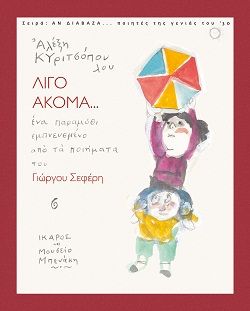
Alexis Kyritsopoulos illustrates ‘LIGO AKOMA’ – a fairy tale inspired by Seferis’s poems
By Eleni Bistika, KATHIMERINI 16/05/2012 Illustrations for children and adults with a pure childlike heart by Alexis Kyritsopoulos and poetry by Giorgos Seferis – a tender fairy tale from Ikaros Publications and the Benaki Museum has arrived at the newsroom to show us how we can rise just a little higher...And how we need this at a time when everything is in flux and time seems to have come to a standstill in a ‘today’ with no ‘tomorrow’. With beloved and creative souls departing, and those of us who remain trying to keep our wits about us and our composure – both of which are difficult...A painter-poet, Alexis Kyritsopoulos has painted with images and words ‘a fairy tale inspired by the poems of Giorgos Seferis’.The result is a gem of a book that can dispel the gloom and set free the eagle of our carefree childhood years, with ‘Just a Little More’ effort to soar a little higher.The cover shows the way – mutual aid, cooperation, perseverance and the eagle, even without a glider, soars high on the wind of companionship...‘“Once upon a time,” a grandfather and grandson in a small boat with its sail folded begin to unfold the fairy tale it holds within: a mermaid in the open sea, sea caves, and a shipwreck, just like at the bottom of Kaldera. The journey continues until, in the grandfather’s garden amidst the wildflowers and the green grasses of spring, the grandson discovers the secret of friendship, which lasts forever, even when the fairy tale ends. Alexis Kyritsopoulos dedicates it ‘to Zoe and Anastasia’.Learn more
-
The Olive Tree
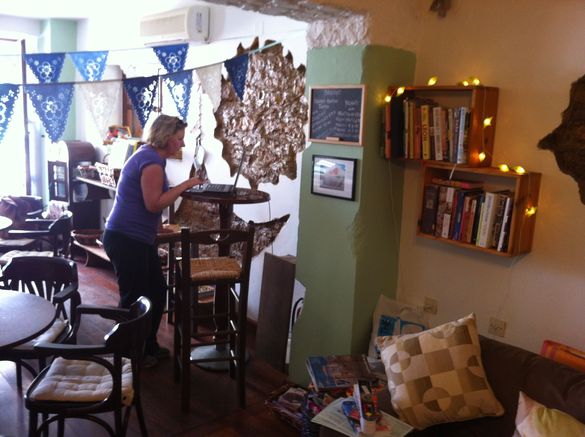
In the village of Symi, 500 steps uphill from Gialos, there is a café hidden away in the narrow streets, called Elia. Janine and Tina, the owners, came to Symi 13 years ago and decided to settle on the island. Elia (or Olive Tree for visitors) is more than just a simple café. It organises guided tours, excursions and photography walks, whilst also offering a range of catering services, including cakes and tarts for special occasions. What struck me, however, were the books. The space is very well-kept and cosy – unlike most tourist cafés on the islands. In every corner, there are books – lots of books. “This is where I keep my favourite cookbooks,” Janine tells me as I browse through them and notice little notes and dog-eared pages on her favourite recipes. Next to us, a tourist from England is using the laptop provided for guests to write to her own family. Next to the sofa where we’re sitting, there’s a bookcase full of children’s books, most of them in English. Out of professional curiosity, I start taking them down one by one, whilst Janine tells us with a smile that if we want, we can play with the Lego in a huge bucket. “I have children and I know what it’s like to have them around whilst you’re trying to have a coffee.” Beneath the stacks of books, there are notebooks and coloured felt-tip pens for budding Picassos. Among the books, I’m delighted to find three or four by Axel Scheffler, whose books we’ve already published at Ikaros. A chocolate cake later, we say goodbye to Janine and head down the wide steps of Kalis Stratas, and I think to myself: Why don’t you see books in shops like this more often? Is it down to the owner? A matter of culture? Arriving at Yialos, passing in front of the tavernas, I count the aquariums...Learn more
-
Karamanlis, an X-ray of a career
By Nikos Vatopoulos, KATHIMERINI 28/04/2012 A biography that is a pleasure to read and offers a wealth of information as well as inspiration for further reading, is the work of the academic Konstantinos Svolopoulos, who has published his study on Konstantinos Karamanlis in Greek. It is a formidable challenge to present a political biography of a man of K. Karamanlis’s stature in just 250 pages, but it is precisely this density of expression that lends the reading vigour and intensity.It is a classic biography, that is to say, one that begins with his birth and ends with his death. If anything characterises historian Konstantinos Svolopoulos’s work above all else, it is his adoption of scientific methodology, which excludes the mediation of hindsight and adheres to the narrative of historical time.Of course, Konstantinos Svolopoulos is a man who knew Karamanlis personally and is himself the founder and, since then, general director of the Konstantinos Karamanlis Foundation. The reader can detect between the lines a certain ‘warmth’ of familiarity with the man and an understanding of his environment. However, one cannot say that there is any subjectivity. What is of particular interest is the emphasis K. Svolopoulos places on the wider context.I particularly liked the many references to the Macedonian issue, which is also linked to Karamanlis’s childhood experiences (let us not forget that when he was born, in 1907, Macedonia still belonged to the Ottoman Empire), his early years in Athens in the 1930s as a young lawyer, the analysis of his character, his asceticism and his obsession with ideals, his need to serve, his belief in political stability, and his ambition in the 1950s to lift Greece out of underdevelopment and anchor it to Western Europe. The narrative reaches its conclusion. It is interesting that K. Svolopoulos emphasises Karamanlis’s study of the ancient Greeks, from whom he was influenced on fundamental issues of political philosophy. This occurred mainly after 1963 and during his years in Paris. Karamanlis believed that Greece might not be able to compare with the wealthy countries in terms of economic size, but that it was fully competitive in terms of its culture. It is telling that, during Karamanlis’s first term, Pikionis was commissioned to redesign the area around the Acropolis. The transition to democracy, accession to the then EEC and the period of the presidency are also analysed, as are relations with A. Papandreou. One has everything to gain from reading this book. Konstantinos Svolopoulos, ‘Karamanlis, 1907–1998. A Political Biography’Learn more