News
News List, News Categories, Events
-

Upcoming Releases | September – December 2016
We are welcoming autumn with a host of important books for readers of all ages. Read on for more information about the titles we plan to publish by the end of 2016.GREEK POETRYThe World, Small and Great by Odysseas Elytis, set to music by Giorgos Kouroupos Edited by: Ioulita Iliopoulou To mark the 20th anniversary of the death of Odysseas Elytis, a special anthology of the poet’s poetry and prose will be published in five languages (Greek, English, French, Spanish, Italian). Poems and excerpts from Odysseas Elytis’s prose are presented alongside his photographs and artwork. The publication is accompanied by 2 CDs containing all the texts from the book, some recited and others set to music by Giorgos Kouroupos. Kiki Dimoula: Semicolon Kiki Dimoula’s new collection of poetry.Yannis Antiochos: Dissolution Yannis Antiochos’s new collection of poetry. GREEK PROSE Dimitris Nollas: Stories Are Always Foreign (Short Stories 1974–2016)The book includes all of the author’s short stories from 1974 to 2016. Specifically, it contains the collections: Polyxeni (1974), Tender Skin (1982), I Dream of My Friends (1990), The Blurred Windows (1996), The Old Enemy (2004), In the Place (2012), and three further short stories published in anthologies. The volume is supplemented by an extensive afterword by Titika Dimitroulia.PHILOSOPHYChristos Giannaras: Ontology of the PersonChristos Giannaras: Attempts at Ontological InterpretationFOREIGN PROSEAnthony Marra: The Tsar of Love and TechnoTranslation: Achilleas KyriakidisFrom Leningrad in 1937 to Siberia in 1999, and from Chechnya in 2000 to present-day St Petersburg, perhaps the most significant novelist of the youngest American generation, Anthony Marra, has penned yet another gripping journey through time and history, at once heart-wrenching and witty, tender and violent, following in the footsteps of his multi-award-winning *Constellation of Vital Phenomena*.A mural-like novel written in nine short stories that span the history of this vast and long-suffering country, featuring characters, images, and even objects that move from story to story to form a hidden fictional universe, with the spectacle of a mosaic, yet the coherence of a novelistic narrative.Colm Tóibín: BrooklynTranslation: Athina DimitriadouIn the 1950s, in a small town in south-east Ireland, Ellis, a girl from a poor family, like many others, struggles to find work. As soon as she is offered a position in North America, she accepts it without hesitation. This decision takes her to Brooklyn, where she patiently builds a new, happy life, leaving behind her frail mother and her charismatic sister. But her past will soon call her back, forcing her to choose between her homeland, her family and love.With restraint, skill and exceptional emotional insight, Colm Tóibín, one of the finest Irish writers of our time, has crafted a compelling story about destiny.From the author of the novels *The Testament of Mary* and *Nora Webster*. *Brooklyn* was adapted for the big screen a few months ago, with a screenplay by Nick Hornby and directed by John Crowley.Canek Sánchez Guevara: 33 Revolutions (33 revoluciones)Translation: Achilleas KyriakidisCanek Sánchez Guevara’s 33 Revolutions is like a vinyl record with 33 tracks, through which we hear the daily routine of a bureaucrat on a Caribbean island.Our hero is separated from his wife and spends most of his time in the company of a Russian neighbour, through whom he discovers the joy of reading. The books he reads gradually broaden his horizons, whilst the grey and corrosive reality surrounds him: the office routine, the daily complaints—big and small—from colleagues, his own obsessive thoughts spinning like a broken vinyl record.Every day he observes the incredible outbursts of dissent in the streets and witnesses the sad spectacle of young people leaving the island in makeshift vehicles, whilst at night he suffers from Kafkaesque nightmares in which he is arrested and put on trial for no reason.His real problems, however, will begin when he declares his unwillingness to become a state informant.The 33 Turns is a candid and moving story about the disillusionment of a generation that believed in the ideals of Castro’s revolution, as well as a unique insight into the lives of ordinary people in Cuba over the past few decades. Alejandro Zambra: The Private Life of Trees (La vida privada de los árboles)Translation: Achilleas KyriakidisThe Private Life of Trees recounts the story of one long evening: Julian, a professor of literature, reads to his stepdaughter Daniela whilst waiting for his wife Veronica to return home. Every evening, Julián tells Daniela stories about the private life of trees, and every Sunday he devotes time to writing his novel. None of this changes today. As Julián realises that his wife will not return, he recalls their life together to date and imagines Daniela’s life as she grows up—at 20, at 24, at 30, without a mother—and wonders what she will think of his book. In a world on the brink of collapse, why does Julián choose to read and write books? This question haunts the pages of The Private Life of Trees, steeped in nostalgia and melancholy.Yet another novel that confirms Alejandro Sabra as one of the most remarkable writers of the younger generation. NON-FICTION Erik Larson: Dead Wake (Greek title to be announced) Translation: Katerina SchinaThe gripping story of the sinking of the Lusitania.On 1 May 1915, with the First World War already in its tenth month, the Lusitania, a luxury ocean liner, set sail from New York bound for Liverpool, carrying a large number of passengers, including many children and infants. Despite the fact that Germany had declared the seas around Britain a war zone, the liner’s passengers did not believe they were in any danger, as for a century civilian ships had been kept safe from any attack. For months, German submarines had been sowing terror in the North Atlantic, but the Lusitania was one of the finest and fastest transatlantic liners of the era, known as the ‘Hound of the Seas’.Germany was determined to change the rules of the game, and Walther Schwieger, captain of the submarine U-20, was ready to rise to the challenge.In Dead Wake, Erik Larson, in a manner that captivates the reader, examines the sinking of the Lusitania by U-20 and the events surrounding the wreck, bringing to the fore the lives of a host of formidable characters, he paints a sweeping portrait of America during the progressive era.CHILDREN’S BOOKSAntonis Papatheodoulou, Myrto Delivoria (Illustrations): Tick tock. Clocks, time for a lesson!It’s hard to learn to tell the time. It’s even harder to learn how clocks tell the time. In this new, hilarious book by the two creators, time and the relationship between the teacher and their pupils are presented from a different perspective. Wasn’t it about time for a book like this? Jannie Ho: Our friend Rosie and the nursery Translation: Filippos MandilarasA wonderful activity book with 3D cut-out figures for creative children.Rosie is a teacher at the nursery in Foteinoupoli and she loves teaching the children new things. Can you help her take the register, make a clock so she can teach the children the time, become more creative in the classroom and, finally, organise a very special exhibition? Tracey Corderoy, Tim Warnes: Now!Translation: Filippos MandilarasArchi has absolutely no patience. There are so many things he wants to do every day. And, of course, he wants to do them... NOW! It’s the perfect story to share with impatient little children who want everything... NOW! Mary Hoffman, Ros Asquith: The First Big Book about Families Translation: Antonis Papatheodoulou There are families that are big, small, happy, sad, rich, poor, quiet, noisy, angry, cheerful, stressed or relaxed. Most are a bit of all these things at times. How is yours today? The first major book on Families, with humour and sensitivity, explores the various forms of the family today and provides a wonderful opportunity for discussion between young and old. Rebecca Jones: Colouring Cards and Envelopes – NATUREA book for all ages containing 24 cards, envelopes and stickers!Grab your crayons and felt-tip pens and colour the pages of this book in the most amazing colours. Create unique cards and envelopes with a NATURE theme and give them to your friends and family.CHRISTMASJulia Donaldson, Axel Scheffler (Illustrations): The StickmanTranslation: Filippos MandilarasThe Stickman has lived in a tree for a very long time. There, he is kept company by his wife and their three children. But it’s dangerous being Stickman: a dog wants to play with him, a swan wants to build a nest with him, and much more... He even ends up in a fireplace, ready to catch fire! Will he manage to find his way back to his family and his tree? Another highly successful book by the two award-winning creators. New York City Ballet-Valeria Docampo: The NutcrackerTranslation: Antonis PapatheodoulouThe Nutcracker, the classic and much-loved fairy tale, is presented for the first time based on George Balanchine’s production for the New York City Ballet.It is Christmas Eve and Mary, beneath the moonlight and the soft glow of the Christmas tree, falls into a deep sleep, embraced by her beloved Nutcracker. The magical dream she is about to have will lead her to discover true happiness in the distant world of the Land of Sweets!The story of this beautiful book, which has remained unchanged over time, follows the choreography of the famous ballet, and its illustrations are inspired by the actual sets of the production, which is considered the best in the world.Do you believe in The Nutcracker? Rebecca Jones: Colouring Cards and Envelopes – CHRISTMAS A book for all ages containing 24 cards, envelopes and stickers!Grab your crayons and felt-tip pens and colour the pages of this book in the most amazing colours. Create unique Christmas-themed cards and envelopes and give them to your friends and family.Learn more
-

Interviews
Eftychia Giannaki: Interview on In.gr
Eftychia Giannaki answers questions from Georgina Doutsi of in.gr, to mark the release of her crime novel *In the Back Seat*. The interview concludes with the author’s ten commandments for a good crime novel. The interview is republished here:In the Back Seat is the title of your new book and forms the first part of the Athens Trilogy, starring Inspector Haris Kokkinos. What plot unfolds in your new book and what themes are you exploring in it?A film director is found brutally murdered in the basement of the Plakas Theatre, and Inspector Haris Kokkinos and his team are introduced to readers through a case in which they will need to unravel a web of shared secrets, cover-ups and violence in the heart of modern-day Athens. At the same time, the son of the forty-five-year-old Inspector is arrested on charges that force him to delve into his own family history. The pressure of time and the silence of the silent will prove that things are never simple for those who found themselves in the back seat. In a society where everyone is guilty, some will be called upon to pay the price, including Haris Kokkinos, whilst the interrogations paint a portrait of the people of Athens who feature in the story.The themes that concern me most are the veiled violence that goes round in circles, collective guilt, the past and what we think we have left behind, shared secrets, superficiality, the simplicity of everyday things, humour in the face of the abhorrent, and our fears as they unfold within the familiar setting of a city that is not merely the backdrop to the crime story, but its very essence. How did the book’s title come about, and what does writing or reading a crime novel offer you? The book’s title is inextricably linked to the essence of the plot. We have all sat in the back seat as children, and some will find themselves there as suspects. The connection between a criminal act and the past, and the search for its causes, forms the core of this particular story.When writing crime novels, I like to create situations of fear in order to bring the fears of everyday life under my control and, ideally, to confront them. I believe this is the pleasure of the crime novel. And it is the same whether you are writing crime novels or reading them. The plot unfolds against the backdrop of modern-day Athens, in a familiar society full of stereotypes and taboos. What image does Eftychia Giannaki have of the Athens where she lives and works? Athens is my city, and particularly the city centre where I live and work, and I would say that it is not merely the backdrop to the story. Anyone who reads the book will see it come to the fore on many occasions.My interest in the city and its inhabitants, as well as its evolution over time, reveals nothing other than my determination to understand the changes undergone by a structure that in recent years seems to be shaking to its foundations. It is a time when the certainties of the past are being shaken, lawlessness and chaos are ever-present, and the prevailing rule seems to be that no rule is observed. In this sense, I believe it provides an ideal setting for the development of a crime story. Crime fiction is a popular and much-loved genre among readers worldwide. Why do you think readers are so keen on devouring this kind of novel? Don’t we read about plenty of murders and acts of violence in the daily news? I believe that crime fiction is the narrative that sheds light on the things we avoid looking at in depth in our daily lives. News coverage of these issues and the speed with which they change often leave us bewildered and full of questions, and it is these questions that usually seek answers in a crime novel.The seriousness of a crime narrative is often questioned, and for many years it was regarded as light reading. I am among those who believe that the development of this genre in recent years manages to reflect the social, psychological or even philosophical dimensions of a story in a direct way, a fact which, in my view, makes it popular with readers worldwide. ‘How likely is it that you would murder someone, rather than kiss them? wondered Inspector Haris Kokkinos”, allow me, in turn, to pose the question contained within the book... If I did not believe it to be highly likely, I would not be writing crime fiction. I believe that, potentially, we are all perpetrators and victims under certain circumstances. And it is precisely this possibility—of finding ourselves in one position or the other—that is tested when reading or writing a crime novel.What is the ‘formula’ you follow when writing a crime novel? My formula, if I may call it that, is that I try to create something I would find interesting to read. Because I don’t have the full plot development in mind from the start, it’s like playing a game of chess against myself, page by page, chapter by chapter.Do you read Greek crime fiction? I read both Greek and foreign crime fiction, and I feel that in the future Greek crime fiction may produce significant works, given that the conditions in which we have been living as a country in recent years, conditions of instability, insecurity and lawlessness may well provide fertile ground for reflection and the development of crime stories. So what else will The Athens Trilogy include, and when can we expect the next two books?That is a closely guarded secret, a puzzle I am currently trying to solve whilst preparing the second story featuring Inspector Haris Kokkinos.As for the timing, I believe that Ikaros Publications’ response will not disappoint even the most impatient readers.”&The ten commandments of a good crime novel, by author Eftychia Giannaki: It is important to have a clear central idea that captures the essence of the plot and the reason why the story is worth telling or reading. The characters, both main and secondary, must be well-rounded, so that the reader feels they are people one might encounter in real life, rather than fabrications or caricatures.&The plot must be interesting and convincing in its development. Ideally, it should be so compelling that the reader cannot put the book down. The atmosphere, the setting and the backdrop must be presented in a way that makes the circumstances surrounding the crime and the resolution of the case understandable, thereby enhancing the development of the story. The methods used to solve the case must be convincing and stand up to the scrutiny of an intelligent reader familiar with police mysteries. The social, psychological and philosophical implications of the story must be presented in an accessible manner, without the reader feeling that the action is being slowed down. The balance between lightness and gravity in the narrative, and even humour in the face of the abhorrent, can illuminate a crime story in a unique way and, in my view, should be sought. The solution should not come about by coincidence or through a deus ex machina, whilst the motives must be thoroughly justified The reader’s way of thinking and moral compass must be put to the test, as they are called upon to provide answers to complex issues or dilemmas. Upon closing the book, the reader should feel that they would like to read another book by the same author.Learn more
-
Mr Yannis Metaxas wrote in To Vima about Ikaros’s children’s books.
Mr Yannis Metaxas, professor emeritus at the University of Athens and full member of the Académie Européenne Interdisciplinaire des Sciences, on the occasion of Axel Scheffler’s children’s book *The New Friend*, the new story of the beloved characters Tic and Tela, for young and old alike, takes a look back at the children’s books published by our company with this lovely piece he wrote for the Sunday edition of the newspaper To Vima (published on 31 July 2016).We are republishing the text below: A children’s book, then! By Axel Scheffler. Which, along with some other equally appealing titles, is available from Ikaros Publications. So that children can fly away with them. Little Icaruses. But what is a children’s book? More precisely, what can it be? First and foremost, it is an object (before its words and its pictures). A thing to look at, to touch, to smell. But also to hear! Don’t some books, as they open—especially the first time—make a faint, unfathomable sound? Something like a soft rustle... the softer ones? Something like a crunch... the sturdier ones? Memories that return later. And sometimes, right through them, one remembers that book. Benji Davies’ *The Little Bear Goes on Holiday* may be one of them, with words wonderfully rendered by F. Mandilaras, though here the eyes are guided by the fingers. Tik and Tela, the New Friend tells us how friendship is born. Without words. But with innocent words, it is bound together afterwards! This book, an example of tangible aesthetics, has a texture that creates a special bond with little hands. Its cover, a little cushion, removes any resistance to picking it up. And the book fits in effortlessly. What subtle things can these books from Vouli Street teach us? Through their shapes: the square, the rectangle, the friendly curves? A lesson in flexibility, an unconscious opposition to the absolute rigidity of often brutal verticality. Oliver Jeffers’ book *How to Catch a Star* is a feast! It will leave the child with the Cavafian suspicion that whatever you desire from the heavens, you may find it on earth, provided, of course, you are willing to search for it. Is there not an Odysseus lurking here? Is it easy for a child who has loved such books to later seek out something aesthetically inferior? What do you think? I just wanted to say a few words about all this. And thank you. Mr Yannis Metaxas, professor emeritus at the University of Athens, is a full member of the Académie Européenne Interdisciplinaire des Sciences.Learn more
-
Interviews
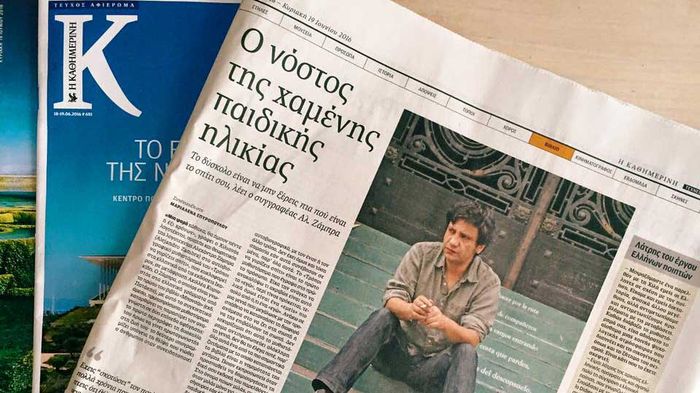
The nostalgia of lost childhood; an interview with Alejandro Sabra in Kathimerini.
To mark the publication of Alejandro Sabra’s book *Ways of Returning Home*, Marialena Spyropoulou spoke with the Chilean author in a very interesting interview for the newspaper Kathimerini, which was published on 18 June in the Arts and Letters supplement. “I got lost once, I must have been five or six years old,” writes the Chilean writer, poet and literary theorist Alejandro Zambra in his autobiographical novel Ways of Returning Home, published in Greek by Ikaros Publications, translated by Achilleas Kyriakidis. Zambra, who is known in Greek literary circles from his first book, *Bonsai*, manages with this moving, direct, first-person novel to draw the reader into two narrative levels: the first describes the protagonist’s struggle to take centre stage in his own life; the second subtly underscores the sorrow a person feels when they realise they cannot return to what has ultimately been lost forever. – In your latest book, an earthquake – both real and symbolic – shakes the protagonist’s memory. What are the internal and emotional ‘earthquakes’ an adult needs in order to ‘return home’?– We grew up with the idea of an earthquake. My grandmother used to tell us bedtime stories about the people who died in the great earthquake of 1939. When it happened again in 1985, I thought, ‘So this is what an earthquake is like’. I feel that earthquakes shape your sensibility in many ways. You come face to face with the feeling that everything can be destroyed in an instant; that changes your life. And it gives you a sense of fragility. Since then, I can’t imagine the world as indestructible. – What was your childhood like? Is the book autobiographical? – I think all books are autobiographical, in one way or another. But it doesn’t really matter whether these things happened to me, after all. Ways of Returning Home is the first novel I wrote in the first person. I felt the need to discover exactly what this ‘I’ is, what it’s all about, but ultimately it’s more of a ‘we’ than an ‘I’. I belong to a generation that grew up trying to understand the difference between living in silence and having silence imposed upon them. I’m not claiming that this novel represents the entire generation—I would never say that—yet one of the most important issues the book grapples with is the legitimacy of memory. Whom do you represent when you try to create your own version of the past? In whose name do you speak, even when you speak only for yourself? I’m not sure if I had a happy childhood, but I certainly wasn’t unhappy. And I was growing up during the most dreadful years of our national history. Whilst I was more or less free, hundreds of my compatriots were being murdered and tortured, and Chile was surrendered to the most savage form of capitalism. This realisation, which came during my adolescence, reshaped my memories. In other words, suddenly all my memories turned bitter. And the very act of remembering became bitter. The intensity of poetry – You are also a poet and a professor. Your grandmother used to ‘whittle out’ little verses. Yet you have written that you feel uncomfortable with your poetic nature.– I have loved words since I was a small child. I loved storytelling too, but I think I gradually discovered stories I wanted to tell. I’m not the ‘let me tell you a story’ type. Besides, I don’t believe in themes. In that sense, I proceeded as a poet. On the other hand, I’m not sure whether there are boundaries between prose and poetry, or what they might be. – Why do you consider poetry more important than fiction?– That’s purely a matter of intensity. Poetry appealed to me more as a reader, of course. And when I was twenty, writing novels seemed boring... spending hours in front of the computer...– You once said that you’re always looking for that moment when you’re not sure about what you’re doing... – I firmly believe in that. I don’t treat writing as a matter of me saying something the other person already knows. When you write, you might have a few ideas, but as the writing progresses, you lose control. I like the moment when I catch myself not knowing what I’m doing, but on the other hand I know that I’m doing something. I start with an image and try to develop it like a small sculpture. There’s already something there, and you work on it until you discover it. – Do you find it difficult to write or finish a book? You’ve said that books are born as soon as they’ve moved beyond you. – I wouldn’t call it just difficulty. There are, of course, many pleasant, good moments as well. Even when you’re writing about painful things, you experience a sense of fulfilment, or the illusion of it. It isn’t always consciously pleasant. It’s hard for me to accept that a book is finished. My Spanish publisher, Jorge Herralde, teases me because I’m very good at making last-minute changes. But as soon as the book is published, I forget about it and move on. Pinochet’s Chile – You grew up during the Chilean dictatorship. You describe the feeling of playing a secondary role on the stage of your own life. What is your life like today? – It took us a long time to feel like protagonists in our own lives. We grew up with parents who claimed the experience and legitimacy of History entirely for themselves. That is difficult to deal with. But now we are the parents. And I’m interested in the transition. That is precisely what the novel *The Private Lives of Trees* and the poetry collection *Facsimile/Multiple Choice* deal with. I insist on the shift, on the transition from the singular to the plural. Everything there is caught up in this oscillation. – You write about memory. The memory of your generation. What is the specific psychological and political context of this generation? – These are the questions I ask myself, and I can only answer them by writing a novel! I consider Ways of Returning Home to be a novel about dealing with the past, in various ways. It is not just a matter of ‘killing the father’. It’s mainly about the fact that you’re no longer 20 years old and you ‘killed’ your father many years ago, and you discover that you want to bring him back to life, and that’s not possible. You want to go home and you don’t know where home is.– Every novel is a letter to the world. What sort of letter did you send? – I have no idea... The idea of being translated is something that fascinates me. I do feel, however, that I sent a letter. Writing is the ability to share and to lose. I love Emily Dickinson’s poem: ‘This is my letter to the world, which never wrote to me...’ but ultimately I can’t help but see how lucky I am. I’m in touch with so many people, and I read everything my readers write to me and feel devoted to them all. A lover of the work of Greek poets – we Greeks share a past with Chile when it comes to poetry. We too had a dictatorship, albeit on a different scale, but we have faced and continue to face problems with transitions. As I was reading your novel, I had a subtle sense of a shared psychological atmosphere that pervades the families, as well as the issue of the earthquake. Is this something you have considered? – I am a devotee of ancient Greek prose and I am very fond of modern Greek poetry, with which I am well acquainted. I studied under Miguel Castillo Didier, a great teacher, who is arguably the greatest translator of Cavafy. He has also translated Seferis, Ritsos, Elytis and Kazantzakis. I know these works in Spanish translation inside out and I adore them. Cavafy’s ‘God Has Forsaken Antony’ is one of my favourite poems. When I was 21, I wrote my own version of this poem for a tribute to Cavafy. Castillo Didier asked young poets to contribute, so I wrote something for him and he translated it himself. I don’t know what became of that poem, but now that I think about it, the first language into which any of my work was ever translated is Greek. I’m not comparing the two national histories, although I do believe, unfortunately, that we have things in common because of the political violence we have experienced.Learn more