News
News List, News Categories, Events
-
Interviews
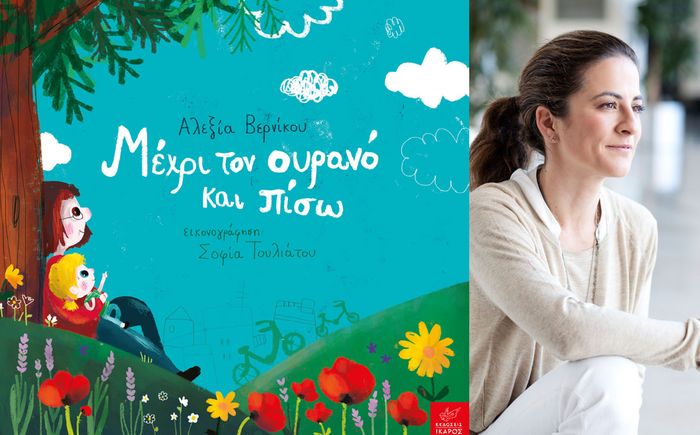
Alexia Vernikou: ‘The good always win’.
To mark the release of her first fairy tale, ‘To the Sky and Back’, Alexia Vernikou gave an extremely interesting interview to Alexandra Papadaki and All You about loss, coming of age and the little moments in life that make it so beautiful.You can read it below: If you have a young child, you’re sure to be familiar with the My Playce pre-school centres co-founded by Alexia Vernikou, and you’ll have read her articles on psychology and parenting advice. The latest venture of this multi-talented mum of two girls is writing, and her first book, *To the Sky and Back*, tackles a difficult subject: loss, which affects us all, parents and non-parents alike. I read your (wonderful) book to my 9-year-old daughter Ioanna and immediately... it went on the shelf and never came off again. She didn’t want to read it again. She just shook her head as if to say, ‘I know, but don’t tell me any more’. Having only two grandmothers, whom she loves ‘to the moon and back and three somersaults’, she refuses to talk about death. It’s a difficult subject. Tell us about it. Clearly, the subject is difficult (perhaps the most difficult) for both children and us adults. Nevertheless, it is part of our lives, and however much we want to avoid it, we cannot. So, as parents, it’s important to give children the chance to ask us questions on the subject without pressuring them. They need their own time and space to process it. So, Ioanna did the right thing by putting it back on the shelf, as she didn’t want to talk about it right now. When she’s in the mood, or when she needs to deal with it, she knows where to find the book and the answers she needs. I get the feeling that although your book is for children, it’s actually aimed at us adults. To us who are growing up now that no one calls us ‘my child’ anymore. Am I wrong? It started out as a children’s book, but along the way I realised it’s a book that really moves adults, precisely because we know how much this loss hurts. The child’s grandmother is our own mum, and in her eyes we are always children. With her passing, our own coming of age usually follows, and that is when nobody calls us ‘my child’ anymore. You were trained in the Merimna programme for managing loss and grief in children and adolescents. At the recent launch of your book, the proceeds from sales supported Merimna’s work. Tell us a little about your relationship with the association and what we should know about it. Merimna is a non-profit organisation that provides support to children and adolescents facing a serious illness or the death of a loved one. It deals with the management of loss and grief, both by supporting families and by training healthcare professionals. It has been operating since 1995 with counselling centres in Athens and Thessaloniki and is the only organisation in our country dedicated so comprehensively to this cause. Grief management is a subject that touches me both personally and professionally, which is why I decided to become a ‘friend’ of Merimna myself and support their work. You are involved in writing articles, so we can now call you an author as well. How did this new chapter in your life begin, and how do you plan to develop it? I’ve loved writing since I was little, so the articles and the book came as a natural progression. I’d like to write more children’s books because I have plenty of ideas, but also a book for parents on topics relating to children.A particular comment you’ve heard or read about your book... I feel lucky because the book was quickly loved, as was evident from the reviews and the emotional response it has generated. The nicest comments, however, have come from the children in the form of questions about Elli and her grandmother, life and love. What did your daughters say to you about the book?Both Nefeli and Amalia were delighted that their mum had written a book. They told me it was ‘a bit sad but also a bit happy’ and they were thrilled with the illustrations. As for the subject matter, it’s something both of them have brought up for discussion, and it seems that the answers they’ve found in the book are (for now) comforting.I remember when I was little and realised that my beloved grandmother was going to die; I avoided seeing her, as if I wanted to rid myself of her sweetness so that the loss would be less painful. How did you cope with your grandmother’s death? We often see this reaction in children, namely avoiding something they know will upset them. It is, after all, a way of protecting themselves, and (fortunately) they know how to do it very well. When I lost my own grandmother, I felt (and still feel) just like Ellie. I was heartbroken, I was angry, and the loss was immense. I missed her terribly and I still do, but I have kept the sweetest place for her in my heart and I carry her with me through all the good times...What prompted you to study Psychology and Art Therapy? When I had to choose what to study, I knew there were two things I loved: children and art. My studies back then and my work today allow me to combine both and enjoy what I do. To become a psychologist and deal thoroughly with other people’s problems, must one first have resolved one’s own? I would say that they need to be at peace with themselves. We humans are a ‘work in progress’, constantly evolving and learning to manage and resolve our problems and difficulties.What are your fondest childhood memories? Summers in Corfu. With those long barefoot days, the carefree atmosphere, the family, the endless children and the sea. You have co-created the MyPlayce pre-school centres. What do you think the children and parents gain from them? A space they trust, where they can get dirty, experiment, dance, climb, cook, share, learn and play. All of this in a way that is creative for them, relaxing for their parents and enjoyable for everyone. In your years of working as a parent counsellor, if you had to single out just one piece of advice for parents, what would it be? I firmly believe that we must tell children the truth. Whatever the question, whatever the subject. Always taking into account their emotional and developmental stage. What is the biggest mistake we make with our children? All parents have made, are making, and will make ‘mistakes’ because we too are growing and learning alongside our children. If I had to single out one thing, I would say that today’s parents struggle to set boundaries. They struggle to say ‘no’ and struggle to remain consistent in what they ask of their children. This confuses them and ultimately causes insecurity in the children. I suppose you’re in high demand among groups of parents because of your role (they ask for advice, tell you their problems, etc.). Or do they perhaps avoid confiding in you, preferring to bury their heads in the sand? I imagine both happen. As parents, we tend to sugar-coat situations, and this may lead us to bury our heads in the sand. However, there are many times when the exact opposite happens, and so I often hear the phrase ‘I’ve got a question for you...’. When should we seek help from a psychologist for ourselves or (and) our children? When and if we feel the need to do so. It’s not compulsory, but it’s important to know that we can if we wish to. A parent’s instinct is very strong, and it’s important to listen to it. Both in matters concerning ourselves and in matters concerning our children. What is the greatest truth you’ve heard from your children, Nefeli and Amalia? That... ‘the good always win and our good deeds make us feel good’. It has pretty much become our family motto. The best moments of the day with your daughters... When they wake up and just before they go to sleep. When we read fairy tales, when they tell me their news from school, when we draw at the easel, when they burst out laughing, when we get up to mischief together, and when they hug each other...Living in a constant hubbub, with lots of people and lots of children’s voices, do you occasionally long for complete isolation? For not even picking up your ringing mobile? Very often. And when I feel the need, I do it. I switch off my mobile, pull down the shutters and find the peace within me. ‘From a young age we learn to lose; loss could be our cradle; you can’t have it all; the first phrase we learn’. Lyrics by Gerasimos Evangelatos, performed by Natasa Bofiliou. Do you find truth in them? Of course. We encounter loss early on, and not just in the form of death. That is why it is important to learn to deal with it. What great thing have you discovered about life so far? That it is beautiful. And that it is all the little moments, which cannot be shared in words, that ultimately make it so beautiful.Learn more
-

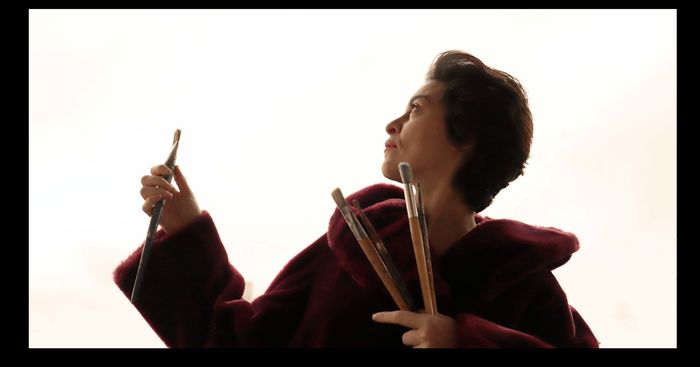
Maria Protopappa plays the Colombian painter Emma Reyes.
‘I paint ordinary people on the street. My paintings are like silent screams, full of colour. The monsters that emerge from my hand are people, gods or animals, or a bit of all of them together.” Maria Protopappa’s ‘EMMA’, an adaptation based on the book Memories by Correspondence (trans. Maria Palaiologou), written by the Colombian painter Emma Reyes at the urging of Gabriel García Márquez, is being staged from 27 February at the Second Stage of the Kefallinias Street Theatre, for 10 performances, every Monday and Tuesday. The theatrical world of ‘EMMA’ appeals to the senses, not the mind. It is a three-dimensional painting or a song in prose. Through the eyes of a four-year-old child, it brings to life early 20th-century Colombia, within an atmosphere of Latin American mysticism and Catholic austerity. It is inspired by the life of a female Oliver Twist who, through her courage, innocence and unbridled imagination, managed to survive in harsh conditions, travel the world and excel in Europe as an artist.-Who showed you love when you were a child? -I don’t remember us having such worries...The legend of ‘Emma Reyes’ was born in Bogotá in 1919. She grew up without parents or an identity. She died in Bordeaux, France, in 2003, aged 83, from an unknown virus.Her writing is oral and unpretentious, as she was illiterate: “I value what you have lived through more, and what you have read much less.” Contributors Adaptation-Performance: Maria ProtopappaTranslation: Maria PalaiologouDramaturgy Consultant: Kitty PaitazoglouSet Designer-Costume Designer: Maria PanourgiaLighting-Photography: Sakis BirbilisMovement Supervision: Mariela NestoraCostume Making: Paraskevi ProtopappaSet Construction: Another Kind Of Art Production: Kart ProductionsInfoSecond Stage of the Kefallinias Street Theatre18 Kefallinias Street, KypseliInformation – bookings: 2114117878Performance dates and timesFrom 27 February, for 10 performancesMonday and Tuesday at 21.00Find out more hereLearn more
-
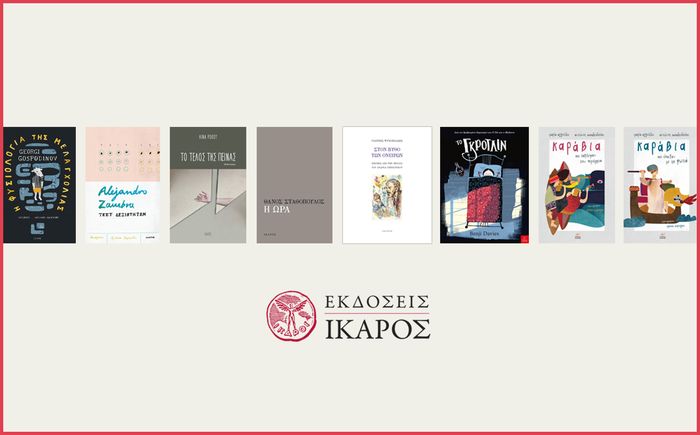
Upcoming Releases | February – June 2018
Ikaros Publications has a number of significant books due to be released over the coming months. Read on for detailed information about the titles we plan to publish by summer 2018:GREEK POETRY Yannis Efthymiadis: Patrida Yannis Efthymiadis was born in 1969 in Piraeus. He studied classical literature and undertook postgraduate studies in ancient Greek drama. He has published five collections of poetry (Stigma, privately published 2004, Kainos Diaretis, Nefeli 2007, Letters to the Prince, Mikri Arktos 2010, 27 or The Man Who Falls, Mikri Arktos 2012, On Your Body, Little Bear 2014) and a literary essay (12 Conversations with Odysseas Elytis’s Monogram, Kalligraphos 2014). He has translated English and American poets. His poems have been included in Greek and international anthologies and have been translated into English, French and German, whilst the cycle of poems The Crystal of the World (Metronomos 2016) has been set to music and recorded. He works as a teacher, has published literature textbooks for secondary education, and is a contributor to literary publications, both print and online, and magazines. Thanos Stathopoulos: The Hour Prose texts, notes, quotations, traces, readings, references, observations, fragments on the poetics of space, space as a laboratory, architectural space and the spiritual centre.In his seventh book, Thanos Stathopoulos emphasises the poetics of space, alluding to what we might call ‘architectural space’, that is, the realm in which human expression takes place and which is defined by the body, actions, habitation, memory, time, signs, form and the psychic centre. Reality is recognised through the dream, and the text is understood as an erotic event. Time stands at the centre of things. Yannis Psychopedis: At the bottom of dreams. Images from Andreas Embeirikos’s Octana. Visual artist Yannis Psychopedis draws inspiration from Octana, one of the finest works of Greek literature, and presents a volume featuring 39 paintings and selected excerpts from the work.The works included in the publication will be exhibited at the Zoumboulakis Gallery from 27 to 31 March 2018. GREEK PROSE Eftychia Giannaki: City in the LightA pregnant woman, a former model, is brutally murdered in her detached house in Kavouri. Inspector Haris Kokkinos and his team take on the task of solving a crime that brings them face to face with dashed expectations, doping rings in sport and a cycle of violence that begins in Serbia in 1995 and ends in Athens in 2014. At the same time, the son of the forty-five-year-old police inspector stands trial on charges that test his resilience, as he seeks to come to terms with his own responsibility for the mistakes of the past.In this case, everyone is a suspect, and the interrogations bring to light a city that is turning into a closed room. The question that arises is how far you can go when you have nothing left to lose. When you realise that hope is not the last thing to die.The story is the third part of the Athens Trilogy and would not exist were it not for the city, its light and its darkness. Lina Rokou: The End of HungerThis is the first book by journalist Lina Rokou. ‘‘I’ll sell you my spleen,’ says Emma to San, and so begins a chain of strange transactions between the young unemployed woman and the eccentric junk dealer who is interested not in washing machines but in the woman’s diaries and love letters, which she invites him to read at her home. Whilst he buys more pieces of her body, she reveals to him the peculiar relationship she had developed with L.R. and how the latter wanted to rebuild her body. How do you deconstruct the other to reach their core? Can you buy his wits, and at what price? Can a lollipop serve as monetary compensation? Are there flying plants? How is a heart sold? Have you read pages from Mr P.’s diary? Has an apple ever got stuck in your throat? DIARYGeorge Seferis: Days H & Days IEdited by: Katerina Krikou-DavisThe last two volumes of George Seferis’s personal diary.These are two voluminous books which, in addition to Giorgos Seferis’s entries, include an introductory note by the editor, notes, an appendix with supplementary material and an index of persons. In her extensive commentary on the entries, Katerina Krikou Davis provides factual explanations, identifies literary references, clarifies the political and cultural events of the era, and provides information on the countless figures who pass through the pages, whilst also highlighting parallels with the poet’s other works.The Days H span from January 1961 to December 1963. They cover the final months of Seferis’s tenure as Ambassador to Great Britain and extend to his return to Greece and the announcement of the Nobel Prize.The Days X begin in February 1964 and the last entry is in May 1971, a period that also includes the imposition of the junta in Greece.The long-awaited two volumes, H and I, complete George Seferis’s diaries, covering the last decade of his life. PSYCHOLOGY - BOOKS FOR PARENTS Athanasios Alexandridis: School for Anxious Parents: Children’s FearsIn the second book of the ‘School for Anxious Parents’ series, psychiatrist and psychoanalyst Athanasios Alexandridis returns with yet another important issue that concerns the majority of parents: that of childhood fears. The material in the book, like that in the first volume of the series, Childhood Loves (Ikaros, 2017), was compiled from transcribed recordings of evening discussions and lectures given by Athanasios Alexandridis to the parents of pupils at the Argyris-Laios Primary School.The strong need of parents to express and discuss a range of issues relating to their children’s development, intra-family relationships and the children’s connection with school and the social environment forms the backdrop to these meetings.The family is a constantly changing space of potential conflict, both between the forces of love and those of aggression within each of its members, and between the family as a whole and the external reality. It is through this lens that the discussions take place; it is with this psychodynamic psychoanalytic perspective that the answers are defined. FOREIGN PROSE Sebastian Barry (Ireland): Days without endTranslation: Maria Angelidou Irish author Sebastian Barry returns with a compelling novel set in America in the mid-19th century: a powerful story of two men living through some of the most critical moments in American history.Having enlisted in the US Army in the 1850s, at the age of just seventeen, Thomas McNulty and his comrade-in-arms John Cole fight in the Indian Wars and subsequently in the American Civil War. Orphans, both having endured terrible hardships, and despite the atrocities they witness, they find their days filled with light and vitality. Then, a young Native American girl crosses their path and the possibility of happiness seems within reach, provided they can survive.Spanning the plains of the West to Tennessee, Sebastian Barry’s latest book is a masterpiece of atmosphere and language that challenges us to consider that perhaps a bitter life is worth living if it contains moments of scattered happiness.The book was honoured with the 2016 Costa Book Award for Fiction and the 2017 Walter Scott Prize, and was also longlisted for the 2017 Man Booker Prize, the 2017 HWA Endeavour Ink Gold Crown and the 2018 Andrew Carnegie Medals for Excellence in Fiction.In February 2018, Sebastian Barry was honoured with the highest distinction in Irish literature (Laureate for Irish Fiction). Georgi Gospodinov (Bulgaria): The Physics of SorrowTranslation: Alexandra IoannidouHaving been shortlisted for the Strega Europeo (Rome, 2014) and Gregor von Rezzori (Florence, 2014) and honoured with every literary prize in Bulgaria, the novel The Physics of Sorrow ranks Georgi Gospodinov among Europe’s most inventive and daring writers.Using the myth of the Minotaur as his central image, the book’s narrator (the author’s alter ego) constructs a labyrinth of stories about his family, jumping between different eras and perspectives, exploring the mindset and dead ends of Eastern Europeans.An incredibly moving yet humorous book about human anxieties, empathy and its loss, which sheds light on issues such as abandonment and isolation. Its original structure and stunning narrative captivated international critics, who hailed it as one of the finest European postmodern novels. Fabio Stassi (Italy): The Missing Reader (La lettrice scomparsa)Translation: Dimitra DotsiIn Fabio Stassi’s captivating novel, books end up serving as remedies, medicines, and even investigative tools for solving a crime.A highly literary character, Vince Corso, is born of his mother’s fleeting affair with a traveller, and his only inheritance from his father is three books left behind in his room before he left.Influenced by this, and having read extensively throughout his life, he is now convinced that literature is a strange lie, capable of manipulating life... To survive, he invents bibliotherapy, through which he recommends notable books as medicine to people who describe their mental or physical ailments to him.When he discovers one day that his neighbour has disappeared, and that her husband is accused of murder, he begins to study the woman through the books she read, which a solitary bookseller had recorded in his archives. He is convinced that, through her death, the woman has written a story that only he can decipher.Perhaps the truth that emerges from this investigation is a bittersweet victory for literature, allowing us to wander through the magical labyrinth of writing. Marina Tsvetaeva (Russia): My Pushkin (Мой Пушкин)Translation: Fotis LambrinosIn this book by the popular Russian poet Marina Tsvetaeva (1892–1941), My Pushkin, the author blends narrative, autobiography and poetic prose with great interest, in a unique quest to discover literature and its ability to transform reality.Marina Tsvetaeva sketches the Pushkin of her childhood, her secret readings, her journey and her encounter with the great poet. Alejandro Zambra (Chile): Skills Test (Facsimile)Translation: Achilleas KyriakidisTo say that Skills Test is a novel is just as risky as saying it isn’t. Perhaps it is better simply to say that it is a book by Alejandro Zambra, because the style and themes that have made him a significant voice in Latin American literature unfold here in a substantial and intense manner.Taking as his starting point the structure of the university entrance examination system implemented in Chile from 1967 to 2002, the author creates an unexpected work in which stories coexist with literary excerpts and linguistic exercises that are, in essence, moral dilemmas: the need to lie in order to be validated by others, the desire to form bonds despite mistrust in love and family, the difficulty of navigating a minefield of secrets, the desperate conviction that, instead of learning to think, we have been trained to obey and repeat. CHILDREN’S BOOKS Series: ShipsMaria Angelidou – Antonis PapatheodoulouIllustrations: Christos KourtoglouAges: 7 years and upReal and imaginary ships, from mythology and literature, from ancient and recent history, invite us to set sail with them on a journey through space and time, a journey where everything can be told as a maritime tale.The creators of the ‘Ships’ book series are back with two new titles: Ships that played with fire When a ship sinks, how is it that the fire it carried in its hold remains on the surface… and does not go out? What will become of Sam, the apprentice riverboat pilot, when he grows up? How many ships were burned for the sake of a single pirate island? How many years could it endure in utter darkness, the Sun’s own ship? Ships that carried curiosityWhy does Calypso like to sit upside down, with the keel up and the bridge in the water? Which ship was it that held the most insatiable of all the world’s curiosities? Are there, I wonder, ancient ships… brand new? Which ship was it that made Megalexandros weep? And why? How far did the Vasa, the pride of the royal fleet, intend to go with its bold long-range voyage? The first two books in the series (Ships That Were Not Afraid and Ships That Carried the Imagination) have been recognised by the Greek Children’s Book Circle and have been included in the international White Ravens list. Benji Davies: The GrotlynTranslation: Antonis PapatheodoulouAges: from 4 years oldA uniquely illustrated book full of mystery and suspense from the award-winning creator of The Boy Who Saw the Whale, Grandad’s Island, and the Little Bear series. What is the mysterious Grotlyn? What sort of creature is this that roams the town, terrifying everyone in its path? Grotlin comes to your house at night, wandering in the darkness… But be careful, don’t get confused!The eye sees whatever you think. In his long-awaited book, Benji Davies presents an atmospheric story with rhymes and many characters that will confirm, in the most subversive way, the saying that ‘appearances can be deceiving’... Julia Donaldson and Axel Scheffler: The Ugly FiveTranslation: Filippos MandilarasAges: from 3 years oldInspired by the ‘ugly five’, as these – not so well-known – African animals are called, this brand-new book by Julia Donaldson and Axel Scheffler is a wonderful read for those who feel unloved because of their appearance.The funny, enthusiastic rhymes of the text are ideal for reading aloud, whilst the illustrations bring the impressive savannah to life before every reader’s eyes.Ikaros has also published the following books by the two creators: Zog, The Scarecrows’ Wedding, and The Little Woodpecker, whilst Axel Scheffler has published the successful series of books Tick and Tella. Linda Sarah - Ben Mantle: Tom’s Magnificent MachinesTranslation: Antonis PapatheodoulouAges: 3 years and upFrom the author of Friends on the Hill comes another emotionally charged yet deeply optimistic book that thoughtfully explores themes such as love and support between children and parents.Tom and his Dad loved making things together, and more specifically, things that move! Soon their inventions became bigger, faster and crazier. Now their house was full of creations that went up and down, spun round and round, and flew. And then, a change came, as fast as lightning. Dad lost his job. Sadness spread through the house like a winter cloud. Until Tom came up with a brilliant idea inspired by their unique vehicle inventions, creating something amazing, something the world had never seen before...Learn more
-
Interviews
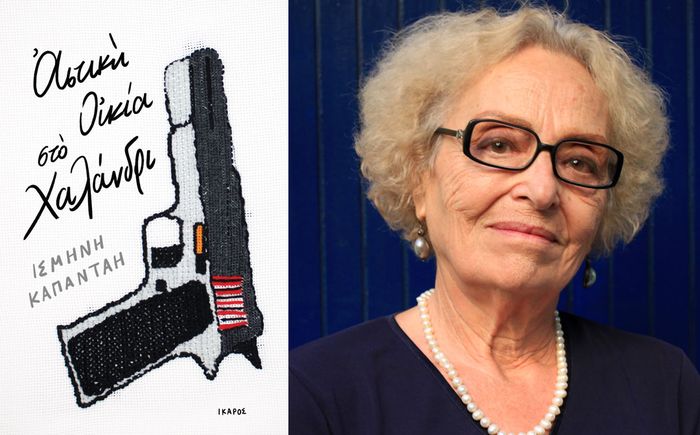
Ismini Kapantai: “Were we turning a blind eye? Were we self-destructive? […] Today we’re simply paying the price, which is greatly inflated, of course. In life, everything—and I mean everything—comes at a cost, and we’d obviously forgotten that.”
To mark the release of her first crime novel, *Asitiki Oikia sto Halandri* (A Townhouse in Halandri), Ismini Kapantai gave an extremely interesting interview to Elpidoforos Intsembelis for diastixo.gr.You can read it below: What inspired you to write the book *Asitiki Oikia sto Halandri*?Recently, I have been trying to understand when and where we went wrong as a society and how we arrived at what we are experiencing today – namely, the crisis, a crisis that is not merely economic, but primarily social. It was only natural, then, to look back to the years that preceded this, the years of false bliss, not so much the 1980s as the 1990s, years during which the certainty had taken root within us that whatever happiness we enjoyed had, and would never have, any cost. At the same time, I should perhaps add that recently I have been rereading, for other reasons of course, the history of the creation of the modern Greek state (Diamantouros, Dertilis, Klog, as well as memoirs of freedom fighters). If one delves into this material, one realises, however unbelievable it may seem, that in so many respects—and these are always the ‘bad’ ones, the negative ones—we remain unchanged in our social behaviour. Experience clearly does not teach us, and we repeat, indeed with passion, the same mistakes. This, I believe, is how the Urban House in Halandri came about.Is the title you chose symbolic, or does it refer to specific people or situations? The title is purely symbolic. From time to time, the issue of social classes in Greece is raised, and specifically the issue of the middle class, sometimes as a question, ‘Does Greece have a middle class?’, and at other times as a definitive conclusion: ‘Greece has never had, nor does it have now, a middle class’. The answer, of course, will eventually be provided by scholars and historians. In *The Bourgeois House* in Halandri, however, some of my fictional characters are, in my view as a writer, a version of the Greek bourgeoisie. In the novel, the main character is Aspasia Arnaouti. Where does she find the strength to assert herself over the whole family?In the Greece of Aspasia Arnaouti’s youth, and whilst gender equality could only exist in the realm of science fiction, it was women who, in essence, ruled their households, and this with the consent of the men. Their roles were, of course, separate and distinct, but the man was always regarded as the head of the household. Let us not forget, however, that during the Ottoman period on many islands, where the seafaring men of the family were away all year round, women took on their roles in all areas of life. This resulted, amongst other things, in the family home being legally bequeathed not to the eldest son, as was the case elsewhere, but to the eldest daughter, also known as the ‘kanakari’. Aspasia is a woman who has fought hard and who knows in advance what lies ahead. Is that enough for her to survive in the business world? Aspasia Arnaouti belongs to a particularly gifted, yet on the other hand terrifying, breed of people, men or women, who have resolved never to be defeated, never to lose, and are, consequently, prepared to pay any price in the game they are playing in order to win, without a second thought. People who do not hesitate to sacrifice everyone and everything – Aspasia in my book not only sacrifices children and grandchildren but, in a sense, by doing so, actually enjoys it. It is the human species that has no inhibitions, the people who, particularly in decadent societies, not only impose themselves but also serve as role models. You are referring to the 1990s. So why did everyone believe that money could buy them everything? Unfortunately, I don’t have an answer to your question. Looking back now, we are all baffled by the naivety that characterised us as a society back then. Were we turning a blind eye? Were we self-destructive? I don’t know, but when we look back, we are astonished to realise how readily we accepted all the positives (the ‘free’ positives) without ever asking ourselves how they came about or why. Today we’re simply paying the price, which is, of course, vastly inflated. In life, everything—and I mean everything—comes at a cost, and we’d obviously forgotten that. You describe harsh situations and, more importantly, the exploitation of people. Is there no justice to punish those who use the weak as pawns to achieve their goal, which is profit? Justice has always existed and continues to exist, but alongside it there is also institutional corruption, which flourishes in periods of social decline. The society in which my characters live is clearly in decline. Mitrodora, or Dori, is playing with fire. Is she perhaps overstepping the boundaries set for her? I wouldn’t say so. Who, after all, sets these specific ‘boundaries’, as you call them, and when? Are they always the same, in every era? Dori grew up and lives in an environment where the only thing that matters is ‘how much you have’, and certainly not how you acquired it. It is a society where the main and primary concern of those who make it up is ostentation. Dori, too, is a member of this society of ‘appearances’, and acts accordingly. The standards were set by others and Dori operates according to them; I would consider her more of a victim, and by no means a perpetrator. Blackmail, underhand dealings, fraud. Do all these things coexist in the daily lives of businesspeople, or do they belong to the realm of fantasy? I consider ‘daily’ to be an exaggeration. Alas, surely in every field there are also the honest, the worthy, those who do not cheat or blackmail to succeed. The successful, yet dishonest, who are accepted without hesitation by society, and in many cases even serve as role models, existed back then and, unfortunately, continue to exist today. A glance at the newspapers, or listening to the radio and watching television, is enough to see this. And then a murder takes place. Is it a consequence of the abuse of society’s unwritten laws? Certainly, and not only of the unwritten laws but also of the written ones. It is not the commandment ‘Thou shalt not kill’ that has prevented us and continues to prevent us from getting rid of anyone who, at any moment, annoys us. There is also the criminal justice system, which, however, is violated with alarming ease by those in power – those with money and access to the so-called ‘deep state’, that is who I mean. On the other hand, we have police officer Christou. What makes him charismatic? Christou is a man of the people who set himself goals early in life. He is intelligent, ambitious, hard-working and methodical, so it is only natural that he succeeds most of the time. Let us not forget, however, the factor of luck, as well as his harmonious working relationship—which is his own choice—both with his superior and with his subordinate, with whom he develops another kind of relationship: a romantic one. At one point you write that Christos reads crime novels. Could something like that happen in real life? Personally, I haven’t yet had the chance in my life to come into contact with people working in that particular field so as to exchange views with them on literature; I cannot, therefore, know whether this is the case, that is, whether police officers enjoy reading crime novels, but why not? I would, in fact, consider it highly likely. After all, we know that crime novels are popular with the reading public, far more so than many other genres. And, as always, the presence of romance. Is this also one of the factors that makes the novel more interesting?In my novel, as you will have seen, there are many characters. They are men, they are women, young or not so young; it would be natural and to be expected, I think, for love to arise between them at some point, just as it does in real life.How do you use suspense to keep the reader hooked and engaged? In a good crime novel, there is always ‘suspense’ and, if you’d like my opinion, I believe there is plenty of it in *The City House*. However, as I am the author and may be biased, we will have to wait for those who read it to provide the answer that really matters to your question. I would, however, like to pose another question here. Is it only the suspense that keeps the reader hooked on a crime novel? My personal view, as a member of the reading public now, is that suspense alone is not enough. You need well-developed characters, above all, and a plot that rings true. Which crime writers do you like? Many, from the classics like Simenon, Conan Doyle, Hammett, James; I’ve also recently read Jo Nesbø, but my favourite remains Agatha Christie with her unsurpassed *And Then There Were None*.Why are so many crime novels being published lately? I believe a publisher would give you the most authoritative answer to that question. However, with the economy in its current state – that is, with the crisis that has literally crushed the market across all sectors – I imagine that publishers prefer them because crime novels have always sold very well and consistently.Learn more