News
News List, News Categories, Events
-
Interviews
Eftychia Giannaki: Interview on In.gr
Eftychia Giannaki answers questions from Georgina Doutsi of in.gr, to mark the release of her crime novel *In the Back Seat*. The interview concludes with the author’s ten commandments for a good crime novel. The interview is republished here:In the Back Seat is the title of your new book and forms the first part of the Athens Trilogy, starring Inspector Haris Kokkinos. What plot unfolds in your new book and what themes are you exploring in it?A film director is found brutally murdered in the basement of the Plakas Theatre, and Inspector Haris Kokkinos and his team are introduced to readers through a case in which they will need to unravel a web of shared secrets, cover-ups and violence in the heart of modern-day Athens. At the same time, the son of the forty-five-year-old Inspector is arrested on charges that force him to delve into his own family history. The pressure of time and the silence of the silent will prove that things are never simple for those who found themselves in the back seat. In a society where everyone is guilty, some will be called upon to pay the price, including Haris Kokkinos, whilst the interrogations paint a portrait of the people of Athens who feature in the story.The themes that concern me most are the veiled violence that goes round in circles, collective guilt, the past and what we think we have left behind, shared secrets, superficiality, the simplicity of everyday things, humour in the face of the abhorrent, and our fears as they unfold within the familiar setting of a city that is not merely the backdrop to the crime story, but its very essence. How did the book’s title come about, and what does writing or reading a crime novel offer you? The book’s title is inextricably linked to the essence of the plot. We have all sat in the back seat as children, and some will find themselves there as suspects. The connection between a criminal act and the past, and the search for its causes, forms the core of this particular story.When writing crime novels, I like to create situations of fear in order to bring the fears of everyday life under my control and, ideally, to confront them. I believe this is the pleasure of the crime novel. And it is the same whether you are writing crime novels or reading them. The plot unfolds against the backdrop of modern-day Athens, in a familiar society full of stereotypes and taboos. What image does Eftychia Giannaki have of the Athens where she lives and works? Athens is my city, and particularly the city centre where I live and work, and I would say that it is not merely the backdrop to the story. Anyone who reads the book will see it come to the fore on many occasions.My interest in the city and its inhabitants, as well as its evolution over time, reveals nothing other than my determination to understand the changes undergone by a structure that in recent years seems to be shaking to its foundations. It is a time when the certainties of the past are being shaken, lawlessness and chaos are ever-present, and the prevailing rule seems to be that no rule is observed. In this sense, I believe it provides an ideal setting for the development of a crime story. Crime fiction is a popular and much-loved genre among readers worldwide. Why do you think readers are so keen on devouring this kind of novel? Don’t we read about plenty of murders and acts of violence in the daily news? I believe that crime fiction is the narrative that sheds light on the things we avoid looking at in depth in our daily lives. News coverage of these issues and the speed with which they change often leave us bewildered and full of questions, and it is these questions that usually seek answers in a crime novel.The seriousness of a crime narrative is often questioned, and for many years it was regarded as light reading. I am among those who believe that the development of this genre in recent years manages to reflect the social, psychological or even philosophical dimensions of a story in a direct way, a fact which, in my view, makes it popular with readers worldwide. ‘How likely is it that you would murder someone, rather than kiss them? wondered Inspector Haris Kokkinos”, allow me, in turn, to pose the question contained within the book... If I did not believe it to be highly likely, I would not be writing crime fiction. I believe that, potentially, we are all perpetrators and victims under certain circumstances. And it is precisely this possibility—of finding ourselves in one position or the other—that is tested when reading or writing a crime novel.What is the ‘formula’ you follow when writing a crime novel? My formula, if I may call it that, is that I try to create something I would find interesting to read. Because I don’t have the full plot development in mind from the start, it’s like playing a game of chess against myself, page by page, chapter by chapter.Do you read Greek crime fiction? I read both Greek and foreign crime fiction, and I feel that in the future Greek crime fiction may produce significant works, given that the conditions in which we have been living as a country in recent years, conditions of instability, insecurity and lawlessness may well provide fertile ground for reflection and the development of crime stories. So what else will The Athens Trilogy include, and when can we expect the next two books?That is a closely guarded secret, a puzzle I am currently trying to solve whilst preparing the second story featuring Inspector Haris Kokkinos.As for the timing, I believe that Ikaros Publications’ response will not disappoint even the most impatient readers.”&The ten commandments of a good crime novel, by author Eftychia Giannaki: It is important to have a clear central idea that captures the essence of the plot and the reason why the story is worth telling or reading. The characters, both main and secondary, must be well-rounded, so that the reader feels they are people one might encounter in real life, rather than fabrications or caricatures.&The plot must be interesting and convincing in its development. Ideally, it should be so compelling that the reader cannot put the book down. The atmosphere, the setting and the backdrop must be presented in a way that makes the circumstances surrounding the crime and the resolution of the case understandable, thereby enhancing the development of the story. The methods used to solve the case must be convincing and stand up to the scrutiny of an intelligent reader familiar with police mysteries. The social, psychological and philosophical implications of the story must be presented in an accessible manner, without the reader feeling that the action is being slowed down. The balance between lightness and gravity in the narrative, and even humour in the face of the abhorrent, can illuminate a crime story in a unique way and, in my view, should be sought. The solution should not come about by coincidence or through a deus ex machina, whilst the motives must be thoroughly justified The reader’s way of thinking and moral compass must be put to the test, as they are called upon to provide answers to complex issues or dilemmas. Upon closing the book, the reader should feel that they would like to read another book by the same author.Learn more
-

Interviews
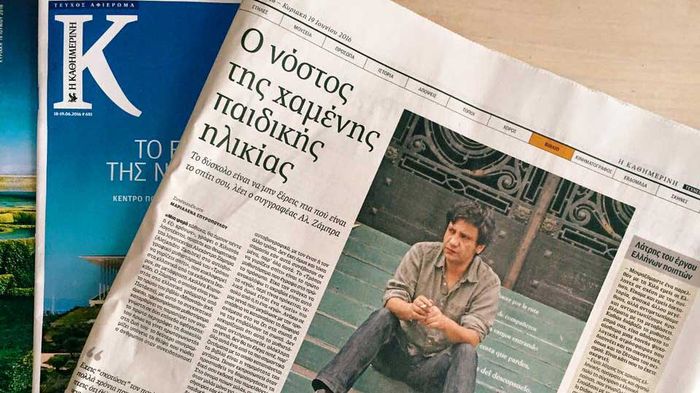
The nostalgia of lost childhood; an interview with Alejandro Sabra in Kathimerini.
To mark the publication of Alejandro Sabra’s book *Ways of Returning Home*, Marialena Spyropoulou spoke with the Chilean author in a very interesting interview for the newspaper Kathimerini, which was published on 18 June in the Arts and Letters supplement. “I got lost once, I must have been five or six years old,” writes the Chilean writer, poet and literary theorist Alejandro Zambra in his autobiographical novel Ways of Returning Home, published in Greek by Ikaros Publications, translated by Achilleas Kyriakidis. Zambra, who is known in Greek literary circles from his first book, *Bonsai*, manages with this moving, direct, first-person novel to draw the reader into two narrative levels: the first describes the protagonist’s struggle to take centre stage in his own life; the second subtly underscores the sorrow a person feels when they realise they cannot return to what has ultimately been lost forever. – In your latest book, an earthquake – both real and symbolic – shakes the protagonist’s memory. What are the internal and emotional ‘earthquakes’ an adult needs in order to ‘return home’?– We grew up with the idea of an earthquake. My grandmother used to tell us bedtime stories about the people who died in the great earthquake of 1939. When it happened again in 1985, I thought, ‘So this is what an earthquake is like’. I feel that earthquakes shape your sensibility in many ways. You come face to face with the feeling that everything can be destroyed in an instant; that changes your life. And it gives you a sense of fragility. Since then, I can’t imagine the world as indestructible. – What was your childhood like? Is the book autobiographical? – I think all books are autobiographical, in one way or another. But it doesn’t really matter whether these things happened to me, after all. Ways of Returning Home is the first novel I wrote in the first person. I felt the need to discover exactly what this ‘I’ is, what it’s all about, but ultimately it’s more of a ‘we’ than an ‘I’. I belong to a generation that grew up trying to understand the difference between living in silence and having silence imposed upon them. I’m not claiming that this novel represents the entire generation—I would never say that—yet one of the most important issues the book grapples with is the legitimacy of memory. Whom do you represent when you try to create your own version of the past? In whose name do you speak, even when you speak only for yourself? I’m not sure if I had a happy childhood, but I certainly wasn’t unhappy. And I was growing up during the most dreadful years of our national history. Whilst I was more or less free, hundreds of my compatriots were being murdered and tortured, and Chile was surrendered to the most savage form of capitalism. This realisation, which came during my adolescence, reshaped my memories. In other words, suddenly all my memories turned bitter. And the very act of remembering became bitter. The intensity of poetry – You are also a poet and a professor. Your grandmother used to ‘whittle out’ little verses. Yet you have written that you feel uncomfortable with your poetic nature.– I have loved words since I was a small child. I loved storytelling too, but I think I gradually discovered stories I wanted to tell. I’m not the ‘let me tell you a story’ type. Besides, I don’t believe in themes. In that sense, I proceeded as a poet. On the other hand, I’m not sure whether there are boundaries between prose and poetry, or what they might be. – Why do you consider poetry more important than fiction?– That’s purely a matter of intensity. Poetry appealed to me more as a reader, of course. And when I was twenty, writing novels seemed boring... spending hours in front of the computer...– You once said that you’re always looking for that moment when you’re not sure about what you’re doing... – I firmly believe in that. I don’t treat writing as a matter of me saying something the other person already knows. When you write, you might have a few ideas, but as the writing progresses, you lose control. I like the moment when I catch myself not knowing what I’m doing, but on the other hand I know that I’m doing something. I start with an image and try to develop it like a small sculpture. There’s already something there, and you work on it until you discover it. – Do you find it difficult to write or finish a book? You’ve said that books are born as soon as they’ve moved beyond you. – I wouldn’t call it just difficulty. There are, of course, many pleasant, good moments as well. Even when you’re writing about painful things, you experience a sense of fulfilment, or the illusion of it. It isn’t always consciously pleasant. It’s hard for me to accept that a book is finished. My Spanish publisher, Jorge Herralde, teases me because I’m very good at making last-minute changes. But as soon as the book is published, I forget about it and move on. Pinochet’s Chile – You grew up during the Chilean dictatorship. You describe the feeling of playing a secondary role on the stage of your own life. What is your life like today? – It took us a long time to feel like protagonists in our own lives. We grew up with parents who claimed the experience and legitimacy of History entirely for themselves. That is difficult to deal with. But now we are the parents. And I’m interested in the transition. That is precisely what the novel *The Private Lives of Trees* and the poetry collection *Facsimile/Multiple Choice* deal with. I insist on the shift, on the transition from the singular to the plural. Everything there is caught up in this oscillation. – You write about memory. The memory of your generation. What is the specific psychological and political context of this generation? – These are the questions I ask myself, and I can only answer them by writing a novel! I consider Ways of Returning Home to be a novel about dealing with the past, in various ways. It is not just a matter of ‘killing the father’. It’s mainly about the fact that you’re no longer 20 years old and you ‘killed’ your father many years ago, and you discover that you want to bring him back to life, and that’s not possible. You want to go home and you don’t know where home is.– Every novel is a letter to the world. What sort of letter did you send? – I have no idea... The idea of being translated is something that fascinates me. I do feel, however, that I sent a letter. Writing is the ability to share and to lose. I love Emily Dickinson’s poem: ‘This is my letter to the world, which never wrote to me...’ but ultimately I can’t help but see how lucky I am. I’m in touch with so many people, and I read everything my readers write to me and feel devoted to them all. A lover of the work of Greek poets – we Greeks share a past with Chile when it comes to poetry. We too had a dictatorship, albeit on a different scale, but we have faced and continue to face problems with transitions. As I was reading your novel, I had a subtle sense of a shared psychological atmosphere that pervades the families, as well as the issue of the earthquake. Is this something you have considered? – I am a devotee of ancient Greek prose and I am very fond of modern Greek poetry, with which I am well acquainted. I studied under Miguel Castillo Didier, a great teacher, who is arguably the greatest translator of Cavafy. He has also translated Seferis, Ritsos, Elytis and Kazantzakis. I know these works in Spanish translation inside out and I adore them. Cavafy’s ‘God Has Forsaken Antony’ is one of my favourite poems. When I was 21, I wrote my own version of this poem for a tribute to Cavafy. Castillo Didier asked young poets to contribute, so I wrote something for him and he translated it himself. I don’t know what became of that poem, but now that I think about it, the first language into which any of my work was ever translated is Greek. I’m not comparing the two national histories, although I do believe, unfortunately, that we have things in common because of the political violence we have experienced.Learn more
-
Interviews
Interview with Alexandros Adamopoulos on Ert.gr on the occasion of the play ‘Ochinelegontas’.
Following the success of the play *Simigdalénios*, which ran on the Main Stage of the National Theatre for seven months, and to mark the launch of his new play, Ochinailegontas, he gave an in-depth interview to Dora Cheiraki of Ert.gr, in which, among other things, he discusses the book’s publication abroad as well as the story behind its original title. Following the acclaimed Simigdaleno, which ran for seven months on the Main Stage of the National Theatre, Alexandros Adamopoulos presents his new play, entitled Ochinailegontas, which has already been published in Turkish and English translations.The writer-translator recounts, in his own poetic, dreamlike manner, the hidden facets of his brand-new story—which, though it has endured for centuries, remains relevant—, reveals the origin of his work’s original title and takes us on a journey through magical fairy-tale stories spanning from the Middle Ages to the present day.-Mr Adamopoulos, *Ochinelegontas* comes twenty years after *Simigdaleno*. Beyond their vast differences, they share one common point: this too is written poetically. Why? Although I do not consider myself a poet, poetic language came and imposed itself on me of its own accord, quite naturally in both works, which deal with something so general, so archetypal, as love; human relationships, if you prefer. If we consider that literature deals with simple events but makes them remain ever relevant, poetic language, in this particular case, makes every word resonate more truly; it illuminates it further, giving special weight even to the slightest syllable, to every breath, to every pause. Poetry is the most condensed form of writing and conveys a greater charge of energy to the reader-spectator, and that is very important.-Does this also apply to theatre? For this particular genre, I think so; I would say absolutely yes. Simigdaleniou’s experience taught me: In his eighty productions, almost entirely different from one another, over the past twenty-five years, not a single person – spectator, director, musician, choreographer, critic, actor – has ever been puzzled and asked me why it is written poetically. For me, precision matters greatly; in the sense that I strive to write exactly what I mean; as simply as possible and with the greatest possible clarity. From this perspective, poetic language – and indeed the perfectly measured kind, with all its possible rhythms and rhymes – is the only way forward. The verses are crafted so that each has its own music, so that they laugh, hesitate, run, gasp, weep; so that they flow effortlessly. And this has appealed to important figures in the theatre. If Simigdalénios hadn’t been written poetically, it would have been a schoolteacher’s little story and the narrative a old-fashioned melodrama; whereas it isn’t like that.-Where did you draw inspiration for the distinctive title you gave your book? From an old, stray verse of mine: ‘whispering horribly with boundless ease…’. I used to write it mechanically on sheets of white paper. I wrote it whilst reading the newspaper, doing crosswords. I often recited it to Margarita Karapanou when she was writing ‘YES’; wanting to show her that she never actually says ‘yes’ but always says ‘no’.-So, how would you describe your work in a nutshell? That’s very simple: There was a man and there was a woman…-Contemporary themes, which you set, however, in a bygone era…-Yes; why not? Once upon a time, then; there was a man and there was a woman… It suits me, I like it. I live very intensely in our own time and amidst the sad problems that spring up like mushrooms every day everywhere, in our society that is so comfortable, free, sensitive and democratic, that at times—without denying reality in the slightest—I like to withdraw in order to say things that are entirely contemporary, as if they weren’t happening in the present day. Perhaps I am doing the opposite of some current approaches. Instead of, for example, having Orestes speak on his mobile with Pylades, I prefer to show a young woman weeping and writhing in agony at her realisation, in a deserted inn by the light of torches, rather than leaving unscathed from a psychoanalyst’s couch. I believe it is more cathartic—both for her and for the audience. —But now, in the midst of this crisis? —Precisely… As we said: literature is news that always remains news. Obviously, the whole country is dragging itself along, groaning and gasping dangerously. We are living on a knife-edge and our lives have become unliveable. But no one, when they pick up a book to read, or when they come to the theatre, expects me to tell them whether the public debt is sustainable or not, or to tell them where they will find work. To each his own. Just because we have a public voice, there is no need to pretend to be wise by dabbling in matters we know nothing about. But everyone, even in the midst of the greatest disaster, looks for a glimmer of hope, seeks a little light; they want something alive and warm by their side. Everyone feels the need at some point to find something genuine, something true. Perhaps to look deep within themselves, to see what is going on, what is wrong with themselves. If you manage, even for a moment, to truly touch another person’s soul, that is by no means insignificant.-And isn’t the Chorus you use an anachronism?-Not at all; why? I needed a common denominator; a voice of the people, so to speak, that says things we could all think of, without any pretension. The Dance of the Guardians of Love isn’t some group of old men in tunics and fake beards down to their navels, chanting various choruses that nobody understands. It is a tremendously lively group of half-naked youths, with drums, tambourines, rattles, bells, tambourines and zurnas, which participates organically throughout the entire play and contributes decisively and with boundless enthusiasm to its Dionysian finale. The Chorus is thus completely intertwined with the play. After all, I didn’t conceive it intellectually; it was there from the start and kept me company. So why not? Could *Ochinailegontas* be staged abroad, particularly in Turkey? Look, the English translation was enjoyed by all the English people who read it. Now, as for Turkey, I don’t know; what can I say? The fact that they translated *Ohinelegontas* into their language and published it there means something. The fact that they invited me to teach it—in its English translation—at Boğaziçi University also says something. The theme of the play, however, and the way it is written certainly know no borders. The only thing that troubles me, however much it tickles me inside, is whether it might be staged first on a foreign stage without having been staged here. Is that a possibility? Perhaps. Let’s not forget, after all, that Simigdaleniou was first staged at the State Theatre ―Şehir Tiyatro― in Turkey and only later at our own National Theatre.-And how would you view the staging of Ochinelegos here? First and foremost, I like the fact that it is written in such a way that any reader can experience it by reading it on their own. -You mean, in other words, as a book? Exactly; as a book. As a self-contained literary text that anyone can read at home. Beyond that, I envisage a contemporary, very lively production, one that is ethereal, dreamlike and yet firmly grounded. Frantic, yet boundless. I imagine it not in a small, enclosed theatre, but in larger venues or even open-air theatres. Tightly interwoven with sounds and music; music that, however, always serves the Word. Without long-winded passages that drag on endlessly. With energy, with pulse, with perfectly measured movement. With a fast pace, yet unafraid of pauses or silence. Dim lighting, shadows, no stark colours or exaggerated expression. Genuine expression; no showmanship, no grimaces. A collaborative work, where everyone gives their all. Amidst the constant twists and turns, a continuous crescendo of emotion, sound and action, culminating in the finale, which requires the precision and fine-tuning of a symphony orchestra to succeed; otherwise the work sounds off-key. I hope we get to see it soon… Take care, thank you; until then, however, anyone can read it for themselves and see it as they wish.Learn more
-
Interviews
Alekos Papadatos: ‘Leander could be one of us’"
Alekos Papadatos speaks to Alexandra Panagopoulou of plusmag.gr in a wide-ranging interview about his new graphic novel *Democracy*. We first met Alekos Papadatos in 2014 when he presented his work ‘Encounters’ at the Cube gallery in Patras. Back then, everyone was asking him about Logicomix. Today, everyone is asking him about his new graphic novel ‘Democracy’, the fruit of his collaboration with Avraam Kawa and Annie Di Donna. And “Democracy” proved to be the perfect excuse to catch up again. Alekos Papadatos talks to us about the birth and development of the idea, the state of graphic novels in Greece, democracy today, and what the era we live in would look like as a comic. How did ‘Democracy’ come about? How did the story come about? There had been some thoughts and discussions about creating a graphic novel on the theme of political history as soon as Logicomix was finished. I’d started to get the itch to do something related to ancient Greece that wasn’t just ‘educational’ or glorifying the chlamys, but something more substantial. At some point, my daughter came to me with a school assignment in which her teacher had asked her to look up some historical figures and names of ancient Greeks, and Cleisthenes popped into my mind – a figure about whom I’d previously had a very hazy impression. I looked him up and found that various online encyclopaedia sites described him as the founder of democracy. That impressed me. Because I had this preconception, I started looking into it. It turned out that this subject is extremely interesting. The era of Cleisthenes is very obscure. We know much more about the 5th and 4th centuries, which are the ‘Hollywood’ centuries of ancient Greece, with Plato, Socrates, the Peloponnesian War, the Acropolis and so on, but we don’t know how we got there. That was a question. Let’s see how we got there. It is the second graphic novel to be published within a few months on the subject of history. This trend didn’t exist in the past. How do you explain it? There was a wave of so-called graphic novels that began in the mid-1980s abroad and, as far as I know, I think the first major work in this field, in terms of page count, was Art Spiegelman’s *Maus*, which was historical and dealt with the Nazi concentration camps. It was a real page-turner. A few years later we had V for Vendetta, Watchmen, Blankets and others, which created a trend that gradually made its way to Greece and really got us excited. We wanted to tell a more expansive story with Logicomix, which woke many people up from the slumber of the small-scale comic that was either for children or, if for adults, contained pornography, violence and horror. Everyone began to think, like Soloup, of telling stories that weren’t fantastical. They all drew on this trend. And before Soloup, there was Nikos Pagonis, who created a book about the Fall of Constantinople. Then came Logicomix, Aivali, and now Democracy. There’s a lot in the pipeline now. The new generation of comic artists have caught fire and many have started working. There is a scene. How do you see the comic scene in Greece developing? Here in Greece, we have a culture that doesn’t do much to support narrative illustration. We have a Byzantine past; we’re a country that didn’t experience the Renaissance like others in Western Europe. For example, we don’t have illustration schools like those found elsewhere, such as in England, France, etc. Here, there is only the Orneraki School. Unfortunately, our only tradition here—and a very good one, of course—is political caricature. A graphic novel is something that takes years to produce; it takes a lot of effort to create it, and it requires money. You have to take your subject very seriously because, for a publisher to publish it, they need to be interested in it; you can’t just do whatever you like. It’s harder to create a graphic novel than to write a novel, which we see being churned out by the truckload every day… On an international level, if you go to Amazon, you’ll realise that truckloads of graphic novels are being churned out every day! How does the story work as a comic? There aren’t many graphic novels that deal with historical events of broad significance, which might interest even people who don’t read comics. Depicting historical events through sketches brings them to life, because at school history seemed a bit ‘dry’ to us. Usually, it has to be a subject that transcends borders. So the options for historical graphic novels aren’t that plentiful… How difficult was it to strike the right balance so that you could narrate historical events without sounding like a schoolteacher? We found a ‘trick’ to achieve this. And we applied the technique familiar to writers: telling the story through the eyes of a fictional character who lived during that era. So, in a way, our doubts—which stem partly from ‘gaps’ in the sources, as there aren’t many sources for this period—our questions and our comments, we conveyed them through this person’s narrative. He is a fictional character who lives out his youth during this turbulent period and, in a way, allowed us to show that, just as today, so too back then people found themselves facing a tsunami of changes in the political and social situation of the societies in which they lived, without being able to do anything about it. We completely moved away from simply saying, ‘This is the story of Cleisthenes, this is how he carried out the reforms, end of story,’ and making it sound like a school textbook. We wanted it to convey knowledge, but not in a way that feels like school. We wanted it to impart culture, and if anyone wants to look into it further, they can do so afterwards. Since we’re talking about democracy, do we have democracy today? Yes, we do, a kind of democracy, just that what we have today is different from what the book describes. The book recounts the first ‘technical’ steps taken by democracy as a system. On the other hand, what we lack today compared to that era is the intellectual representation of citizens, since the representatives we choose to represent us in the legislature usually look only to their own interests and use us merely as tools to climb the ladder of power, whereas back then this was not the case to such an extent. But today we have something they did not have back then. There was no concept of individual rights. When the majority of the city decided to expropriate your home and banish you from the city for 10 years, there was no way you could defend yourself. There was no rule of law. Today there is. Citizens have the tools to fight for it. Women can vote, something that only happened at the beginning of the 20th century; slavery ceased to exist. It is a system that evolves and improves, becoming increasingly refined and adapting to circumstances. If in Greece and Europe we are experiencing a time when our democracy is showing some unpleasant aspects related to populism, corruption, and public apathy, we should remember that this system will never function perfectly because we will never be satisfied with anything. It is something in our own image, and right now it is going through a phase that resembles us very much in how we are on an individual level. So you can’t say we are better or worse off than back then; it is simply evolving. So we are in a different phase of democracy. Yes. After the Industrial Revolution, after the Enlightenment, after the movements of the 20th century… And I hope that perhaps in the future there will be an awareness of the ecological problem, things will move to a different level and the system will once again move towards the better. Certainly, however, no progress will be made if the system becomes authoritarian rather than democratic. Is there a more contemporary theme you’d like to illustrate, some events from recent history? Yes, of course. I have some ideas at the moment for a possible future book of this kind. In any case, 20th-century history is very interesting in this respect. By understanding the past, you gain a better sense of where you are and where you’re going. In that sense, I’m interested in seeing if there’s anything to be done with 20th-century history, not the wars, of course… Wars are events; they happened. The point is to see why these things happened. The underlying context is what shapes everything. We’ve seen the phenomenon, we’ve done one thing or another – comics, books. We know it all. The question is how people navigate through time and why these things happen. Is it related to the economy, to politics? It’s a matter of reflection. I’m just reading at the moment. I’d like to create something that, like Logicomix and Democracy, can transcend our borders a little and speak to people living in cultures different from our own, yet allow them to connect with the core of this book and with themselves at the same time, to speak to them as well. This presents many difficulties and challenges. Could the present day be turned into a graphic novel? Of course. What is happening in the Eastern Mediterranean in general, in North Africa and in the part of Asia that is close to us, as well as in the Middle East – and how this affects us and ‘impacts’ life in Europe – is of great interest. Of course, our own problems—entirely our own—which we know far better because we follow the news on a daily basis, might lead some to say that they show that Greeks are a bit inward-looking, a bit ‘parochial’. Greece is very isolated from the rest of the world. And that bothers me and pains me, but if you sit and think about it, it’s a very Balkan trait because right now the Bulgarians and the Serbs and other Balkan countries are living by eating their own flesh. I hope that one day we’ll be able to make a difference abroad. Right now, we can’t even influence our own lives. As for the politicians, they recycle their presence by changing labels: one moment they’re right-wing, then left-wing, then right-wing again, and then centrist. That pains me. The years go by and you see that those in power have no intention of letting anyone take their share. Isn’t that the case today too? We see that although the events of ‘Democracy’ unfolded centuries ago, there is a parallel between the institutions and events of that time and those of today. Yes! And indeed, one might even say that unless you climb up there, unless you are obliged to govern, you cannot understand the perspective from which these people view things. Just as you cannot understand the extent to which their souls are worn down by the arrogance of exercising power, unless you experience it yourself. Because these people are psychologically worn down by what they do. We, who are on the ground watching events unfold and simply casting our votes, have a completely different perspective on the whole situation from the one they have. They are two different realities unfolding in parallel. If you had to create a comic about today, what would it be like? I don’t think it would differ much from what we did with Democracy, because Leandros could easily be one of us. He’s a bloke who’s growing up, maturing; his ‘ego’, his swagger, is violently shattered, and through violent situations he comes into contact with a reality that gives him an awareness of what’s going on. Little by little, he realises that the problems are not just his own, but collective. Given the incredible individualism of a section of society, I would do the same in a different context—it could be a kid in jeans and a hoodie… It could be Fyssas. Fyssas’s story is a deeply moving image; it has power and concerns us all. This young man was not the son of some high-profile lawyer from Ekali who was studying at Harvard. A young person growing up today and fighting for things would be a narrative thread on which one could base a story. Alexandra PanagopoulouLearn more