News
News List, News Categories, Events
-
Interviews
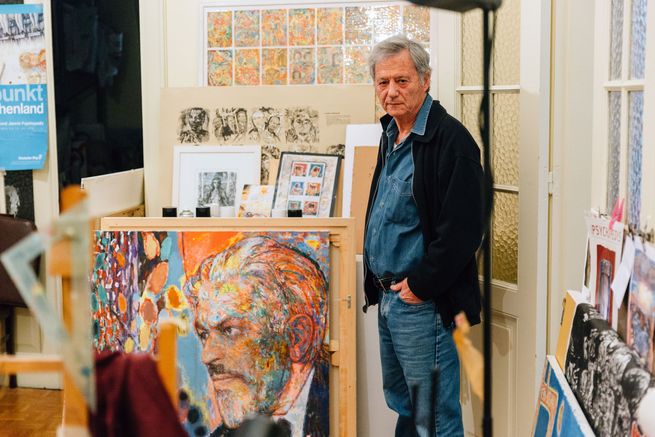
Yannis Psychopedis: “We live in an abandoned and shattered Athens.”
The Athenian artist recounts his life to LIFO and Yannis Pantazopoulos on the occasion of the publication of his book *At the Bottom of Dreams*—Images from Andreas Embeirikos’s Octana, as well as his exhibition at the Zoumboulakis Gallery (open until Saturday 31 March). You can read an excerpt below: Photo: Paris Tavitian/LIFO I was born in Athens in 1945. Our family home was at number 23 Ypsilantou Street in Kolonaki. This large house, which has now been demolished, was a paradise of childhood adventure and exploration, full of dark corners, hidden spaces and a large, winding wooden staircase connecting the floors. It was a staircase where, at every turn, strange sounds, whispers, anxieties and fears from our childhood imaginations lurked. I grew up with parents who loved poetry and literature dearly. They had a natural affinity for the arts, and all that richness was passed on to us, without ever being imposed on us as an obligation. My mother was a teacher and my father a lawyer. So, our home was a place of ideas and reading was a matter of course. From my early secondary school years, I had made it clear what I would do in life and what I would pursue. Perhaps it is an inexplicable instinct that leads you to ‘something’. I studied printmaking at the Athens School of Fine Arts and then painting on a German government scholarship at the Academy of Fine Arts in Munich. However, I believe that talent only exists through hard work. One may possess the raw power that guides one towards the bigger picture, but in order for this to become conscious, a framework, an environment and a culture are needed. During my childhood and teenage years, I travelled extensively in Germany. Memories of many childhood summers are linked to that country. I had experiences that connected me to a civilisation and a culture that helped shape my identity. Later, from 1977 to 1986, I lived in Berlin, whilst until 1992 I lived and worked in Brussels.Ypsilantou Street, in its extension, connected the ‘cultured’ Kolonaki with the magical, fairy-tale world of Evangelismos Park, where, amidst the green flowerbeds and statues, Vasilis, the photographer. A beloved guardian of black-and-white memories, surrounded by photographs, negatives and posed shots on painted backdrops or against a flower-filled backdrop for the secret romances of conscripts on leave with the maids from the neighbouring houses.The balconies of our house looked out directly onto the British Embassy and its gardens. In the summers, we watched from above the open-air receptions, the arrivals of dignitaries in their evening gowns and tailcoats amongst the palm trees, like scenes from the mythical sequences of the first colour films. For years we believed that the British ambassador was none other than the dapper man in the gold uniform. Much later it was revealed to us that, despite all his pomp, he was merely a driver, and the real ambassador was the seemingly insignificant, grey little man who accompanied him. It was a discrepancy that proved significant for my subsequent understanding of the world. And this became most apparent during my school years, when, from a tender age, I had become involved in a romantic relationship with the young daughter of the embassy driver, who also lived in the staff quarters.The revelation of the true roles and identities of the individuals brought us down to earth with a bump, into a reality where, through the harshness of romantic rejection, we learnt relatively early on the complex relationship between being and appearing, between the obvious and the obscured truth of the world, between overt and covert social power. In the corner of our house, Ypsilantou and Loukianou, in the square by the British Embassy, our political consciousness first awoke when, overnight, the lower section of Loukianou Street suddenly changed its name and was renamed Karaoli-Dimitriou. Further up, next to the little dairy in Lykovrysi, on the upper side of Kolonaki Square, stood the mysterious figure of an elderly man who sat, come winter or summer, on a small wooden box. He sold precious treasures from our childhood reading world, such as second-hand issues of ‘Little Heroes’. This legendary man reminded me of a work by Magritte: a seated male figure wearing a hat, through the open collar of which you can see, in place of his body, a cage with a bird. Read the rest here.Learn more
-

Interviews
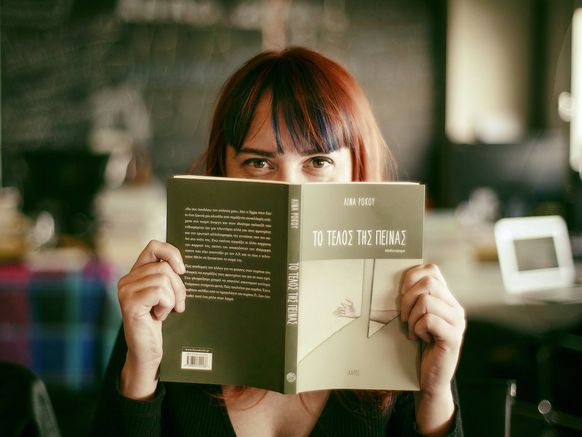
‘Desire undermines my human existence’: Lina Rokou’s favourite quote from her book.
Lina Rokou, on the occasion of the publication of her first novel, The End of Hunger, gave a very interesting interview to Womantoc.gr and Efi Alevizou. You can read it below: Lina has vibrant, red hair and a lively writing style. She tackles many things. From poetry to city reporting and from interviews to the latest trends. She is what – for the sake of brevity – we would describe as a ‘child of her time’. A time that is strange and edgy, cheerful and gloomy. An era that is changing rapidly, with new existential questions springing up to join the list of those already unanswered and fundamental: How do you deconstruct the other to reach their core? Can you buy their wisdom, and at what price? Could a lollipop serve as payment? Her first book, The End of Hunger, may well hold all the answers. If, of course, such answers exist at all.-What is the story of The End of Hunger? A strange series of transactions begins between the unemployed Emma and the junk dealer San when the former sells the latter her organs and body parts, whilst the shadow of an old love falls over the relationship that develops. How are the body, reason and emotion deconstructed when we give ourselves to someone? Is there a price to pay for the joy of love? How do we pay it back? I would describe it as a next-door story with strong doses of paranoid romanticism.-Give me a summary of your story. Where are you from and where are you going? I grew up in Corfu until I was 19. My parents live there, so I go back often. My relationship with Corfu has shaped me more than anything else in my life. For me, Corfu is a living organism; it nourishes me, it torments me, it heals me. But it’s better from a distance. Relationships that intense don’t last long in everyday life. I love Pagrati and Mets. I don’t think I could live anywhere else in Athens. I work at Popaganda, I’m out and about in the city a lot, I try to make the most of what it has to offer. I have no idea where I’m going. I’m interested in the present; I reflect on the past but don’t feel nostalgic for it; I think about the future but recognise that I can’t predetermine it—perhaps only build it, and even that only to a certain extent.-You’re a prolific journalist. What does writing mean to you? As a journalist, writing is my job. A job I chose and love. It’s torture, I think, to do something professionally that you don’t like, because just think how many hours a day we work. I almost liken doing a job I don’t fancy to sleeping with a man I don’t desire.-How difficult is it for someone to write a book? What else, apart from writing ability, is required? I don’t know if it’s easy or difficult, generally speaking. For me, the easiest part was the writing itself, and the most demanding part was the editing and proofreading. I read the book countless times, editing, changing, tweaking. I was mainly preoccupied with the ‘editing’, by which I mean that the whole story wasn’t written in a linear fashion. I proceeded using both my logic and my instinct. There were, however, chapters that were written in one go and I hardly touched them at all. I think it requires dedication. You have to be preoccupied with writing your book not only when you’re actually writing it, but also during the rest of the day. In a way, the book becomes an integral part of you; you can’t get it out of your head. Credit: Dimitris Koulelis – Name three books of contemporary literature that have left you speechless.‘Bring Me Maria Kensora’s Head’, the collection of short stories by Panos Tsirou that gives me palpitations every time I read it. ‘Amberludachamin’, a long poem by Samson Raka, the most important poet of our generation. Thirdly, ‘Fin’s Hair’ by Eva Stefanis, for the raw paradox it exudes. – How many hours a day did you work on your book, and how long did it take you to finish it? There was no set schedule. There were days when I didn’t write anything (but I was constantly thinking about it) and others when I spent hours, with the necessary breaks, in front of the screen. I started writing in March 2014 and finished the first draft in August 2014. However, I picked it up again and worked on it intensively from August 2015 until October of the same year. And once more, in early 2017, when I actually changed the ending. Thankfully! – A line from your book that means a lot to you.‘Desire undermines my human existence. I love daisies and hedgehogs. When you come near me, I’ll growl at you. Don’t be afraid. It’s my nature.’ Read the first few pages of the book here.Learn more
-
Interviews
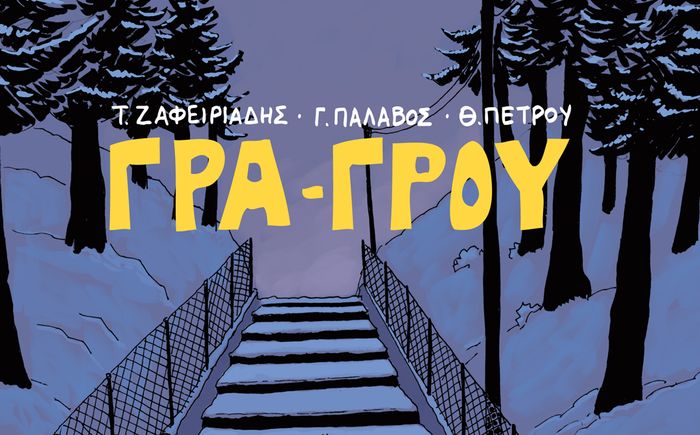
Interview with the creators of the graphic novel ‘Gra-Grou’ on the ERT3 radio programme ‘Kalimera’.
Listen to the very interesting interview given by the creators of the graphic novel Gra-Grou, Tassos Zafeiradis, Giannis Palavos, Thanasis Petrou and Michalis Siganidis on the ERT3 radio programme ‘Kalimera’ on 31 January 2018.Journalist Anastasia Grigoriadou spoke with the creators of the publication about their atmospheric story, set against the backdrop of the eponymous restaurant in Vermio, outside the village of Kastania, a landmark of an entire era for Northern Greece. The programme also featured the music composed for the book by Michalis Siganidis. The material comes from the ERT S.A. Archive.Learn more
-
Interviews
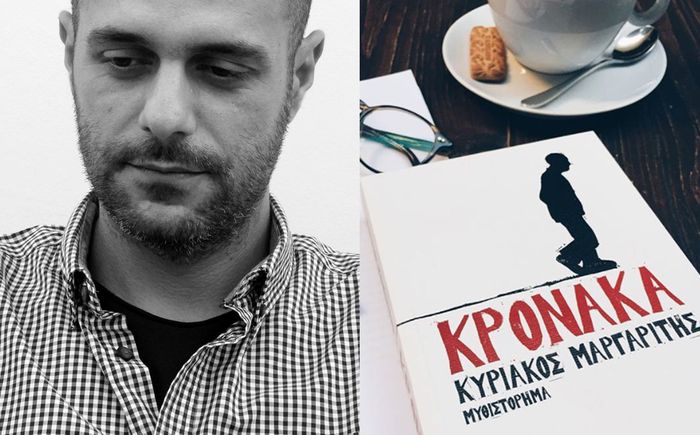
Kyriakos Margaritis: ‘I perceive everything as a vast novel.’
Kyriakos Margaritis gave a very interesting interview to Tetragwno.gr and Eva Filiou to mark the publication of his latest book, *Kronaka*. You can read it below: Mr Margaritis, what event sparked your interest in writing? I would say it was my entire childhood. I was blessed to grow up in a world full of stories: my grandfather’s tales, mythology, Homer, the Bible, those wonderful adaptations of Dumas, Scott and Stevenson, comics, films, even music – these taught me to perceive the world in terms of narrative economy, as a novel in which everything is in constant relation to everything else. Until I was twelve, I tried to ‘write’ it through drawings and comics, but at that time I read Xenopoulos’s work, My Life as a Novel, in an edition by Biris, and I felt that writing was a kind of destiny. Since then, for the past twenty-four years, I haven’t stopped writing. I could say: I am living a novel. Your latest work, entitled Kronaka, published by Ikaros, centres on the history of Cyprus. How did this idea come about? What was your motivation for writing the book? Look, Kronaka is the introduction to what is likely to be a lifelong project, which I’ve grouped under the same title. My plan, admittedly audacious, involves some thirty volumes – as many as I can manage. Of course, something like this could not have come about suddenly. As I said, I perceive everything as one vast novel. My motivation lies in my previous answer; it is my life, my relationship with the world. I have been consciously pursuing this since 2003. Everything I have written has been an introduction to a broader fictional cycle. Some fell by the wayside, whilst others progressed but were never published. All of them, however, were channelled into Kronaka (the series) around 2013. Cypriot history is not exactly the central theme but the starting point, the point of reference and the catalyst for subsequent developments, which I believe will be fascinating, especially if you consider that the walk marks the Apocalypse – the only happy ending I recognise: the beginning.In the novel, there is a dialogue between the past and the present. How difficult is it to combine history with personal experiences or even with fictional elements? I believe that the combination you mention (the link, the relevance, the connection) is a given, since we live in the world, engaging, willingly or not, with all its contents, with History and its stories. The difficulty lies not in the act of combination (in which case we risk ending up with a mishmash) but in identifying it, in highlighting the erotic connection in which everything exists—all that has been, is, and will be. Perhaps we are talking about the alertness required to set Chaos free, not to cram it into half-baked ideas, and to watch its dance as that eschatological moment of Harmony, which is not some future finale but the profound condensation, in meaning, of each of our days: a revelatory everyday life. In such a context, fiction is superfluous. The only thing that concerns me is sight and the accompanying senses, chiefly touch – with the clarification that I am referring above all to the touch of Light, the uncreated.The central character of the book is Arsenios Theseus, who undertakes to investigate the history and mythology of the island. Could you introduce him to us? Who does he represent? What is he supposed to represent? Do you remember that line in Seferis’s ‘Narrative’? He doesn’t represent anything; it’s just that, somehow, I want to speak too, now that we’ve all got used to everything. Let me just note that Arsenios, who first appeared a decade ago, in the text ‘Requiem for the Absent’, is not some alter ego, but my narrator as the author’s shadow, perhaps his soul or his truest self, whom the written word allows me to approach. We shall meet one day, where will he go? As for his introduction, you will find it in Kronaka, in an excerpt from Raymond Chandler, with the detective’s portrait. And you will know, of course, that Chandler is essentially describing Sir Galahad, Arthur’s purest knight. That is (or should be) Arsenios, with the addition of priestly devotion, an element that makes him (a favourite word of mine) a monk-knight. And that is what I want. What process do you follow to write a book and how long does it usually take you? The truth is that, as time goes by, the texts (the thirty-odd volumes we were talking about) develop in my notebooks almost simultaneously: one leads to the other, literally. At some point, one of them comes to the fore, based on the structure of the series and my own state of mind. Then, the flow of thoughts turns more intensely towards the dominant theme, the notes multiply, lists are drawn up of the references I will use, and a table is devised showing the position of each ‘micro-narrative’ within the overall framework. The actual writing, on the computer, can take a month or six months, depending on the content and so on. Let me also say that the plan is strictly loose, so that any critical moment that occurs during the writing process can find its way into the text: as if I were keeping a diary, as the title of my work suggests: Kronaka, that is to say, the Chronicle. When you are not writing, what is your daily life like? You will have guessed by now that my daily life consists mainly of the novel, of unceasing work. A good friend of mine calls me a monk in this respect. I wish he were right! What is certain is that I did nothing on purpose. My life has ended up in this state less out of personal choice and more as a redemptive necessity: it was the only way I had to survive spiritually in Athens. And, you know, I love Athens very much. When I’m not writing or studying, I mostly walk around the city for hours. This year I’ve done away with public transport altogether; everything has become a walk, even though my destinations are few: two cafés, three bars, the Politia bookshop, and my favourite churches, mainly Zoodochos Pigi on Akademias Street, Simonopetritiko Metochi in Vyronas, Agioi Anargyroi on Solonos Street, and so on. I also watch films all the time, and some of those incredible TV series, and I listen to a lot of music. Surprisingly, I’m beginning to suspect what Bach was up to, and that’s a good sign; it suggests that everyday life is finding the rhythm of the Fugue: asceticism.Do you believe that literature today has been marginalised because the reality that overwhelms us has surpassed all imagination? Don’t get me wrong, but I’m not interested in literature as we usually understand it. I believe in the Art of the Word, a work of prayer (supplication, thanksgiving, doxology), the function of words to bring us into communion with the eternal Word of existence, and there to fall silent, to enter into music. My own literature, the writers I love, have never had anything to do with fantasy – unless one thinks that Dostoevsky or Papadiamantis, or so many others, sat down to invent stories. I fear, moreover, that this reality you say is overwhelming us (and you are right) is already fantasy, made real. You see, fantasy has always held power, and it still does. Its greatest achievements were Auschwitz, the Gulags, Hiroshima. Reality has no connection with our current, haphazard world. It belongs elsewhere, in the World as Jewellery. Are you optimistic about the future of literature in Greece? Yes, I have boundless hope, because I am convinced that this future will be inhabited by works and people we have not yet suspected, such as Nikos Gabriel Pentzikis, Fotis Kontoglou, Takis Papatsonis, and others, who are always on the way. Do you have your next novel in mind? I have them all in mind, all thirty of them! Since 2014, when Kronaka was written, four more have emerged, and I reckon that what I’m working on this year, if I factor in various other projects that aren’t strictly novels, might be published towards the end of the decade after next, which raises the crucial question: who lives? Who dies? Because I believe only in the Resurrection, I shall answer ‘no’ to both (no one), and I shall insist on the peculiarity of a post-mortem daily adventure: mortar, pestle, writing, reading, walks, etc. Above all, music, rhythm, harmony. What do you think: will I make it in time?Learn more