News
News List, News Categories, Events
-
Interviews
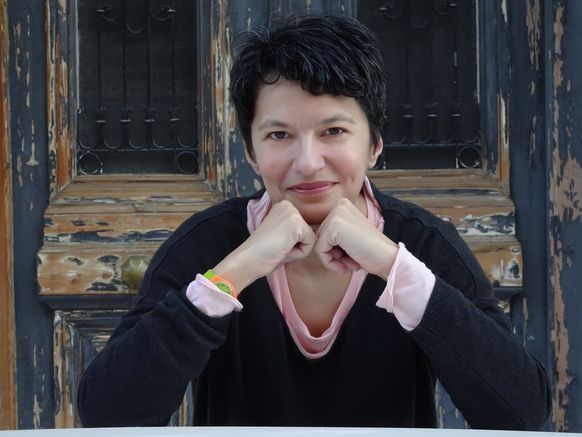
Eftychia Giannaki: “We are dependent on the falsehood of words.”
Read below the interview given by Eftychia Giannaki to the newspaper Ta Nea and its new column ‘Recommendations’, on the occasion of the publication of *The City in the Light*, the third part of the Athens Trilogy featuring Inspector Haris Kokkinos. The last time I was moved by a complete narrative was… a few days ago when I met Maria, who was feeding the stray cats outside the Archaeological Museum, even though she has lost her job and everything she owned and is trying to sell her helmet for ten euros, because she no longer has a motorbike, so what use is the helmet to her, but she doesn’t have a mobile either because it was stolen, and often she doesn’t even have enough to eat, though there is a cheese pie seller who helps her out at the end of the day. Though the narrative was incomplete, it was made whole by the silences, the glances and the complicit coexistence in this city that has been grinding everything down and digesting it all for centuries, inside and outside the Archaeological Museum, in such a way that even for the stories it makes no difference whether they are true or not. It is simply the navel of my own, or rather our own, world. If I could write to music, I would choose… to listen to classical music. At this time of year, I could listen for hours to Debussy’s ‘Afternoon of a Faun’ or Stravinsky’s ‘The Rite of Spring’ or Chopin’s ‘Nocturnes’, which I used to play. Not as I used to play them, but as Brigitte Engerer performs them, preferably.The most painful thing about the writing process… is that at some point you emerge from the imaginary world you’ve created—that is, from your own Garden of Eden—and find yourself back in the real world, which you realise you should never have left. The next day you repeat the same thing, not out of stupidity, but out of necessity. You are addicted to the falsehood of words. You are addicted to yourself. No higher power cares to save you from your writing, and this realisation is painful and, in a way, inevitable.Three books I would definitely recommend for a sixth-form library would be… Camus’s *The Stranger*, Kafka’s *The Trial* and Orwell’s *1984*. I read them for the first time as a teenager, and that was enough for me to realise that literature would never be a simple matter in my life. The criticism I accept concerns… every kind of opinion and perspective. When it is substantiated, it can open up a fruitful dialogue; when it is not substantiated, it may end in an interesting monologue. In any case, I seek it out. Self-criticism begins with… the word, moves on to the sentence, the paragraph, the chapter, the book, the books. I always look at the part, but also at the whole, to ensure it has some meaning so that it can exist and be read over time.The opening of a classic book that I envy is… the opening sentence of Virginia Woolf’s *Mrs Dalloway*. I won’t write it down, though, so you can’t look it up.When I hear about the ‘crisis in literature’ or ‘literature of the crisis’, I think of… those who judge without reading and those who read without judging. Find out more about Eftychia Giannaki here: www.giannaki.comLearn more
-

Interviews
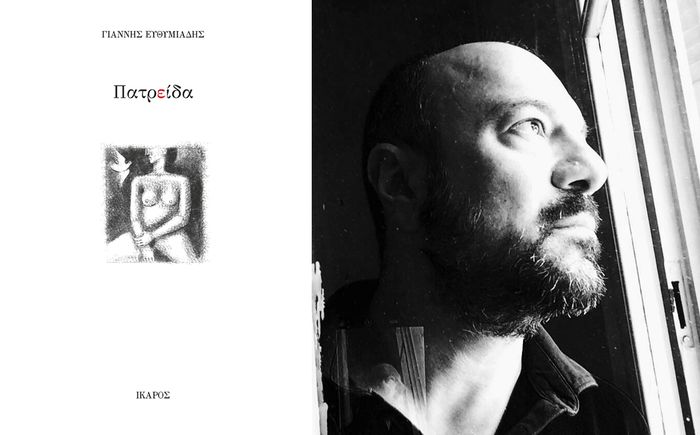
Yannis Efthymiadis: Homeland, an image of ourselves through the ‘other’.
Read below the interview given by Yannis Efthymiadis to Poli Kremnioti for the newspaper *Avgi*, on the occasion of his new poetry collection *Patreida*. “‘The revolution will come from deep darkness,’ declares Yannis Efthymiadis in his latest poetry collection, ‘Patreida’. Introspective yet thoroughly political, this poetry redefines the poet’s relationship with the concept of homeland, which is now approached on the basis of a re-engagement with humanity as both the individual self and a collective entity. ‘I shall say that for me, homeland is all that I love and all that I have seen,’ writes the poet in the first of the four sections into which the poetic composition is structured."In this work, I attempt to capture the image of a homeland as we have all experienced it over the last few decades, through our collective memory and through the loving relationships between people.Through this endeavour, I consciously began to redefine its meaning, to disconnect it from the narrow concept of place and to link it to people, to the lived experience of both those born here and those who found themselves in this place, and made it their homeland. Thus, the concept of homeland transcends its narrow geographical boundaries and is redefined within a much broader context, now as an image of ourselves through the other,” notes Yannis Efthymiadis.In the first section of the same name, the poet’s gaze turns to the people and things that make up the homeland; in the second – ‘The Week of the Depths”—highlights the grim reality of our world as reflected in the years of deep crisis in our country and globally.The third section is an elegy, “not, however, in the sense of a lament of resignation, but of realisation—that pivotal moment, in other words, that makes you realise you must react,” says Yannis Efthymiadis. In the final section – ‘the revolution will come from deep darkness’ – the poet urges action not out of over-optimism, but out of awareness. As he puts it, ‘poetry owes nothing, but poets owe a great deal’. In a time of transition, within a fluid international environment and a globalised context where boundaries are blurring and identities are shifting, Yannis Efthymiadis draws on the poetic tradition of his homeland, playing with rhyme and metre to highlight the internal structure and rhythm that run through the composition. ‘Rhythm is an element closely interwoven with our contemporary poetic tradition. I returned to the source because the deeper one digs, the more universally one speaks. Our times frighten me, because personal and collective identity has been lost; whether as an act, an expectation or a vision, fundamental codes of values have been distorted and counterfeited, which disorients us and leads us to chase illusory dreams. The omnipotence of money has marginalised our humanity, our aesthetics, our ethics; it has disrupted the hierarchy of values in our lives.”“Is this an issue that concerns poetry internationally?” we ask him. “The issues highlighted by our times concern poets, creators and artists all over the world. I think we are all in a period of searching and redefining; we are trying to pick up the thread where we left off when the post-war social vision collapsed. The reconnection with form and a more structured mode is a phenomenon that poets across the world are seeking today, so that they may build a new poetic reality on a firmer foundation. It is also a healthy reaction to the chaotic freedom to which the over-interpretation of postmodernism has led.” In this sense, the political dimension of poetry comes to the fore. "Poetry, from its very inception, is a deeply political phenomenon; it contains within it conflict and revolution, first and foremost against ourselves, against any certainty, whether we have defined it ourselves or it occurs without our knowledge.We always speak politically in poetry, even in its most lyrical outbursts, if one considers that poetic discourse comes to challenge the narrow economic and technical framework of the era. Perhaps, and indeed most likely, poetry cannot provide the solutions, but it can give us the strength to find them."Perhaps this is why Yannis Efthymiadis concludes his elegy with the firm assertion: ‘in arid times, the root grows deeper...’.Learn more
-
Interviews
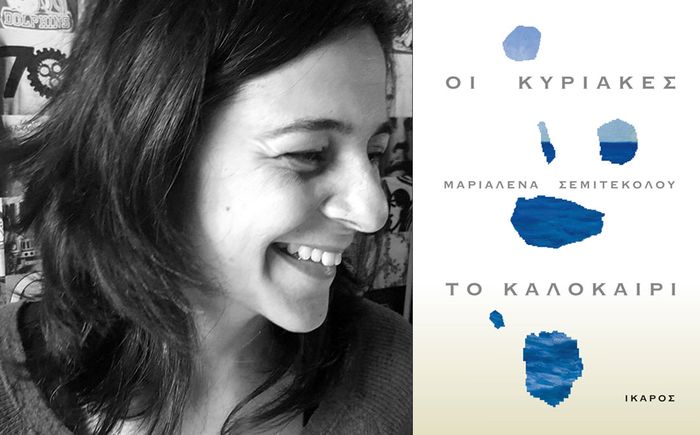
Interview with Marialena Semitekolou in “Pages for Book Lovers”.
On the occasion of the publication of her first novella, *Sundays, in Summer*, Marialena Semitekolou gave an interview to Sofia Politou-Ververi of Nakas bookshops. Read it below: Your debut with the book ‘Sundays, in Summer’ is a powerful one; it is a very expressive book with a heroine who draws us into her heavy inaction. Tell us about your choice to present Marina, the protagonist of your book, within the summer atmosphere of a city. Summer is not an ‘easy’ season. I chose it for Marina precisely for this reason. It is the season when people – young and old – grow up. Our growing up is not all joy; it involves pain and disappointments. Yet, in a strange paradox, the time of summer – which makes us grow up – seems to stand still; it doesn’t do you any favours: it is slow to turn to night, the days last longer, and one has the feeling that the slowness of summer time is constantly asking something of you. It was, then, this contradiction of simultaneous growth and suspension that probably led me to summer. And indeed, an urban summer that intensifies this sensation and gives it the image of a prolonged pause, rather than enriching it, which is what would happen in a natural landscape bathed in summer light.There is no typical happy ending in your book; what was your intention when you began writing your book ‘Sundays, in the Summer’?I knew the book’s final sentence and was entirely focused on it long before I wrote what came before. So perhaps it is a book written from the end to the beginning, rather than the other way round. On the other hand, I don’t know how common happy endings are, how long they last, how they’re defined or what they actually mean… In the case, say, of Marina, what sort of twist on her Sunday would constitute ‘a typical happy ending’? I don’t know… We’ve often wondered whether Marina suffers from depression. We’ve also wondered whether her behaviour reflects a large proportion of young people in our country. What would you say to us?I am sceptical about the ‘ease’ with which we conclude that someone is suffering from depression. I have the feeling, that is, that the verb ‘to suffer’, followed by a diagnosis, is a sign of the times we live in, and that it shuts people down rather than helping them to grow. What does, say, depression mean in Marina’s case? I prefer to describe her as a woman who surrenders to the allure of the melancholy that all Sundays inherently possess. If she suffers from anything, I imagine she suffers from the fact that she is alive... however paradoxical that may sound. In that sense, yes. She reflects a large proportion of young people, and of course those older in age, who are alive. What I don’t know is to what extent, both young people and older ones, we can bear to go with the flow that Marina is on, rather than sitting in front of a screen, idling or typing.What do you think is really missing from Marina to set her in motion, to pull her out of her sterile passivity? I wouldn’t for the life of me want to describe Marina’s passivity as sterile. I love her very much and I’d be doing her an injustice if I did. Marina’s ‘passivity’ harbours a whole host of things that will either help her grow or destroy her. I don’t know the outcome of this situation, although deep down I’d like the first scenario to come true, and I fear the second!How much did your studies in psychology help you in shaping Marina’s personality and the environment in which she moves? I’m afraid I don’t know the answer to that question. I imagine that my studies in psychology helped in some way. But the reverse could also be true. I really enjoy observing people and describing them from within, and that is perhaps why I decided to study psychology. If I had to say what helped me most in writing this story, I’d say it was all the summers I’ve spent in the city, reading other people’s stories or watching them at the cinema.After Marina in the height of summer, what can we expect from you? Do you have any ideas swirling around in your mind to get you started on writing?I’m very drawn to the idea of parallel monologues that ‘respond’ to one another, without ever knowing or finding out about it. I have a feeling this idea will torment me more than the idea of Marina. Marina was extremely kind and generous towards me. Where can we meet you online and in person? I’d love to tell you that you’ll find me in bars and cafés in the city centre. Even more so that I’ll always be on the terrace of a summer cinema and/or in the dark auditorium of a winter one, waiting for the opening credits of a much-anticipated film... Most likely, however, you’ll find me on public transport to and from the city centre or see me walking around my neighbourhood, doing all those everyday chores that help families function...Learn more
-
Interviews
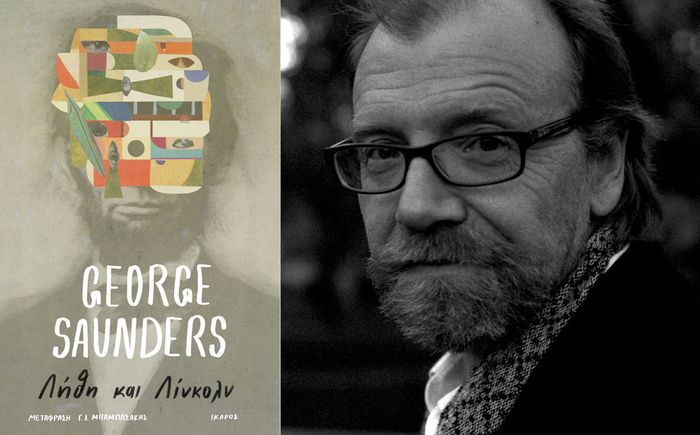
George Saunders: ‘Materialism is winning out over spirituality’.
On the occasion of his visit to Greece, George Saunders gave an extremely interesting interview to Sakis Ioannidis for the newspaper Kathimerini. Read it below: One of Harry Houdini’s first tricks was to free himself from a pair of handcuffs. The locksmith who made them had spent five years perfecting the security mechanism, and it did indeed take the resourceful conjurer over an hour to escape. On the shoulders of the cheering crowd, the king of escape wept. The American short-story writer George Saunders often brings Houdini to mind. The magician who set himself an ever more difficult problem each time. If he failed to unlock his chains, he would fail; but if he freed himself, then the problem became a trick, a performance. His latest book and first novel, ‘Oblivion and Lincoln’ (trans. Giorgos - Ikaros Babasakis, published by Ikaros), won him the Booker Prize in 2017. It is a journey of emotions, humour, love, and the struggle between good and evil in the ‘in-between’, in a spiritual state between the living and the dead, which unfolds as Abraham Lincoln visits the grave of his eleven-year-old son Willie in Georgetown Cemetery. Often, Mr Saunders felt the fear of Houdini struggling to free himself from his bonds. ‘If, as an artist, you want to tackle something difficult, you have to think of new tricks; the old ones won’t work,’ he tells us. “A historical novel, the death of a child, Lincoln – it’s like saying ‘I’m going to write a novel from a chicken’s point of view’. At first you’ll say, hmm, yeah, okay, but if you pull it off, you’ll be like Houdini,” he tells us. The worry Like everything else in his writing life, his latest book began with problems. “When I start a project, my mind makes a list of problems, such as that it might turn out badly, be banal, or tedious, and then I know I have a project. I was worried, but at this stage of my career, not worrying is dangerous. ‘I know how to write a story, and that’s the danger,’ he tells us. George Saunders was born in 1958 in Amarillo, Texas, with Greek roots tracing back to his great-grandfather in Crete. He grew up just outside Chicago in a family full of humour and funny stories. He studied engineering and for a time worked for an oil company that sent him to Sumatra in Indonesia. Until college, he had never left the US, and the travels he undertook afterwards changed his views; he moved from being a conservative to the political spectrum of the American Left. In 1986, at the age of 28, he was accepted onto the creative writing programme at Syracuse University, with the writer Tobias Wolff as his tutor and mentor.Sipping small sips of coffee from a paper cup, dressed in a dark short-sleeved shirt and black trousers that he frequently pulls up – he forgot to tuck in his waistband– he speaks nervously and effusively about his time in Syracuse, Chekhov’s stories, his admiration for Ernest Hemingway and Raymond Carver, and his image of what it means to be a writer. ‘I was young and thought that a writer had to be tough, drunk, uncompromising, and Toby (ed. Tobias Wolff) was none of those things. He was tough but kind, and I’d just watch him with his family, how he’d come and give a wonderful lesson, how he’d write his beautiful stories, and there was something liberating about it all. ‘You could be yourself; you just had to have an original idea,’ he tells us. Mr Saunders now teaches budding American writers on the creative writing programme at Syracuse University. Every year, there are around 650 applications for just six places, and we ask him about the tradition of American writers in the short form of the short story. In the America of ‘pragmatists’, he tells us, there is a tradition opposed to intellectuals that makes young writers feel uncomfortable with the grand themes of literature, a factor, he points out, that has favoured the development of the short story. ‘They feel more at ease with Hemingway’s approach: crafting something small and beautiful and letting the truth spring from within. The other reason is financial. Creative writing programmes are a great opportunity for young writers to enjoy a few years of freedom and favour short stories; they work best in the short form,” he emphasises.George Saunders is considered one of the greatest contemporary American short story writers, yet he shuns the ‘big issues’ that preoccupy other writers and remains ‘silent’ when his colleagues speak of ‘ideas’. ‘Writers like Roth come in through the front door and change the house. I come in through the basement window and thresh the grain in there. I’m like a thief, I look at the house and think about which window I can sneak through. I think I can contribute something regarding class issues. I’ve written about it and I’ll write about it again. I come from a middle-class family; in my twenties I lived at a lower level and I think I understand quite a lot about this subject, which is important and has been neglected. But when I see writers like Roth, Wallace, Flannery O’Connor, I think they’re simply brilliant. ‘I’m playing at a lower level, but I do it with passion and perhaps I can offer something,’ he tells us. His public silence, however, vanishes when he enters the writing process, where he poses questions without knowing the answers in advance. Thus, ‘Lethis and Lincoln’ touches on issues at the heart of America, such as slavery and racism, by placing in the narrative black people who have died, buried in an isolated mass grave. ‘I didn’t want to deal with slavery at first; I found it difficult for me. But then I thought, we’re in the Civil War, there’s Lincoln, we need some Black voices. Then it becomes automatic: where are they, why aren’t they allowed to be with the others, why is there a boundary? Suddenly you have all their stories. If you start this process and decide to be honest, the world will flood into your book whether you want it to or not,” he emphasises. “‘The ideas of humanity and kindness do not exist.’ Abraham Lincoln is something of a Jesus figure in American political history, and beyond. He is a figure recognised throughout the world, who steered the Union’s fortunes during the American Civil War, abolished slavery, modernised the economy, and whose face still appears on posters, T-shirts and American banknotes. The death of little Willie, the family’s third child, from typhoid fever, left a deep mark on Lincoln, who visited the child’s grave alone after the funeral.The idea of writing about the tragic event had been on George Saunders’ mind for 20 years. ‘There is a moment of truth when you realise that you are resisting something because it is difficult. If you do that, it means the end of your career. I trusted the feeling of terror I was experiencing, the one you feel when you see a beautiful person and are afraid to speak to them,” he tells us.The book’s publication coincided with Donald Trump’s election, and whilst he himself feared the book would be judged as ultra-patriotic (he firmly believed in Hillary Clinton’s election), people saw Lincoln and America in a different light. “It was as if they were saying, ‘Look at this wonderful thing we had, we took it for granted and now it’s changing’.”Historical sources coexist with ghosts, which give the book its distinctive flavour, its poignancy and its humour. The author likes them because they remind us that the world seems complete ‘because our senses are limited’.Loss and the process of mourning run through Mr Saunders’s book, and when asked whether addressing the subject through the novel helped him come to terms with the idea of mortality, the answer comes effortlessly: ‘Only because it didn’t happen to me!’ Neurotic and nervous Years ago, during a routine flight, one of the engines on the aircraft Mr Saunders was travelling in failed and cut out mid-air. “All I remember is saying ‘no, no, no, no’, as if I wanted to go back in time and have people say no, that’s not how it works,” he notes. He hasn’t come to terms with many things in general; he remains neurotic and nervous, he says, whilst as he grows older he realises that if he makes it to the end without major losses, in good health and with some sense of fulfilment, “it’s pure luck, it’s not something you earn”.The ‘corrosive idea’ of American capitalism, he emphasises, boils down to the simplistic notion that if you have a nice car, you’ve earned it; if you don’t, then it’s your own problem. “There is no compassion in this logic; the sense that anything can happen to anyone. This also applies to American politics: if you are unlucky, there is a sense that the responsibility lies solely with you,” he notes.Raised on the teachings of the Catholic Church at a time when the idea of the spiritual person came first, he now sees the world turning away from spirituality. “Throughout my life, I have seen materialism triumph over spirituality,” notes Mr Saunders, who has turned to the teachings of Buddhism. Blind faith in the slogan “America First” is terrifying, he points out. “The ideas they ought to be following—humanism, kindness, spirituality—are nowhere to be found. I don’t just mean Trump; the whole government is like that. This does not suggest a serious culture,” he concludes.Learn more