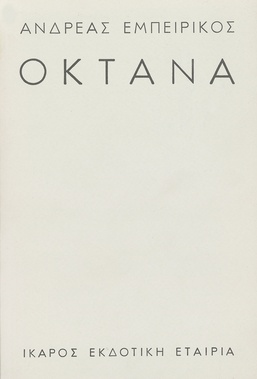
Octana is one of the finest works of Greek literature, in which Andreas Embeirikos envisioned the existence of a universal utopia of love, where people live in absolute bliss. The book expresses a coherent philosophical and cosmological system, dealing with love, death and the vision of a new world as its central themes. It consists of 31 prose pieces, of a lyrical nature, spanning a long period of time, written between 1958 and 1965. And now one might reasonably ask: ‘But what will Octana say?’ It is a fair question, and the answer will come quickly. But to fully understand it, first take a good look within yourselves, and immediately afterwards take another look around you, to the right and left, up and down. Then close your eyes for a moment and open them abruptly, opening your souls wide as well. The answer will be right before you, not merely intellectual, but tangible — a body, beautiful, living and pulsating. And now (amen, amen) I say unto you: Octana, my friends, shall be the meeting place of Earth and Heaven, where, extending into one another, the two become one. Octana shall be fire, motion, energy, the seed of speech. Octana shall be free love with all its pleasures. Octana shall be poetry at every moment, yet not merely as a means of expression, but also as the eternal function of the spirit. Octana will mean that perfection which makes what is impossible to achieve immediately ultimately possible, even the chimera, even utopia, perhaps one day even the immortality of the body and not just of the soul. Octana will mean the ‘I’ becoming ‘you’ (and conversely the ‘you’ ‘I’) in a single, immediate outburst, in a redemptive departure, in a divine union, in a supreme communion, which may well constitute divine Grace, the miracle within and beyond the self, whenever it takes place in ecstasy. Excerpt from the poem “Not Brasilia but Octana” (1965).
Author:
Andreas Empeirikos
Pages:
109
Dimensions:
21 x 14,5
ISBN:
978-960-7233-31-8
Publication:
1980
Categories:
Literature, Books, Poetry
Andreas Empeirikos
Andreas Empeirikos was born in 1901 in Braila, Romania, and died in Athens in 1975. From 1926 to 1931 he lived in Paris, where he became associated with André Breton and the Surrealists and began psychoanalysis with René Laforgue.
In 1935, he delivered his famous lecture on ‘On Surrealism’ in Athens and published ‘The Blast Furnace’, the quintessential surrealist text, whilst beginning to practise psychoanalysis, which he would cease in 1951. In 1945, “Endochora” was published, followed by “Writings or Personal Mythology” in 1960, and “Argo or Balloon Voyage” in 1964–65 in the journal “Pali”, in abridged form. After his death, in 1980, the complete "Argo", the collection "Octana" and Picasso’s play "The Four Little Girls", translated by the poet, were published. In 1985, “Ai geneai Pasei or Today as Tomorrow and as Yesterday” and “Armalas or Introduction to a City” (an introduction to a novel that was never written) were published.
In December 1990, in accordance with the poet’s wishes, the publication of “Megas Anatolikos” began; this was Andreas Embeirikos’s monumental life’s work, on which he had been working for 25 years. He began writing it in 1945 and completed it, after various interruptions, in 1970. The novel consists of 100 chapters, comprising five parts, and its publication was completed in 1992 in eight volumes. It is the longest and most ambitious novel in the Greek language.
In 1995, to mark the 20th anniversary of the poet’s death, a commemorative plaque was issued featuring his poem ‘ES-ES-ES-ER Russia’.
In 1997, his unpublished prose work “Zemphyra or The Secret of Pasiphae” was released, which belongs to the collection “The Whispers of Love”, to which “Argo” also belongs.
In 1999, the two eulogies for N. Engonopoulos were published as a separate volume: “Nikolaos Engonopoulos or The Miracle of Elbasan and the Bosphorus” and “Lecture 1963”.
Also in 2001, “The Diary” was published, along with the poet’s photographs from his trip to Russia in December 1962 with O. Elytis and G. Theotokas.
Andreas Embeirikos is one of the leading proponents of the science of psychoanalysis in Greece, alongside D. Koureta and G. Zavitzianos, with the collaboration and assistance of Maria Bonaparte. He practised psychoanalysis for sixteen years (1935–1951). Andreas Embeirikos’s psychoanalytic writings were first published in 2001.
The majority of Andreas Embeirikos’s work is published by Agra Publications, which has also published Hector Kaknavatos’s text “On the Great Eastern” as well as Savvas Michael’s study, “The Voyage and Return of the Great Eastern”, and the critical essays by Guy (Michel) Saunier, entitled: “Andreas Embeirikos: Mythology and Poetics”.
In 2001, the Year of Empeirikos was declared to mark the 100th anniversary of the poet’s birth, and numerous commemorative events were organised (conferences, publications in Greece and abroad, special features in newspapers and magazines, etc.)