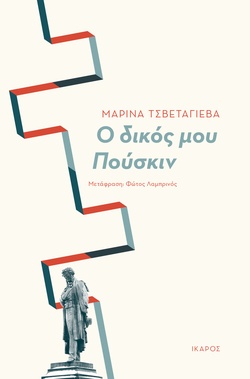
My Pushkin
In her book by the popular Russian poet Marina Tsvetaeva (1892–1941), ‘My Pushkin’, the author blends narrative, autobiography and poetic prose with great interest, in a unique quest to discover literature and its ability to transform reality.
Marina Tsvetaeva sketches the Pushkin of her childhood, her secret readings, her journey and her intellectual encounter with the great poet.
Marina Tsvetaeva sketches the Pushkin of her childhood, her secret readings, her journey and her intellectual encounter with the great poet.


Marina Tsvetaeva wrote the text My Pushkin towards the end of 1936 and the beginning of 1937, when she was forty-five years old, in the outskirts of Paris, where she lived. She herself says that ‘My Pushkin’ is the Pushkin of her childhood, whom she read in secret, ‘with her head inside the wardrobe’, where a thick book (Anthology) of Pushkin’s works was kept.
While writing, she sent letters to organise an evening at which she herself would read the text. The evening took place on 2 March 1937 in Paris, organised by the wife of the Nobel Prize-winning author Ivan Bunin. Tsvetaeva eventually received around 700 francs from the proceeds, paid for her son’s schooling and fed her family, something of which she felt proud.
Is there any prose more intimate, more penetrating, more heroic, more astonishing than that of Tsvetaeva? Has the truth of reckless emotions ever been so stark? Has it ever had such momentum?
―Susan Sontag
Author:
Marina Tsvetaeva
Translation:
Fotos Lambrinos
Text editing:
Maria Simeonidou
Date of publication:
12/06/2018
Pages:
88
Dimensions:
13.5 x 20,5 εκ.
ISBN:
978-960-572-238-8
Publication:
2018
Categories:
eBooks, Essays & Thought, Δοκίμιο
"...Tsvetaeva’s Pushkin is not the writer she assesses as an adult reader, but the impetus and elation that stirred in the soul of a little girl when she came into contact, without any literary mediation, with the works of a poet who speaks of love, fear, darkness and metaphysical anguish."
– Vangelis Hatzivassiliou, APE-MPE"...When Marina Tsvetaeva (1892–1941) writes about Alexander Pushkin (1799–1837), the temptation to lose oneself in the tumultuous biographies of Russia’s two great poets, neglecting their work, is immense. Their short lives were utterly fairy-tale-like, tragic, cinematic. On the other hand, their work, particularly their purely poetic output, remains virtually unknown in Greek. Praise is therefore due to the translator and publisher, for with this impassioned essay, written by Tsvetaeva in exile in Paris 100 years after Pushkin’s death...”
– Maria Topali, Kathimerini"...Marina Tsvetaeva’s book, _My Pushkin_, was published in 2018 by Ikaros, in an excellent translation from the Russian by Fotis Lambrinos. Tsvetaeva, one of the most important Russian female poets of the 20th century, describes in 1937, at the age of 42, how she had known Alexander Pushkin since she was three years old: Pushkin the poet, Pushkin the legend, the ‘statue of Pushkin’. The extensive reference to the poet’s statue in Moscow, which stood near Tsvetaeva’s home, is of particular significance: Alexander Pushkin employs the same device in one of his most mature works, ‘The Bronze Horseman’, whose hero is the statue of Peter the Great, whilst its subject, of course, is Peter the Great himself."
– Giorgos Tsaknias, Kathimerini"...So, I must tell you that if the word ‘essay’ weighs heavily on you, if prose rather than poetry is your great love, if you have no serious reason to turn to 19th-century Russian poetry, and if you do not heed my advice, then I very much fear you will miss the chance to read a masterpiece. That is the only way I can describe this book."
– Vivian Avramidou-Ploumpi, Amagi"...This short essay is, above all, a literary discovery, because alongside testimony and observation, Tsvetaeva gives primacy to language. A poet herself, she manages to incorporate the essay, memories and literary criticism into her own interpretation of Pushkin."
– Dimitris Doulgeridis, Ta NeaMarina Tsvetaeva
Marina Tsvetaeva was born in Moscow in 1892. She is counted among the most important Russian poets of the 20th century, alongside Pasternak, Mandelstam and Akhmatova.
She published her first collection of poetry in 1910. In 1912, she married the poet Sergei Efron, with whom she had two daughters and a son. She lived through and wrote about the Russian Revolution, and the famine that followed claimed the life of one of her daughters in 1920. She remained in the Soviet Union until 1922, when she was exiled, first to Bohemia and then to France. In 1939, she returned to the Soviet Union. That same year, her daughter was imprisoned and her husband was executed. The environment was particularly hostile towards her. She eventually took her own life in 1941, in the town of Yelabuga, where the Tsvetaeva Museum is now located.
Her poems were influenced by her complex personality, her relationships and her emotions. Due to her passion and bold experimentation, she is regarded as a great chronicler of her era.