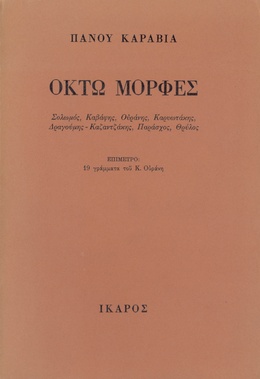
-
Author:
Panos Karavias
Pages:
388
Dimensions:
21,5 x 15
ISBN:
0000000000104
Publication:
1981
Categories:
Books, Essays & Thought, Δοκίμιο
Panos Karavias
Panos Karavias was born in Athens, the son of a wealthy family originally from Ithaca. He made his literary debut as early as 1921 with the publication of the poem ‘Holland Park’ in the magazine *Musa*. This was followed by further publications of poems and translations in the same magazine. During the same period, and whilst he had not yet finished secondary school (1923), he became a member of the demoticist group ‘Student Society’ and, during one of its events at the Hellenic Conservatory, gave a lecture on the work of Kostas Ouranis, a subject he had also addressed in articles published in the newspaper Athinaiki two years earlier.
From 1924 to 1930 he lived in Paris, where he studied at the École Libre des Sciences Politiques and the Collège de France, whilst, on the recommendation of Kostas Ouranis —whom Karavias had met following his 1923 lecture—he also worked as a correspondent for the newspaper Eleftheros Typos. Upon his return to Athens, he turned to journalism as a career. He worked for the French-language Egyptian newspaper Al-Ahram (as a permanent correspondent in Greece, from 1934 to 1946) and the Athenian newspapers Estia, Ethniki and Asyrmatos, whilst during the German occupation he contributed to the underground press under various pseudonyms. From 1946 to 1955 he lived in New York as editor-in-chief of the Greek-language newspaper Ethnikos Kiryx (1946–1947), and as a correspondent for the Athenian newspapers Athinaiki (1951–1953) and Eleftheria (1946–1955); with the latter he continued his collaboration even after his return to Athens, publishing columns and political articles. He served as general secretary of the board of the Association of Foreign Press Correspondents in Greece (1935–1939) and as a corresponding member of the New York Academy of Sciences (from 1950). He married the painter Celeste Polychroniadis. He died in Athens.
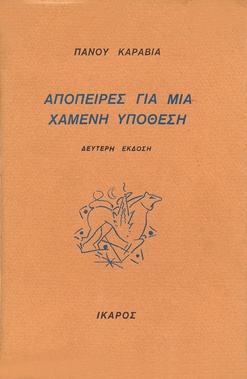
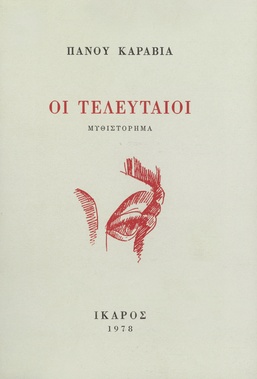
Alongside his journalistic work, he was also involved in literature and essay writing. The bulk of Panos Karavias’s literary output consists of prose works. He was a member of the editorial board of the magazine Símera during its first year of publication (1933) and a contributor to the magazines Peiraika Grammata, Nea Estia and Kainouria Epohi. His first publication was in 1930 with the collection of short stories The Night with the Colourful Lights. He was honoured with the State Essay Prize (1958 for the collection A Journey Without Stars and 1970 for The Passion of Writing and Landscapes), the First State Novel Prize (1963 for the work A Shadow on the Horizon), the essay prize of the Group of Twelve (1963 for Theses), the essay prize of the University of Athens (1970 for The Passion of Writing and Landscapes), the Ourani Prize of the Academy of Athens (1971 for the novel Constellations).
The work of Panos Karavias is situated within the context of Greek literature of the interwar period, amongst the prose writers of the so-called ‘30s generation. With roots in the European literary movements of aestheticism, romanticism and expressionism, and having begun his literary career in the field of poetry, Panos Karavias brought this poetic dimension to his prose as well. His entire body of work reveals his personal narrative mythology (which he also presented in his essays), with a strong presence of elements such as the subversion of traditional narrative structures, dreamlike writing, cosmopolitanism and sensualism, within the context of his constant quest to approach an idealised, transcendent reality capable of giving meaning to human existence.