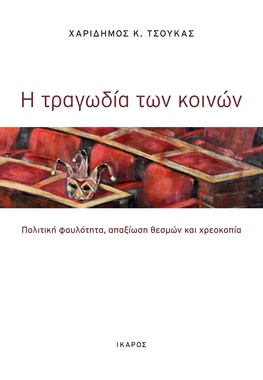
The tragedy of the commons - Political corruption, the discrediting of institutions and bankruptcy
-
When today’s children ask us tomorrow why the country went bankrupt, we will have to, if we are to be honest, tell them this, lowering our eyes in shame: Greece went bankrupt because we only cared about ourselves and not about the country!
This is the ‘tragedy of the commons’: in a system with distorted institutions, collective failure arises when individuals (particularly those in leadership positions) and organised groups (particularly clientelist parties, colluding businesses and predatory trade unions) methodically serve only their own narrow self-interest. Bankruptcy is the extremely painful result of a combination of political corruption, the discrediting of institutions and the incompetence of leaders.
This book is an anthology of my political columns (mainly in Kathimerini, To Vima and Kerdos) from 2007 to 2014, framed by an extensive introduction. The Tragedy of the Commons is, in essence, a chronicle of the descent into bankruptcy. His articles will give you the opportunity to look back and reflect – that is, to revisit the political and institutional processes
and decisions that led to the widespread collapse we are experiencing. A retrospective examination of political life reminds us of the problems we ignored or failed to address properly, highlights the opportunities we missed, and sheds light on the deeply ingrained mindsets we reproduce at every turn. The realisation of our collective failure may lead us to delve retrospectively into its causes. If we succeed, the economic disaster will have made us wiser.
Author:
Charidimos K. Tsoukas
Pages:
464
ISBN:
978-960-572-054-4
Publication:
2015
Categories:
Books, Humanities & Social Sciences, Οικονομία & Πολιτική
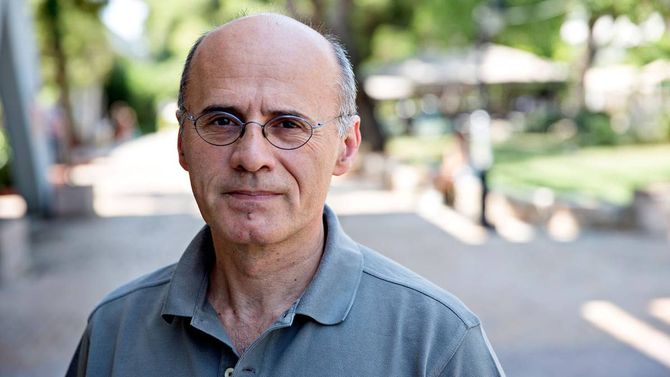
Charidimos K. Tsoukas
Charidimos K. Tsoukas was born in 1961 in Karpenisi. He graduated as an electrical engineer from the Aristotle University of Thessaloniki and as an industrial engineer from Cranfield University in the UK. However, he did not become an engineer, but turned to the social sciences, completing his doctoral thesis on Organisation Theory at Manchester Business School.
He completed his military service and subsequently pursued an academic career. He taught at the British universities of Manchester, Essex and Strathclyde, as well as at the ALBA Graduate Business School in Athens. He is currently Professor of Strategic Management at the Columbia Ship Management Chair at the University of Cyprus and a Distinguished Research Professor of Organisational Studies at the University of Warwick in the UK.
He has published dozens of articles in leading international academic journals in his field, as well as several books (either as author or co-editor), including: Complex Knowledge (Oxford University Press), Philosophy and Organization Theory (Emerald), From Stagnation to Forced Adjustment: Reforms in Greece, 1974–2010 (Columbia University Press) and If Aristotle Were a CEO (Kastaniotis). He is a co-founder of the prestigious International Symposium on Process Organization Studies and co-editor of the series “Perspectives on Process Organization Studies” published by Oxford University Press, whilst he has served as editor-in-chief of the distinguished academic journal Organization Studies. In 2014, he was awarded the high academic distinction of Doctor of Science by the University of Warwick for his scholarly work.
He has contributed to Greek newspapers and maintains a personal blog on political commentary (htsoukas.blogspot.com). He strives to instil in his students the value and method of critical and reflective thinking, without forgetting Wittgenstein’s aphorism: ‘Look, don’t think’.