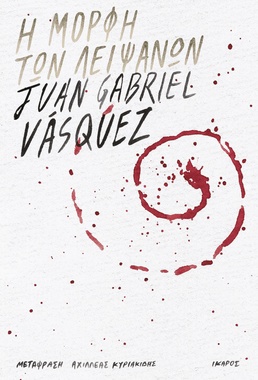
The Form of the Remains
Shortlisted for The Athens Prize for Literature 2019
A gripping novel and a unique historical exploration of the relationships we forge in a world rife with wounds and the machinations of power.
A gripping novel and a unique historical exploration of the relationships we forge in a world rife with wounds and the machinations of power.


‘Conspiracy theories are like climbing plants, Basques: they cling to anything to get higher, and they keep climbing until you take away what’s supporting them.’
In 2014, Carlos Carvajo was arrested in a museum in Bogotá for the theft of the cloth suit belonging to Jorge Eliezer Gaitán, the liberal political leader who was assassinated in 1948.
Haunted by these mysteries of the past, Carvaggio is constantly searching for clues that will give meaning to his quest. Yet no one, not even those closest to him, can fathom the deeper reasons behind his obsession.
What links the assassinations of John F. Kennedy and Jorge Eliezer Gaitán, whose death shaped the history of Colombia? How can a crime that took place in 1914—that of the leader of the Liberal Party, Rafael Uribe Uribe—mark the life of a man in the 21st century?
For Carvaggio, everything is connected and there are no coincidences. Juan Gabriel Vásquez, as the narrator and central character of the novel, decides to delve into the secrets of the darkest aspects of Colombia’s past.
By recounting the story of a crime, the author manages to shed light on a collective illusion, to show us that the novel seeks to reveal nothing other than what we truly are.
Arturo García Ramos, ABC
Author:
Juan Gabriel Vásquez
Translation:
Achilles Kyriakidis
Cover design/illustration:
Christos Kourtoglou
Pages:
680
Dimensions:
13,3 x 20,5 εκ.
ISBN:
978-960-572-190-9
Publication:
2018
Categories:
Literature, eBooks, Foreign Literature
"...‘You cannot escape the violence of Colombia,’ says Juan Gabriel Vásquez, who, in his new novel, delves into his country’s 20th-century history, a history marked by two political assassinations and the rise of the drug mafia, which flourished around the notorious Pablo Escobar. The past, the author agrees, is inherited. But when you look ahead, you are never bound by the past."
– Marilia Papathanassiou, The Books’ Journal
"...Vásquez’s unrivalled narrative ease, his ability to weave between the subplots that make up the story, the way in which he navigates back and forth through time, allow the reader a seamless reading experience, through which the author’s intentions are clearly revealed, but also—perhaps most importantly of all— the novel’s self-contained existence as a reality parallel to the reader’s own.”
– NO14me"...Vásquez’s recent work *The Shape of the Remains* begins as documentary fiction, evolves into political noir, and culminates in an existential drama."
– Nikos Davetas, Kathimerini"...From the particular set of elements that Vásquez chooses to place in his work, it becomes clear that this is not a simple political thriller, but a work that appears to constitute a duty and a statement by the author towards the Colombian people. It is no coincidence, moreover, that the protagonist-narrator himself, speaking in the first person and revealing many autobiographical elements of the author, recognises in himself the scars of his country’s extremely violent past.”
– Smassing Culture"...Crimes of the 20th century scar lives today, in this explosive tale of conspiracies that spread like climbing plants."
– Athens Voice"...The _Form of the Remains_ is, in simple terms, an explosive political thriller that demands your complete devotion, so that you can become one with the gripping development and climax of events and enjoy the hidden power of the narrator’s words."
– Kelli Kritikou, Athens Voice"...Lessons in Colombian history and, at the same time, an exemplary study of the psychology of conspiracy theories in the book by the talented Colombian author, who draws us into a veritable-fictional journey into his homeland’s past, as well as a literary game of interwoven references rooted in the Latin American literary tradition."
– Despoina Zeukili, Athinorama"...Vásquez’s book is excellent. Its length does not weigh it down. The unknown Colombia becomes known and prompts reflections similar to those of our own history. The framing of the two murders and their interweaving with the present day adds new dimensions and is thrilling. Highly recommended!"
– Ioanna Pappisa, in2life.gr"...If one wishes to understand why the very history of a place reveals the most gripping and, at the same time, painful instances of anguish and terror, one must read Vaskes."
– Tina Mandilara, LIFO"...What is certain is that, from book to book, Vaskes delves ever deeper into the heart of his native land. He belongs to a generation of Colombian writers who have decided to call a spade a spade, refusing to hide under the heavy shadow of magical realism."
– Dionysis Marinos, Bookpress.gr"...Although it refers to real historical events, *The Shape of Remains* is not a pure historical novel. It begins as an autobiographical confession by Vázquez and evolves into a crime-political thriller with alternating narrators and strong doses of suspense, constantly building bridges between the past and the present. And at the same time, it is a reflective novel about the old crimes that continue to haunt us, about how violence is passed down from generation to generation, and about the mementos that allow us to communicate with those we loved and lost."
– Stavroula Papaspyrou, LIFO"...Vásquez himself has stated that it took him years before he dared to confront the history of his homeland. In *The Shape of Remains*, he delves deep into the history of Colombia and gives us yet another outstanding novel that reaffirms, once again, his narrative mastery."
– Angeliki Boziki, Ogdoo.gr"...In this grand narrative, Vazquez, together with Carvaggio, crafts his own ‘post-history’. A work composed of a wealth of documents (indeed, in its pages Vazquez includes photographs of evidence), yet one that never for a moment allows the reader to feel that they are not reading a work of fiction. This is because the author, behind the collective memory and inherited history, seeks to uncover individual motivations."
– Christos Vasmatzidis, Eφημερίδα των Συντακτών"...Vásquez seems to feel that the time has come for Colombia’s intellectuals not to feel comfortable in their silence. They must speak of their history. The remains of their own dead have memory and form. For history repeats itself. As do the murders."
– Erika Athanasiou, Diastixo.gr"...Taking as his starting point the political assassinations of his fellow 20th-century politicians, as well as that of US President John F. Kennedy, the Colombian author invents himself as the narrator and central figure of his book, linking everything to everything else. With the assertion that ‘there are no coincidences’, he both develops and simultaneously undermines conspiracy theories. The attentive reader will also find some parallels with pre-1974 Greece."
– Dimitris Fyssas, Athens Voice"...The author unravels the thread of the conspiracy not to reach the beginning of the tangle, but to trace the paths it followed in an attempt to identify the difference between the trigger and the causes leading to the sudden outbreak of significant events, events which, over time, are recorded as historical moments, enter the official pages of History and stand like walls that cast a shadow over the events that preceded them."
– Aphrodite Dimopoulou, Diavasame.grJuan Gabriel Vásquez
Juan Gabriel Vásquez was born in Bogotá, Colombia, in 1973, and studied Latin American Literature at the Sorbonne. He has published eight novels, three collections of short stories, and four collections of literary essays.
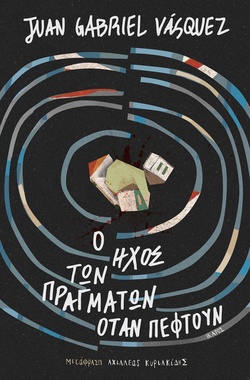
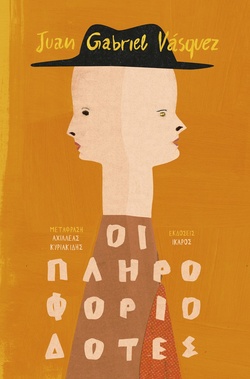
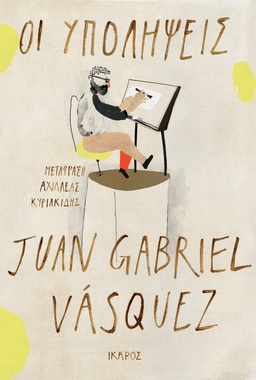
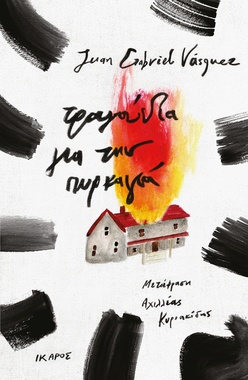
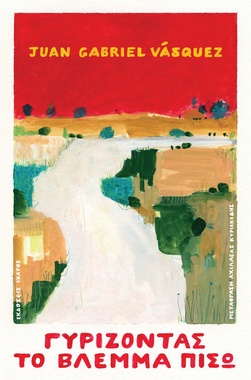
His books are available in Greek from Ikaros Publications: The Sound of Things Falling (2014), The Informers (2015), The Shape of Remains (2018), The Sublimations (2019), Songs for the Fire (2020) and Turning the Gaze Back (2021).
He has been honoured with numerous international awards, the most significant of which are the Premio Alfaguara (2011), the English Pen Award (2012), the Prix Roger Caillois (2012), the Premio Von Rezzori (2013), the IMPAC Dublin Literary Award (2014), the Premio Real Academia Española (2014) and the Biblioteca de Narrativa Colombiana Award (2020).
His books have been published in 28 languages and in more than 40 countries. In 2016, he was awarded the title of Knight of the Order of Arts and Letters by the French Republic.