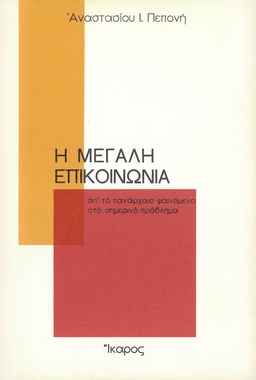
-
Author:
Anastasios I. Peponis
Pages:
176
Dimensions:
21 x 14,5
ISBN:
0000000000061
Publication:
1974
Categories:
Books, Essays & Thought, Δοκίμιο
Anastasios I. Peponis
Anastasios I. Peponis began as a student during the Occupation (1943–44), actively participating in the underground resistance press and other activities.
In 1951–52, he served as elected General Secretary and later President of the Youth Wing of E.P.E.K. (N. Plastiras). He opposed the executions of Belogiannis, Batsis, Kaloumenos and Argyriadis, resulting in his expulsion from the party.
In 1964, he took over as Director-General of the National Radio Foundation (E.I.R.). He introduced the Demotic Greek language on the radio, re-established formal cooperation with the Cyprus Broadcasting Corporation (R.I.K.) and founded the Experimental Television Station, which marked the beginning of E.R.T. television.
On the night of 15 July 1965, he opposed the royal coup and broadcast Georgios Papandreou’s message on state radio, denouncing the Palace government and marking the start of the Second Uncompromising Movement.
In 1966, he was a member of the editorial team of ‘Nea Dromoi’ (New Paths), the theoretical organ of the then centre-left wing of the Centre Union, led by Andreas Papandreou.
Immediately after the coup d’état of 21 April 1967, he took part in anti-dictatorial initiatives. He was convicted by the Special Military Court. He was released under the first partial amnesty. He was subsequently exiled twice. He was arrested twice more by the E.S.A. and held in strict solitary confinement. He was an elected member of the Board of Directors of the Society for the Study of Greek Problems (E.M.E.P.), which was dissolved by the dictatorship. He was also a member of the editorial team of ‘Nea Keimena’ during the same period.
Member of Parliament for Athens A, PASOK, 1977, 1981, 1985, 1989 (twice), 1990, 1993, 1996. Member of the European Parliament in 1981.
General rapporteur for the Constitutional Revision of 1985–86.
As Minister of Industry, Energy and Technology, he introduced natural gas into the country’s energy system and established, amongst other things, the Centre for Renewable Energy Sources (CRES) and the Industrial Property Organisation (IPO). He proposed and initiated the acquisition of the American company ESSO, which subsequently led to the establishment of the current EKO.
He served as Minister of: Industry, Energy and Technology (four times); President of the Government (twice); Justice; and Health and Welfare.