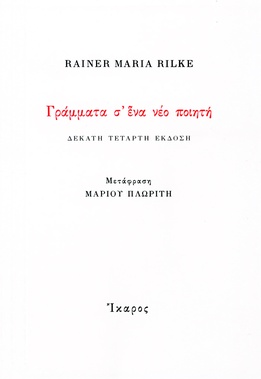
Ten letters that Rainer Maria Rilke sent between 1903 and 1908 to a young stranger, Franz Xaver Kappus, a cadet at the Military Academy and later a second lieutenant in the Austro-Hungarian Imperial Army, who soon left the army to devote himself to literature.
Author:
Rainer Maria Rilke
Translation:
Marios Ploritis
Pages:
111
Dimensions:
17,5 x 12
ISBN:
978-960-7233-30-1
Publication:
1944
Categories:
Books, Biographies & Personal Narratives, Αλληλογραφία
Rainer Maria Rilke
The Austro-German poet Rainer Maria Rilke (1875–1926) was born in Prague to a father who had been a soldier and a mother who was a society lady from a wealthy family of industrialists, the daughter of an imperial councillor. As a child and teenager, he was not particularly happy. His education was disorganised and fragmented. He initially pursued military training, but was unable to adapt and eventually abandoned it due to his fragile constitution. He enrolled at the Commercial School in Linz, but after a year he returned to Prague and focused on his studies; in 1895 he enrolled at Charles University and studied literature, art history, philosophy and, for one semester, law. He continued his studies in Munich and Berlin. He travelled ceaselessly throughout Europe. The fruit of his visits to Russia, which would prove to be a turning point in his life, was *The Clock* (1905). In 1901, he married the sculptor Clara Westhoff, and their daughter was born that same year. He settled in Paris, his geographical and artistic centre for some twelve years, where he became closely associated with Rodin and developed a new style of extreme linguistic and lyrical refinement, which is reflected in the "New Poems" (1907–1908) and the ‘Memoirs of Malte Laurids Brigge’ (1910). He fell into a creative crisis and deep depression until 1922, when, in the midst of a creative frenzy, he completed the "Duino Elegies" (1923), which he conceived in a moment of clarity in 1912 in Italy, whilst composing, in the space of just a few days, the “Sonnets to Orpheus” (1923), inspired by the death of a young girl; these two works would be regarded as his poetic masterpieces and would bring him international fame. Rilke spent the last years of his life in Mezy, near Lake Geneva, in the Rhône Valley, and died on 29 December 1926 at the Valmont sanatorium in Switzerland from leukaemia. According to legend, Rilke fell ill after being pricked by a rose thorn whilst tending his garden.