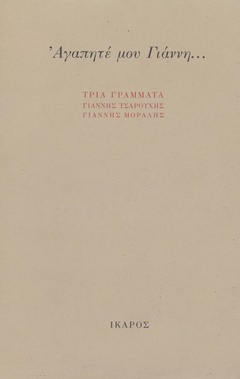
Two letters from Yannis Tsarouchis and one from Yannis Moralis, which the two friends exchanged in 1958, when Yannis Tsarouchis was in Dallas working on the sets and costumes for the opera "Medea" by Cherubini, starring Maria Callas. It also includes conversations between Dionysis Fotopoulos and the two great painters regarding that era, Tsarouchis’s impressions of America, their meeting and friendship, and photographs of the two friends from the archives of Yannis Moralis and Dionysis Fotopoulos.
Author:
Giannis Tsarouxis, Giannis Moralis
Pages:
72
Dimensions:
19,5 x 12,5
ISBN:
978-960-7721-14-3
Publication:
1997
Categories:
Books, Biographies & Personal Narratives, Αλληλογραφία
Giannis Moralis
The painter Yannis Moralis (Arta, 23 April 1916 – Athens, 20 December 2009) was one of the most distinguished Greek artists of the 20th century. His appointment to the Athens School of Fine Arts and his teaching there for 35 consecutive years (specifically from February 1948 to August 1983) proved to be of decisive importance in relation to a series of choices and directions in visual arts production in Greece in the years that followed.
Giannis Tsarouxis
Giannis Tsarouxis was born in Piraeus in 1910, the second son of Athanasios Tsarouxis, a merchant from Arcadia, and Maria Monarchidi, who hailed from Psara. The neoclassical building where he first saw the light of day, at the junction of Vasileos Georgiou Avenue and Louka Ralli Street, no longer exists. This great Piraeus-born painter spent part of his childhood (1920–1925) in the Metaxas family’s luxurious mansion, near his aunt Despoina Metaxas, who was his mother’s sister. Although the Tsarouchis family moved to Athens in 1927, Piraeus remained deeply ingrained in the artist, both because of the upper-class environment in which he was raised and which influenced him artistically, and because of the poor working-class neighbourhoods where he often escaped to during his childhood. In 1938, two years after his return to Greece, he held his first solo exhibition at the Alexopoulos gallery on Nikis Street in Athens, featuring works of distinctive character that were praised by the art critics of the time, Papantoniou and Kapetanakis. In 1940, he was conscripted and served in the Engineers. During the Occupation, he founded a private art school, which was attended for a short time by several young people who later became aspiring painters[1], such as Kosmas Xenakis, Minos Argyrakis, Nikos Georgiadis, and Rosita Sokou. In 1947, he held two solo exhibitions featuring watercolours and theatrical sketches. In 1950 he travelled to Paris once again, where a year later, in 1951, he exhibited in Paris and in London at the “Retfry Gallery”, whilst in 1953 he signed a contract with the Iolas Gallery in New York. In 1956 he was nominated for the Guggenheim Prize and in 1958 he took part in the Venice Biennale. In 1967 he settled in Paris. In 1982, the Yannis Tsarouchis Museum was inaugurated in Marousi, in the artist’s home, which he himself converted into a museum by donating his personal collection of works. The Tsarouchis Foundation also operates with the aim of promoting the painter’s work....Alongside his painting, Yannis Tsarouchis was also involved in theatre direction, indeed from 1928 onwards. He designed sets and costumes for the “National” and “Royal” theatres, the “Kotopouli”, “Municipal” Piraeus, etc., particularly for prose plays, as well as for the classic play “Romeo and Juliet”, which was staged in 1954 at what was then the Royal Garden and is now the “National” Theatre.Yannis Tsarouchis’s work primarily expresses the joy and wonder of life. He sought to balance the great traditions and capture eternal artistic values. His paintings incorporate many folk and folkloric elements, particularly from the port of Piraeus. He is considered one of the greatest contemporary Greek painters with an international reputation, particularly in France. At the same time, however, he worked as a set designer in both Greek and foreign theatres, always with great success. It is to him that we owe the establishment, in almost all scenes of Greek cinema shot in folk venues, of the presence of the sailor—whether dancing or not—which was indeed considered indispensable. In 1977, he staged Euripides’ The Trojan Women himself, in his own modern Greek adaptation, with his own direction and set design.