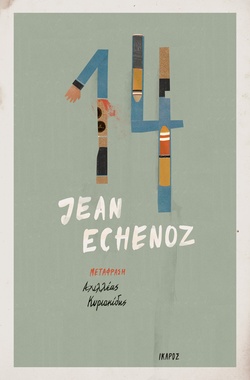
14
Jean Enoz purifies even the most toxic pages of history with his unparalleled narrative finesse and, above all, with the jabs of his bitter humour that exorcise Evil and bad literature.
“And then, a single bullet leaves the gun, travels twelve metres through the air at a height of seven hundred metres and, at a thousand metres per second, enters Nobles’ left eye and re-emerges above his neck, behind his right ear, and from that moment the Farman, out of control, hovers for a moment and then takes a pitch that becomes increasingly vertical, and Charles, with his mouth agape, over Alfred’s slumped shoulder, sees the ground approaching ever closer, into which he is about to crash at full speed with no alternative but an immediate and irrevocable death, without the slightest trace of hope – a ground that still belongs to the commune of Zonsery-sur-Velle, a pretty little village in the province of Campagne-Ardennes, whose inhabitants are known as Zonca-viduliens.”
Having chronicled in his own distinctive way the artificial solitude of charismatic eccentricity (Ravel), the compulsive endurance of the long-distance runner (Zátopek) and the natural genius (Tesla), Jean Enoz, himself a solitary writer on the contemporary literary scene, widens his focus just enough to accommodate five friends trapped in the trenches of the most outrageously bloody chapter in human history.
One hundred years after the outbreak of the First World War, which was to cost the lives of sixteen million people, Jean Enoz, in just one hundred pages of a novel that begins with the description of a double-faced summer and ends with the birth of a man, clears away even the most suffocating pages of history with his unrivalled narrative finesse and, above all, with the jabs of his bitter humour that exorcise Evil and bad literature.
Author:
Jean Echenoz
Translation:
Achilles Kyriakidis
Cover design/illustration:
Christos Kourtoglou
Pages:
112
ISBN:
978-960-572-015-5
Publication:
2014
Categories:
Literature, Books, Foreign Literature
The ‘foul-smelling and gloomy opera’ of the First World War, as Esnoz calls it, stripped the words heroism, honour, valour and courage of their meaning. And literature demonstrated this, transforming despair into narrative power
– Katerina Schina, KathimeriniIn this book, mutilation is equivalent to reintegration into the landscape of peace, and this is a statement by the author, who constantly and consciously removes the troublesome details from his canvas.
– Nikos Xenios, bookpress.gr"...14 is not a simple novel; it is a brief recollection and record of what once happened on this long-suffering continent, Europe, and it is also a literary achievement on Esnoz’s part, namely his ability to condense so much information into so few pages...”
– Yannis Antoniadis, culturenow.grJean Echenoz
Jean Echenoz was born in Oragne, France, in 1947. He lives in Paris and has published 17 books, all with Minuit. His first novel [The Greenwich Meridian (1979)] was awarded the Fénéon Prize for the best work by a new author, and his second [Cherokee (1983)] won the Médicis Prize.
The following are available in Greek: the novel *Lake* (1989) from Kastaniotis Publications, and the novels *The Tall Blondes* (1995), *I’m Leaving* (1999) – Goncourt Prize, Above All Not Chopin (2003) and the fictional (or non-fictional) biographies Jérôme Ledon (2001), Ravel (2006), The Road to Endurance (2008), Lightning (2010), and, from Ikaros Publications, the novel 14 (2014).