News
News List, News Categories, Events
-
“We are doomed to save the place”
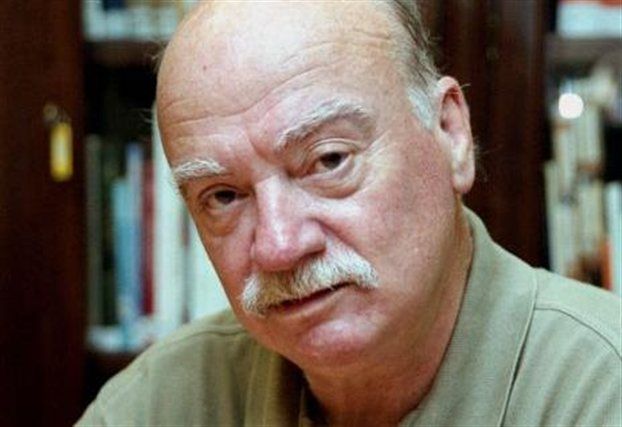
Stavroula Papaspyrou | Eleftherotypia | 15 March 2013 Dim. Nollas’s ‘The Journey’ captures the Greece that wounds us. How much of Greece can fit into 180 pages? If we’re talking about Dimitris Nollas’s new novel, enough to make it fall on your head as heavy as an axe. A few months after his short story collection ‘In the Land’, which emphasised the call for solidarity, understanding and love, the 73-year-old author returns with a dense work that seems to embrace all his previous books.‘A Journey to Greece’, due to be published in a few days (Ikaros), is set in 1963, yet is brimming with references that probe the darkest aspects of our recent history. A mosaic of situations and mentalities from which much of our suffering has stemmed and continues to stem, and an attempt, at the same time, to reconcile us with the famous ‘Greek character’, which today seems more valuable than ever.The journey of the central character—Aristos, an aspiring poet living in Germany, supposedly to study— the aspiring poet Aristos—is set to last no more than three weeks, and however confused his feelings were upon arrival, they will be even more so upon his departure. By the time he sets off on his return journey to that corner of Bavaria, where until recently he was ‘scraping by’ on his share of the family estate, Aristos will have realised that the image he took away from Greece was at odds with the idealised notion he carried within him. Even those closest to him – let’s set aside the inheritance disputes – will disappoint him. In his attempt to understand what sort of person he is, he will realise that, in the end, he is anything but blameless...Old wrongsIt all begins in the compartment of a train crossing the former Yugoslavia, with Aristo reluctantly accompanying a rather frail woman twice his age, ‘a poor soul’, a former factory worker in Germany, and indeed since ’43. He has undertaken to deliver her to her family, but as soon as they arrive in Thessaloniki, his ‘baggage’, as he describes her, vanishes off the face of the earth. And because he feels indebted to the man who entrusted her to him, he will call upon every acquaintance he has in his hometown to track her down. This serves as the pretext for the main plot of the story to unfold, along with all its subplots.The first stop on the journey is a Thessaloniki undergoing ‘modernising reconstruction’, ‘riddled with chasms’, where Aristos, at the sight of his French grandfather’s once-imposing villa—his grandfather having been the pre-war publisher of a local newspaper— recalls images from his childhood, long repressed: the figure of the loan shark who, during the Occupation, stripped the villa of its heavy furniture; his brother hiding during the Civil War, sought after by both the communists and the government forces. Nolla’s hero does not mince his words about the city’s ‘plague’ – ‘the black marketeers, the informers, the members of the Security Battalions, the plunderers of Jewish property...’—of the very same city that has just been charged with yet another crime, the murder of Grigoris Lambrakis. Old injustices are always joined by new ones...In a ‘backwater’ with the exotic name ‘Bombay’, amidst building contractors, traders, estate agents, informers and ‘uniformed bumpkins’ with an effeminacy that catches the eye, Aristos will seek the help of a diminutive Gendarmerie officer, in whose face one can discern the ‘experience of a century of interrogations’. The moment when he realises the price required for the information he seeks has not yet arrived. However, his brief stint in the illegal Communist Party of Greece and his association in Munich with left-wing students will prove to be his Achilles’ heel.The next stop on the journey is a mountain village in Western Macedonia, where lives perhaps the only person Aristos’s missing ‘luggage’ would wish to meet: an intellectual-rancher of considerable wealth, who looks up to Tolstoy, someone who witnessed the Trial of the Tones in his youth and saw his father murdered by a gang of mountain bandits, a man who is now slowly dying and who is eager to pass on to Aristos a distillation of his own experience of fratricidal heartbreak. We are now at the heart of the book, where perhaps the whole essence lies. Can anyone remain neutral in a civil conflict? Are those who plan to take the place of the old masters, promising the poor and the outcasts the abolition of classes and inequalities, just as much liars and deceivers as their predecessors because they conceal the fact that people will always be in search of a shepherd? Does not every new ‘shepherd’, whatever he professes, tend to his flock in his own way? Will Evil ever end? Rowers in the galley of life, people are at the mercy of circumstances, Nollas seems to argue, hostages of History but also of their ‘self’, that inexhaustible reservoir which revitalises the way we move forward. Every time ‘the roof above us leaks’, whenever our homeland is threatened by familiar arrows, we are doomed to rally our forces to save it. This is the land we were dealt, as if to say, this is the land we must live in.Learn more
-

A journey into the ‘heart of darkness’
Aristotelis Sainis | The Journalists’ Newspaper | 16 March 2013 In his most voluminous novel to date, the minimalist novelist attempts, once again, to shed light on the dark side of the country. Some wish to live seven lives, some have died and simply haven’t realised it, some cling stubbornly to the shell of life. The 1960s, the human geography of northern Greece and the coordinates of northern Europe, mythological allusions and literary fragments, as well as fateful destinies on the cusp of dream and reality, intersect to map the here and beyond of memory—both individual and collective.Dimitris Nollas’s new novel ‘The Journey to Greece’, recently published by Ikaros Publications, is read and presented by Aristotelis Sainis.M. Fais Just as the grotesque scenes in the offices of ‘The Lighthouse of the Blind’ formed the core of Alexandros Kotzias’s ‘Antiposeis Archis’ (1996), a den of debauchery appears to be the starting point of Dimitris Nollas’ latest novel. Pages from the relevant chapter were already published in autumn 2011 in the magazine ‘Odos Panos’. Skampardonis’ billiard halls (‘Too Much Butter on the Dog’s Hide’, 2006) and Vasilikos’s dens in ‘Z’ pale in comparison to this hidden, Europeanised backwater of ‘Bombay’, concealed behind smoked meats and bunches of garlic. Here, in the centre of Thessaloniki, the motley crew of patrons ends up in a surreal orgy: drunkards and street urchins, teenagers and young labourers, shop assistants and street vendors, but also contractors, estate agents, merchants and loan sharks, and finally, the police, today, protesting against their commanders being referred to the investigating magistrate… This is where ‘the heart of the city’ beats! The early years of the turbulent 1960s, and the ‘murder’ of Lambrakis casts its grim shadow over the foggy co-capital. ‘Mother’ Thessaloniki, once a labyrinthine refugee shantytown, is transformed into ‘a well down to the centre of the earth’ by ‘modernising’ reconstruction. The Tagmatasfalites, the Paotzides, the Poulikis, and the plunderers of Jewish property still hold sway. The narrative is framed by the assassination of Lambrakis (May 1963) and the elections of the same year, which bring to power a ‘bunch of Centrists, thirsty for money and power’, whilst the story’s timeline stretches back to the years of the Civil War, often even further, following the personal stories that converge in the present of the narrative.However, the precise chronotopic coordinates do not negate the text’s mythical aura, but merge with it. Undead Argonauts, demonised Prometheuses, Ariadnes and Penelopes, Icaruses and Odysseuses move openly or covertly through the text. Damned Hesiodic ‘poliokrotaphos infants’ repeat the same banal everyday story. Folk songs, biblical passages, overt or veiled intertextual references (Malakasis, Pentzikis, Seferis, Nietzsche – Kazantzakis, Goethe, Melville, etc.) create a textual labyrinth, analogous to the one in which the fictional characters move.Aristos Karabinis, a student in Germany who dreams of becoming a painter or even a poet, returns to his homeland, his mind still filled with ‘heroic holocausts, bloody acts of sabotage and massacres’. He is accompanied by an enigma, Chrysanthi: an early emigrant to Germany from the time of the Occupation, with an almost unknown background, only to lose her as soon as he arrives in Thessaloniki…The supplementary chapters at the beginning (‘Heading South’) and the ‘Northern European ascent’ at the end frame ‘Journey to Greece’. Aristos’s initial intention for an ‘exploratory visit’ to his birthplace quickly turns into an attempt to grasp the image of the ever-present and ever-absent, the innocent-guilty Chrysanthi (Margarita, Eleni and Evridiki together). Her death shifts the focus of the quest and places him at its centre. The leisure trip becomes an ‘apprenticeship’. In the northern Greek hinterland, steeped in myths and blood, at the bedside of the ailing, Promethean Apostolos, Aristos will come face to face with ‘horror’. In his attempt to unravel the tangle of old stories and shed light on dark family affairs, he will lose himself in the labyrinths of personal and collective memory, in the many ‘truths’ of personal narratives and historical accounts. An Odyssean ‘Nekyia’? A Virgilian ‘descent’? Dante’s Inferno? A new version of Faust? As the ‘gates’ of his hometown slowly close behind him, Aristos will be forced to pay his own ‘ransom’. Tryfon, a ‘peculiar child-monger’, a gendarmerie officer, in the role of Mephistopheles, will offer to ‘help’. Shortly before his departure from Greece towards the light (?), Aristos’s final, hesitant glance at Chrysanthi – before losing her for the second and final time – accompanies his decision to publish his poems. Perhaps because ‘writing begins with the gaze of Orpheus’ (Blanchot).‘Journey to Greece’, one of the longest works by the meticulous minimalist Nolla, constitutes the fictional development of his latest collection of short stories (‘In the Place’, Ikaros, 2012), as well as the dominant theme of his prose: the search for identity within an inhospitable and hostile world. As for the novel’s narrator, he surveys the story from above, shifts narrative levels, gradually becoming interventionist or even didactic, glancing askance and at times looking the dystopian present straight in the eye, convinced that ‘closely bound together, human beings drag behind them all that is to follow, always amidst all that was and is in the making’.Learn more
-
70 years on the wings of ‘Ikaros’
The ‘Ikaros’ publishing house is celebrating seven decades of existence and creative endeavour this year.Learn more
-
Covers
It is with great pleasure that we announce today the start of our collaboration with graphic designer and illustrator Christos Kourtoglou (@masterview_), who will be designing the covers for Ikaros’s new series of contemporary foreign fiction.Learn more