News
News List, News Categories, Events
-
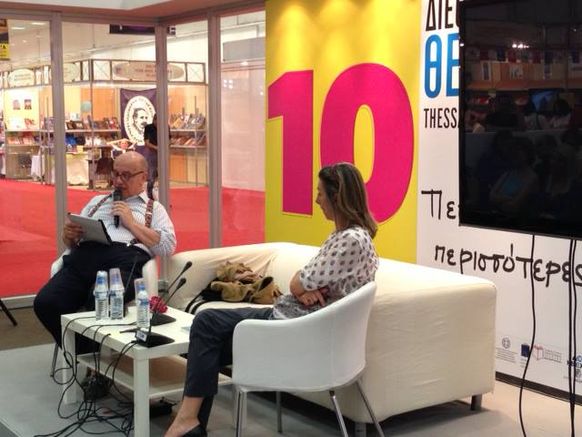
Friends in slight disagreement
Presentation of the Forster-Cavafy Correspondence by Panos Theodoridis at the 10th Thessaloniki International Book Fair.Learn more
-

New children’s books – May 2013
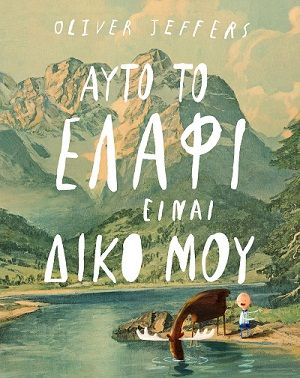
Two new books are hitting the shelves in bookshops these days, by two very different but much-loved authors!Learn more
-
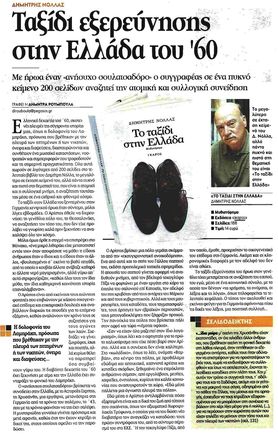
A journey of discovery through 1960s Greece
Dimitra Rouboula | Ethnos | 18 May 2013 The Greek 1960s, the dark sides of our modern history, such as the assassination of Lambrakis, figures who found themselves on the side of the defeated or the victors, dreams and disappointments, intersect and form a mosaic of situations, mindsets and behaviours that continue to shape today’s reality.All this fits into fewer than 200 pages in Dimitris Nollas’s latest book, his longest work to date, yet always dense and faithful to its theme, which is individual and collective memory, the search for identity within a hostile and envious world. The journey to Greece by the protagonist, an expatriate in Germany, was brief, lasting just a few weeks. Aristos wanted to explore his hometown, Thessaloniki, to seek out the place he had not had time to get to know properly before setting out to discover the whole world.But when the time came to return to Munich, ‘a small pebble had shifted within him’ when he decided to find out what sort of person he was and what sort of people others were, ‘plunged into that deep well, from which the bucket sometimes drew clear water and sometimes murky water’, but they circled round it, “as they all repeated the same myth, the same mundane daily story”.Aristos is one of those eternal students who survive on some family allowance and odd jobs and constantly postpone their studies until the next semester, as they spend their time discussing the struggles of the people. He plans to become a painter, perhaps a poet too, but above all he wants to observe what is happening around him. The infamous 1960s have begun in bloodshed, and Greece has been shaken by the murder of Lambrakis.The ‘restless wanderer’ finds himself accompanying Chrysanthi, a labourer and migrant to Germany since the war years of 1943, on the Acropolis Express to Greece; over the years, she seems to have lost her way. The mysterious woman becomes a pretext and then vanishes, as her own people have declared her to be, to whom he is obliged to hand her over. Aristos finds a city full of potholes from the ‘modernising reconstruction’. One of these is the house of his French grandfather, a pre-war publisher of a local newspaper. The absence of the house serves as a catalyst for memories to surface: of the vile loan shark Piza loading the living room furniture onto a cart with a labourer during the Occupation; of his brother hiding from Markos’s guerrillas and the government forces. But also the black marketeers, the informers, the members of the Security Battalions, the looters of Jewish property, the thieves who stole dowries. The plague of the city that is once again at the forefront and now ‘spews venom’. ‘‘As if they’d all been lumped together in the same account,’ as the narrator says of the first welcome that had weighed heavily on Aristo. But what follows is no better. In the ‘dive’, as he calls it, named ‘Bombay’, in the city centre, with a lobby filled with local and colonial delicacies, smoked meats and bunches of garlic, a motley human universe gathers, comprising contractors, estate agents, informers, uniformed officers, and gentlemen of high society who are rebuilding the country. ‘Here, an unknown side of the city pulsates.’ Here, Aristos realises just how dependent his own life is on the very types of people he despises, such as the Gendarmerie officer Tryfonas, who, in order to issue him with a new passport, forces him to denounce his former comrades from his brief stint in the Communist Party. Or the loan shark Piza, from whom, he learnt, his family allowance in Germany originated. Even the inheritance disputes with his brother are not innocent.The hero’s journey of exploration to his birthplace turns into a search for the self, the ego, within a social whole to which he is bound by ‘money, names, words and speech’, as the final chapter is titled. The place follows him and he leaves for Germany, leaving behind his own words, a collection of poetry...Bookmark‘...hundreds, if not thousands, of other people shared the same fate as Chrysanthi, finding themselves on the wrong side during that deadly decade, when the rebel insurgents were defeated, as it was impossible for them to return to protect their livelihoods without risking arrest and perhaps execution, with final convictions hanging over their heads. And so their relatives, their brothers and cousins, even their neighbours and distant kin, driven by the passion of jealousy, hatred and greed, would rush to declare them missing so that they could then get their hands on a few acres of land or many, (...), to pass into the ownership of those who had chosen to remain in their homeland and on the side of the victors’ (p. 131)Learn more
-
Interviews
Vangelis Raptopoulos: Interview in the newspaper Avgi
Poli Kremnioti | Avgi | Monday 29 April 2013 Much water has flowed under the bridge of history, from the December Uprising to the Indignant Movement. That thin thread, however, which links these historical cycles, can easily be traced in Vangelis Raptopoulos’s new book *The Most Hidden Wound* (published by Ikaros).In a charming "ping-pong" between memory and the present, between the frozen stillness of the past and the speed of the present, and with a lifelong love providing the impetus and dictating the whys and wherefores, the author runs through events and deeds, but above all he expresses his own anxiety about what we are experiencing today. And he calls a spade a spade, speaking out about the press, his colleagues, ideological and political practices, and the role they play in the particularly difficult times we are going through.From Peristeri, where he was born and raised, to the squares of 2011 and Manolada the other day, Vangelis Raptopoulos traverses this distance not as a mere observer but as a participant in the social game. After all, “in any case, the way out and the solution for me remains collective resistance,” he says today, and on every occasion. In his ‘Sto Kokkino’ programmes, in his books, in his teenage daughter… Interview with Polly Kremnioti: Is the wound of the civil war still as hidden as the title of your book suggests?I think it is; I realised this, after all, whilst writing the book, when I asked older people and they didn’t answer, but also in the time that has passed since its publication, during which people don’t want to hear about the civil war. I have presented the book from Veroia to Heraklion in Crete and from Kalamata to Thessaloniki, and everywhere I encounter the same reactions. Although the civil war is rhetorically brought up in public discourse, or the government is compared to the collaborationist government, Merkel to the Third Reich and Golden Dawn to the Nazis, the civil war remains a taboo. As I write in the book, the early years of the post-dictatorship era were spent on the recognition of the National Resistance, which was completed in the early years of PASOK. Since then, a few books on the civil war have been published, yet it remains a wound that society is still unable to come to terms with. Why do you think that is?Because the civil war brought to the surface the beast that lies hidden within each of us, and people do not want to remember that. Can this hidden wound of the civil war be healed today, at a time when Greek society faces a new, open wound?The great danger is not merely that it will not heal, but that we will slip back into the same cycle, into a new civil war, as a result of the unprecedented social injustice we are experiencing today, the widespread impunity, and the dysfunction of almost all institutions. All these problems have their roots in corresponding situations that arose from the civil war and were exacerbated by the post-civil war state with its persecutions, the ‘desert islands’, the certificates of social conduct, and everything else that Greek society endured for so many years.Why are you focusing on this historical period now? I grew up in Peristeri, just like the heroes of my novel, a neighbourhood where much blood was shed during the December events of ’44. I heard similar stories as a child from my father, and they left a lasting impression on me. I read voraciously and gathered material on the civil war, but the spark to write about it came from the Indignant protests in 2011. It is no coincidence that my novel begins with the transition to democracy and ends with the Indignants. The December events of ’44 are merely a flashback. I wanted my two middle-aged heroes, who are in love, to be convincing when they say they fear a new civil war. Only they can be so convincing because the novel describes the extent to which the civil war has become an obsession for them.Your two protagonists fall in love during the years of the post-dictatorship transition, and for the girl’s sake, the boy learns everything about the December events of ’44. His life is haunted by the idea of the civil war and by this great love, which, in contrast to the fast pace of our times, endures over time. It sounds strange...Even stranger is that this love begins in an era, the post-dictatorship period, when the sense of community was still strong, and lasts until the Indignants, when we witness the re-emergence of a sense of community. In the intervening period during which this love endures, our society has sunk into extreme individualism and privatisation. The novel seems to be saying that, if we do not want to end up in a blind, violent outburst, we must tackle the crisis not individually, but through collective processes.It is your most political book to date. Does the times demand it? And how does the writer engage with the times, each time? Since ‘The Invention of Reality’ and ‘Friends’, my books have turned increasingly and openly towards politics. Of course, I had some relevant background, if you consider books of mine such as ‘Does Simitis Listen to Mitropanos?’. But our times do not allow you to remain uninvolved. During the boom years, the dominant form of art was entertaining and decorative. Now we are witnessing a shift towards art that is comforting and uplifting. Yet we do not see this among artists and intellectuals.The majority of artists, like the majority of our society, have turned into ruthless conformists and opportunists. The few who have an opinion, and indeed a dissenting one, are not given a platform to speak. The neoliberal *Kathimerini* did not even review the book, whilst *To Vima tis Kyriakis*, which had made a show of slandering the Indignants in 2011, dismissed it summarily. Is our ideological opposition coincidental? I wish it were, but I don’t believe it. ‘Lifo’ was equally slanderous towards the Indignants. On a recent cover, it equated a Golden Dawn member with a rioter. How can such a publication endorse a novel that gives a voice to the rioters? And I say this because the penultimate chapter of *The Most Hidden Wound* is a young man’s account of the clashes with the riot police during the Indignant Movement era.Does this treatment bother you, given that you were one of the media establishment’s ‘favourite’ children? A favourite, but also often the target of criticism. In this particular case, however much it saddens me as a writer, it angers me as a citizen and confirms my worst political fears. The establishment neoliberal media, despite their rhetoric about democracy, are becoming increasingly authoritarian, increasingly repressive and censorious towards dissenting voices. Let’s not forget that the media, especially these days, play a leading role in manipulating and controlling the population. As Eco said, when you have the media, you don’t need tanks. Did your daughter read the book? How did she react? The historical and factual part of the book about the civil war discouraged her somewhat. Perhaps because her generation—Katerina is nearly 17—unlike mine, no longer has the slightest connection to those specific historical events. At her age, I was immersed in the literature of the civil war. But there is another reason: children of authors look for autobiographical elements in their parents’ works and identify the protagonist with the parent, especially when the narrative is in the first person. I think that of all my books, she enjoyed ‘The Incredible Story of Pappisa Ioanna’ the most, precisely because I didn’t live in the Middle Ages! What worries you about your child’s future? The paramilitary gang of Golden Dawn. What frightens me even more is that the 8% the neo-Nazis received in the elections means that there are broader sections of our society that have become more conservative and, to put it bluntly, have become fascist. The thugs who shot at the migrants in Manolada are Golden Dawn, whether they vote for them or not. The same goes for those who are not bothered by such atrocities. But this is the fruit of so many decades of privatisation and brainwashing by the mainstream media. Without the complacency and proverbial incompetence of the ruling parties, Golden Dawn would find no foothold for demagoguery nor any support within Greek society. The social insensitivity of neoliberal policies, the absurd and dangerous theory of the two extremes, as well as the eagerness with which some of my colleagues offer their services to the system – all these hatched the serpent’s egg. And without all this, perhaps people would not now be so numb, in this state of hypnosis. In any case, the way out and the solution for me remains collective resistance.info: "The Most Hidden Wound" by Vangelis Raptopoulos will be presented tomorrow at 7.30 pm at the Giorgos N. Vogiatzoglou Art Gallery (61-73 Eleftheriou Venizelou, Nea Ionia), at an event organised by Ikaros Publications and the Gallery in collaboration with radio station "105.3 Sto Kokkino". Speakers include Aris Hatzistefanou, Makis Milatos, Nikos Kourmoulis, Kostas Arvanitis and the author. Moderated by Fotini Lambridi. Readings by Mata Kastrisiou and Vangelis Zapaniotis.Learn more