News
News List, News Categories, Events
-
Children's book
Have you ever thought about what all the heroes you love have in common?
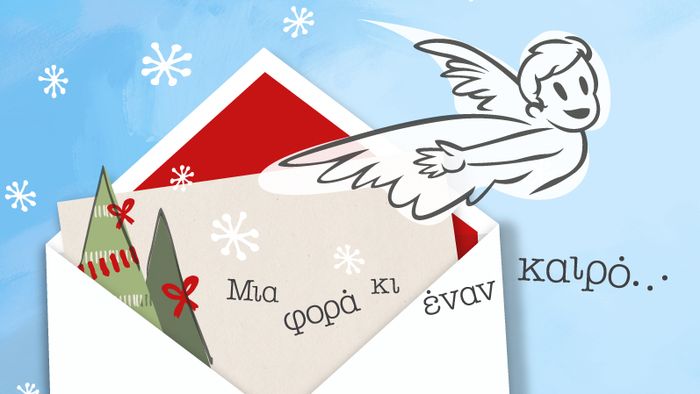
Just before the festive season, we have an original story to tell you about little Icarus, filled with the books we loved this year! Open the festive envelope now! Once upon a time, there was little Ikaros. ‘I love colouring cards and envelopes,’ he mused as he prepared a present for his friend. He was going to give her the biggest book about Families. Suddenly, he heard the clock in the living room ticking insistently. “Oh! I’m late for our friend Rosie’s surprise party!” he thought. “I must set off now! It’s a long way to her house.” As he was going, he thought of calling some of his other friends, but discovered that Kuku Vau was having a carnival party, his beloved Tsio Tsio was looking for the Easter Bunny, and Tik and Tela and their new friend had other plans. Just before he arrived, he also found Xylarakis. ‘Do you want to come with me?’ asked little Ikaros. ‘I’ve been looking for the way home all day and I can’t find it,’ he replied. ‘But I’m going anyway,’ he thought. ‘Rosie is waiting for me!’He arrived, and what did he see: all his friends were there and the surprise party was actually for him! So, the friends on the hill played their hearts out and had a great time. Even the Nutcracker was there – what joy!We know full well that authentic stories inspire us and open up new worlds, the discovery of which fills us with even greater satisfaction! The Ikaros team wishes you a happy new year and hopes that 2017 will be shaped by the authentic stories you love.Learn more
-

Interviews
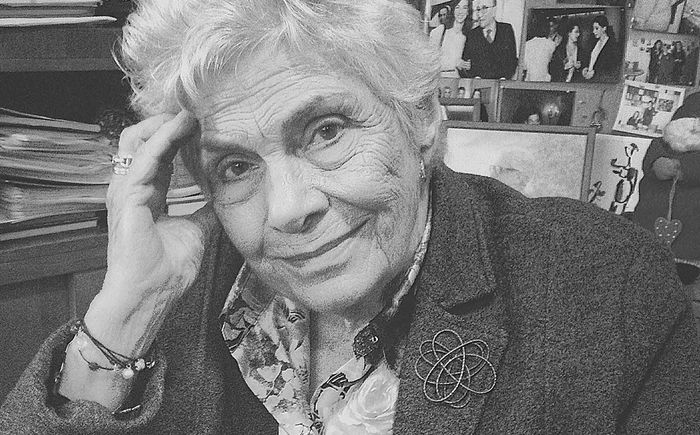
Kiki Dimoula: ‘The unknown remainder of my life still hangs in the balance’
The Greek poet and academic, Kiki Dimoula, on the occasion of the publication of her poetry collection ‘Ano Telia’, spoke with journalist Yiannis Hatzigeorgiou in the magazine ‘Filgood’ of the newspaper ‘Fileleftheros’ in Cyprus.The interview was published on Sunday 11 December and you can read it below: “Are there answers to ‘Must love be faithful? And if it isn’t, what should we do? Love with our arms crossed?”, Mrs Dimoula? I think the only one who would definitely answer “yes, we should love with our arms crossed” is Christ... As for mortals, they would answer according to the advice their endurance would give them... Please forgive me for prefacing every answer with ‘I think’. It is a polite, perhaps even prudent, cover for the honest ‘I don’t know’.What do you not know about life?… I do not know how it can be beautiful. Nor do I know how, whilst it is not beautiful – at least not constantly – it is constantly desirable and beloved. What is it that makes it so unpleasant at times? Whatever unpleasant things do. And above all, memory, the reminder that time is passing and so I will lose what I like or dislike. That’s no small thing – time is no small matter in life. Has the passing of time ever frightened you? When I was 16, it didn’t frighten me. When I was 20, it didn’t scare me. But after 35, I started to get the jitters… Now? Now I can’t even think about it. Now I’m really scared. Really, really scared. I’m not scared of anything else. And one way I found to combat that fear was to sit down and write a book. That takes time away from me a little… What is love to you? It’s an unknown thing… A completely unknown and uncertain thing. I don’t know what love is. Why do you say that? Because, my dear, we don’t know what the soul is. Just as we don’t know what feelings are either. We know nothing! Nothing is constant in this world and nothing has just one form all the time. So it is with love: it changes constantly. Think how great love can suddenly turn into no love at all! Therefore, I ask you too, what is love? Have you never had the certainty in your life that you were loved deeply? No. Now, if you mean whether my poems were loved, that is another story. I cannot say that I was loved deeply by many people. By my children, yes. By my mother, yes. By Athos Dimoulas, as much as I needed to be loved, because excesses aren’t nice. I, yes, loved very much. And Athos Dimoulas, and the days that passed, and the bad days that passed…In what way did you love the bad days too?… I loved those very much too. If I were told I had another five years of unpleasant days ahead, provided they didn’t involve the loss of people close to me, I would gladly live through five years of unpleasant days.How do you interpret the expression ‘I’m fine’? ‘I’m fine’ means I’m forgetting about death. Has something happened, has a little time passed—perhaps even three minutes—during which I’m not thinking about death? Then I’m fine! When I’m not thinking about it, I’m fine. How did you cope in the past with the loss of people very dear to you? Very badly. It was very hard. And I suffered from severe depression. My whole life changed. And when we talk about losses, I mean the loss of Athos Dimoulas. No other loss is as heavy as the loss of a person with whom you have lived for 35 years and who is suddenly gone. It’s not a simple thing; it’s nightmarish.Is there any way to ease this pain? Fortunately, time lends a hand and we no longer feel that acute pain that feels like madness – because we don’t forget. And it is madness, especially at first, because you cannot comprehend what has happened. How a person was lost. It’s not easy. It’s terrifying and impossible to describe the feeling that takes the place of this loss. Have you suffered many times in your life? I find that quite easy. It doesn’t take much for me to feel pain. Perhaps I get over the little things easily. But, in any case, I must say that I am sensitive; I am susceptible to pain. So what is joy? It is something entirely fleeting. Joy is being able to put your worries aside.Has happiness been a distant concept in your life? I have often, and with great regret, apologised for happy situations that I misinterpreted as sparse or even uncertain, when they were not. Is ‘happiness’, then, a difficult word for you?It isn’t difficult, no. Because happiness is, in any case, an unknown word. I don’t even know if such a thing exists in the world. Unless we’re fooling ourselves by saying ‘I’m happy’. What is this happiness which, if it exists, not everyone can have? So perhaps we all lead miserable lives? I don’t know. The things that cause our mood to change suddenly are elusive and unpredictable. You can’t foresee them. Something that is extremely unpleasant might not affect me at all, whilst something that is only slightly unpleasant for others might completely break me. It is a matter of the soul as to what a soul can face heroically. When does the soul become a heroine? Every day.In what way? Because every day it loses. And it’s terrifying to know that this soul, which you’ve never seen, which you’ve never touched, will one day leave along with the whole body. Fortunately, though, that’s how it is. Because it would be terrifying for the body to die and the soul to live on. Do both leave together? Yes. And one is inside the other. I think the body is the soul’s hiding place. What, in the end, is poetry, Mrs Dimoula? Passion or love? Or simply work – just as a bank employee goes to work every day? I think it is both passion and love, but above all a tireless, hard-working perseverance. Have words ever become a threat to the routine of your existence? For your daily life – which involves cleaning, cooking, going for walks, chatting on the phone with friends – without knowing what inspiration means and moving to another level, beyond this world?I deeply appreciate everyday life for its fertility. It conceives days, and it is itself the skilful midwife who gives birth to itself. Every day. And it is this precious regularity that inspires repetition. We criticise it as tedious, forgetting that it prolongs our lives. For how long? As long as time sees fit. Have you ever felt you were reaching God whilst writing a poem? As if it were not your own? As if someone else were dictating it to you? No ambition of mine has ever troubled God by asking Him to fulfil it. His own great creation demands His constant protection. Simply, if a poem, whilst impossible to write despite my efforts, is suddenly written, I do not claim it as my own; I say that the mysterious wrote it, or perhaps chance, whose DNA I believe is akin to that of the mysterious.You mentioned the word ‘ambition’. Have you ever been ambitious? Is it possible for me not to be and yet sit here writing a book? Of course I am. The first stage is that I have something inside me and I want to bring it out, but there is also the expectation that people will like it, because if they don’t, I can’t take it back.Why is poetry, in most cases, identified with melancholy and silence? Is it forbidden to embrace the joy and bustle of the world? Of course not. It is neither forbidden nor does it turn it away. It simply does not convince it that they have the lasting value to be included in its inspirations. How are ‘melancholies derailed’, Ms Dimoula? But how else – poetic licence. This very verse was written with that same licence.When you finish a poem, how do you feel? Relief? Or does it ‘torment’ you, days later, over its perfection, over the ‘what if’—what if a word had been placed elsewhere, perhaps the result would have been better?I don’t have blind faith in my poems, and so I let myself be gnawed away by a persistent, nagging anxiety. What about you? Is it possible not to have faith in your poems? No faith at all! None whatsoever, ever. I have a constant sense of uncertainty, even when the poems are applauded. And I think it’s quite right that I feel this way. It makes me more careful, more restrained in general; my head doesn’t get carried away and I’m very down-to-earth. I often think, ‘If I like this poem, does that mean it’s any good?’ I don’t know what a good poem is! They say that everything in life is mathematical. Even the way you arrange the words in a sentence. What is poetry?In my own opinion, of course, poetry is a very reverent ‘I don’t know’. Is poetry logical? Or perhaps not? Poetry has a logic that can only be deciphered by its half-brother, known as inspired absurdity.Does poetry sometimes tell lies? They aren’t exactly lies. They are a noble veiling of the unbearably crude truth. Are there moments when you would prefer your mind not to create poetry? Where, at times, does all this become a torment? I did not choose my temperament and its symptoms. I found it ready-made and respected it, adhering to it to the letter.Do you believe you were born with the destiny to become a poet? I regard ‘poet’ simply as a nickname for ‘human being’. Your poetry grapples with immortality. It has almost been imposed upon it. Are you happy that your poems will still be read even when you have departed from this mortal world? Let me state in advance my indifference as to which of my traces will survive, when I shall be compelled to submit to a second mortal world after this one…What comforts you today, amidst humanity’s many problems – which are ever increasing? So far, no comfort has seemed capable of reassuring me. Nor have I received any auspicious sign from distant prophecies. I am simply adding my two cents to the collection organised by faint hope in favour of the instinct for self-preservation. Are dreams old-fashioned after all, Mrs Dimoula? (smiles) Old-fashioned, yes. In the sense that they do not keep the promises they make to our naive slumber or our impoverished desires. What passions do you retain from your youth? Or have they all been ‘covered up’ over the years? You are almost asking me for an autobiography. But that has been taken over by secrecy. Christ lost ‘the delight of his all-holy love’. What have you gained from love? What have I gained? That I welcomed it without asking for a letter of introduction, and that I cared for it when it died… When does love die? That is very simple. It is no riddle at all. Love dies when it dies. We realise it immediately. Immediately! From a profound sadness that replaces that fragile feeling which is love. Are you lost to love? I am lost only to my obedience to my parent, fear. Does love have logic? Love is something completely illogical.Is it also an illusion? It is an illusion. It is also often something false. Love may not exist, but we may think we are in love because it elevates everything – everything soars when this happens; you are no longer earthly, you are heavenly.Is there no happiness in love? Of course there is. When? When you are the one in love and not the other way round, I think that is a state of happiness. Because the happiness of love is what you feel, not what the other person feels. Has it ever made us happy when someone is in love with us but we are completely indifferent to them? Things, you know, are very carefully balanced, with a certain wisdom, so that people can cope with conflicts and disappointments. Are there many such disappointments?Every minute. A minute ago I was different, and that is now contradicted by something else. What are you crying about, Mrs Dimoula? If you mean the reason I am crying, I won’t answer because tears are silent and their cause is introverted.Then how do you define your sensitivity? Where do you find it? I find it where it is called upon to ache. If someone asked you, ‘What kind of life have you lived, Mrs Dimoula?’, what would you answer? What kind of life have I lived? Well, the one that has passed. That is its most poignant feature. Was ‘this destiny of life’ that you have experienced so far a ‘long, tiring journey’? I shall answer that question of yours when I discover whether I am going or coming…What kind of life do you hope to live from now on? I don’t hope for anything. I only wish that certain things would not affect my children – health issues, because there are various such things that pose a threat. Beyond that, I’d like not to realise I’m dying – I wouldn’t want that. For it to happen simply, in my sleep, so that I never find out. What could be more terrifying than never knowing you’ve died! Quietly… Not just quietly. Not knowing that you are dead. Whereas you know when you are alive, that you are living. Is this not the ultimate rebellion of things? Do you still have unanswered ‘whys’?… Many. To which only fate is competent to answer. Which either turns a deaf ear or wonders itself who anointed it as inevitable. The ‘full stop’ at the end of your latest poetry collection suggests a continuation. And something unfinished. What have you not yet finished, Ms Dimoula? What remains unresolved in your life? The unknown remainder of my life, which is still unfolding…Learn more
-
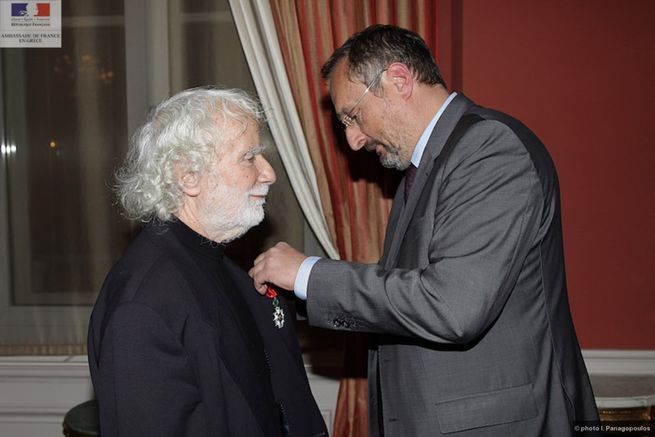
Honorary distinction for composer Giorgos Kouroupos.
On Tuesday 29 November 2016, composer Giorgos Kouroupos was honoured by the French Ambassador to Greece, Mr Christophe Chantepy, with the insignia of Knight of the National Order of the Legion of Honour.This distinction is a tribute to the popular composer’s successful career as a whole, as well as to his work in promoting contemporary French music to the Greek public.During the award ceremony, Giorgos Kouroupos spoke of the influence French culture had on him, the great reception his compositions have received in France, and how he strives to pass on to the Greeks the very best he has learnt from the French. Among other things, he said: ‘…I must have been nine years old when I first read Victor Hugo’s Les Misérables, in a children’s edition we had at home. I think that, deep down, my French dream—the Parisian one, to be precise—began to take shape subconsciously within me through Les Misérables…’ ‘…Nine hyperactive but happy years in Paris, sometimes tiring, but always creative. The impressive success, however, is more than enough reward for my efforts. My music is played everywhere, in the great concert halls of Paris, at international festivals of contemporary music. Commissions for new works are constant—the most important ones come from the Avignon Festival. I am also offered administrative posts (initially at the Paris Conservatoire and later at the Cultural Centre in Créteil, a suburb of Paris.)““...I tried, during my life in Greece, to give others what the French had given me, what they had taught me, but also what they had indirectly taught me in terms of civic education. I don’t know if I always succeeded…’ Those present had the opportunity to hear some of the composer’s works. The evening was graced by the presence of many artists and musicians, as well as the Minister of Culture, Ms Lydia Koniordou.Recently, we had the honour of publishing the very special five-language anthology of poems and prose by Odysseas Elytis, “The Small World, the Great World!’ by Odysseas Elytis with music by Giorgos Kouroupos”, in which the lyricism, boldness and expressive power of Elytis’s writing are combined with the colour of his visual artworks and the original musical settings of his poems by Giorgos Kouroupos. Find out more about the book here.Learn more
-
Children's book
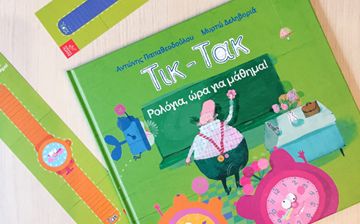
How time flew by making the Tick-Tock _ Clocks, time for a lesson!
“It’s no easy job raising clocks…” And indeed, it’s true: children don’t know that even clocks have to go to school to learn to tell the time… and the time has finally come for them to find out!This is the opening line of Tik-Tak, the brand-new, colourful fairy tale by Antonis Papatheodoulou and Myrto Delivoria, which tells us about time and its essential value in all our lives. The original portrayal of the ‘clock-teacher’ with his clock-pupils presents time from a different perspective: time that passes slowly or quickly, time that does not turn back, time that we spend together. At the same time, the narrative highlights the tender relationship between the teacher and his pupils from each of their perspectives.Today, we are sharing with you some of the book’s early drafts, as well as snapshots of Tik-Tak’s journey from the conception of the initial idea – about a year ago – to the day the book reached the printers. These meetings are the most creative and rewarding part of a publisher’s work. Ideas follow one after another, striving to better convey the story itself and its fresh-faced characters. The conversations are sometimes serious and sometimes incredibly funny, and through the ‘time we spend together’ we bond even more, and so we celebrate the publication of every new book together! Tik-Tak will be in bookshops from this week. Don’t forget to look out for the clock-bookmark we’ve designed. With it, time will pass even more enjoyably!Learn more