News
News List, News Categories, Events
-
Interviews
Ioulita Iliopoulou: “Elytis never lost sight of human values.”
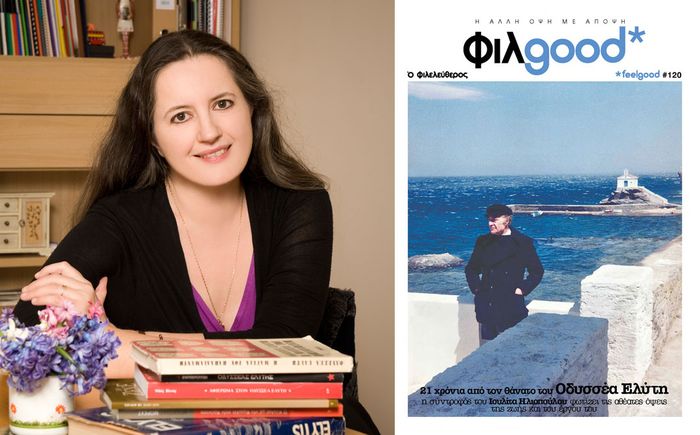
Ioulita Iliopoulou, on the occasion of the publication of the five-language anthology “The Small World, the Great World!” by Odysseas Elytis, set to music by Giorgos Kouroupos, as well as the 21st anniversary of the death of the leading Greek Nobel Prize-winning poet Odysseas Elytis, spoke with journalist Yiannis Hatzigeorgiou in the cultural supplement Filgood of the newspaper Fileleftheros in Cyprus.The interview was published on Sunday 12 March and can be read below: 21 years after the death of the leading Greek Nobel Prize-winning poet Odysseas Elytis, who passed away on 18 March 1996, his partner and companion in life, the poet Ioulita Iliopoulou, sheds light on the unseen aspects that have been inextricably linked to his existence and art all these years. Where does poetry stand today, Ms Iliopoulou? Where we are, I would say, with all that that implies. It is, after all, a very internal process within us, which, whilst it seems to follow our concerns, often dictates them; whilst it seems to capture our thoughts in language, it often provokes them. It is energy, power, for the writer perhaps, for the reader certainly – and it is there, unseen or visible, with him.What is the difference between writing poems and living poetically – or even placing oneself within the poetic function? For me, poetry, the poetic function and art are almost synonymous. The code of expression changes each time: language when it becomes poetry, sound when it becomes music, and so on. To live poetically, however, as you say, if it is not identified with the meaning given by Hölderlin when he wrote ‘all toil, and yet poetically dwells man upon this earth’ and is interpreted in its current, distorted sense, I do not know if it bears any relation to the deeper meaning of the poetic function. That which demands vigilance, transformation, boldness, sometimes arbitrariness, devotion, struggle, perseverance. To live amidst this constant stirring of one’s mind and soul, in constant vigilance, yes, that could truly be poetic! What is the ‘little and essential’ of life, according to Odysseas Elytis, ‘the little and precise’? But life itself in its elemental truth, in the purity of its sources, in the clarity of feelings, in the grandeur of thought, in the strength of the soul, in the reading of the secrets of its signs. How did he himself live his daily life? And in what way did he transform simple, everyday things into poetry? Just as poetry is transcendence, the overcoming of contradictions, free and combinatory imagination, but also order and definition, so too can the poet become a creator of wonders, yet at the same time he is a persistent cultivator, armed with ‘reason and dreams’. Elytis lived with order and a routine, devoted to his work, always very simply. He undoubtedly accepted stimuli, but the thematic core of his poems was not detectable – most often, even at a superficial level – within current reality. A particularly internal process gave meaning to his themes and transformed them linguistically. Photo: Alexandra Argyri‘Alone I ruled my sorrow… Alone I despaired of death…’. It is customary for us, as readers of poets, to imagine them – removed from all social interaction – in their solitude, creating, brooding, falling alone and then rising again, drawing courage from a secret strength that springs from within them. Was that how Elytis operated too? Spirituality is one thing, antisocial behaviour another; introspection is one thing, melancholy another. Elytis did not have a good relationship with melancholy, nor with isolation. He had loves, friends and collaborators throughout his life and always adopted a positive attitude towards life, with all its problems and difficulties. His focus on the essential, his deep faith in the power of poetic art, and his constant search for the crucial, constituted a way of life, of action and of responding to adversity.How did the poet work? How many hours did he devote to his poetry each day? The rhythm of daily life and work, in any case, changes according to the different phases of our lives. Elytis always worked on his writing, whether it was poetry or prose. When he was immersed in a project, he worked systematically from the morning, with short breaks to deal with practical matters. The hours of the night were always the most productive. Did he himself prefer the day and the light to the darkness, even though poets are usually inspired by the latter? Elytis built his entire body of work around the theme of light, shaping a ‘solar metaphysics’ – we are not merely speaking of a physical preference, but of a concept rich in meaning. Did he demand absolute silence when he wrote? Did he isolate himself? He loved the quiet during working hours, but nothing absolute or excessive. Isolation, after all, was not a matter of physical space, but of the inner process of contemplation. Even when he wasn’t writing, did you feel that he was already writing his next works in his mind? Thoughts, words and ideas are always circulating. Of course, no one writes only when they pick up a pen. Often he would be preoccupied with a line, a missing word, which he might find at an unexpected moment outside the writing process.Were there works he particularly loved, his own or those of others? He himself loved to move on to the next one. To change form whilst remaining true to himself. He did not refer selectively to his own works. On the contrary, he often referred to Dionysios Solomos or Hölderlin. Who, in his opinion, could be called a poet? I think that the work, and ultimately time, history, bestow titles and names. Elytis’s choices in his prose writings set the standard; they convey with absolute clarity the scope and the defining distinction of the meaning of ‘poetry’ and, by extension, ‘poet’.How did Odysseas Elytis’s human sensitivity and spirituality combine with the intellectual power of his thought, with his vigorous yet at the same time lyrical writing? I see nothing contradictory in what you say. Spirituality and intellectual power, lyricism and sensitivity, are complementary and reciprocal pairs, good conduits of their energy.The world, because whilst it is small, it is at the same time great, just as the title of the excellent Ikaros publication you recently edited suggests? Was this also the world of Odysseas Elytis? The small, humble elements of this world are those that have the greatest significance, value and endurance. Whether it is a mint leaf, a seashore, a word or an embrace. The world of small units presented in ‘Doxastikon’, for example, captures both the grandeur of the mystery of existence and the essence of his own Greek identity. Tell us about this new edition: ‘The Small World, the Great World!’ by Odysseas Elytis, with music by Giorgos Kouroupos”, published by Ikaros Publications… It is a portrait of the poet, a brief yet substantial exploration of Elytis’s autobiographical and essayistic writings, accompanied by an anthology of characteristic poetic fragments that reveal, to the initiated reader and, above all, to the uninitiated, his poetic principles and his value system. The poet’s visual works—tempera paintings and collages, as well as photographic material—adorn the publication, which encompasses not only the image but also the sound of poetry. Recitations, musical accompaniments alongside the spoken word, but above all Elytis’s poetry set to music by Giorgos Kouroupos, are captured on the two CDs included. This is a magnificent musical setting, which succeeds in offering all the delight of a joyful lyrical listening experience through enchanting songs, whilst also demonstrating the deep connection between the word and the musical phrase, thus leading the listener deeper into the magic of the poetic world. At the same time, all this material—both poetry and prose—is rendered in four other languages. Translations into English, French, Italian and Spanish are included in this five-language anthology.How did you discover this magic of Odysseas Elytis? In other words, what was the point at which Odysseas Elytis became the most important of all to you personally, to your daily life, to his presence – even in his absence today? My first real encounter with him – with his work, I mean – took place when I was a schoolgirl and read ‘Three Poems with a Flag of Convenience’. From a collection of, one might say, idiosyncratic theoretical poems, I subsequently came to appreciate the lyricism, the philosophical reflection and the magic of his language. This encounter continues – I mean my engagement with and study of his work. What, however, were the difficulties of living alongside one of the most significant figures of Greek intellectual life? Elytis never lost his sense of human proportion. He lived simply, applying the principles of his work to his life; he lived honouring the little and the precious, the essential, the humble things that can be priceless. He had great energy, a positive attitude towards life, and respect for others. He gave space to those he loved; he was keen for others to find their own path. All these things are precious in a shared existence.In what moments is he present in your life today? Well, the people we love live within us anyway. Elytis, in fact, is constantly present. Don’t forget that a large part of my work – apart from my own writing – is connected to his work. I study his work, I collaborate with translators and scholars on it, and I recite his poetry. Elytis was also the poet who, through his art, celebrated Greece, its beauty and its islands like few others… What was his own relationship with the sea, with travel, which islands did he love? Insularity in his poetry is a distinct theme, one that is present and evolves throughout his entire body of work. It is simply, I would say, the identity of the Greek; it is his fingerprint, a mark created by art, history and the natural landscape. Elytis travelled extensively throughout the Greek islands. Spetses, as the place where he spent his summers as a child, shaped, I would say, his island consciousness. Later, of course, the Cyclades were a destination for exploration, as he encountered these islands in their unspoilt state.Did he distinguish Cyprus from Greece? He loved Cyprus – beyond the fact that it had been his refuge for a few months during the dictatorship in Greece – he honoured its history, admired the industriousness of many Cypriots, and worried about its fate. How could he distinguish Cyprus from Greece, you ask, since, as he wrote, ‘where the language is, there is the homeland’? Did he realise the extent of his own importance? He had no conceit, if that is what you are referring to.Did he not even believe, when he was awarded the Nobel Prize, that he was truly important and memorable? The Nobel Prize did not change anything in his life. It perhaps took two years of his work, because he was forced to respond to certain proposals, deal with a huge volume of correspondence, and undertake journeys. But with the same dedication as before, as soon as the great commotion of the Nobel Prize had died down, he returned to his same small office, to his writing, battling ‘the “No” and the “Impossible” of this world’. ‘‘I lived on nothing / words alone were not enough for me…’. In what circumstances were words alone – and only words – enough for him? Words are never enough, because we carry on writing and searching for a new formulation, a different way of capturing a fresh thought. Did he have friends? Did he enjoy socialising? Or was he particularly – and very – selective in that regard too? Of course he had friends. Empeirikos, Moralis, Gatsos and many others were suddenly his close friends. Evangelos Louizos, for example, the publisher Nikos Karydis, Takis Horn. In fact, he maintained friendships dating back to his university days, friendships that lasted until the end of his life. Love is also a significant part of his poetry. How did he perceive it? As yet another god? As something innocent? As something that, when it happens, silences all other aspects of existence? Love is a primary element in his work, permeating his writing, existing either as a romantic conception of the world, or as sensibilities refined by the intellect, or as a natural approach. It is love ‘in each other’s embrace’, but also the belief ‘that love is not what we know, nor what the magicians claim. But a second life, unblemished, in eternity’. You were, Ms Iliopoulou, that slender girl with long black hair, always by the poet’s side and in literary circles. What do you retain in your memory today from all those images? What I retain is not a memory, but the desire to exist with the same purity, respect and love towards the creations of the mind and art – towards life. When did you first encounter poetry? If you mean when I started writing, quite young, at primary school. How much has your perspective on it changed since you ‘met’ Elytis? I met Elytis early in my life. For me, then and now, he represented and continues to represent the embodiment of marvellous richness of content and expression – I’m telling you this just as I expressed it back then, as a schoolgirl. Of all the things he used to tell you from time to time, which is the one you would take with you for today’s world? Of all that he told us, to everyone, and tells us daily through his work, let us conclude with the exhortation to seek within our reality ‘the deepest meaning of a humble paradise, which is our true self, our right, our freedom, our second and true moral sun”. Find out more about the five-language anthology “The Small World, the Great World!” by Odysseas Elytis, set to music by Giorgos Kouroupos.Learn more
-

Citizenship and moral imperatives in the difficult times of Dimitris Nollas.
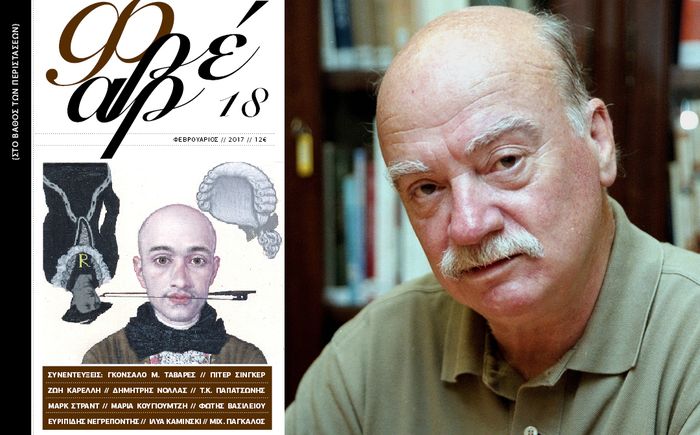
Literary critic Alexis Ziras has written a very interesting piece on citizenship and ethical issues in the author’s work, prompted by Dimitris Nollas’s trilogy *Difficult Times*.The review was published in the 18th issue of the literary magazine Freat (February 2017). You can read the text below: Often in literature, the material from which an author draws and through which he represents his mythical realm is such, and of such intensity, that it is capable of ‘take’ the initiative and overturn the original design with which it was conceived and planned, steering it towards a specific form of work. It reaches the point, so to speak, of snatching the creation from the creator’s own hands and setting it on a course other than the one intended. And this ultimately regardless of whether what the author originally had in mind was realised or not. Why does this happen, assuming it does? Because the fictional characters, their relationships, their speech, what they see, think and convey to the visible or invisible narrator, when they are embodied in a work of fiction, automatically acquire their own way of thinking, as Milan Kundera said in his essay ‘The Wisdom of the Novel’i. A way that is sometimes different from that of the author. And with the ‘wisdom’ they possess—which is interwoven with the depth of their language—they can ‘assure’ or ‘mislead’ their creator (by leading him astray), convincing him that the story he has written is best left as it is or, conversely, to leave openings and loose ends and to hint (together with the author and the reader) at its continuation. In any case, self-contained stories and self-contained works cannot literally exist; it is one of the delusions of the prevailing theory, which always dreams of imagination as its tool, chained like a wild beast! Every story, every narrative, is more or less open-ended, which means that the accounts it opens do not concern only what will emerge as its continuation, but also what has already emerged as accomplished and is supposed to be closed and finished. This multifaceted dialogue, which the work can only bring to a halt through its own demise, is both the author’s greatest fortune and his greatest risk, however often he himself may fail to realise this immediately or choose to sidestep it. A privileged reader Having completed his previous book, The Journey to Greece (2013), it is reasonable to assume that Dimitris Nollas became a reader of it himself. I suppose that, on rereading it, he felt how the world of the novel was suffocating within the confines of that particular fiction, where it had been locked away. Which world? The post-civil war, exhausted world of Thessaloniki and the surrounding ruined Macedonian hinterland, which was already, with the blessings and encouragement of the state, emigrating to Belgium and then to Germany. Furthermore, the post-civil war opportunists and their various hangers-on (beyond the explicit or implicit ‘ideological’ connections) who emerged from their burrows, profiting from the capacity for political transformation. In other words, everyone and everything that went into the meat grinder of post-war Greek history. And furthermore: the very circumstances that the figures of fiction carried with them, their fate and their vision of life. Above all, the unfinished relationship with what they left behind as they set off on their journey to the beyond: the spirit of connection with the familiar, but also something even stronger, the spirit of the land. In the language they used—which, understandably, was most comprehensible to their creator himself—they admonished him that whatever he had hoped would be realised as the novel’s meaning remained unresolved. For this reason, we assume that the planned trilogy, subtitled ‘Difficult Times’, was not announced from the outset, in the first edition of 2013, but in the 2015 reissue, so that its second part, Marbles in the Middleii, which, if not exclusively, will at least largely occupy us in the remainder of this critical journey, might be seen as a kind of continuation of The Journey, continuing to ‘weave through the night’, illuminating everything around it, in accordance with Nolla’s intertextual borrowing from Andreas Embeirikos’s beautiful poem ‘Strofes strofalon’! However, this change in the sailing itinerary, with a destination of at least a three-part fictional voyage, has indeed already created a curious relationship between the first two parts. One could say that *Marmara*, in relation to *The Journey*, is a book of reflection and introspection, or an apologia. But given the impending arrival of yet another volume to complete the trilogy, would such a preliminary apologia not be both pending and, at the same time, invalid?Certainly, in the fictional parts we are already familiar with, the contribution of the jack-of-all-trades Aristos Karampinis is fundamental; a young man whose presence—active, shadowy or behind-the-scenes, significantly shapes the course of the narrative, even after his death, under circumstances about which we know very little. His presence also plays a key role in the soteriological/moral message that the author of Difficult Times seeks with intensity and passion to convey to the reader, regardless of whether the critical reception of Nolla’s books has generally sidestepped this issue, stammering, feeling at a loss, or not knowing how to handle it! It is true that this truly idiosyncratic writer (and by ‘short-story writer’ I mean in his early books) has always been fascinated by characters who played various roles and wore a variety of masks. If we look closely, what remains of these characters is, to a very small extent, their specific physical traits and, to a greater extent, their psychological makeup, their behaviour, what they say, feel and express. Moreover, their enigmatic and fluid nature is based precisely on this: the fact that, as readers, we construct their identity piece by piece, whilst simultaneously revising it, as the new pieces sometimes fit and sometimes do not fit the image we have created in our imagination. Which means, at least for Nolla’s stories, that stability is an illusion, something hinted at in *The Marbles* from its very first pages, where the reader, accompanied by the unseen narrator, watches the unfolding of the hypothetical (diachronic) mural of Thessaloniki in the basement of the *Aerostat*iv.Where the Odyssean Karabinis... The Odyssean, resourceful and multifaceted Karabinis, as we came to know him in the first two parts of Difficult Times, ‘takes to his heels’, ten years after the civil war ends, literally seeking to escape the closed horizons of the Greek police state and the barren tug-of-war between right and left. He went to study in a Germany reborn from its ashes, but what essentially tormented him constantly, keeping him in a state of limbo, was his identity crisis. It will take three years after his first departure for him to return to Macedonia and Thessaloniki, to gather new experiences, to see his birthplace again but with a different perspective, the gaze of the exile turned towards the unwritten and written past of history, to find there the missing unity. So that, at some point, his mature apprenticeship might bear fruit in his awareness of the place, in the demands of the era, in the sense of homeland. His second departure for Germany is to cast off the last shackles that keep him bound by convention. And, of course, it is no coincidence that one of the central symbolic themes in Marbles is the mural in the semi-basement tavern of Aerostatos, to which we have already referred. It is perhaps a form of implicit reckoning with his life and a reconciliation with his nationality. He painted the mural after his second exile to Germany, at a time when he had lost everything, being in a state of delusion and poverty, yet free within his marginality. The difference between the first and second exiles lies in the fact that, whilst in The Journey Aristos is a character who acts directly, returning to the persistently devastated Greece of the 1960s, wandering around Thessaloniki and the surrounding area, in Marmara, he continues to act only through the memories of those who knew him and lived with him among the Greeks of Münster in Germany. And how could it be otherwise, since he is now absent as a physical presence, given that, according to rumours, he was murdered whilst embroiled in a financial scam! But both the life of this beatnik in his daily existence and Stalinist communist in his ideas, full of the sharpest contradictions, and his works (apart from the mural, there is an unfinished autobiography of his with the enigmatic title 999), if we look more closely, constitute pivotal points where the lives and destinies of those playing leading or supporting roles in the two-part novel to date intersect and intertwine. The lives of both men and, in particular, women. In other words, without Aristos Karampinis, everything would have unfolded quite differentlyvi. We mentioned earlier that The Marbles is a book of reflection, primarily on the fate of the few ‘blessed’ people who, for reasons of a mysterious, personal disposition, or a calling, have discovered that they cannot live with the herd and have set out to find their solitude. Not in an abstract way, with a transcendent vision from on high that detaches them from the human, but with a vision that grounds the transcendent, transforming it into an asceticism of the body. This quest is not, however, something new in Nolla’s books. Since the early 1990s, at least, one of the most characteristic figures in his prose has been that of the refugee, the stranger, the outcast, even if they are a refugee or outcast in their own land or a ‘refugee’ forced to break away from the futility and bloodshed of political strife in other eras. Although most of them are ‘loners’, they are certainly not all the same. Alongside the absolute of the ascetic types lies the other absolute: that of the exterminating angels, those burdened by fears and guilt who, to eradicate them, throw themselves—even more driven mad by the terror of the innermost recesses of the conscience that awaken and set a dance in motion— into violence and murder. This is something we shall see immediately if we look at some of Nolla’s novels, for example The Man Who Was Forgotten (1994) or Everyone’s Time (2010), two stories that border on the thriller genre and are directly linked to betrayal, that is, our deeply ingrained memory of treachery with political connotations. Although, to take it a step further, such political connotations here take on the character of a punitive moral code. Thus, ideas feel secure and spread by treading on corpses or piling up corpses!The natural and moral order (and disorder) of thingsBut in these as well as in other, earlier books, and of course in the two parts of the announced trilogy, in Journey to Greece and in Marbles, everything that happens, sacred and profane, has two significant, interlinked starting points: they revolve around certain moral issues—friendship, love, sacrifice, empathy for others, companionship, but also betrayal, deception, exploitation; and secondly, they follow a quest for the primordial unity of citizenship and place. Although the starting points of Nolla’s stories are fixed and recognisable, and although the main characters—whom he selects through his imagination—are almost always imbued with something extreme that renders them fated, the way in which he narrates and mythologises is subject to a kind of ‘anarchic will’. It is a style full of surprises and leaps, often circling back to the same things without sufficient reason, and, as if borrowing elements from the identity of his marginal characters, it too becomes intensely emotional. It judges and condemns through the unseen narrator, satirises, takes a stance on everything, but not in the heat of the moment. Later, maintaining the distances that place him in an unassailable position, since, in any case, whatever was to happen in the story has already happened. The author’s strongly critical stance as narrator towards his characters is not, in my opinion, due solely to their programmatic instability, to the fact that they have been constructed to appear to be in a state of emotional turmoil and crisis, and therefore to the fact that they are psychologically vulnerable, as we shall see in more detail below. It is mainly due to the incompleteness of their existence within the fabric of the novel, to their relative lack of autonomy, as they always cede a part of their identity, their secrets, their thoughts and, above all, their memories, to the jurisdiction of the omniscient and omnipresent narrator. They exist through him, and only in this way. For instance, it is very characteristic that in *Marbles in the Middle*, as indeed in *Journey to Greece*, the narrator in question speaks on behalf of everyone, alludes obliquely to their past in Greece or Germany, sees through their eyes, turns to the reader and conveys the thoughts and concerns he has ‘stolen’, incorporating into his indirect narration here and there, when he deems it appropriate, the direct speech of each character. He is, therefore, a kind of narrator and supreme regulator. Yet this omniscience of his, this wisdom—if we recall Kundera—since, on the other hand, the narrator in Nolla is the eye of God, I wonder if it intensifies the already existing certainty of the story’s mentally unstable characters, as well as, consequently, the fluidity of their memory. In the opening pages of Marbles, Babis Tsernesis, now a quarry products merchant, formerly a consular official in Düsseldorf, Germany, one of the book’s secondary characters, goes down, having nothing else to do, to the cellar-tavern of Münster, the Aerostato. And there he examines the extensive but chaotic—in terms of its conception and execution—mural by Karabini, who was, among other things, an icon painter. A fresco that depicts, with a creative anachronism, the imaginary panorama of the city of Thessaloniki which, quite enigmatically, appears as the other half or the Siamese twin of the medieval city of Central Europe. The detailed focus, undoubtedly a product of the knowledge Karabinis acquired regarding Byzantine iconography, highlights the movements, faces and expressions of a crowd of people moving in unison, defying the sequential progression imposed by the logic of history, blurring the past and the future, the Zealots’ movement of 1343 with the Anabaptist movement of 1535 in Germany. But perhaps ―we ask now― stepping outside the framework of the book, perhaps this jumble also reveals Karabinis’s own origins, experiences and beliefs, both Greek and German? Be that as it may, it is clear that Babis does not understand much of what lies before him; we see him puzzled, at a loss, so he swiftly sets about navigating the mural’s narrative, making historical references and comparisons, ‘sidelining’ the ever-present Babis, the very man who created him, the mastermind of the novel and the one responsible for its twists and turns! Indeed, this focus on the fresco of the Airship gives him the opportunity to present his credentials to the reader from the outset, to articulate his views on the order and disorder of the world, on the cyclical nature of the fate of phenomena, for, as he admits, such narratives and works [...] have neither beginning nor end, nor much less a middle, just as all things in life continue to this day to exist without a head or a tailvii, which makes it possible to narrate them like a well-drawn mathematical straight line. Indeterminate and, of course, unplanned and chaotic, like the journeys of the mind, they enter and exit, rise and fall, come and goviii.The narrator’s omniscienceA spectacular distillation of this chaotic fluidity, which appears both in people’s lives—the most interesting of whom seem to be constantly pursued by something, visible or invisible—and in their innermost thoughts, is channelled into the Marbles by a narrator who, as we have said and shall say again later, not only does not condemn disorder but, on the contrary, is inclined to believe in its value, since disorder foreshadows the other. That is to say, that which, as a cosmological composition, transcends it, but also that which, when we move into the microcosm of narrative representation, makes the author a minor god! Nolla’s stubborn obsessions? Perhaps. But, referring to 999, the unfinished book by Aristides Karabinis, whose content consists of the embedding of one narrative within a broader one, the threads of which, however, are pulled by the same guiding mind, the disguised Nollas makes a mocking, self-referential comment. With this comment, he demonstrates his absolute desire to control everything, placing a quasi-eyewitness within the fiction of his stories ―here, those of Marmara— who has the supreme privilege of recalling events, innermost thoughts or conversations that none of the other characters are able to do. And how could they, since they lack the gift of omniscience? And at the same time, he demonstrates how little regard he has for narrative conventions, first and foremost the famous autonomy of the characters whom someone else might bring to the stage, setting them free and giving them their own voice:It is indeed worth noting that the author and narrator of the story himself made no attempt whatsoever to hide behind another fictional character. Whenever he intervened in the text, he did so as someone who had no obligation to account to anyone for what he was doing on that pageix. But similar evidence is found in the previous book, Journey to Greece, where the same omniscient narrator, whilst conventionally anchored in the period when Aristos, shortly before the assassination of Grigoris Lambrakis, arrives in Thessaloniki, yet, shadowy as he is, moves with characteristic ease back and forth, reaching as far as the Occupation and the Civil War, just as the ever-permeating flow of time and the sweeping imagination have the capacity to do: Let us not be surprised that the narrator of 1963 has the ability to oversee not only the events preceding that present moment, but also those yet to come. The fictional narrator of this particular Journey to Greece never completely, or abruptly, severed the ties of this fictional story from the mooring of realism and its constants. His aim was not for the genuine and sensitive reader to turn away from the author, but to make Aristos Karampinis’s passions his own. From these very first pages, then, Nollas introduces us to a peculiar universe, static yet unstable, motionless, yet dizzying in terms of the speed and complexity of its associations, the threads of which and its ‘logic’ are ultimately driven by Nollas himself! If, for example, we wish to pinpoint the movement in the way the somewhat numb Tserneis examines the narrative of the mural representation, the movement lies elsewhere: it is created with devilish glee, enthusiasm and poetic insight by the unseen yet ever-present narrator. He takes us by the hand, mentally, and guides us towards Karabini’s mural composition, setting aside Tserneis’s supposed gaze. And with this swiftness that combines seemingly reverse historical events, showing how much the past belongs to the future and how much the present constantly carries within it that which gave birth to it, we realise that everything belongs to time, that everything is time ―and not the other way round―. And indeed, moving now to the fictional realm of The Marbles, the movements of the characters, the movements of the characters in Nolla’s story within the space where they are supposed to live, are minimal, whilst, on the contrary, they are all too willing to stand motionless in contemplation or to expound in soliloquy on how they perceive their situation, which is usually turbulent, neurotic, full of internal tensions, stemming rather from the fact that most (perhaps all the characters who are ‘contracted’, according to the book’s data, in the commercial give-and-take?) are constantly tormented by a sense of dissatisfaction, a discontent with who they are and what they have achieved.The quarry products merchant Yiannis Polychronopoulos and our already familiar figure, his associate and later partner, Babis Tsernesis, are up to their necks in this peculiar despondency. On the surface, they are overcome by discontent, as they prove to be poor businessmen when, at a truly inopportune moment, they decide to cross the Balkans—a region torn apart by nationalist and religious chauvinism— bypassing Yugoslavia—bombed and subsequently dismantled by a systematic international plan—to escort a shipment of a large, recently quarried marble block to Germany. But deep down, perhaps, what troubles them is not the loss of financial gain; it is something more. This very marble they brought all the way here to Münster, abandoning it in a field by the river, seems to throw them off balance, plunging them into a state of psychosomatic crisis, as its whiteness symbolically embodies the incomprehensible sorrow they feel at the absence of a vital centre in their existence! If, through art, the material quarried from the Attica quarry has been transformed into a kind of disguise for the sacred, this marble, by virtue of its purity, becomes a reflection of citizenship. Conversely, its abandonment highlights even more starkly the baseness and vulgarity of monetary exchange. Even the unassuming Babis Tsernesis feels uncomfortable and distressed in the face of the gluttony of the petty-crook Caucasian taxi driver, Kozakos, who appears as the voice of profit-driven logic, reminding us of the other profiteer in The Journey, Piza, the usurer of Asia Minor origin in The Journey to Greece. As for Kozakos, the author’s stance towards him is abundantly clear in the satirical manner in which he presents him, caricaturing him, whilst he has not held back his words regarding Piza either, since in a conversation shortly before the publication of The Marblesxi, in which he defends a kind of personal ascetic withdrawal or a kind of moral-political modus vivendi, he comments on the contradiction that exists between the Cappadocian usurer and his homeland: by extolling ‘money, he shocks with this chaotic contradiction between his profession and his place of originxii’! And it is at such points that Nollas takes his sharpest, most dissenting stance: If a society does not have at its core that which transcends it to sustain it, that society is doomed to crawl between the trivial and the mundane rather than to envision and realise the greatxiii. A deliberately eccentric book that seeks its centre However much The Journey was not lacking in inward-looking reversals and regressions—indeed, these were reinforced, as we showed earlier, by the frequent appearances of the unseen narrator at the forefront of the story, with the aim of summarising or connecting the fragmentsxiv, there was a clear cohesion of the narrative, so that the vertical sections were linked to the author’s interventions and self-commentary. Marbles in the Middle is an even more eccentric book than its predecessor, with a host of scattered parables, which Nollas uses to convey his obsessions to the reader; these, ultimately, constitute his very essence, the reason why his moral stamp stands out within the prose of recent decades, a prose that usually shirks its responsibility, merely describing what is easy to read! Is Marbles, then, a book of reckoning, and, to put it bluntly, the details of its fiction are more convoluted than those of The Journey, since the author has chosen a German city as the setting for his fiction and has also opted to focus on characters and intimate scenes within a confined space or even a single room. First and foremost, the characters in this book form a small Greek community in Münster. However, on the other hand, there are very few depictions of the city’s landmarks, whilst even fewer – just one or two – Heinrich, Urania’s former suitor, and the Hungarian ex-wife of Aristos Karabinis—are the characters of different origins in the novel’s cast. More than all of this, however, what matters is that Nolla’s narrative compass is set on Münster, yet its needle constantly points downwards, towards the south-east, towards Greece, something noted by his ever-present narrative persona, perhaps implying that staying in Germany is a necessary convention to intensify the sense of homesickness. Throughout the book, the reader follows a series of introspections which, taken together, constitute the central quest of return, that is, the search for solid ground, a place, a homeland. Hence the maxim at the very beginning of *Marmara*: ‘and yet there is a place’xv, in the sense that despite all that has transpired over the last 70–80 years, there remains a welcoming space, a centre lost to many of the wanderers, which always awaits to be ‘inhabited’ by those who feel its absence and the need to settle therexvi. That they belong to a place not built from the ideological/false materials of history and the times, but from those of an ‘inexhaustible thirst for the transcendent’xvii, that is, for the logically inconceivable and the absolute, just as the narrator’s words are when he sought to describe what he means by a return in the case of the ascetic Ourania. In this way, the advice that Chrysanthi gave to Aristo in *The Journey to Greece*, upon arriving in Greece in ’63 and before disappearing for good, retrospectively acquires a different, parabolic and perhaps political—in the broadest sense—meaning. She told him, ‘Flee and be saved’, borrowing the supposed divine exhortation heard in a dream by the hermit Arseniosxviii, in response to his dilemma as to whether he could live both conventionally and unconventionally at the same time. ‘The exhortation to salvation through flight’, the narrator concludes in The Marbles, “could only mean, in Chrysanthi’s words at least, that it is the distancing from the burden of material things that can be regarded as salvific and prove to be so.” With such borrowings of phrases from patristic, evangelical and biblical texts, organically woven into Nolla’s oblique discourse, his recent books are literally imbued with them, whilst, in parallel, the author’s extensive interpretative commentary creates a hybrid form of reflective and apologetic essay on issues of personal and social ethics that serves to ‘supplement’ or annotate the fiction itself. Just how important this annotation is to Nolla (regardless, of course, of the reader’s expectations) is also evident from the fact that, from roughly the middle of *The Marbles* onwards, our familiar omniscient narrator seems not to be particularly concerned with whether or not his interventions serve the solidity and coherence of the story! He does exactly as he pleases... Return as a response to the crisis. Nostos, then, the nostalgia for returning, but for something that is and yet is not tangible, and which particularly overwhelms the vulnerable and unstable characters of the novel, is not limited to the recollection of a geographical point on the map. Moreover, this return signifies a stripping down, a rejection of the superfluous, a desire to be freed from the burdensome weight of eudaemonism, as Western societies know it as a pragmatic ideal. When Chrysanthi tells Aristo ‘go and save yourself’, she is indirectly urging him to take to his heels, for he is in danger of being swallowed up (and lost) within the conventional and unhealthy relationships that are woven around him. Nollas sees this stripping bare, this shedding, as a form of ‘holiness’ of the few – of the few who, in his view, are nonetheless the most essential. It is the very same sanctity that we see in *The Marbles* having captivated and elevated Ourania, however much this is not fully conveyed by the author, as the narrative, as it is structured, with constant flashbacks and digressions, leaves many gaps, many things unfinished and just as many hanging in the air. I would say that Urania is ultimately the reflection of Chrysanthi, her successor, in a series of reflections or mirror images, which Nollas, who delights in disguises, cross-dressing and dual presences, distributes them, incorporating them into various stories of his, thus suggesting that there exists, as the source of many of his fictions, a stable driving force of similar ideas, obsessions and fearsxix. To limit ourselves to his last two books, Chrysanthi and Ourania are indeed similar characters, with similar psychological traits, just as similar are the two servants of the logic of profit who hail from the Asian periphery of Hellenism, Pizas and Kozakos; or, indeed, just as Aristos Karabinis and Apostolos, Chrysanthi’s former fiancé in The Journey, seem to be one the continuation of the other, differing by a span of about twenty years! A similar pair, again in The Journey, are Vasiliki and her sister, Chrysanthi, who in fact look so much alike—or give the impression of looking so much alike—that Aristos is fooled; and when they arrive by train in Thessaloniki and Chrysanthi disappears, he hands her suitcase to Vasiliki, because he thinks she is the same person. Finally, I cannot fail to mention the narrator, who is virtually one and the same as the author, brotherly other narrator, who, as we noted earlier, pops up wherever and whenever he pleases in the flow of this already rudimentary fiction, without taking anything into account, disrupting the very conventional ‘logical’ coherence – insofar as we can say it stands on its own two feet – and showing us, through his interventions and digressions, that the intended composition in Nolla’s stories does not arise from harmonisation but from the unspoken ‘order of chaos’.[May, October 2016]Alexis Ziras See also Alexis Ziras, ‘Apprenticeship in the Novel’, Letters and Arts, no. 53 (Nov.–Dec. 1987), pp. 5–6 Difficult Times [II]. Marbles in the Middle, Ikaros, Athens 2015, 144 pp. See here the first stanza of the poem: ‘O transoceanic one, you sing and sail / White on your hull and yellow on your chimneys / For you have grown weary of the foul waters of the anchorages / You who loved the distant isles / You who raised the highest sails / You who sail fearlessly into the most dangerous caves / Rejoice that you let yourself be charmed by the sirens / Rejoice that you never feared the Scylla and Charybdis.” Inland (1997). What a brilliant contrast! A hot-air balloon lifting the dark entrails of an artistic creation into the ether. According to the words of Ungareza, his ex-wife.We could say exactly the same about Journey to Greece, replacing the persona of Aristos with that of Chrysanthi. Without the explicit or implicit reference to Chrysanthi, the book would not be the same. See also the observation by Giorgos N. Perantonakis: ‘Who, then, is Chrysanthi, who is sketched out in her absence and provokes a general mobilisation? [...] The longer she is absent, the more she is sought after and becomes the indispensable foundation of the narrative’, bookpress.gr, 3 June 2013. As Marios Chakas said in Koinovio. Marbles in the Middle, p. 20 Marbles in the Middle, p. 64 Quoted by Lakis Papastathis: Efimerida ton Syntakton, 5 June 2013. The quote is taken from Journey to Greece, p. 177. ‘If we live today as [?] hypocrites, tomorrow we will live as [?] victims’, ef., To Vima/Books, 22 March 2015. Conversation between D. N. and Grigoris Bekos. Ibid. 4 On the other side of this world that lives by the vision of profit, Nollas places both Chrysanthi from The Journey to Greece and Ourania from Marbles, the daughter of Yannis Polychronopoulos, who sacrifices everything in order to ‘have’.Marbles in the Middle, p. 132EuthigramosLearn more
-
‘I Dreamt I Died’ Nikos Koundouros (1926–2017)
One of the greatest contemporary Greek film directors, Nikos Koundouros, has passed away at the age of 90. Nikos Koundouros was born in Agios Nikolaos, Crete, in 1926. He studied painting and sculpture at the Athens School of Fine Arts. His first two films, ‘Magical City’ (1954) and ‘The Dragon’, established him over time as one of the most important Greek directors. He has directed 11 films, all of which have been screened and won awards at Greek and international festivals (Venice Film Festival, Berlin Film Festival, etc.). He served as president of the Greek Directors’ Association. In 1998, he published the volume "Stop Carre", featuring models, sketches, stills and photographs of the characters, sets and costumes from his films. In 2009, his autobiography was published by Ikaros, entitled I Dreamed I Died. At times writing in the first person, and at others adopting the detached perspective of an observer, the author draws on sixty years of memories and narrates the story of his life using a technique reminiscent of cinematic editing.In February 2014, he was honoured with a special plaque by the Directors’ Guild. Here is a characteristic excerpt from the book: ‘...now that I am beginning to see some kind of end, I want to say this too. I feel an almost Christian sense of forgiveness, for people and things; time, wise and relentless, imposes its own order without asking and without waiting for an answer. I bid you farewell. [...]Am I still at the beginning or at the end of my journey? I can no longer make up my own stories and resort to the easy options. To the past, to grave-digging, to the unearthing of old tombs, spellbound by the anticipated surprise, what could possibly be beneath this slab, something I know, something forgotten, something that has died for good or something that still lives hidden in a crack of the mind and waits? Ghosts everywhere. Shadow-people, once alive. And in some dark corner, there it is, something lurking, perhaps good, perhaps bad, but nothing frightens me anymore. Memory, at ease, makes everything come together in a celebration, inaccessible to others, staged just for me. I let go of one image and grasp another, which I too will leave unfinished, like the Cretan folk songs where the singers never sing the final verse, because every ending brings sadness. Loves, romances, stubbornness, expectations, friends, fears. And finally, death. The death of others and your own death. Here I end, just as I began this chronicle of life, half true and half false. Just as it suits my mind, which has learnt to weave stories and fairy tales with people and ghosts. Because my truth is mine alone, and the truths of others I, too, twist as I please, and as it suits me. It helps, too, that the haze of so many years and the treacherous memory that asks no questions, plays its own games, picks and chooses whatever it wants and casts the rest into eternal and definitive oblivion. A mysterious force decides, without asking me, without being tormented by doubts and second thoughts. But I will not forget those I loved and those who loved me. An ancient respect protects them and protects me from oblivion. ‘Live so that you may remember us,’ my mother’s words again. ‘Rest easy, mother,’ I thought then. And now I think the same. ‘Rest easy, mother.’Learn more
-
Interviews
Christos Giannaras: ‘We are slaves to “sensationalism”, to emotions, to sensational headlines, to the propaganda of television “news”’.
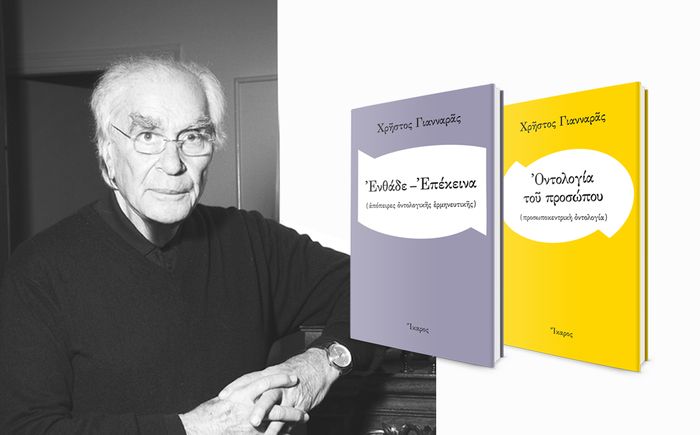
Christos Giannaras, on the occasion of the publication of his two most recent books, *Ontology of the Person* (Person-centred Ontology), and Here and Beyond (Attempts at Ontological Interpretation), spoke with journalist Yiannis Hatzigeorgiou in the magazine Philgood, published by the newspaper Phileleftheros in Cyprus.The interview was published on Sunday 12 February and you can read it below:The philosopher, academic, thinker and ―above all― one of the few remaining intellectuals in Greece continues, in one of his rare interviews, to remain incisive, bold, and at times ‘heretical’, boldly posing new questions for reflection in every answer he gives.The living room of the author and one of the most significant contemporary Greek thinkers, philosophers and professors of philosophy—noted for his public discourse and writings (at Panteion University, though he has taught philosophical terminology and methodology, political philosophy and cultural diplomacy at universities in Paris – he is, after all, a Doctor of Philosophy from the Faculty of Humanities at the Sorbonne University—as well as in Geneva, Lausanne, New York, Boston, Belgrade, etc.) is not filled with books, studies – let alone his own extensive bibliography – but, on the contrary, with framed photographs of his loved ones, mementos from his travels, and small but undoubtedly precious objects. It was very cold that Friday evening when we met, in the little alley where he lives and works, opposite the church of Agios Charalambos, in Nea Smyrni. ‘The old folks were right to build houses with small windows rather than large panes,’ he remarked at one point, smiling. He treated me to some mastic ouzo, poured himself a glass too – ‘it’s just the thing for this sort of weather,’ he said, and sat down in the armchair by the fireplace. He asked me a few things about Cyprus, mentioning specific names of politicians and arguing for or against his opinion of certain ones, concluding that ‘Cyprus pays for our empty faces’ and remained silent for a moment. ‘Savvopoulos was spot on with that line,’ he concluded. A few days ago, you wrote in an article: ‘In Greek society, nothing is renewed with the passing of time. Unbiased, fundamentally realistic thinking also rules out hope. We know the human quality of those who manage our lives, the effectiveness of the institutions and functions of public life, the laws of the jungle that prevail in our much-vaunted cultural ‘model’. All of this rules out hope.” So should we expect utter destruction in the future? And to what extent?What I personally conclude, Mr Hatzigeorgiou, from history and human experience, is that only a realistic awareness of reality can give rise to the surprise of a recovery. The hopes of the Greeks in 1821 were nil: the Ottoman Empire held overwhelming superiority, and the authoritative power of the ‘Holy Alliance’ in Europe ruled out any possibility of rebellion against the established balance of power. A similar overwhelming imbalance existed in the Greeks’ confrontation with the ‘Axis Powers’ in 1940. In both cases, the surprise stemmed from the Greeks’ consistent and utter despair: they knew what they risked losing, and it was unthinkable to them that they should lose it. Today we cling to ‘optimism’ – we dare not despair, because we have nothing of value to defend. What is most valuable to us today are our ‘individual rights’ and the maximisation of our consumer freedom. Yet we can, more or less, retain these even whilst enslaved – to the Turks or to the ‘Markets’.It seems that this ‘crisis’ is not merely circumstantial or temporary; many, countless signs point rather to an unstoppable momentum towards the historical end of Hellenism. What you write sounds terrifying – your reference to an ‘end’. As if every trace of hope, of optimism for the future, has been lost… Perhaps the reference to a historical end seems like an exaggeration to you. But consider this: is there today any element, any quality, that Hellenism bestows upon the Greek (whether from mainland Greece, Cyprus or the diaspora) which is so precious that without it, their life would no longer have meaning? In other words, an element for which they are prepared to die, so as not to lose it? When Cypriot politicians today haggle over terms that will make the Turkish minority and the invaders the arbiters of Greek life, or when Greek politicians hand their country over to humiliating trusteeship, that is, to a complete surrender of national independence, sovereignty and self-determination, does it shock you that we speak of the ‘historic end’ of Hellenism?Speaking of ‘Cypriot politicians haggling over terms that will make the Turkish minority and the invaders the arbiters of Greek life’, are you also referring to the ‘end of Cypriot Hellenism’ which some have been emphasising almost from the outset of the latest – critical – talks on the Cyprus issue? I am not referring to individuals, I am referring to the fact of the ‘negotiations’. To the unthinkable absurdity of a supposedly independent state, a member of the EU, with a democratically elected leadership, is haggling over its own self-destruction, its submission to the outrageous demands of a domestic minority and to the blackmail of brutal occupiers condemned by all international organisations. Hellenism has every right on its side and, unfortunately, elects leaders of pygmy stature to defend those rights. What, then, must be done, in general, to change the current situation – if it is to change at all? Must sweeping, structural changes take place? Beyond the state and the citizens? Given the fatal decline of Hellenism today, it is utopian to discuss what ‘must’ be done. Even if we were to agree on certain ‘musts’ (which seems impossible), who will then enforce them? The comical little men who govern us? The courts? The police? The citizens, however, do not bear the main responsibility for what is happening today, Mr Giannaras? ‘The most nightmarish of all afflictions is the complete numbing of Greek society’s reflexes,’ you write… Which citizens are we talking about who bear the responsibility for this disgrace and destruction? For the last 43 years – since 1974 – educational policy in Greece and Cyprus has systematically engineered the linguistic and intellectual incapacity of the masses (it is well known that people without language are people without thought), and the complete distortion of their historical consciousness. And the infectious influence of radio and television complements and completes their impoverishment. For only voters who have lost their reason, their judgement and their dignity are capable of sustaining such a debased political class as that which represents Hellenism, both in mainland Greece and Cyprus, over the last few decades – with the unforgettable exception, throughout Greece, of Tassos Papadopoulos. If the Greek people bear any responsibility for the ruin and disgrace in which they are now mired, that responsibility lies solely in the fact that they did not revolt. But even the possibility of revolt has been discredited and ridiculed by the nihilism and amorality of the so-called ‘left-wing progressive and modernising forces’.What do you mean when you refer to ‘revolution’ and ‘uprising’? Armed revolutions, as you understand, are now impossible. I mean, for the key institutions of collective life to react: the judicial authorities, university senates, bar associations, teachers in every school, cultural institutions and associations; for citizens to take to the streets and demonstrate their faith in freedom and dignity. It is unthinkable that people’s humanity should be put at risk and haggled over by politicians whom no one would ever entrust with running even a newsstand.Do the Greeks ‘suffer’ from immaturity, an obsession with the past, a superficial approach to handling difficult situations and ‘spoilt behaviour’, in comparison with other peoples, as they are ‘accused’ of? Has the ‘glorious past’ ultimately done a disservice to the current inhabitants of Greece?My personal opinion is that we modern Greeks suffer only or mainly from pretentiousness, just like all those newly liberated Third Worlders who are dazzled by beads and trinkets. We neither understand nor care about the cultural contribution that Hellenism has made and continues to make to humanity – we are only interested in the tacky kitsch produced by Elladex (Greek and Cypriot) for tourists. Ask an MP from AKEL or ‘New Democracy’ to answer this: why is the Parthenon a more important monument than the Eiffel Tower or the Empire State Building? When, from the generation of Evagoras Pallikarides, Karaolis and Dimitriou, Grigoris Afxentiou, or the generation of Seferis, Elytis, Tsarouchis and Manos Hadjidakis, we are separated by a mere few decades, to what factors can we attribute the rapid decline of Hellenism into today’s nightmare? It is abundantly clear that, in an era where technological progress has created unprecedented opportunities for mass manipulation, these opportunities have been exploited, primarily in Greece and Cyprus, by people of tragically low calibre.What connection do you think there is between the Greeks of Greece and the Greeks of Cyprus? Many people observe a different mindset, different ways of reasoning and different approaches to historical adversity, different points of reference and ways of thinking… Your question raises a very interesting issue: from my personal experience, my impressions and my reading, I have formed the opinion (without claiming that it is the correct one) that there was a crucial difference, up until the mid-20th century, between Hellenism in mainland Greece and Hellenism ‘in the periphery’, as they were called at the time – the Hellenism of Egypt, Asia Minor, Pontus, Crimea and the Danubian regions. Hellenism outside mainland Greece tended to preserve a sense of the superiority of Hellenic identity and no sense of inferiority vis-à-vis Western Europeans. This sense allowed the Greeks to adopt the achievements of Western modernity to serve their own needs, not to avoid lagging behind the Europeans in modernisation. Thus, the adoption of Western elements was assimilative rather than imitative; the critical adoption of Western customs and institutions did not in the slightest diminish the Greekness of the Greeks – they chose, they did not mimic. In mainland Greece, unfortunately, due to Bavarian rule following Kapodistrias, and the inferiority complex (coupled with snobbery) cultivated by the quisling collaborators of the era, followers of Korais, a servile inferiority complex and a lifeless imitation of the West prevailed, accompanied by a deep contempt for anything Greek… As this is a crucial issue, allow me to refer to a relevant book I have written, entitled: ‘Europe was born of the Schism’, published by ‘Ikaros’.Cypriot Hellenism, I believe, embodied the same sense of superiority over the West, right up until the island was declared an independent (?) state. The active Greek self-awareness of the Cypriots gave birth to Hellenism’s last great breath: the EOKA liberation struggle. I cannot forget, as a child at the time, the iconic figure of Polykarpos Ioannides, who wore, all his life, traditional Cypriot ‘alantza’ costumes, thereby undermining the English ‘cashmere’.This conscious Greek identity seems to have been lost for good with Cyprus’s ‘independence’. Cypriot society has changed rapidly and relentlessly into a sad imitation of Greek decline and disgrace. Why do you question Cyprus’s independence? And, furthermore, what do you mean when you say that ‘Cypriot society has changed rapidly and relentlessly into a sad imitation of Greek decline and disgrace’? In a single interview, it is not possible to present a documented and therefore convincing account of a social reality. I dare to make allusions that refer to the attestations of shared experience. It is clear to any rational person that the Greek Cypriot community has established a state, yet its state is not independent; it is a captive of the power of an international terrorist, Turkey, which provocatively denies the very basics of logic and international law, rewarded by the ‘enlightened and illustrious nations of the West’, our own, those pretentious idols. As for the sad Cypriot imitation of Greek decline and disgrace, it is up to each individual to recognise the parallel. At least in terms of intelligence and dignity.In many of your writings, you speak of ‘Greeks’ rather than ‘Greeks from Greece’. Why? Yes, because the majority of the population, simply and coincidentally, inhabits Greek soil, with the mindset and behaviour of a globalised consumer. A Greek under the age of 50 today does not understand Papadiamantis or Roidis; he does not know what ‘I fight for the victorious General’ means. When one hears the ‘Greek’ spoken by George Papandreou, Costas Simitis, Dimitris Christofias and Nicos Anastasiades, one is convinced that a history of three and a half thousand years of Hellenism is ending in disgrace.Isn’t what you say about these particular politicians rather harsh – and perhaps unfair? That, dear Mr Hatzigeorgiou, let us leave to our readers to judge. I judge the ‘Greekness’ of our politicians as a teacher, not as a supporter or opponent. Has realism always been the compass of your thinking, writing and teaching? Have you never resorted to… ‘magic’?I think we have become addicted to operating in a consumerist manner, and our consumerist naivety is fed mainly by ‘impressions’. And even the most insignificant or wretched product can lay claim to titles of quality thanks to ‘packaging’ that makes a good impression. Even someone who is blatantly delusional or utterly corrupt can be elected prime minister or president of the Republic, if they spend a fortune on their advertising and succeed in ‘brainwashing’ the masses. With this ‘logic’, we label as ‘optimism’ or ‘pessimism’, ‘realism’ or ‘utopia’, whatever the well-oiled mechanisms of impression-making would have us believe. We are slaves to ‘effects’, to emotions, to sensational headlines, to the propaganda of television ‘news’.I wonder: over all these years, have you ever been ‘inconsistent’ in your views, exercising the right of a person to reconsider what they once believed, given that the surrounding environment and circumstances change?Allow me to observe that a person’s ‘views’—every person’s—their ‘opinions’ and ‘beliefs’ are, as a rule, individual choices, preferences and inclinations that are, at their core, arbitrary in nature. In today’s cultural ‘paradigm’, this arbitrariness is enshrined as an individual ‘right’ – the conventions that enshrine individual rights have the authoritative force of laws that are ‘binding on all’. The basis of our ‘civilisation’, in other words, is the enshrinement of ‘freedom’ as an individual right of choice, a legal shield for the unchecked indulgence of impulses, appetites and interests. This is why the protection of rights, when it establishes the terms of collectivity, equates civilisation with the barbarism of individualism, not with the exercise of freedom that is the society of relationships. Consequently, whatever is an individual choice (views, opinions, beliefs) we can easily change. However, whatever is the fruit of the endeavour of self-transcendence—that is, freedom from the ‘self’ in order to attain the shared truth of the relationship (of faith and trust, of love and self-giving)—does not change. Its expressive form may mature, but the intended goal remains unchanged. Many describe you as a ‘philosopher’ – and ‘heretical’. Certainly one of the very few in Greece who continue to articulate a discourse. What do such labels mean to you? In the Greek tradition, we attribute labels that embody moderation and modesty. A ‘philosopher’ is not the wise man, the one who possesses wisdom; he is the ‘friend’ of wisdom, the lover of knowledge, the one who loves the truth and seeks it. The title of ‘philosopher’, therefore, is an honour and a compliment. The meaning of the word ‘heretic’ has today strayed far from the original meaning the Greeks attributed to it. Today, ‘heresy’ refers to the notion of truth as ideology, that is, as an individual choice of definitively (or even infallibly) formulated ‘beliefs’. The ‘heretic’ questions or even rejects the codes of certainty of ideology; they have chosen individual ‘beliefs’ that do not align with the ‘principles’ and certainties that are obligatory for the ‘faithful’ followers of the ideology. Thus, the word ‘heretic’ has today taken on a rather positive connotation: it refers to the person who questions the ‘infallible’ dogmas of ideologies, the rigid, mandatory ‘beliefs’. It refers to a person who seeks empirical access to the truth. These, then, are roughly what the terms ‘philosopher’ and ‘heretic’ mean to me. Much has been written and said about your views in relation to religion. In simple terms: what does Orthodoxy mean to you today? Orthodoxy has come to be the name we give to the Greek version of the Christian Church, the Greek experience and witness of the ecclesiastical reality. The Church is not just another religion, even if it is ‘better’ than the others. It is a reality, a way, a means of revealing the truth – and ‘truth’ is existence free from time, space, decay and death. The Greeks had called it the ‘church of the demos’, not merely a general assembly of citizens, but the act, the work of ‘poiein’ the political: for citizens to realise and reveal the ‘polis’, that is, another way of being and coexisting that aims no longer merely at necessity (the society of need) but at truth (the society of the true, at harmony according to reason, at civility). It was with this very same Greek meaning that Christians adopted the word ‘ekklesia’: a gathering that realises and reveals the true ‘way’ of existence and coexistence, freedom from the necessities of self-centred impulses – freedom of erotic self-transcendence and self-offering.To conclude, a question – a personal query of mine – to a man like you: what is the meaning of life, Mr Giannaras? The meaning of life cannot, fortunately, be found in a formula, in a ‘should’. Can we ever experience love by following recipes, advice or exhortations? The meaning of life, just like love, is bestowed as an antidote to the exercise of realising freedom from the ‘self’. That is why, within a cultural ‘paradigm’ founded on the absolute priority of shielding the ‘self’, both the ‘meaning’ of life and love are achievements reserved for only a few stubborn souls. Photo: Penelope MasouriLearn more