News
News List, News Categories, Events
-
Interviews
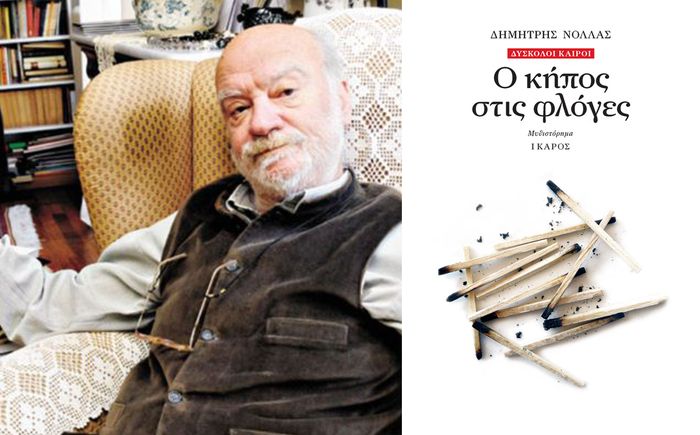
Interview with Dimitris Nollas on the occasion of the publication of his book ‘The Garden in Flames’.
Dimitris Nollas, on the occasion of the publication of his book The Garden in Flames (the third part of the Difficult Times trilogy), spoke with Dionysis Marinos in the newspaper Eleftheria tou Tupou.The interview was published on Monday 19 June and you can read it below: What if Greece were an amateur theatre troupe? And what if the play they were staging ended with a ‘forest’ of flames that would leave nothing intact in its wake? Does destruction also contain the seed of creation? Dimitris Nollas, having completed the trilogy ‘Difficult Times’, speaks to ‘Eleftheria tou Typou’ about his latest novel ‘The Garden in Flames’ and more. Mr Nollas, having completed the ‘Difficult Times’ trilogy, can we conclude with ‘what is our homeland?’ I think your question concerns the reader of the book more. For me, however, my homeland is everything I still experience in this blessed land and the joy I derive from those literary works created in the Greek language by the masters of the past, the present, and the future. Have you decided within yourselves whether we were struck by storms we could not withstand, or whether we brought them upon ourselves? Only the dead cannot withstand the storms that befall them. Man can overcome all storms. Of course, whoever provokes them is asking for trouble. Don’t you think that those who provoke storms should be prepared to foot the bill? Note that even left-wingers, when faced with power, did not hesitate to play their part.Do you think that left-wingers are immune to the cult of power? That they are angels who exist outside this world? Your heroes are part of an amateur theatre troupe. One might say that the choice is no accident. As if this troupe symbolises Greece. No, it is not a random choice. In a fictional construct, chance is controlled. Even the ritual burning at the end of the book suggests that only destruction can lead to a new beginning. Do you believe that? I believe what I write and I always take responsibility for it. I believe, therefore, that when we stray from moderation, it is always destruction that follows. This is true in society, just as it is in nature. A new beginning always comes to heal the harm caused by a catastrophe. I do not believe that a catastrophe is the end of the world. One need only recall, to stick to our modern history, the years 1897, 1922, and indeed the entire 1940s. Is there any personal responsibility for how we got here? For many years, the phrase ‘we all ate it together’ was at the heart of a fierce debate. Without personal responsibility, we have no individuals, we have a faceless mass. What made this statement so outrageous was that it was uttered by a political leader who did not have the courage, at the very moment he said it, to repent and apologise to all those sheep who followed him and voted for him, taking advantage of the handouts he showered upon them (with borrowed money, let us not forget). That is why it ‘became the focus of intense controversy’, as you say, because that condemnation stung, as it forced each of us to face up to our own personal responsibility. Further proof that this statement corresponded to reality. Such words, however, require courage, which this particular individual lacked. And he did well to withdraw from politics shortly afterwards. Let us give him credit for that. Did the ruling Left prove to be little or no Left at all? Or, in the end, is it succeeding? What do you think? Left or no left, whether it’s a lot or a little, it is obliged to manage the communal areas of the block of flats. The most important thing, however, is that, for the time being at least, it is not rummaging through our souls, but our wallets. Do hard times produce good works of art? Does literature need ‘crises’ to flourish? I think that, in any case, works of art are the fruits of intellectual crisis. Does the movement of ‘partakism’ (an excellent neologism) still exist in these times of crisis? In extreme circumstances, such as a crisis like the one we are experiencing, selfishness (‘philotomaris’ is a suitable term) evolves into the ‘partakism’ movement. In other words, the primitive feeling that I am the centre of the world becomes widespread, and thus only my personal survival will ensure the world’s continued existence. The salvation of the Universe will depend solely on my own. Others do not exist. I do not see them, I do not understand them, nor do I perceive them as my fellow creatures of God. You realise that we have already entered the antechamber of the prehistoric jungle. And if that sounds exaggerated to you, well, the antechamber of the madhouse. Are we an angry people, Mr Nolla? I don’t know. What is worrying, however, is that very few of us are angry about our own actions, about our own choices. What I do know is that, in any case, the angry person finds it hard to find a ‘solution to their drama’.Learn more
-

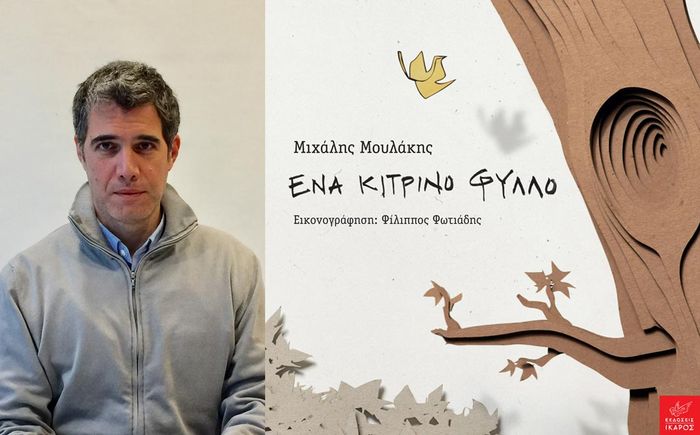
Let us discover ‘A Yellow Leaf’ through the eyes of Michalis Moulakis.
How can the short journey of a yellow autumn leaf towards the ground lead us to discover a different way of looking at our world? And yet, the combination of Michalis Moulakis’s tender text and Filippos Fotiadis’s distinctive, photographic illustrations creates a symbolic fairy tale that will introduce young readers to ideas such as life and rebirth, the perception of reality, and the balance between the forces that coexist in the world.&The author describes how the original idea for the book came about, as well as his collaboration with the illustrator: The idea for A Yellow Leaf came, in a way, literally out of the blue. I was half asleep in my bed. My eldest son, who was three years old on that distant Sunday morning, pointed to something outside the window and said, ‘The yellow leaf is falling from the tree.’ As if a secret chamber had opened in my mind, that phrase instantly revealed the whole story to me. I wrote it down as quickly as I could, for fear of forgetting it. Philip was one of the few people to whom I showed the text. He told me he liked the story, and I asked him to illustrate it. We both agreed straight away that we didn’t want the leaf character to be depicted in a human-like way. No eyes, no little hands, no little feet. It was absolutely vital to us that the leaf looked completely natural in every illustration. The big challenge for Filippos, then, was to convey the full range of emotions experienced by the leaf throughout the story solely through the natural poses in which it is depicted. The very distinctive visual approach we eventually settled on emerged only after the illustrations had first gone through a great many different techniques and trials. It was a project that—without exaggeration—took several years. However, the shadows and depth of the final image serve the story in a truly unique, perfectly fitting way. Read the first few pages of the book here. Join us on Thursday 8 June at 7.00 pm, to celebrate the book’s launch and view the exhibition of his original drawings at the MARTINOS exhibition space: Learn more
-
Takis S. Pappas in Kathimerini: Our useful history
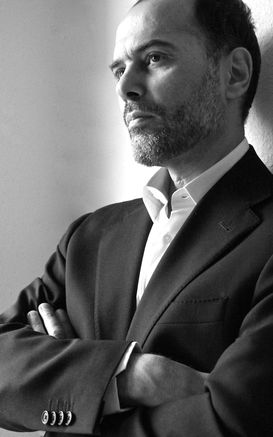
On Sunday 28 May, *Kathimerini* published a very interesting article by Takis S. Papas, summarising ten conclusions (and useful lessons) he drew whilst writing his latest book, On a Tightrope: National Crises and Political Acrobatics from Trikoupis to Tsipras. We republish the text below: Like all of us in this country, which for many years now has been struggling in the throes of a crisis with no positive outcome in sight, I too have tried to understand the deeper causes of the crisis, to explain the dynamics of the current situation and to predict what lies ahead. I felt that the best – if not the only – way was to look back at the long historical past. And so I wrote a book entitled ‘On a Tightrope: National Crises and Political Acrobatics from Trikoupis to Tsipras’ (Ikaros Publications), which is based on three key observations. Firstly, that what we call a ‘crisis’ is not a single event but a spiralling sequence of many crises with an as yet unknown outcome; secondly, that the current spiral of crisis bears striking similarities to three historical crises that also took the form of a spiral or vicious circle; and, thirdly, that previous crises offer us valuable lessons that we must not allow to go to waste.The first of the aforementioned crisis spirals began with the bankruptcy of 1893 and ended with Eleftherios Venizelos’s first premiership in 1910. The second began with the Venizelist military coup of 1935 and lasted until 1952, when another military figure, Alexander Papagos, established a – certainly ultra-conservative – regime of political stability, which formed the basis of post-war economic development. The third spiral of crisis began to unfold with Georgios Papandreou’s demagogic ‘Uncompromising’ policy, until finally, following the dictatorship and the partition of Cyprus, it culminated in the establishment of our current democratic system.&I summarise ten conclusions – and some useful lessons – that I have drawn from writing this book. With four successive spirals of crisis in the space of just five 25-year periods, modern Greek political history resembles a rollercoaster. It climbs and then plunges at terrifying speed, yet none of us can imagine the final outcome. We all, however, feel a sense of vertigo. Periods of uninterrupted (relative) stability are brief, with the most significant exception being the post-dictatorship era, a fact mainly attributable to Greece’s accession to the then EEC, now the European Union. Conversely, periods of spiral crisis are exceptionally long, averaging 15 years. This, obviously, is not a good sign. The incubation stage of each spiral crisis lies within the preceding period of relative stability. Thus, the crisis of the late 19th century was primarily due to unfulfilled nationalism; the crisis that began in the 1930s was due to national division; the crisis of the 1960s has its roots in the post-civil war anti-communist regime, whilst the current crisis would not have occurred without the prevalence of populism in the post-dictatorship political system. The common feature in all the above cases is the delegitimisation of the parliamentary democratic process and, consequently, the erosion of – albeit imperfect – parliamentarism. In summary, I propose the following general interpretation: The country’s enduring political problem is that parliamentarism has never acquired universal and fully established legitimacy in our country. When the country enters a spiral of crisis, and throughout its duration, three negative developments are observed. Firstly, the succession of unsuitable leaders to power; secondly, the rapid further erosion of parliamentary institutions, mainly due to polarisation; and, thirdly, the rapid weakening of the middle classes and the rise in emigration. Of these three developments, the most crucial is ‘poor’ leadership, as political polarisation and the sense of social suffocation depend primarily on this. A way out of the crisis is always linked to new, strong and appropriate leadership. It took Eleftherios Venizelos to halt the first spiral of the crisis, Papagos to initiate a virtuous cycle of stability and growth following the second spiral, and Constantine Karamanlis to usher in the Metapolitefsi. What is most interesting is that all the above leaders shared six common characteristics. All of them (a) had a long and successful political or military background, (b) an ambitious national vision and a specific political programme, for the realisation of which (c) they created new parties which they staffed with new political personnel, (d) established a new legal and institutional framework, which (e) gained broad support from the middle classes, whilst (f) they enjoyed significant foreign political and economic support. If ‘good’ leadership is associated with emerging from crises, ‘bad’ leadership appears immediately after every ‘turning point’ in our national history, that is, precisely when the country has just achieved something significant, with disastrous consequences. Thus, following the victorious Balkan Wars, the divisive political star of King Constantine II shone brightly; after Liberation, the utterly unsuitable leadership of the Communist Party of Greece; following the so-called post-war ‘economic miracle’ the demagoguery of G. Papandreou, following the early post-dictatorship liberalism; the populism of And. Papandreou; and, following the country’s entry into the Eurozone, a whole chain of unsuitable leaderships stretching right up to the present day. If history teaches us anything, it is that the only way we will ever emerge from the crisis is by electing a leader who embodies (most of) the characteristics of ‘good’ leadership. However, the way out will again be temporary and conditional. That is why we must never forget the obvious: namely, that in a representative parliamentary democracy, leaders are elected (both in government and in opposition) by the people’s vote, that is, on our own responsibility alone. Modern Greek political history unfolds neither linearly nor cyclically. Nor is it teleologically predetermined, perhaps with a final and redemptive ‘triumph’. In the relentless reality of history, the situation in the country always unfolds as an endless loop (akin to the myth of Sisyphus) which, to be broken once and for all, requires the establishment of a liberal and consensual parliamentary democracy. Yet this has been the country’s great, enduring quest since the end of the 19th century.Learn more
-
Public Book Awards 2017: Two Ikaros books among the best of the year!
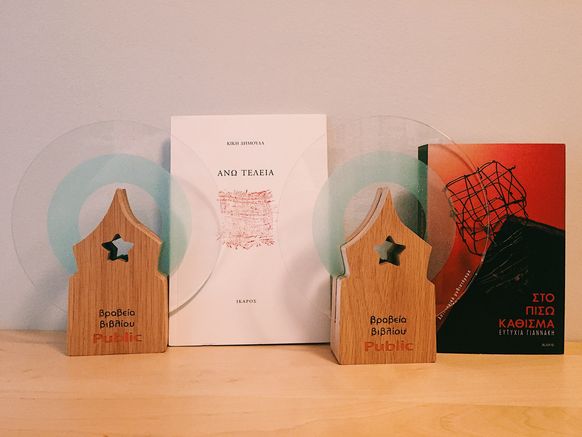
On the evening of Tuesday 23 May at the Pallas Theatre in central Athens, one of the most important events in the world of books took place: the presentation of the 2017 Public Book Awards!For the fourth consecutive year, readers expressed their preferences and selected their favourite books with more than 140,000 votes. Ikaros had the pleasure of receiving two awards:In the Contemporary Greek Poetry category, Kiki Dimoula’s latest poetry collection, ‘Anotelia’, was awarded.We would like to thank Kiki Dimoula very much for her excellent collaboration, her writings, her words, and her trust over all these years. Katerina Karidi receives the award presented to Kiki Dimoula from Eleftheria Arvanitaki.In the Greek Novel category, the award went to Eftychia Giannaki’s book *In the Back Seat*. The book marked the launch of crime fiction at Ikaros, and we thank her warmly for her trust. Her second book, featuring Inspector Haris Kokkinos, *Alcyon Days*, is already at the printers and will be released in the coming days. Eftychia Giannaki receiving her award for Best Greek Novel. We would also like to extend our warmest thanks to all the readers who singled out these two books and honoured us with their votes. The evening was hosted by Odysseas Papaspiliopoulos, and Mariza Rizou provided musical accompaniment with wonderful retro tunes. A total of 160 publishing houses took part in the competitive section of the awards, 1,300 authors and 2,200 titles, of which a total of 13 books were awarded. We look forward to seeing you again next year!Learn more