News
News List, News Categories, Events
-
Interviews
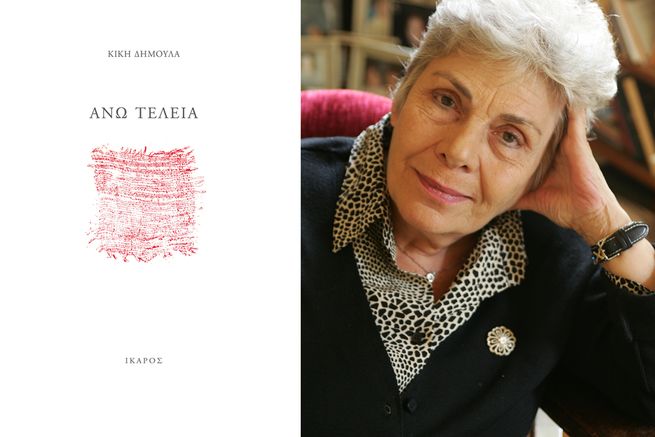
Kiki Dimoula: “I am still hungry for life.”
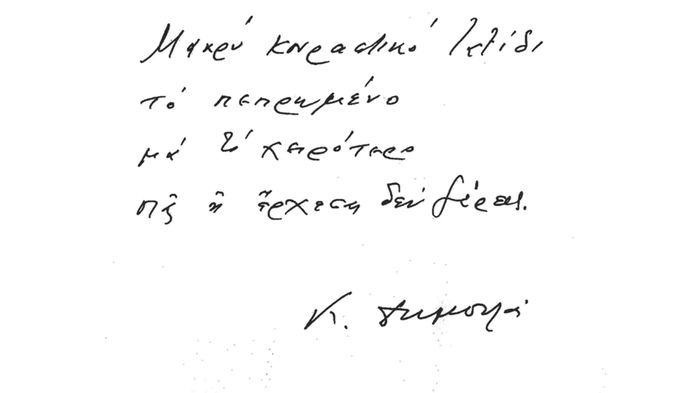
The Greek poet and academic, Kiki Dimoula, on the occasion of the publication of her poetry collection ‘Anon Telia’, gave an in-depth interview to Giorgos Archimandritis for the magazine ‘K’ of the newspaper ‘Kathimerini’, speaking about time, death, love and the prevailing uncertainty. The interview was published on Sunday 6 November and you can read it below: Anapha. A metaphysical punctuation mark, embodying the end in its least definitive form. A punctuation mark synonymous with a temporary pause. On the occasion of her eponymous poetry collection, which encapsulates all the laws of her poetic world and offers a comprehensive portrayal of the human condition, the poet and academic Kiki Dimoula shares with us the thoughts, anxieties and questions of a person faced with the art of poetry and the human condition. Kiki Dimoula, in one of your poems you say: ‘A long, tiring journey / destiny / but the worst thing / is that you don’t know whether you’re going or coming’. Where are you coming from and where are you going? It is said that after this life there is another. I neither believe this, nor does it comfort me. That’s why I say ‘you don’t know’. Are you setting off for the next life, or are you coming from the other one and this is the new one? Destiny is unknown, yet certain at the same time. And I believe this without having any proof or argument. What strikes me, however, is that everything unfolds as if it were premeditated. And it unfolds with such precision that I cannot call it a coincidence. I cannot say ‘it just happened’. I do, of course, consider ‘chance’ to be responsible for many creations; I attach far greater importance to it than to the planned. But in our case, where there is life there is also death. No one will ever change that. Do you believe there is a guiding force? Yes. And it is rhythm. The rhythm of life. I see no other. And I cannot, of course, blame any God. If there were one, and if there is one, I believe he is not as cruel as fate. For fate is cruel. From the moment death is foreseen at a time when you have learnt to live, at a time when you have grown accustomed to this terrible thing, or if you like, this meaningless thing – because in old age life doesn’t have much meaning – yet you prefer it to dying, to heading towards the unknown. But it is not so much that you do not want the unknown. It’s that you don’t want to lose the familiar. Because that is what we have come to know. We came here through life, we didn’t come through death. And that is nature’s great trick: that it sent us here unprepared to face what is to come.Are you afraid of death? I tremble at the thought of it. I really do tremble. Because I know that then none of the things that are happening now will be happening. He is the almighty one, after all, and no one else. Just think that from the moment you are born, you are on the verge of death. Because that is what it is all about. I have not got used to that, and I have not forgiven it. And I am still hungry for life. Perhaps even the fact that I am still writing poems at eighty-five is an expression of this reluctance of mine to die, of my inability to imagine what might exist when a body dies. Because, let’s be honest, what is a soul without a body? Without a body, what is a soul? The body is the soul’s justification for existing. Its justification and its home. Yes. Within this body, it is nurtured and it nurtures. Of course, it’s not impossible that it has created everything in wisdom; I’m not in a position to rule that out. I’m simply not an enthusiastic devotee of all this business and all this uncertainty where you don’t know who our creator is. That is what I would like to know. Unless I shouldn’t or mustn’t know. Ultimately, life itself is cautious towards us. It neither betrays us, nor foretells us anything, nor reveals anything to us. Whatever comes is as if we are experiencing it for the first time, even though we may have lived it before. Does it promise us anything? No. Our desire promises us. Our desire pretends to be the voice of life. Life itself is detached and moral. And not at all a liar. Life makes no promises. We imagine. Life simply exists and lets you see it as you wish. That is why some people are very happy with the way the world is, whilst others are disappointed and unhappy. The point is to analyse and evaluate what cannot be otherwise. That is why we write poems under the illusion that we will change what is happening or describe it in a different way.How certain have you ever felt about poetry? I have never felt certain about anything. Never. Only that I will die. And I consider poetry to be an extremely treacherous and deadly state of affairs. It doesn’t tell you that you’ve been had. It doesn’t tell you that you’ve said this before. It doesn’t tell you that you’re repeating yourself. Nothing. It lures you in, traps you, and you think that this time you’ve said it a bit differently from last time, when in fact you’ve said it exactly the same way.So she’s a bit of a deceiver too, just like life? Yes. We help her with that, of course. We give her a face that the poor thing might not have. Ever since poetry has existed, pretence has existed too. Poetry is a form of acting. You’re playing a part whilst you write; you’re creating certain roles. I can’t think of any other way to explain this persistence or even this ambition – because it promises you that some people will talk about you, that you’ll occupy their minds, that you’ll influence them. But that’s not it. It’s a force I can’t stop. And the fact that I’m still writing is perhaps a desperate move to ward off old age. Because poetry is a way of not understanding time. To spend it, trying to write and thinking that this is ultimately a saving rather than an expense. But isn’t a truth ultimately revealed through this pretence? We don’t know if it’s the truth. It’s another mask. I believe that everything that circulates, everything we present, everything we use, is a mask. What and who we really are, we either do not know or do not want to know. Because poetry, too, is the result of a sense of inadequacy. Why else would you create the world? Because that is what poetry is: you attempt to create a new world. But who will believe in this world, and who will inhabit it? Is it not enough for its creator to inhabit it? Isn’t poetry a way of magnifying life? It is rather an illusion that in this way you are fighting against the death of leaving and being forgotten entirely. Herein lies the delusion: that you will not be forgotten. And so what if someone momentarily remembers the great Tassos Leivaditis, Seferis, Elytis or my own Cavafy, me, my own? What does it change? I know that we each have a different character, which we serve at all costs. So, a person who is pessimistic isn’t just being fussy. It’s their hormones that make them that way. Nor is it because they deserve a different life – they don’t even know what life they want. They are simply born to worry. And they must entrust this worry to something. And they entrust it, I think, to poems. Tell me about the first word of a poem. How important is that first word? That word is ‘You’. ‘You’, my interlocutor or the one I dream of and wish to move or cause pain to. For the target is always the Other. Your ‘I’ cannot be unframed, however much it serves you. Is it possible to want to be alone? Besides, I don’t think the poet himself is in a position to analyse his own poems, because he inevitably becomes too lenient towards them. Although I am happy to decapitate them. The reader, however, I would not want to decapitate them for me. Anyway. There is but one deity here: uncertainty. Not just in the poems. Everywhere. That is the driving force. That is the goddess. She may be a tormenting goddess, but, on the other hand, she lends such charm to that which offers you no certainty, that in the end you love her. She is wise. She protects you from boredom. Because it is a bore to know what will happen. You mustn’t know. Because you can’t explain it? Exactly. That’s why I say ‘the inexplicable silences you / and go on, try to grasp it’. Isn’t that what we do? Don’t we struggle to grasp something that is inexplicable? And the inexplicable hurts you, kills you. All the inexplicable things that happen in our lives, however much they carry the weight and significance of a new garment, are variations. Only death makes a difference. If you think about it, love is also a death – its own – which is bound to happen. So I ask the Almighty, and I ask you too: ‘Why do we die?’. How on earth did this happen? Someone tell me. The agony of death ought not to be part of man’s destiny. And yet it is. It is an agony he has never experienced before. Not even in loves that die. These are grand words. A painful death is merely the end of life. You can recreate love – for love too is artificial; we create it ourselves. But you cannot recreate life. ‘Dreams and love’, however, as you say in one of your poems, are part of this life. They are very fragile, of very short duration. If only life were all love, that is what I wanted. All of life. It would end at some point, of course, but the fleeting nature of our intense moments causes us pain. The possibility of losing them fills us with fear. And I think that, in the end, the way all this is put together, there is a wisdom to it. Because, if it weren’t like that, perhaps weariness would eventually prevail, which now doesn’t have time to take hold. The new being arrives, rested, thirsty to live out this whole lie that is our life. Because it is a lie, a lie that sometimes lasts many years, sometimes few. Of course, if they asked me, would you now like to be reborn and not be entangled in this lie? Now, yes, I wouldn’t, because I am bound to everything that has been. Did you love what has been? Certainly. And first and foremost, my actions. And my actions are that I have given birth to children and raised them as I did. Is there one action of mine I do not love? That I grew up myself. Ultimately, I believe that the only thing that is truly ours, and not entirely so, is ourselves. Ourselves and our mistakes. That is why I say somewhere: ‘Wisdom is not experience; it has simply lost the power to err’. Because when you err, you care about nothing. You dare. But how can I err now? What temptations do I have left to face? The temptation to believe, despite everything, in life. But if I fear death, it is because I believe in it. And ‘I believe’ does not mean ‘I trust it’. It means ‘I love it’. We believe in someone we love. I would like to know, I would like to have seen the face of God. And, you might say, is faith of any value when it is based on certainty? But I cannot understand how anyone can be faithful in the face of uncertainty. Generally, life teaches you to want to put your finger ‘on the pulse’; you didn’t come up with that yourself out of your own imperfections. Life tells you: ‘I want to grasp that which rules over me.’ Because supposedly, the whole of the heavens above is authority. And time? How would you describe your relationship with time today? Bad. Very bad. I don’t look at my watch, but I’ll tell you this. If I had an old watch that was always two seconds slow, I’d wear that one. Precisely because, if you multiply two seconds behind every day, think how much time you gain. Time is something that cannot be gained by any means other than forgetting. Because along with that, you will have forgotten that it is slipping away too. The best method is to forget. If you forget again, you are an empty vessel that doesn’t know what it’s for. That is, things are never just like that and only like that. They are like that and otherwise. And whatever draws you in, the full or the empty. And you’re not to blame for that choice. Nature makes you that way, the thousands of cells that came before, that programmed you, that changed and shaped you. All this mysterious thing. Which we call destiny. And where, let me emphasise again, ‘whether you go or come, you do not know’. And that is far more tiring than the word itself, which is in itself very tiring.Learn more
-

Interviews
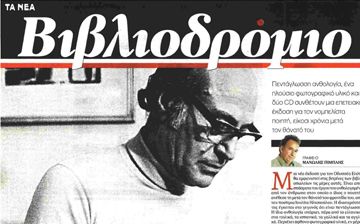
Ta Nea-Bibliodromio: Four and a half languages for Odysseas Elytis.
Ioulita Iliopoulou, on the occasion of the five-language anthology ‘The Small World, the Great World!’ by Odysseas Elytis, set to music by Giorgos Kouroupos, spoke with Manolis Pimblis about this publication and the work of Odysseas Elytis.Read below the excellent article published on Saturday 5 November in the newspaper Ta Nea, in the ‘Bibliodromio’ supplement: A five-language anthology, a wealth of photographic material and two CDs make up an anniversary edition dedicated to the Nobel Prize-winning poet, twenty years after his death.A new publication on Odysseas Elytis is set to appear in bookshop windows in the coming days. It comprises excerpts from his work, anthologised by the person to whom the poet himself entrusted his posthumous care: the poet Ioulita Iliopoulou. What makes it unique is that it is in five languages! The anthology itself is available, in addition to Greek, in Italian, Spanish, French and English. It contains a wealth of photographic material, some of it rare, including both captured moments from Elytis’s youth – even his childhood – and his visual artworks. Indeed, the works are not repeated, but each translation is accompanied by different material. At the same time, the publication is accompanied by two CDs containing Elytis’s poems set to music by Giorgos Kouroupos, as well as readings of the poems. These range from longer compositions to songs, performed by Tassis Christoyannopoulos and Theodora Baka. There are four musical instruments, with soloists Thanasis Apostolopoulos (piano), Stella Tsani (violin), Ilias Sdoukos (viola) and Lefki Kolovou (cello). The readings are performed by Dimitris Kataleifos and the anthologist herself. It is a lavish edition by Ikaros, which will, however, be sold at an attractive price thanks to sponsorship from Alpha Bank and the willingness of all involved to contribute, so that such a book may be published in honour of the Nobel Prize-winning poet, who has been absent for twenty years this year. It is noteworthy that the book contains the work of thirty-seven different translators. Given that the anthology does not vary according to language—a feature that allows a multilingual reader to appreciate the translators’ different approaches to Elytis’s work— in several cases it was necessary for certain pieces of the anthology to be translated from scratch, and indeed these pieces differed in each language, depending on what had already been translated or not. Where there was more than one translation, Ioulita Iliopoulou chose to include a variety of translational styles, incorporating translations from different periods. Consequently, the project faced several organisational challenges and required a considerable amount of time to ensure proper coordination and achieve the desired result. Four translators were particularly helpful: David Connolly, Beatrice Stelios-Connolly, Paola Minouchi and Nina Angelidou. Processed with VSCO using the c3 presetThe book, entitled ‘The Small World, the Great World!’ by Odysseas Elytis, with music by Giorgos Kouroupos, includes poems and prose from the works Maria Nefeli, Open Papers, The Rows of Love, Orientations, The First Sun, The Sun the Sun-Bearer, Axion Esti, The Light Tree and the Fourteenth Beauty, The Monogram, The Elegies of Oxopetra, Three Poems with a Flag of Opportunity, West of Sorrow, The Half-Siblings, Sematologion. The aim is to appeal to an international audience – and whilst the songs are in Greek, foreign listeners will be able to follow the lyrics translated into their own language at the same time. ‘Through my choices, I have sought to convey a sense of joy, in contrast to our gloomy times,’ Ioulita Iliopoulou tells ‘ViblioDromio’. “These selections also aim to remind us of Elytis’s value system, which includes concepts that have been lost in our daily lives today.” How would she herself describe this value system? “Elytis’s poetry is governed by enduring values; to give a few examples: innocence as a primary spiritual value, opposition to the prevailing conception of life, a powerful revolutionary force, the dream, and a combinatory and exploratory imagination that leads, on the one hand, to the discovery of a deeper reality and, on the other, to the reconstruction of the surrounding reality, but also a belief in freedom, in justice, in the grandeur of humble elements, in the greatness of humanity, in the powers of the spirit. A projection of transparency on a spiritual level, of magic within the poetic function. Every image, every interplay of words produces, literally or allegorically, proclamations, affirmations, exhortations to life.Transcendence, geometrisation, the reordering of reality, faith in duration, a graceful perception of life, an erotic conception of the world, the sanctification of the senses, solar metaphysics as a method of deciphering the mystery of existence are some of the constant tenets of the poet’s thought,” she tells us. Ioulita Iliopoulou notes that international interest in Elytis’s poetry remains undiminished. “A major anthology of his poetry was recently published in Chile. In Italy, books are constantly being published and there are many translators of Elytis, foremost among them Paola Minucci. Recently, I have been contacted by translators who wish to translate Elytis in Armenia, Serbia and Japan. Last year, Angeliki Ionatos compiled an anthology and translated it into French. In France, too, the ‘Elegies of Oxopetra’ were published in a collector’s edition with engravings. Despite the fact, however, that the language Elytis knew and to which he attached particular importance was French, the languages that seemed to love him most are Spanish and Italian. The fact, however, that his work is translated in very different countries, such as China and Japan or Russia and Armenia, shows that beyond the symbols of his language—which in many cases can be fully understood only by a Greek (even the word “thalassa” sounds different to a Greek than it does to someone living in a landlocked country), the principles and values that characterise his poetry have a universal dimension. I therefore view the proposals of foreign translators, particularly young ones, with interest. I am in favour of multiple translations and against exclusivity. Elytis himself, after all, said that in poetry, translation preserves no more than 20% of the work.The importance of artistic collaborationTaking Giorgos Kouroupos’s musical compositions as her starting point, Ioulita Iliopoulou emphasises the importance of artistic collaboration. ‘The magic of the word is effortlessly brought to the fore by music, when the latter also seeks to engage in an equal dialogue with it. I believe that often an interpretation of a work can be better provided by another art form than by science. In ‘Monogram’, for example, Kouroupos reveals hidden aspects of it, a social element that is not usually highlighted. Through music, the listener often feels what we forget to bring to the fore.” Giorgos Kouroupos has, moreover, repeatedly set Elytis’s poetry to music. In 1989 he set ‘The Little Sailor’ to music for Manos Hadjidakis’s Orchestra of Colours, and shortly afterwards ‘Akindynou, Elpidoforou, Anempodistou’ from the ‘Elegies of Oxopetra’; in the late 1990s he set ten more poems to music for voice and piano; and in 2004 he presented ‘Monogram’, a symphonic suite for voices, choir and orchestra. In this particular project, due to the great variety in the form and content of the selected poems, he too adopted very different approaches, creating everything from simple songs sung in the street to demanding compositions. As he himself says in his short note specifically for this edition: ‘Knowing that music has the power to emphasise, highlight and amplify the emotional weight of words and lyrics, my personal aim is to evoke an emotional response capable of leading the listener to a deeper – or at least different! —understanding of the poet’s work, but also, through the puzzle of phrases, sounds and images, to bring forth effortlessly, clearly and unadorned the figure of Odysseas Elytis.”Learn more
-
Interviews
Kiki Dimoula: ‘The first Nobel Prize is deserved by xrovos’
Leading Greek poet and academic Kiki Dimoula, shortly before the release of her new collection of poetry entitled *Anotelia*, spoke with journalist Manolis Pimblis. Read below the very interesting interview published on Saturday 22 October in the newspaper Ta Nea, in the ‘Vibliodromio’ supplement: Let’s start with the title: ‘Ano Telia’. Why did you choose it? I didn’t choose it; it was imposed on me. Perhaps he was encouraged by the fact that in the poem entitled ‘The Polytonic’ I praise the importance of accents and punctuation. If you now ask me why a semicolon and not a full stop, I would say that I avoided it because it would have been like filing a registry document. Melodrama, in other words. Most likely, however, I was drawn to the word: Up. It drew me upwards, as if to pull me away from the predator: ‘Down’. In the poem ‘On the Train’, you speak tenderly of disused stations and of the ‘irreverent speed’ with which the countryside is traversed. At the same time, you state that you are returning, without saying clearly where. Does the modern person even have the choice not to board the high-speed train? And where, after all, is this train going? It matters where this train comes from and where it is going. My intention, however, was to emphasise that the past is constantly on the move, through its own abolition, with the present and the future as its only daring passengers. I single out your phrases and words: ‘the sickness of sorrow’, ‘melancholy’, ‘times of weeping’. At the same time, you say that we cling to life out of fear. Is the fear of death stronger than any sorrow? And yet, is it not stronger than any joy? So is this the explanation for sacrifice? In my opinion, or rather according to my own fearful psychology, the main cause of all sorrow and of the – most often – unwarranted melancholy is the innate fear of death. It is so pervasive that I suspect creation and creativity are motivated by the avoidance or postponement of death. I would add that, at least for me, I have never known any great joy that did not tremble at the very thought of its own death from the very outset. Indeed, I suspect that these very beautiful and enthusiastic feelings are aware of the limits of their own existence; perhaps that is why they are so spasmodic and unstable. And if that is true, then it is a great act of bravery on their part that they agree to be born and willingly sacrifice themselves in order to toughen up our pampered psyche. You say somewhere: ‘Memory again, oblivion again. I use the same words over and over’. And in your very fine poem ‘The Genuine’, about unhealed wounds, you say ‘superficially you forget’. Is there a way to overcome traumatic memory? I think there is only one way, and it is utterly humiliating. Dementia. But then again, how do I know if dementia isn’t simply a secretive memory, and that the only thing it trusts to safeguard its experiences is oblivion? In the field of history, there has been much talk of memory in recent years. In other words, we are often more interested in what we remember happened than in what actually happened. Do we construct our own traumas? To remember mostly means forcing something that no longer happens to pretend it is happening, with the aid, of course, of nostalgia, which is the most painful of pleasures. But we want it. It is the raw material with which we unwittingly create new wounds, as if our torment were drawing from them antibodies to protect its endurance.You speak subversively of experience, declaring that one must not trust it, but also of omniscience, which will always be humiliated by the Unknown and must ‘tear its reputation to shreds’. What place do knowledge and youthful vigour hold for you in life?I try to be the peacemaker in the unceasing war between knowledge and youthful vigour. But I don’t succeed. And I always find myself in the camp of youthful vigour, as a volunteer to soothe its wounds.You describe the beautiful side of life in two words: dreams and love (in that order). Do you perhaps mean that love is a subcategory of dreams? And that the only reality, therefore, is the one we do not live? Not exactly. Rather, dreams are a subcategory of love. And yes, the only enchanting, generous, desirable reality is the one we do not live. And from the way you put it, I gather that you are, among other things, a poet.Greece, a crossroads, as they say, between East and West, chose politically, with strong logical arguments, the famous ‘we belong to the West’. Do you believe its soul is there too? I simply suspect it comes and goes.What feelings does today’s Europe evoke in you? A sense of security, trust, or, conversely, anxiety and fear? A threat and, at the same time, a reassuring dream. One of the issues causing its foundations to creak is the refugee crisis. How do you process within yourself this reality of the Aegean, filled with refugees, which Greece has recently experienced and is still experiencing? The issue is so tragic that, alas, if grand words and feelings of compassion were to be uttered, it would be a disaster. I am unable to justify such persecution that transcends the human, however much Greece has found itself in a similarly painful situation in the past. In other centuries, poetry held the primacy of expression – and theatre, of course. Today, it seems to be prose. How do you interpret this, and how do you feel about your place in the world of literature?Perhaps prose gives language more scope to expand than poetry, where writing is confined to certain rules, however much they have become more flexible for the sake of modern times, facilitating or misleading the result. As for me ― I answer honestly ― I am so insecure that I do not envisage any ‘position’ in the literary world, however much I might desire it as the mortal being that I am.The generation of the 1930s, which produced two Nobel laureates, has taken on mythical proportions in the collective subconscious; do you think its mythology will stand the test of time?I do not know if time will have the superiority to preserve the Nobel’s rightful prestige, which time itself should have been the first to receive for its unceasing creativity in working miracles.And while we’re on the subject of the Nobel Prizes: what did you make of this year’s award to Bob Dylan? It took me by surprise. But I don’t wish to comment on it further. Do you feel you have drawn on certain poetic sources more than others? Is there a line of poetic excellence and substance from the past that you believe can be traced in your poetry? Which older poets do you feel a kinship with? To have the audacity to feel a kinship with certain poets, I would need to know whether they, too, recognise me as their sister. But are values really so closely related? Do similarities benefit art? As for influences, yes, they inevitably exist, but they act and exert their influence when individual temperaments grow dark and feel alone and helpless.Learn more
-
Children's book · Interviews
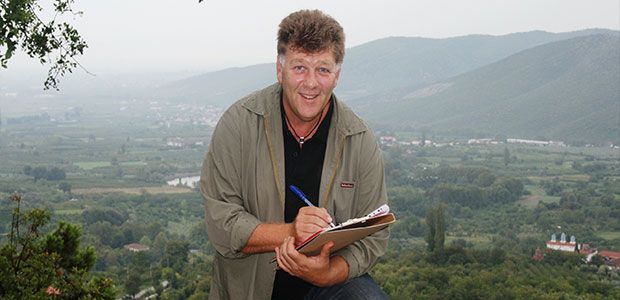
Thodoris Papaioannou in his own words
Theodoros Papaioannou, author of the fairy tales Anapoda and Apenanti, spoke in the first person to diastixo.gr about his first steps in writing.His text is republished here: For as long as I can remember, I have been in a school. A pupil, a student, a teacher. Surrounded by pencils, erasers, pens, exercise books, books and notebooks. Well, you don’t need much else to start writing. I’ve been writing since I was a child. From little notes to stories, short stories, plays and poems. I started writing fairy tales when I was older. When I was little, they used to read them to me or tell them to me. Later, I read them on my own. I never wanted school to end. I don’t know why. I liked it when it stopped for the holidays, but I always wanted it to start again. So the only way for school to continue was to cross over to the ‘other side’, and go from being a pupil to becoming a teacher. ‘Upside-down’ things, in other words. I think that in the end things didn’t turn out quite like that, because most of the time when I go into the classroom I sit at a desk. I feel better at a desk with the children around me. Ah, the children. Without them, I probably wouldn’t write. I collect their sentences and words on scraps of paper, in diaries, in the palm of my hand... Their conversations are usually the starting point for a story or a fairy tale. Is that too much to ask? When I finally believed that my stories could be read by more children, I started knocking on the doors of publishing houses. I knocked with large mustard-coloured envelopes, but they wouldn’t open them. That’s when I remembered I had to be patient. (I’d been through the same thing with music, when I was learning the guitar.) Because I wasn’t patient; I wanted everything to happen straight away. In a flash, as they say. At some point, a man turned up – what we call a ‘sponsor’ – and so my first book, containing two plays for children, was published in a limited edition. It was black and white, but I didn’t care at all. I kept sending out those mustard-coloured envelopes in the hope that a door might open. The exercise in patience continued. ‘A good lesson, I won’t deny it, but how long will it last?’, I wondered. Eventually, I decided to put together a portfolio of my own, containing all the replies from the closed doors. They all said more or less the same thing. ‘Thank you, very nice, but we won’t be taking it because...’. The folder just kept getting thicker and thicker. After a few years, one folder made it through, the door opened, and it became a book! With its colours, its songs, everything about it. Such joy! That wait, with all its setbacks, gave birth to *Anapoda*, which is also my first book to be awarded by the Children’s Book Circle in 2015.With the colours of the rainbow adorning nature and Melios the beetle, it was now clear that, after patience and perseverance, the journey was changing course. The following year, *Apenanti* came along with its songs, won the booksellers’ award from Public, and it too boarded the ship. Well, then came more fairy tales, a teenage novel; some are on their way, some are on paper and others in my mind. I feel lucky because I have precious travelling companions: Viktoras, Sofia, Kostas, Leda, Irida, Marilena, Roula, Vicky, Christina, Myrto and, of course, my son Orestis, who writes the music for the songs in the fairy tales.When I perform or narrate a fairy tale and I’m surrounded by children, I feel that this is the only thing I’ve ever wanted to do. To be among children. I love that they speak the truth without a second thought, that they are spontaneous. That they laugh with all their hearts when something strikes them as truly funny. For children to let you share a story of yours with them is truly a great honour. When they actually enjoy it and have a good time, it’s magic. When I first started writing, I used to say that if even one child fell asleep reading one of my stories, I’d feel happy. Now that I’m sure that’s happened, I can say that I am. When friends ask me, ‘But how do you come up with them? Where do you find them?’ and things like that, I reply: Everywhere. In the trees, in the plants, on a walk in the mountains, in children’s laughter, in a photograph, on a journey... I try to look at the world around me as if I were seeing it for the first time every time.Learn more