News
News List, News Categories, Events
-
Interviews
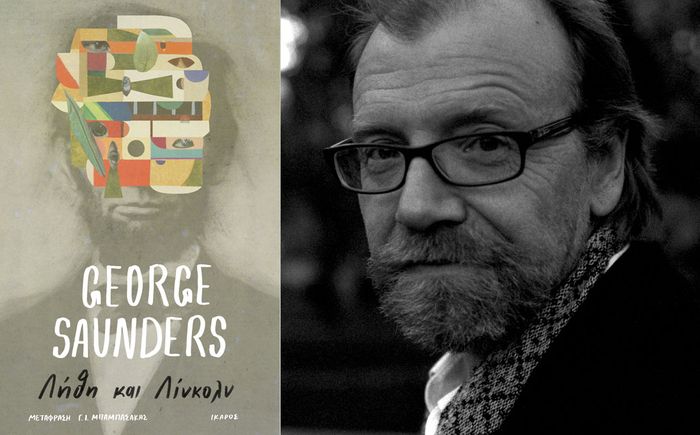
George Saunders: We are lovable beings, but we are finite.
The popular American author, George Saunders, spoke to the newspaper To Vima about his new novel, Oblivion and Lincoln (translation: Giorgos-Ikaros Babasakis), which is in the running for the 2017 Man Booker Prize. Interview by Grigoris Bekos. The interview was published on Sunday 1 October and you can read it below:On 22 February 1862, two days after his death from typhoid fever, 11-year-old Willie – son of the iconic US President Abraham Lincoln – was buried in a marble crypt. That very same night, the distraught father – wishing to mourn a little longer beside his lifeless child – visited Georgetown Cemetery alone. George Saunders structures his new book around this historical event; the Greek title is *Lethé and Lincoln* (the original English title is *Lincoln in the Bardo*). The ‘bardo’ refers to Buddhist tradition; it constitutes a transitional stage, an intermediate state between death and rebirth. Well, the American author transforms this into an unpredictable fictional setting, creating a sparkling, polyphonic story featuring the most human ghosts we have ever encountered in the pages of literature. And that is why he is a nominee for the 2017 Booker Prize... You are in fine company on this year’s shortlist, Mr Saunders, alongside Paul Auster, Ali Smith...’It is, of course, a special honour, and I must admit that it had the strange – though somewhat reprehensible – effect of making me like myself a little more, of fuelling my ambition for much grander projects.”You were devoted to the short story. How did your first novel come about? Was it an experiment that simply went well this time? Did the material you had to work with play a part? ‘I have the feeling that, in this case, the material itself demanded that I handle it in this particular way. I must tell you that, for the most part, I had been cleansed of my desire to write a novel; but I loved the core of this story so much that, once I had properly embarked on the process of actually writing it, the story itself demanded to become something more extensive than a short story. An extremely important advantage for me was, as you say, the experimental nature of the project – I tried to get inside the mind of a ‘newcomer’, so to speak, to adopt his perspective, so that I could discover from the outset how a novel is written. I believe, more broadly, that when an artist begins to mature, they must look steadfastly ahead, indeed provoke in themselves a sense of wonder or bewilderment regarding what they do, and reject complacency, the ‘autopilot’.How did you find out about that particular visit by Abraham Lincoln? ‘At some point, back in the 1990s, my wife’s cousin began telling me about this incident – a tiny seed of history – as we were driving past Oak Hill Cemetery in Washington; namely that President Lincoln, broken with grief, kept the body of his dead son in the crypt. The image lodged itself in my mind and stubbornly refused to leave for nearly two decades. I wrote a play that didn’t turn out well; I tried to forget it, but I simply couldn’t. Gradually, I began to realise that the reason I was trying to escape from all this was my fear that I lacked the skills and qualifications to complete such a book, something terribly distressing for me. Giving up on the project seemed to me like a kind of artistic death. And so, in 2012, I started writing it, absolutely convinced of the outcome: I would give up. But that was when – in a strange way – the book really took off!’ The Buddhist concept of ‘bardo’ is essentially what makes the ‘action’ in your novel possible. In what way exactly did it serve you? ‘I used this transitional condition because it helped me – it reminded me, to be precise – that I must constantly imbue the afterlife with a mysterious aura. In that state – or at least based on the limited understanding I actually have of it – what keeps the soul trapped is precisely its inability to comprehend the state it is in. This means that the soul continues to misinterpret what it is (as is always the case) as something else: a permanent, stable, unchanging entity. This differs slightly from the Roman Catholic Purgatory, in the following sense: the bardo (again, I’m talking about my own version in the novel) is a more flexible and changeable state – in contrast to Purgatory, where, once you’re there, you remain until the end of the world, sitting on some uncomfortable bench or something similar, I don’t know...’. What is striking, if nothing else, is the ‘form’ you chose. Beyond the technique, did you perhaps want to link the president’s personal drama with the stories of ordinary Americans at all costs? ‘Look, all the questions you’re asking are truly very important. For me, however, the whole game of writing and fiction lies in finding, as a writer, a voice that is entertaining. Which means a voice that is literarily accomplished, rich, and at the same time accessible and approachable – that is what I devote myself to faithfully every day, and it gives me great pleasure. Otherwise, everything becomes so rigid, so harsh and, moreover, so restrictive.”Why not, for example, a monologue by Lincoln? ‘When I thought of writing the novel from Lincoln’s own perspective, I simply became depressed, and that is a thoroughly bad place from which to start. It seemed to me that it would be incredibly painful to extract anything authentic or entertaining from his own voice – it would be far too contrived, somewhat deterministic, if you like. An old student of mine predicted, quite out of the blue, that if I ever wrote a novel, it would be a series of monologues – and at that moment something clicked in my head! —the prospect of a tangible possibility, a playful mood, opened up within me.” You write about death in a way that doesn’t depress the reader. Do you approach death differently as a writer and as a person? “What I feel about death has been described beautifully by Woody Allen: ‘I’m not afraid of death – I simply don’t want to be there when it happens’. Otherwise, I believe this: art is something that helps us move towards this inevitable destination for us all; it helps us – if you like – to become familiar with the prospect of death, to redefine it in such a way that, perhaps, it does not seem so alien and terrifying to us – I must admit, of course, that for me this has not worked at all so far; indeed, it may even be making things worse, yet I remain optimistic...’.So? “I think we fear death because we have an innate tendency to invest in ourselves to an excessive degree, as if we were going to remain in this world forever, as if we were the centre of the universe. When we write, and imagine the lives of others, this may result – I say may – in our individualism being somewhat diminished. The same may be true of prayer or meditation. All of this can teach us (and constantly remind us) how things really are: we humans are lovable beings, but finite ones. And all this energy we expend to discover who we truly are is nothing more than a Darwinian trick – it makes us want to stay here longer and longer, by any means and at any cost, which is generally good for all species of fauna and flora, but then again, in the end someone has to foot the bill.You mentioned a bill... Does literature serve a purpose, more specifically, Mr Saunders? ‘I think literature performs a very important but rather humble task: it soothes the reader as an individual. It probably has a more effective impact on the sort of person who doesn’t really need this ‘softening’ all that much; even so, however, who among us doesn’t need to refresh our humanity and compassion towards others every now and then? Speaking as a writer now, for me it is preferable – and better – to focus on and address an imaginary reader, an intelligent, thoughtful person with good intentions: if you manage to inspire such a person, then you have achieved something as a writer. How meaningful can this inspiration be? Can it change them? “Even if your influence, as a writer, is only going to last a few hours for the reader, the fact that someone feels more present and more human in their daily life is, for me, a priceless gift. Something that has certainly happened to me, too, with many of my favourite books. Beyond all that, however: who knows? If we look back at history, we will see that great literature has always existed, but it has always been alongside violence and destruction. What can I say? Good literature is perhaps simply like good sex, or a delicious meal, or effective exercise. Literature is the pressure valve on the lid of the pot in which the evil nature of human beings boils...’ I heard you talking somewhere about ‘radical tenderness’. It sounds wonderful. What exactly is it about? “Ah! I haven’t really thought about the full scope of that concept (laughs). Basically, though, this is what I mean: on only a few occasions in my life — and for a brief period — I have happened to feel overwhelmed with love for certain things or people (following the death of a loved one, for example) and I have experienced just how boundlessly all-powerful this state is: that is, to sense the true place of a thing or a person in the world (a temporary place, not necessarily central, a place of service to others). After that, every decision seemed clear and there was little fear or uncertainty. We usually equate ‘love’ or ‘compassion’ as a way of life with weakness, but we need to consider the examples of Jesus or Buddha, or, for instance, the example of Gandhi, to see how invincible this is: to live in a state of unadulterated love and reduced individualism. Does literature, beyond beauty, also have a duty to cultivate a certain morality? ‘Perhaps. I wouldn’t pin all my hopes on literature in this regard. Literature is undoubtedly a space where you can certainly be free. Sometimes, however, I have found that precisely when I am working within a specific logic imposed by a text, I also clarify my own beliefs more clearly. And as I focus, with each new draft, on a specific character (through the prismatic lens of language), I have the sense that what is happening, reality, let’s say, is somehow slowing down, and at the same time it’s as if I’m watching myself create a kind of second-degree empathy. We practise and do it on paper, for years on end, and perhaps things would go better if we applied it to the world around us, if we pushed ourselves. Perhaps...’.You followed Donald Trump’s election campaign closely and wrote about it in *The New Yorker*. How did that come about? I mean the president himself...’That is precisely what a large proportion of Americans are now asking themselves on a daily basis. I don’t think, however, that any of us has the answer. One factor is certainly the incredible concentration of wealth at the top in the US over the last thirty years: the rich have become vastly richer, whilst the poor have become even poorer. I liken this pivotal development to a community living on a mountain where the oxygen has gradually moved upwards and now exists only at the summit: it is natural for the people living lower down, at the foot of the mountain, to feel anxiety and unease.”How do you relate this image to Donald Trump? ‘I am referring, of course, to one aspect of the whole situation, and that is the appeal Donald Trump holds for the working classes. But even that does not cover the whole picture, given that the new president proved attractive only to white working people. People of colour did not support him. Donald Trump played on certain primal insecurities and exploited them, particularly the misguided tendency we have as a nation to think of our country as a white place. We must also take into account another key factor: the poor quality of the education provided, our national inability to grasp, from his dubious rhetoric, that this man in fact neither understands nor cares – nor has he ever been willing — to learn anything about our political system, world history, etc. So, in other words: I have no idea! Like many others here, I feel disheartened and disappointed, and I’m waiting to see where all this will end up.’ You can find out more about George Saunders and his books published by Ikaros here.Learn more
-

Interviews
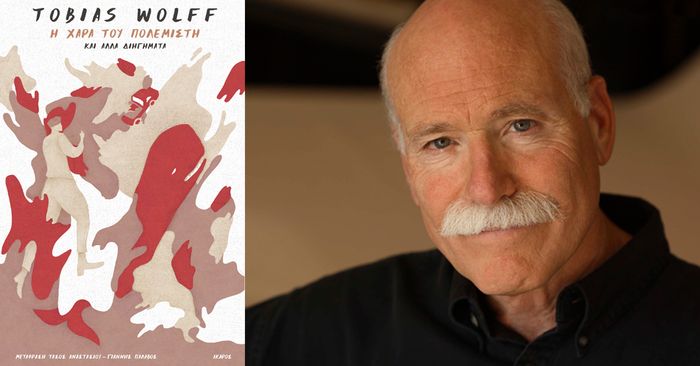
Tobias Wolff, a master of the short form, speaks to Vima.
Tobias Wolff, a master of the short story form, gave a very interesting interview to the newspaper *To Vima* and to Grigoris Bekos to mark the publication of the book *The Warrior’s Joy and Other Stories* (translated by Tassos Anastasiou & Yannis Palavos). The American author talks about the art of short story writing, explains why literature is intertwined with problematic situations, refers to the Homeric epics and expresses shame regarding the new US president.The interview was published on Sunday 6 August and you can read it below: In his first email – the reply – he wrote to us: ‘Of course we’ll do the interview! We’ve got a bit of work on our hands these days, of course: my second son is getting married here at our house this Saturday. But I think your questions will be a pleasant break for me.” In his second email – let’s call it an apology – a few days later, he wrote to us: “Please forgive me! Immediately after the wedding, I had to travel with my family to Mexico, with the result that both my time and my concentration vanished.” But it was for the best and well worth the wait. Because this particular author, apart from being an authentic writer, is also a kind man. And he was not only consistent but also friendly in his conversation with ‘To Vima’. The 72-year-old Tobias Wolff is no stranger to the Greek reading public. In 2008, Polis Publications released his semi-autobiographical novel *The Old School* – that unforgettable portrait of the poet Robert Frost, among others! – and a year later the wonderful novella *The Camp Thief*, for which he had won, in 1985, the prestigious Pen/Faulkner Award. However, the publication by Ikaros of his exceptional collection *The Warrior’s Joy and Other Stories* came as a necessary complement. Precisely because Tobias Wolff, now a professor at Stanford University, is considered one of the leading short story writers in the US, a master of the short form, which proves to be larger than life when handled by the right hands. The recent Greek edition is a well-balanced anthology of ten of his short stories, ranging from his first collection, In the Garden of North American Martyrs (1981), to a piece published a few years ago in The New Yorker. Stories such as ‘Hunters in the Snow’, ‘An Episode in the Life of Professor Brook’, ‘The Liar’ and the later ‘A Bullet in the Head’ – what a text indeed; in a single, dense paragraph we see what goes on in a man’s mind when a bullet practically pierces his brain! — are not only technically flawless but also create a narrative depth that even voluminous novels would envy. However, if we consider the case of Tobias Wolff in terms of his representativeness in the domestic literary scene, we find that there are outstanding issues worth addressing, namely his two autobiographical works: This Boy’s Life (1989), in which he describes the eventful coming-of-age of ‘Toby’ —this book was adapted for the cinema by Michael Caton-Jones, starring Robert De Niro, Leonardo DiCaprio and Helen Birkin—and *In Pharaoh’s Army: Memories of the Lost War (1994), in which the author gives a harrowing account of his involvement in the Vietnam War, a traumatic experience for the US. Mr Wolf, as you are something of a reclusive writer, it is worth asking: are you writing anything at the moment? ‘Indeed, I am currently writing a new book, a novel. I’ve been working on it for a few years now and I hope to finish it within the year, by Christmas – but for writers, deadlines (as Lenin once said of promises in general) are like pies, their crusts are made to be broken’. I know you don’t like being classified within the literary movement of ‘dirty realism’. But what do you think they mean, especially by the word ‘dirty’?Honestly, I don’t know. Realism as a literary style – not to say almost by definition – has always dealt with the most difficult, brutal and dark aspects of human nature and experience. Contemporary writers who have been categorised in this way, who have been – who we have been – labelled with this mysterious tag, suggesting we belong to such a movement, did not – and do not – do anything more strikingly ‘dirty’ than our predecessors. What can I say, it seems it’s still used simply because it’s catchy. We can discern personal experiences in your fiction, but also recurring themes in your work. I wonder, however, about the two memoirs, the autobiographical texts: did you write them because you believe they are unique experiences, or because you consider that they more broadly cover an important part of the American experience in the 20th century?The structure, the very form of my experience – the way in which my life took shape and as described in these two autobiographical narratives — always seemed to me to be inherently fictional in itself, that it needed none of the inventions of fiction, that it required neither the reconstruction of reality nor any embellishment. And I did, in fact, think it would be worthwhile to express and record all of this, to describe the events that make up the coming of age of a young American and, subsequently, to follow that same person to the front lines of a war. My other works – and those you allude to – although also based on certain personal experiences of mine, required me, the writer, to approach them more through my imagination. And that, I must tell you, is an instinct one develops when writing.” The United States has a long tradition of the short story, dating back to the 19th century. To what, I wonder, is this largely attributable? To the writers themselves or to the readers? ‘In reality, very few Americans read short stories. Even today, the most popular reads here are those multi-page ‘bricks’—the highly sentimental and extremely poorly written books that also have pretentious, bombastic titles, the so-called ‘blockbuster’ books. Every now and then something good pops up, a literary work of substance stands out, but it’s usually a novel. Short stories – like poetry – appeal only to a minority of readers.” Something that holds true everywhere, I think… “Yes, and it’s a shame because the short story is a very exciting genre and rewards the reader in many ways. The short story is a lofty, noble form. Besides, it is also a highly diverse form; there are so many different kinds of short story — from the Italian Calvino to Raymond Carver, from Ernest Hemingway to Jorge Luis Borges and Alice Munro — that only a fool would impose prerequisites and rules on their writing. In any case, the best one can say about short stories is that they must be interesting, and linger in the reader’s mind for quite some time after they have closed the book. In your short story ‘The Liar’ we read that ‘a solipsist is someone who believes that they create everything around them’. Is a good writer a solipsist? ‘Far from it; a good writer is the opposite of a solipsist, his gaze is unwaveringly fixed on a world that is ceaselessly charming and captivating by its very nature, and the good writer honours through his work both the complexity and the harsh underpinning that exist in the reality of this world. Furthermore, the good writer is the opposite of a liar. He is the one who seeks the truth, the one who understands that we must expand and use our imagination in order to discern and confront the truth, as far as we are allowed to. In the same short story, Dr Murphy says something strange, that ‘perhaps unpleasant things are more interesting’. And the question is: can there be literature without problematic situations?It is very difficult to imagine literature without problematic situations. It is problems that make literature happen, precisely because they force people to make their choices, for better or for worse. In this way, in any case, people reveal themselves or become themselves. Problems are the stories. Just imagine for a moment an ‘Iliad’ in which Agamemnon sails in great comfort and arrives quickly at Troy – at Ilion, in any case – the city walls come tumbling down like a house of cards, a wonderful peace is immediately made with Priam, Hector and Achilles become the best of mates, and Menelaus simply gives Paris a friendly pat on the back and returns with the lovely Helen to their home, where, thereafter, they lived happily ever after. How boring! Where is the moment when, just before the duel with Achilles, Hector’s young son frightens everyone with his father’s helmet? Where is Patroclus, killed by Hector whilst wearing Achilles’ armour? where is Priam, begging for the dishonoured body of his dead son, where is the Trojan Horse, where is the city engulfed in flames? But how much do we love these tragedies in the end – these problems!’ In the short story ‘Sleepless’, Richard reads the ‘Odyssey’ and gets bored. Has that ever happened to you? “No! I really like the ‘Odyssey’, but the ‘Iliad’ is perhaps the literary text I love most of all genres, from all eras, timelessly. Once I drove all the way from Athens to Mycenae, in an incredible heatwave, just to show my daughter—who had also become obsessed with the ‘Iliad’—the famous Lion Gate. She considers the photograph I took of her standing near the Gate to be one of the most precious gifts I have ever given her, and she is very proud of it. I love ancient Greek drama very much; in fact, I taught it at university, particularly Aeschylus’s ‘Oresteia’ trilogy. And to turn to more contemporary figures: Elytis, Cavafy, Kazantzakis, George Seferis and Yannis Ritsos are some of the Greek writers who have more recently found a place on my bookshelf.” At this stage of your life, do you return to certain authors, rereading them? “In the past, I used to return more and more to certain authors – Dickens, Melville, Hemingway, and Katherine Anne Porter, whom I personally consider a leading figure in American literature. However, in recent years I have been reading more history books; I do not return to literary texts, but rather I am looking for a different perspective on the same historical period that interests me; I am trying to see how another historian interprets the same set of events.” Can technology, the so-called digital age, have a substantial impact on literature, on the way we write and read? ‘I’d rather not answer that; I’ve no idea what we mean by the digital age; I’m not in the know.’ In 2015, you received the National Medal of Arts from then-President Barack Obama. What was it like? “It was a wonderful day for me and my wife, but also for the friends who accompanied us to the ceremony, because we already had great admiration for both President Obama and his wife Michelle. At the end of that day, I remember, we were overwhelmed by a sense of sweetness, a tenderness.” Are your fellow countrymen interested in writers’ opinions? Does the public discourse articulated by writers in the US have any influence? “I hope so! Because literature allows us to step into lives other than our own, to enter other souls. When we manage to imagine ourselves as someone else, we become more cautious about judging and condemning others. Because we see in them a reflection of our own human condition, and this deepens our understanding of humanity as a whole; we see it as a community rather than a war of all against all.” I now think that many of your heroes – ordinary people testing their limits – might have voted for Donald Trump, if they were real. That doesn’t mean they would necessarily all be bad people. But they would have... Why? ‘Donald Trump’s election is a disaster for our country. I’m still trying to come to terms with it and accept it. I really cannot understand what could possibly drive someone to vote for a proven bigot, a man who – by his own admission – mistreats women, someone who mocks the public with his so-called ‘university’, a common thief not only of his employees’ hard-earned labour but also of their personal belongings, a pathological liar, an admirer of the most bloodthirsty tyrants, an ignoramus who believes that climate change is a hoax orchestrated by China, and so much more... But all this was known on election day. I mean, this is Donald Trump. And he is consistent with who he is – I’ll give him that, he is consistently dishonest and repulsive. He has managed to completely disrupt our daily lives in the United States and has made us the laughing stock of the rest of the planet. I feel deeply embarrassed and ashamed about this.”Learn more
-
Interviews
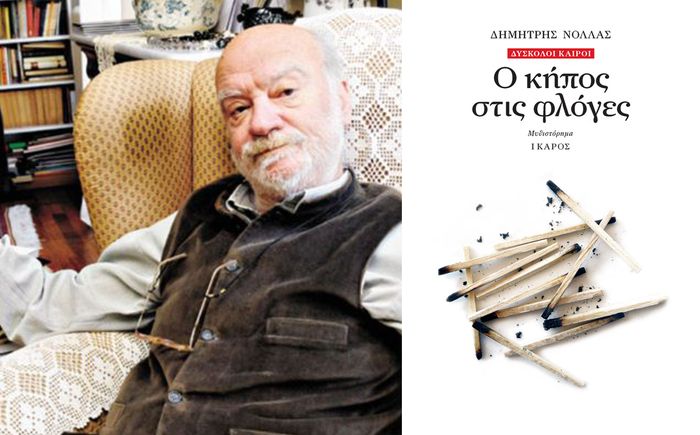
Interview with Dimitris Nollas on the occasion of the publication of his book ‘The Garden in Flames’.
Dimitris Nollas, on the occasion of the publication of his book The Garden in Flames (the third part of the Difficult Times trilogy), spoke with Dionysis Marinos in the newspaper Eleftheria tou Tupou.The interview was published on Monday 19 June and you can read it below: What if Greece were an amateur theatre troupe? And what if the play they were staging ended with a ‘forest’ of flames that would leave nothing intact in its wake? Does destruction also contain the seed of creation? Dimitris Nollas, having completed the trilogy ‘Difficult Times’, speaks to ‘Eleftheria tou Typou’ about his latest novel ‘The Garden in Flames’ and more. Mr Nollas, having completed the ‘Difficult Times’ trilogy, can we conclude with ‘what is our homeland?’ I think your question concerns the reader of the book more. For me, however, my homeland is everything I still experience in this blessed land and the joy I derive from those literary works created in the Greek language by the masters of the past, the present, and the future. Have you decided within yourselves whether we were struck by storms we could not withstand, or whether we brought them upon ourselves? Only the dead cannot withstand the storms that befall them. Man can overcome all storms. Of course, whoever provokes them is asking for trouble. Don’t you think that those who provoke storms should be prepared to foot the bill? Note that even left-wingers, when faced with power, did not hesitate to play their part.Do you think that left-wingers are immune to the cult of power? That they are angels who exist outside this world? Your heroes are part of an amateur theatre troupe. One might say that the choice is no accident. As if this troupe symbolises Greece. No, it is not a random choice. In a fictional construct, chance is controlled. Even the ritual burning at the end of the book suggests that only destruction can lead to a new beginning. Do you believe that? I believe what I write and I always take responsibility for it. I believe, therefore, that when we stray from moderation, it is always destruction that follows. This is true in society, just as it is in nature. A new beginning always comes to heal the harm caused by a catastrophe. I do not believe that a catastrophe is the end of the world. One need only recall, to stick to our modern history, the years 1897, 1922, and indeed the entire 1940s. Is there any personal responsibility for how we got here? For many years, the phrase ‘we all ate it together’ was at the heart of a fierce debate. Without personal responsibility, we have no individuals, we have a faceless mass. What made this statement so outrageous was that it was uttered by a political leader who did not have the courage, at the very moment he said it, to repent and apologise to all those sheep who followed him and voted for him, taking advantage of the handouts he showered upon them (with borrowed money, let us not forget). That is why it ‘became the focus of intense controversy’, as you say, because that condemnation stung, as it forced each of us to face up to our own personal responsibility. Further proof that this statement corresponded to reality. Such words, however, require courage, which this particular individual lacked. And he did well to withdraw from politics shortly afterwards. Let us give him credit for that. Did the ruling Left prove to be little or no Left at all? Or, in the end, is it succeeding? What do you think? Left or no left, whether it’s a lot or a little, it is obliged to manage the communal areas of the block of flats. The most important thing, however, is that, for the time being at least, it is not rummaging through our souls, but our wallets. Do hard times produce good works of art? Does literature need ‘crises’ to flourish? I think that, in any case, works of art are the fruits of intellectual crisis. Does the movement of ‘partakism’ (an excellent neologism) still exist in these times of crisis? In extreme circumstances, such as a crisis like the one we are experiencing, selfishness (‘philotomaris’ is a suitable term) evolves into the ‘partakism’ movement. In other words, the primitive feeling that I am the centre of the world becomes widespread, and thus only my personal survival will ensure the world’s continued existence. The salvation of the Universe will depend solely on my own. Others do not exist. I do not see them, I do not understand them, nor do I perceive them as my fellow creatures of God. You realise that we have already entered the antechamber of the prehistoric jungle. And if that sounds exaggerated to you, well, the antechamber of the madhouse. Are we an angry people, Mr Nolla? I don’t know. What is worrying, however, is that very few of us are angry about our own actions, about our own choices. What I do know is that, in any case, the angry person finds it hard to find a ‘solution to their drama’.Learn more
-
Interviews
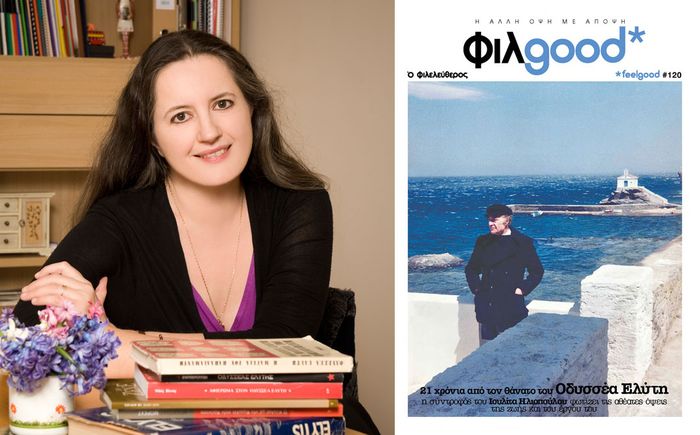
Ioulita Iliopoulou: “Elytis never lost sight of human values.”
Ioulita Iliopoulou, on the occasion of the publication of the five-language anthology “The Small World, the Great World!” by Odysseas Elytis, set to music by Giorgos Kouroupos, as well as the 21st anniversary of the death of the leading Greek Nobel Prize-winning poet Odysseas Elytis, spoke with journalist Yiannis Hatzigeorgiou in the cultural supplement Filgood of the newspaper Fileleftheros in Cyprus.The interview was published on Sunday 12 March and can be read below: 21 years after the death of the leading Greek Nobel Prize-winning poet Odysseas Elytis, who passed away on 18 March 1996, his partner and companion in life, the poet Ioulita Iliopoulou, sheds light on the unseen aspects that have been inextricably linked to his existence and art all these years. Where does poetry stand today, Ms Iliopoulou? Where we are, I would say, with all that that implies. It is, after all, a very internal process within us, which, whilst it seems to follow our concerns, often dictates them; whilst it seems to capture our thoughts in language, it often provokes them. It is energy, power, for the writer perhaps, for the reader certainly – and it is there, unseen or visible, with him.What is the difference between writing poems and living poetically – or even placing oneself within the poetic function? For me, poetry, the poetic function and art are almost synonymous. The code of expression changes each time: language when it becomes poetry, sound when it becomes music, and so on. To live poetically, however, as you say, if it is not identified with the meaning given by Hölderlin when he wrote ‘all toil, and yet poetically dwells man upon this earth’ and is interpreted in its current, distorted sense, I do not know if it bears any relation to the deeper meaning of the poetic function. That which demands vigilance, transformation, boldness, sometimes arbitrariness, devotion, struggle, perseverance. To live amidst this constant stirring of one’s mind and soul, in constant vigilance, yes, that could truly be poetic! What is the ‘little and essential’ of life, according to Odysseas Elytis, ‘the little and precise’? But life itself in its elemental truth, in the purity of its sources, in the clarity of feelings, in the grandeur of thought, in the strength of the soul, in the reading of the secrets of its signs. How did he himself live his daily life? And in what way did he transform simple, everyday things into poetry? Just as poetry is transcendence, the overcoming of contradictions, free and combinatory imagination, but also order and definition, so too can the poet become a creator of wonders, yet at the same time he is a persistent cultivator, armed with ‘reason and dreams’. Elytis lived with order and a routine, devoted to his work, always very simply. He undoubtedly accepted stimuli, but the thematic core of his poems was not detectable – most often, even at a superficial level – within current reality. A particularly internal process gave meaning to his themes and transformed them linguistically. Photo: Alexandra Argyri‘Alone I ruled my sorrow… Alone I despaired of death…’. It is customary for us, as readers of poets, to imagine them – removed from all social interaction – in their solitude, creating, brooding, falling alone and then rising again, drawing courage from a secret strength that springs from within them. Was that how Elytis operated too? Spirituality is one thing, antisocial behaviour another; introspection is one thing, melancholy another. Elytis did not have a good relationship with melancholy, nor with isolation. He had loves, friends and collaborators throughout his life and always adopted a positive attitude towards life, with all its problems and difficulties. His focus on the essential, his deep faith in the power of poetic art, and his constant search for the crucial, constituted a way of life, of action and of responding to adversity.How did the poet work? How many hours did he devote to his poetry each day? The rhythm of daily life and work, in any case, changes according to the different phases of our lives. Elytis always worked on his writing, whether it was poetry or prose. When he was immersed in a project, he worked systematically from the morning, with short breaks to deal with practical matters. The hours of the night were always the most productive. Did he himself prefer the day and the light to the darkness, even though poets are usually inspired by the latter? Elytis built his entire body of work around the theme of light, shaping a ‘solar metaphysics’ – we are not merely speaking of a physical preference, but of a concept rich in meaning. Did he demand absolute silence when he wrote? Did he isolate himself? He loved the quiet during working hours, but nothing absolute or excessive. Isolation, after all, was not a matter of physical space, but of the inner process of contemplation. Even when he wasn’t writing, did you feel that he was already writing his next works in his mind? Thoughts, words and ideas are always circulating. Of course, no one writes only when they pick up a pen. Often he would be preoccupied with a line, a missing word, which he might find at an unexpected moment outside the writing process.Were there works he particularly loved, his own or those of others? He himself loved to move on to the next one. To change form whilst remaining true to himself. He did not refer selectively to his own works. On the contrary, he often referred to Dionysios Solomos or Hölderlin. Who, in his opinion, could be called a poet? I think that the work, and ultimately time, history, bestow titles and names. Elytis’s choices in his prose writings set the standard; they convey with absolute clarity the scope and the defining distinction of the meaning of ‘poetry’ and, by extension, ‘poet’.How did Odysseas Elytis’s human sensitivity and spirituality combine with the intellectual power of his thought, with his vigorous yet at the same time lyrical writing? I see nothing contradictory in what you say. Spirituality and intellectual power, lyricism and sensitivity, are complementary and reciprocal pairs, good conduits of their energy.The world, because whilst it is small, it is at the same time great, just as the title of the excellent Ikaros publication you recently edited suggests? Was this also the world of Odysseas Elytis? The small, humble elements of this world are those that have the greatest significance, value and endurance. Whether it is a mint leaf, a seashore, a word or an embrace. The world of small units presented in ‘Doxastikon’, for example, captures both the grandeur of the mystery of existence and the essence of his own Greek identity. Tell us about this new edition: ‘The Small World, the Great World!’ by Odysseas Elytis, with music by Giorgos Kouroupos”, published by Ikaros Publications… It is a portrait of the poet, a brief yet substantial exploration of Elytis’s autobiographical and essayistic writings, accompanied by an anthology of characteristic poetic fragments that reveal, to the initiated reader and, above all, to the uninitiated, his poetic principles and his value system. The poet’s visual works—tempera paintings and collages, as well as photographic material—adorn the publication, which encompasses not only the image but also the sound of poetry. Recitations, musical accompaniments alongside the spoken word, but above all Elytis’s poetry set to music by Giorgos Kouroupos, are captured on the two CDs included. This is a magnificent musical setting, which succeeds in offering all the delight of a joyful lyrical listening experience through enchanting songs, whilst also demonstrating the deep connection between the word and the musical phrase, thus leading the listener deeper into the magic of the poetic world. At the same time, all this material—both poetry and prose—is rendered in four other languages. Translations into English, French, Italian and Spanish are included in this five-language anthology.How did you discover this magic of Odysseas Elytis? In other words, what was the point at which Odysseas Elytis became the most important of all to you personally, to your daily life, to his presence – even in his absence today? My first real encounter with him – with his work, I mean – took place when I was a schoolgirl and read ‘Three Poems with a Flag of Convenience’. From a collection of, one might say, idiosyncratic theoretical poems, I subsequently came to appreciate the lyricism, the philosophical reflection and the magic of his language. This encounter continues – I mean my engagement with and study of his work. What, however, were the difficulties of living alongside one of the most significant figures of Greek intellectual life? Elytis never lost his sense of human proportion. He lived simply, applying the principles of his work to his life; he lived honouring the little and the precious, the essential, the humble things that can be priceless. He had great energy, a positive attitude towards life, and respect for others. He gave space to those he loved; he was keen for others to find their own path. All these things are precious in a shared existence.In what moments is he present in your life today? Well, the people we love live within us anyway. Elytis, in fact, is constantly present. Don’t forget that a large part of my work – apart from my own writing – is connected to his work. I study his work, I collaborate with translators and scholars on it, and I recite his poetry. Elytis was also the poet who, through his art, celebrated Greece, its beauty and its islands like few others… What was his own relationship with the sea, with travel, which islands did he love? Insularity in his poetry is a distinct theme, one that is present and evolves throughout his entire body of work. It is simply, I would say, the identity of the Greek; it is his fingerprint, a mark created by art, history and the natural landscape. Elytis travelled extensively throughout the Greek islands. Spetses, as the place where he spent his summers as a child, shaped, I would say, his island consciousness. Later, of course, the Cyclades were a destination for exploration, as he encountered these islands in their unspoilt state.Did he distinguish Cyprus from Greece? He loved Cyprus – beyond the fact that it had been his refuge for a few months during the dictatorship in Greece – he honoured its history, admired the industriousness of many Cypriots, and worried about its fate. How could he distinguish Cyprus from Greece, you ask, since, as he wrote, ‘where the language is, there is the homeland’? Did he realise the extent of his own importance? He had no conceit, if that is what you are referring to.Did he not even believe, when he was awarded the Nobel Prize, that he was truly important and memorable? The Nobel Prize did not change anything in his life. It perhaps took two years of his work, because he was forced to respond to certain proposals, deal with a huge volume of correspondence, and undertake journeys. But with the same dedication as before, as soon as the great commotion of the Nobel Prize had died down, he returned to his same small office, to his writing, battling ‘the “No” and the “Impossible” of this world’. ‘‘I lived on nothing / words alone were not enough for me…’. In what circumstances were words alone – and only words – enough for him? Words are never enough, because we carry on writing and searching for a new formulation, a different way of capturing a fresh thought. Did he have friends? Did he enjoy socialising? Or was he particularly – and very – selective in that regard too? Of course he had friends. Empeirikos, Moralis, Gatsos and many others were suddenly his close friends. Evangelos Louizos, for example, the publisher Nikos Karydis, Takis Horn. In fact, he maintained friendships dating back to his university days, friendships that lasted until the end of his life. Love is also a significant part of his poetry. How did he perceive it? As yet another god? As something innocent? As something that, when it happens, silences all other aspects of existence? Love is a primary element in his work, permeating his writing, existing either as a romantic conception of the world, or as sensibilities refined by the intellect, or as a natural approach. It is love ‘in each other’s embrace’, but also the belief ‘that love is not what we know, nor what the magicians claim. But a second life, unblemished, in eternity’. You were, Ms Iliopoulou, that slender girl with long black hair, always by the poet’s side and in literary circles. What do you retain in your memory today from all those images? What I retain is not a memory, but the desire to exist with the same purity, respect and love towards the creations of the mind and art – towards life. When did you first encounter poetry? If you mean when I started writing, quite young, at primary school. How much has your perspective on it changed since you ‘met’ Elytis? I met Elytis early in my life. For me, then and now, he represented and continues to represent the embodiment of marvellous richness of content and expression – I’m telling you this just as I expressed it back then, as a schoolgirl. Of all the things he used to tell you from time to time, which is the one you would take with you for today’s world? Of all that he told us, to everyone, and tells us daily through his work, let us conclude with the exhortation to seek within our reality ‘the deepest meaning of a humble paradise, which is our true self, our right, our freedom, our second and true moral sun”. Find out more about the five-language anthology “The Small World, the Great World!” by Odysseas Elytis, set to music by Giorgos Kouroupos.Learn more