News
News List, News Categories, Events
-
Interviews
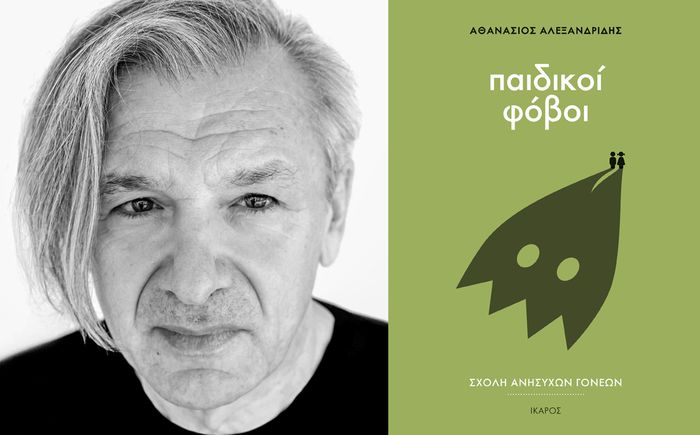
Athanasios Alexandridis: ‘I believe in children’s creativity. With a little help, they can achieve a great deal.’
Read the fascinating interview given by Athanasios Alexandridis to clinical psychologist Magdalini Georgiakou for PsychologyNow.gr, on the occasion of his new book *Children’s Fears*, the second in his series ‘School for Anxious Parents’. MG: Your new book is titled ‘Children’s Fears’. How did ‘Children’s Fears’ come about after ‘Children’s Loves’? AA: A year after the publication of ‘Children’s Loves’ comes the companion volume, ‘Children’s Fears’. If one considers that Love—the life force according to psychoanalysts, or Friendship according to the ancient Greek philosophers—unites the things of this world, it was necessary, after Love, to examine the action of aggression, which aims to unite them by force or to separate and destroy them when they resist. When, in the mixture of Love and hostility, Neikos according to the ancient Greeks, the latter prevails, then all the phenomena of fear are created, from terror and panic to fear itself or anxiety. MG: When we talk about ‘childhood fears’, what are we referring to? What ages do they correspond to? AA: The book attempts an extensive description of children’s fears, but also of parents’ fears regarding their children’s development. It follows the developmental trajectory and so, after an introduction to the concept of fear, it examines chronic and situational fears, bullying within and outside the family, the fear of loss and death, existential fear, separation anxiety, fear of camp, addiction to digital media, and the fear of difference, politicisation and terrorism.In a way, we could say that the narrative begins with the fears of the very young child—those we psychoanalytically refer to as primal anxieties—which concern the question of existence in the world ‘in life or in death’ —which we experience very early on, though it will take many years before we understand it—and moves on to the fears associated with having discovered the other person as someone I need or desire, and so I fear being abandoned by them, their anger, their rejection, the withdrawal of their love from me.The book examines the involvement of parents in these fears, which are quite complex because they often recall or even reproduce their own childhood or long-standing fears. Throughout the book, a constant concern is the intrusion of the social sphere into the family, which, in the form of roles, rules or prejudices, is always present, compelling and, depending on the family’s ability to integrate it, either constructive or disruptive. MG: How do you think the times and society in which we live influence parents in their role and in managing their children’s fears? AA: This era of ongoing and global social crisis greatly influences parents in managing their children’s psychological issues. Professional and financial insecurity, along with the relative unreliability of institutions, have stirred up fears in most parents and adults, as well as the long-standing childhood and adolescent fears they carry within them.Consequently, they have less tolerance for difficulties, whether these stem from the environment or from their children. If we accept that most people wish to be good parents and often feel guilty at the thought that they are not meeting their children’s needs, their children’s fears serve as a strong signal that they have not sufficiently established themselves in their children’s psyche as capable of protecting them. This is also consistent with the anxiety caused by unpredictable social instability. MG: When should parents be concerned about their children’s fears? AA: Whenever they become concerned! What I’m saying may sound funny, but it isn’t. The fact that they are worried is a clear sign that something is happening which the child, the parents themselves and the family system cannot organise or, in psychoanalytic terms, metabolise. Of course, with your question, you are asking to find out what symptoms might indirectly manifest children’s fears, apart from their direct and explicit expression.Because they can manifest indirectly through all manner of symptoms at the level of physical dysfunction, behavioural disturbance and psychological distress – and because I do not wish for parents to ‘play at being psychologists’– that is why I have set the psychodynamic criterion of parental concern as sufficient grounds for seeking a specialist’s opinion. Sometimes just a few appointments are enough to resolve a problem. At other times, fear can be an early symptom that allows for timely diagnosis and the start of monitoring or treatment. MG: What about parents’ fears? To what extent can these fears affect their children’s lives? AA: Unfortunately, there are fears held by parents, or even the parents of the parents, which can be passed on to the child. These are what we call ‘intergenerational traumas’. Unfortunately, we do not have the space here to explore such a serious topic in depth. However, a child’s fear may bring such a trauma to the surface and lead the ‘bearer’ of the trauma, e.g. the father or mother, to seek therapy. In closing this answer, however, I would like to emphasise my belief in children’s creativity and the fact that, often, with just a little help, they can achieve a great deal. MG: In the twelve chapters of the book, you provide a detailed account of various forms of childhood fears, such as timeless fears (fear of death, illness, abandonment) and contemporary fears such as the fear of dependence on electronics, fear of school bullying, etc. How, if at all, are these two categories of fears connected? AA: Your question already implies the answer! It naturally stems from the common psychoanalytic foundation of our thinking. To put it simply for readers: timeless fears form the psychological substrate. On top of these, the specific fears of each era manifest themselves, such as so-called school bullying, but also the fear of social stigma and exclusion. I believe that the fundamental work regarding these timeless fears must be carried out by the family and the school, with the main focus being on recognising the child, from a very young age, as a trustworthy partner in making and keeping agreements!MG: Won’t children feel that such an approach places an excessive burden on them? AA: No, not if the contracts and their requirements are appropriate to their age. On the contrary, they feel more self-confidence when an adult regards them as trustworthy individuals. And there is no greater shield against fears than feeling self-confidence. Look at folk tales: usually, the protagonist starts out as a small child who finds themselves in a difficult situation and is afraid. But when an adult, for example a genie, shows them trust, or a group of companions appoints them as leader, then that trust enables them to overcome their fears and put their mind—or rather, the psychomental programme of their development—into action.MG: Have we made the news? Am I to assume you’re working on a book about fairy tales? AA: I’m not afraid to admit it! But I do have some fear about whether I’ll manage it. MG: After all the books you’ve published, can you still have such fears? AA: As I say in my book, fear, if it is excessive, becomes disruptive; if it is manageable, it proves useful and motivating because it spurs our diligence and ingenuity. MG: I’d like to conclude with the issue of violence and terrorism, which are very much present in our times and are discussed at length in your book. The fear of terrorist attacks or violent clashes often drives parents to restrict their children. To what extent should this fear determine parents’ decisions regarding their children’s present and future? AA: If I had to summarise it in two sentences, I would say: a) restriction is not the solution; b) the solution lies in developing children’s political thinking and fostering a sense that they are citizens in the making from a very young age. The main areas for developing this fundamental quality are the family and school. The third volume of the series, which will focus on School and Society, will be devoted to these topics.Learn more
-

Interviews
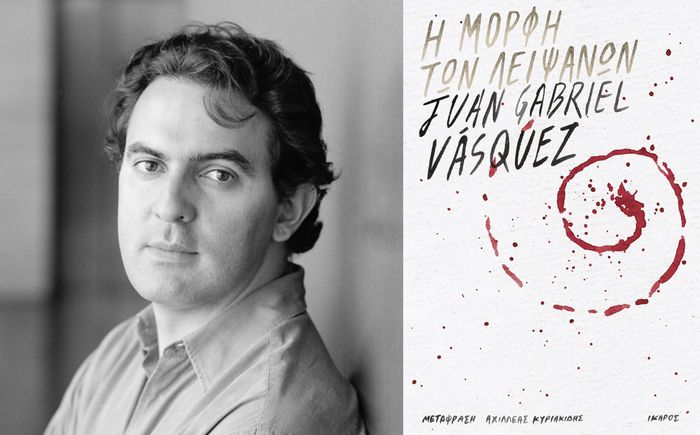
Interview with Juan Gabriel Vásquez in Kathimerini’s ‘K’ section.
Read below the exclusive interview given by Juan Gabriel Vásquez to Athos Dimoulas for the magazine K of Kathimerini, on the occasion of the release of his latest book The Shape of the Remains (translated by Achilleas Kyriakidis). It is 7.30 in the morning in Bogotá and Juan Gabriel Vásquez is sitting at his desk. This is how his daily routine begins. He writes until midday. In the afternoon, he reads, writes articles and spends time with his family. The 45-year-old author returned a few years ago to the Colombian capital and his hometown, after fifteen years in Europe. The Bogotá he had left behind, the Bogotá of his childhood and youth, was a city ravaged by the relentless war with the drug cartels. A terrifying and dangerous place, full of explosions, gunfire and despair. Is there a sense of security today? I ask him. Have the ghosts of the past gone? ‘Oh, ghosts never go away,’ he replies. His own generation, he believes, will carry the scars of that period forever, and no one will ever feel truly safe. Vazquez gained worldwide attention a few years ago with the multi-award-winning bestseller The Sound of Things Falling (published by Ikaros), transporting us to the era of Pablo Escobar’s omnipotence, when he had turned the country into a battlefield. Today he returns with *The Shape of Remains* (published by Ikaros, translated by Achilleas Kyriakidis), a voluminous and ambitious novel, dense and satisfying, in which he examines the nature of conspiracy theories and how they define our relationship with the truth. The narrator (who is the author himself) meets a very unusual man who believes that ‘they are hiding something from us’ regarding the assassination of the popular politician Jorge Eliezer Gaitán in 1948. What gives rise to conspiracy theories? ‘Human nature,’ replies Vázquez. ‘We understand the world and ourselves through stories; without stories to interpret our experiences, we are orphans, living in a void. So, whenever the official narrative fails to provide us with a convincing account of significant events, we fill in the gaps with our own invented stories. Of course, this also happens when the available accounts, though true, simply do not satisfy us.’ Through his book, as with his previous ones, Vásquez delves into the history of his homeland – I should mention that everything I know about Colombia I have learnt from Márquez’s books, from films about Escobar and from his own novels. Does the novelist have a responsibility to convey the truth? Or at least a truth? ‘A truth, more accurately. I wouldn’t write novels just to say exactly what anyone can find in history books or on Wikipedia. Literature explores a different kind of truth: in my novels I try to say (to use Kundera’s words) what only novels can say. With that in mind, yes, I want to help my readers understand the history of my country, the continent and modern life. At one point in the book, the narrator/author reads the comments following one of his articles in the digital edition of the newspaper El Espectador (Vásquez does indeed write for this particular newspaper), in which, he writes, ‘highlighted everything that afflicted my poor country: intellectual poverty, self-satisfied mediocrity, unpunished defamation, but also, above all, verbal terrorism, the schoolyard bullying to which the participants devoted themselves with unimaginable enthusiasm, the cowardice of those who hurled abuse under pseudonyms and would never repeat their insults out loud.” I ask him if he holds the same view regarding social media: “No, no, social media is even worse. I don’t have any kind of profile on them, and I believe that’s the best decision I’ve ever made. For a decade now, I’ve been saying that Facebook and Twitter are destroying political dialogue, hindering our democratic expression and undermining our freedoms rather than strengthening them.” Today, Vázquez is one of the leading figures of this fascinating new generation of Latin American literature, which includes (to name but a few who have been translated into Greek) the Chilean Alejandro Sabra, the Peruvian Santiago Roncagliolo, the Argentine Andrés Neumann, the Mexican Jorge Volpi and, of course, many others. Vázquez believes that Latin American literature is experiencing a new golden age, but he says there is nothing that unites him with his fellow Latin American writers, in the way that their forebears were united by a common political stance regarding the Cuban crisis. Nor are they united by their writing style, although one commonality we might identify is that they have moved beyond the influence of magical realism, which (somewhat simplistically) came to be identified with the tradition of Latin American literature. Specifically, Vázquez has often remarked that the aura of the fantastical has created a false perception of his continent, in whose modern history there is nothing ‘magical’, but, on the contrary, there is a series of tragic events that literature must address with realism. He always makes a point of clarifying, however, that had he not read Márquez in his adolescence, he would never have become a writer. ‘Finding your own literary voice, especially when you come from a strong literary tradition, is by no means easy, but personally I never wanted to break away from that tradition,’ he says. “It would be foolish to want to run away from a language that gave birth to the stories of Borges, *One Hundred Years of Solitude* (by Márquez) and *The War of the End of the World* (by Llosa).” Writing gamesA little writing trick, if I may call it that, or a routine, if you will, which Vazquez reveals during our conversation is this: he chooses a book and reads it alongside the novel he is currently writing. Thirty minutes of reading before he starts writing. It works, he tells me, like the tuner musicians use for their instruments. It tunes him in. Even if the book he is writing and the one he is reading have nothing to do with each other. For *The Shape of Remains*, he used *Crime and Punishment* as his ‘tuner’. Another ‘trick’ he employs is the one already mentioned: the narrator’s complete identification with himself. His protagonist is called Juan Gabriel Vásquez; he is a writer who lived in Europe, wrote a book called The Sound of Things Falling, returned to Colombia, and so on. As he explained to me, he chose this approach because many of the events he describes actually happened to him, and he felt that their impact would be diminished if he spent time constructing a fictional character. In other words, he did indeed meet (for those who have read the book) a doctor who had inherited the remains of a murdered politician, at precisely the time his twin daughters were being born. This identification with the narrator allowed him to express himself more freely in certain places regarding his role as a writer. At one point he writes that ‘the writer tries to bridge the gap between what he does not know and what he can learn’, and then describes how some books constitute a ‘struggle’ for the writer with the world and with himself, and then states: ‘One writes a book like the one I am writing now and has blind faith that the book might matter to someone else too.’ I ask him whether writing The Form of the Relics was indeed a struggle for him. “It was the biggest and hardest battle I’ve ever fought as a writer. It was an incredibly difficult novel to write, and I’m very proud of the result.” And rightly so. The Shape of the Remains is one of the most compelling and best-written novels of recent years. ■Learn more
-
Interviews
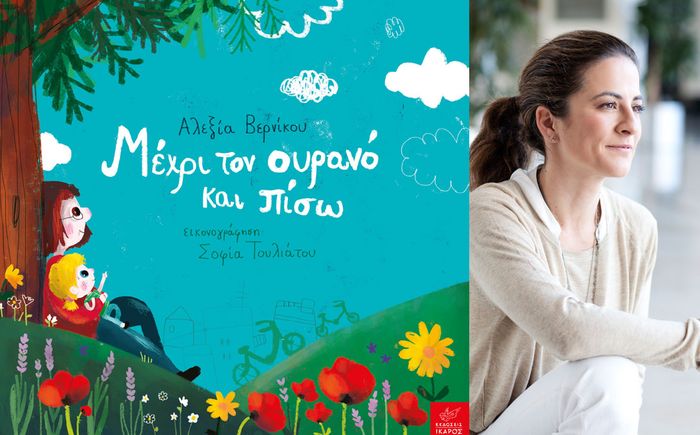
Alexia Vernikou: ‘The most important thing is to raise resilient children’.
At what age do children start to think about death? When do they ask their first questions? Can a book influence children’s attitude and approach to such important issues? And if so, how?Two questions from the excellent interview given by Alexia Vernikou to elniplex.com and Aneza Kolomvou on the occasion of the publication of the fairy tale ‘Up to the Sky and Back’ (illustrated by Sofia Touliatou).You can read it below: What drew you to writing? What was the experience like? Ever since I was little, I’ve enjoyed writing down my thoughts, both real and imaginary, so this book came as a natural progression. As an experience, it was enjoyable, painless, therapeutic and very creative. What is your favourite book or author? If I had to pick one book, it would be Mitch Albom’s Tuesdays with Morrie, which I have read over and over again at various stages of my life. I’ve just finished Hanya Yanagihara’s *A Little Life*, though, which I found absolutely brilliant. I couldn’t put it down, and despite its length, I didn’t want it to end. In your first book, you tackle a sensitive and unique subject: death. How did you come to choose such a subject? Death and loss are subjects that affect me both personally and professionally. Personally, because they are so difficult and painful; professionally, because the questions parents ask me on this subject are almost a daily occurrence. Questions their children ask them, which they find difficult to answer. At this tender age of 4–5 years, is it right to confront children with the most unpleasant aspects of life? Children have already encountered death through their fairy tales and games, and questions about it have usually already begun. Snow White and Cinderella, games involving weapons, battles and killings start very early on and are part of their lives. The difference with children of these ages is that they do not understand the finality of death or the pain that follows. So they can cope with the subject, and it is not as distressing for them as it is for us adults.At what age do children start to think about death? When do they ask their first questions? As early as three years old, many children start asking questions about death. When do we die? Why do we die? Will you die too, Mummy? Will I die too? Where has Grandad gone now that he’s died? If I eat all my fish, will I live forever? These are just a few of the questions they have and the queries they ask. Direct and honest questions that require equally direct and honest answers. Can a book influence children’s attitudes and approach to such important issues? And if so, how? Certainly it can, because children of this age learn through books. They identify with the characters and use them as examples and points of reference in their own lives. The aim of this book is for children to understand that death happens to adults after many years, once they have grown old and their hearts have stopped beating. And when someone dies, we can no longer hug them, but we can keep them forever in our thoughts and our hearts as our most precious treasure. In fairy tales, death often claims the wicked… whilst the good escape it or are resurrected… If only it were like that in real life… The phrase ‘… he became a star in the sky and is watching over us from up there’ is now widely used to avoid causing trauma to a child’s soul. Does this have any long-term consequences? When talking to children about death, it is important to focus on the cessation of bodily functions; in other words, we die because the heart stops beating. That is as far as the body is concerned. As for the soul and the metaphysical explanations we wish to offer—‘the little star in the sky’—this can be used to provide comfort provided the parent believes in it and explains to the child the difference between body and soul. However, we cannot stop there, because there will be many questions and we won’t be able to avoid them… In your experience, do Greek parents visit a specialist psychologist in the event of the loss of a loved one or for any other problems they observe in their children, or do they avoid doing so? As with all issues they face with their children, some parents choose to seek a psychologist’s opinion, whilst others refuse. In this particular case, it would be advisable for them to do so, because children perceive death differently from us; they grieve in their own way and come to terms with their loss at various stages of their lives, giving it new meaning.Recently, teachers have been dealing with an ever-increasing number of children with speech and behavioural problems. Or have they ‘put the children under the microscope’, as is often said? What have you noticed? Do you agree with this view? And if so, what do you think is causing this increase? Unfortunately, it is something I have noticed too when I compare the children I used to meet in my work 10 years ago with the children I meet today. I believe it is due to both biological and environmental factors. The environment and the family can be worked on, improved and developed if there is a willingness to do so. Then we see striking changes in the child’s behaviour as well. Clearly, the stress and insecurity brought on by the economic crisis, anger, the prevailing competition, the lack of boundaries and the influences from the internet have certainly played their part. At the same time, there is the ‘microscope’, and here we need to be careful about who we address and why. What do we do about childhood anxiety? When does it cease to be creative? I would not want to characterise childhood anxiety as creative. Clearly, like all emotions, it is permissible, but it is not pleasant and often becomes an obstacle to our children’s daily lives and functioning. In this age of rapid and multifaceted information and development, everyone is rushing to cover ground and fill gaps. Today, what are the essentials of child-rearing that we need to address in order to raise healthy, well-rounded and responsible individuals? I would say that the most important thing is to raise resilient children. Children who can cope with and respond to these fast-paced and demanding times and the constant flow of information. To achieve this and foster healthy personalities, we need to spend time with our children, listen to what they tell us, set boundaries, stick to them, and tell them the truth. What would you suggest to parents as a creative way to engage their children? I would suggest that every parent finds something they enjoy doing with their children and does it. Whatever that may be… painting, cooking, going for a walk, reading books, cycling. Only if they’re having a good time will their child enjoy it too, and they’ll manage to make it part of their relationship and routine. Is writing books one of your next goals? Of course! I have plenty of ideas, both for children’s books and for a book for parents, always with the child as the theme!Learn more
-
Interviews
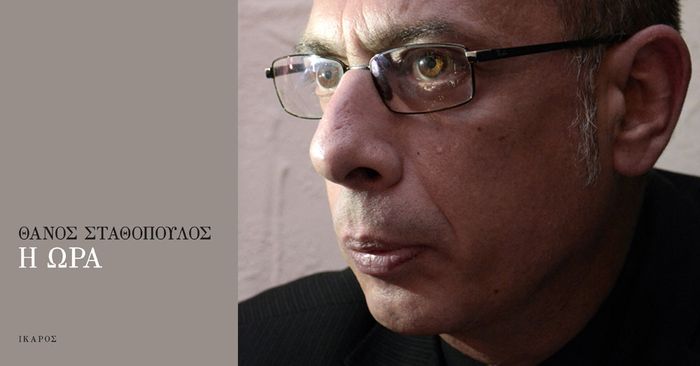
Thanos Stathopoulos: ‘Literature is a space where everything acquires meaning through metaphor.’
Thanos Stathopoulos talks to Lina Rokou on Popaganda about *The Hour*, his latest book. You can read the interview below: *The Hour* as a title. Why? And what role does time play in your writing? Book titles always elude me. I would say, however: Time at the heart of things. The time at which things happen. It is the moment or the duration. Every hour. The flow of time. The present and the past. Now or then. (When?) It is what we tear away and what tears us away. It is the merging. Time and the spiritual centre – a deep, concentrated feeling. All writing is connected to time. In my own writing, the tyranny of time is perhaps excessive. What is your earliest memory? Sitting on a little chair with a toy. Perhaps in 1965, I don’t know. A memory of myself, that is. Like a photograph. This connects me to something in the book: ‘And then the question returns: what is art? And art is what an artist does: sitting in a chair in his studio’. What is the artist’s studio? Life? Memory? Imagination? None of these? The connection takes me by surprise. You’re referring to a passage from a text by Bruce Nauman, which I quote in the book. The artist’s studio is an open field of action: it contains everything. I would say that its existence is of paramount importance. Everything happens there. By ‘studio’, of course, we must mean an expanded state. A space that extends. A spiritual state, certainly. This, after all, is the central theme of the book: space as a studio. Not just the artist’s, but everyone’s. The poetics of space and human expression. Everything can serve as material for processing. Everything you mention is raw material, but it does not constitute the artist’s workshop. The studio is the personal space the artist constructs and the intellectual atmosphere they need in order to exist. And beyond the intellectual space? What about space in its realistic dimension? Where do you prefer to write? Where do you imagine yourself writing? What is the most unusual place you have written in or found yourself writing in? I always write in my studio – the space where I live and work. I have rarely written anywhere else. I often take notes in cafés, which I then immediately transfer to my computer to edit. I’ve never imagined writing anywhere. Under the right circumstances, of course, I could write anywhere. The writing process involves a lot of work, anxiety and tension. You want to write. You wake up in the morning and write, or try to write. Sometimes you manage it, sometimes you don’t. Probably, most of the time you don’t. But you have to persevere. I can’t recall any paradoxical passage I’ve written; obviously, there isn’t one. The only paradox lies in the nature of what I write. What is paradoxical to you? Anything that clashes with common sense.Is ‘The Hour’ a puzzle of time, events, dreams, desires, thoughts, repressed feelings, influences? What is ‘The Hour’? If we exclude the repressed feelings, it is everything you mention. And more. It is a puzzle. Traces, fragments, readings, annotations, quotations. It can be read as a fragmentary text, interpreted as a dream or as a feeling. You hover in space and time. There are the other texts—that is, the borrowed texts—which I present either on their own or by commenting on them, in which I participate. They are the events and details from the lives of others. They are memory, of course. A personal archive of events concerning the poetics of space and the psychological centre, with a nod to what we call ‘architectural or architectured space’, where the body, actions and human expression take centre stage. It is the personal space we construct and the way we exist within it. In other words, what I mentioned earlier regarding the concept of the workshop. How and to what extent does your writing style resemble or differ from your way of life? The way I write embodies the way I live to the same extent that it eludes it. I don’t know if it could be any other way. I am not referring solely to the fragmentary and disjointed nature of what I write. The autobiographical elements in my texts often dictate the style: emphatic, declarative, revealing. Someone who knows me might recognise me by reading my work. Literature, however, is a space where everything acquires meaning through metaphor. The statement functions simultaneously as a metaphor. Readings, references and quotations are indirect experiences. My way of life can sometimes be channelled into my references to artists and writers from whom I quote passages, either from their work or from their lives: a mediated biography, one might say. We are always the others as well.A quote from a favourite writer or artist that expresses better than any other how you feel about writing? ‘I asked her if there was any way I could eat a wild carrot from time to time. ‘A wild carrot!’ she cried, as if I’d expressed a desire to taste a Jewish baby. I told her that the season for wild carrots was coming to an end and that, if until then she could give me only wild carrots to eat, I’d be grateful. ‘Only wild carrots!’ she cried. Wild carrots have a violet flavour, to me. I like wild carrots because they have a violet flavour, and violets because they have the scent of wild carrots. If there were no wild carrots on earth, I wouldn’t love violets, and if there were no violets, wild carrots would be just as uninteresting to me as turnips or radishes. But even in their present state of flora, I mean in this world where wild carrots and violets find a way to coexist, I could very easily do without them.” Samuel Beckett, First Love, trans. Achilleas Alexandrou. Has a woman ever fallen in love with you because of something you wrote? What was it? As far as I know, no. A quote from a favourite writer or artist who expresses better than anyone else how you feel about love? Oh, what can I say… There are many. Each one expresses a truth. I could, however, mention Baudelaire’s text *Consolations on Love*. Among many other aphorisms: ‘One must therefore choose one’s loves. – Beware of the moon and the stars, beware of the Venus of Milos, of lakes, guitars, rope ladders and all novels. – But love the one you love deeply, steadfastly, boldly, fiercely; let your love, having grasped the meaning of harmony, not torment the love of another. – Because every woman is a fragment of the essential woman, because love is the only thing for which it is worth composing a sonnet and donning fine lingerie. I don’t know if it expresses how I feel about love better than any other, but it is a text I have come to love very much. What do you love about everyday life and what can’t you stand about it? I like taking long walks around the city: walking, observing people and the city’s landmarks. I really like cafés – I’ve been a regular at cafés for over thirty years. It’s like a ritual. I like meeting friends there or sitting on my own. I like the quiet hours of the afternoon in my studio. Those are the hours when I can concentrate completely. I always read every afternoon. I like to have a few drinks in the evening. Often I can’t stand my daily routine – it always happens when I’m not feeling well. I can’t stand anything that’s compulsory. I can’t stand it, so to speak, as long as I’m forced to endure the day’s constraints. Learn more