News
News List, News Categories, Events
-
Interviews
Sebastian Barry: “My religion is supporting my gay son.”
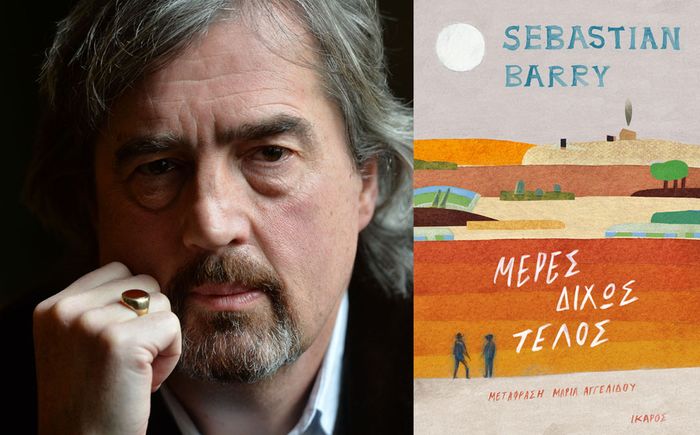
Read below the fascinating interview given by Sebastian Barry to Michalis Mitsos for the newspaper *Ta Nea*, on the occasion of the publication of his novel *Days Without End* (translated by Maria Angelidou).There are some writers who captivate you and leave a lasting impression from the very first moment you encounter them. They won’t let you rest until you’ve finished their book, and all you want to do afterwards is read the next one. I don’t know exactly which category they belong to, but I do know that I feel very close to them. Both them and their heroes. Inias McNulty was my kind of man; it was through his adventures that I began my journey into the world of the Irish author Sebastian Barry. I suffered alongside him when he was hunted by the IRA in the 1920s, after the Irish Civil War. Willy Dun was also one of my own, having fought a few years earlier in the trenches of the First World War: the descriptions of the battles in the pages of *Far, Far Away* are among the most powerful things I have ever read in my life. I naturally felt a close connection to Thomas McNulty too, undoubtedly Inia’s ancestor, who experienced love a few decades earlier, amidst the horrors of the Indian Wars and the American Civil War. Belonging to a sexual minority in times of war makes things even more difficult; we have seen this in recent years in Syria too. ‘I saw a weary traveller, / bedraggled, in rags’: with this motto by the American poet John Matthias, 63-year-old Barry begins his latest book about a great friendship between two boys, which will subsequently develop into a happy family with the addition of a beautiful Indian woman. And as he tells me in the interview that follows, in honour of this couplet he would sing Tsitsanis’s ‘My Jacket Has Worn Out’ if he were to read excerpts from the book in public in Athens.Every child must get up and dance, dance past all the obstacles, dance through the difficult, painful country dance of the end.” Life is a bit harsh, isn’t it? All right, but it’s still a dance. And I’m not even sure if white, middle-class Irish people like me can speak with any authority about poverty. There are many in Ireland who are struggling terribly, including many children, which is disheartening in a recovering economy. Inias McNulty is a fugitive. Willie Dun is a ‘stateless soldier’. Thomas McNulty is a gay immigrant. Is it loneliness that drives you? Or is history written by minorities?There is a useful and beautiful American word that I prefer to ‘loneliness’. It is ‘solitude’, a state of being that even an inanimate object can feel. The universe itself is undoubtedly a manifestly solitary structure. Generally speaking, however, for me as a writer, the character who is constantly forced to leave a place looks back at that place with great intensity and sincerity, and either adores or detests it with a strange precision.What did it mean to be gay in 19th-century America? Certainly not what we mean today. As far as I know, the word didn’t even exist, and if it did, it wasn’t derogatory or abstractly biblical. In that place of new beginnings and fresh starts that was 1850s America, great hardships went hand in hand with great possibilities, something that still seems to define America. One of those great possibilities was the birth of the freedom to be gay – indeed, to be whatever nature and the song of creation make you. One can see this glimmering and flickering through human history – albeit faintly.The Guardian wrote that the fact you managed to fit Irish emigration, gay identity and the creation of Europe into 260 pages is a miracle. Really, how did you manage it? I honestly have no idea! I followed Thomas’s voice with all the devotion and faith I could muster as a human being. All these things are inevitably intertwined in his story, and just as we are compelled to live day by day – ‘Where else are we to live but in the days?’ as Philip Larkin said – so too is a book, thankfully, written page by page; otherwise we would have fled the battlefield in terror.You’ve spoken to the press about the day your son Toby told you he was gay. Since then, you said, he has introduced you to the ‘magic of gay life’. It seems, then, that you did not follow the Pope’s advice, who said that parents should seek psychiatric help for their homosexual children…And just imagine that up until that point we’d had such a high opinion of the Pope in my household – even though it’s a household that’s half agnostic and half Protestant. This simmering zeal of some people to keep saying that there is something wrong with being gay is criminal and has always been criminal. Do the consequences of what they say ever cross their minds? It is as if they are offering a cheap excuse for being homophobic, a shameless passport to hatred. Your country has changed to a striking degree. What is the secret? Extroversion? Modesty? (‘because the clothes are in tatters’, as you say somewhere) Humility? Here are some good reasons! It would be truly interesting to understand the undoubtedly complex and mysterious mathematics of a country’s transformation. And what is certain is that the way the world is made has to do with a whole host of mysterious numbers. Extroversion, modesty, humility – a fine bouquet of words under the name of any democracy. We should adopt them immediately. The big issue of our time is identity. This is clearly evident in ‘Days Without End’. What is your view on the politics of identity? I am the father of a gay son who is now 21 and flourishing as an artist, a student and a human being: that is my only religion. The religion I choose is to support my son. This is what all parents of gay children need to understand. Being gay is an example of human radiance. That is how I feel about it. What have you discovered in the year that has passed since you were honoured with the highest distinction of the Irish Fiction Laureate?During this time, I’ve had the opportunity to visit, with the book club I belong to, places I would never otherwise have been able to enter, such as the Central Psychiatric Hospital, various hospital wards, and the Centre for Successful Ageing in Dublin. I also took part in various online broadcasts with other Irish writers, and was charmed by their open-mindedness, their modesty, humility and kindness towards me. I must admit I was impressed by all of this. How did the financial crisis affect Irish writers? The major change for writers was probably the drastic reduction in advances from publishers, as they anticipated a fall in sales. In Ireland, artists used to be completely exempt from tax. That has now changed and a tax-free allowance has been introduced. That is the practical side of things. I think it’s a bit harsh to say, but I’ll say it anyway: the crisis seemed to particularly encourage Irish writers to make greater efforts and achieve more, with new voices emerging from the murky sea of troubles alongside so many fully-fledged gods – Sally Rooney, Sarah Bom, Aimee McBride, etc., etc. Come to think of it, we could talk for an hour about the best names in new Irish literature and not mention a single man! I’ve just finished ‘Normal People’, Sally Rooney’s new book. An amazing portrayal of the characters, and the author is only 27 years old… Just as she is a brilliant and very interesting person. Completely independent, intelligent and admirable. At first I compared her to Elizabeth Bowen and Maria Edgeworth – now she can only be compared to herself. What does ‘Irishness’ mean in literature? In real life? Now that’s a difficult question. There is a strand of literature that has sought, and continues to seek – sometimes even with a touch of mischief – to constantly enrich the rather limited set of adjectives that once defined Irishness. As someone whose defining adjectives – city-dweller, middle-class, agnostic, etc. – never seemed to convey to others my own sense of an urgent Irishness, I have been striving to do so on my own for forty years. I therefore hope that Irishness in literature will continually tend towards Irishness in so-called real life. Strolling slowly towards Bethlehem… ‘The Odyssey of Inias McNulty’ is the first book of yours I read. Faced with the danger of old wounds reopening in Ireland because of Brexit, would you say that the hero’s adventures are not yet over? That question frightens me. Even for us in the South, the troubles in the North were always there, a violent presence in the back of our minds. And they were a strange and almost surreal echo of the troubles in Ireland during the civil war and afterwards. An unquenchable hatred that not even the power of good could stop. I pray, I pray, that people like Inias may continue to rest in their often unknown and unmarked graves. A few years ago, in an interview with ‘To Vima’, you said that your greatest literary brothers are Joseph Conrad, Thomas Hardy and Cavafy. You also said that you love Tsitsanis, Jacques Tati and Bergman. Do the writers of the new generation have so many points of reference too? Ah, Tsitsanis… I hope so. Perhaps not that specific set of points of reference, because I am 63 years old and a child of a particular era. I first came across Tsitsanis in a small seaside restaurant in Dryos, Paros, because the owners – some wonderful people from Trikala – had stuck those faded photographs on the back wall of the café… They piqued my curiosity. And then I felt that intense fire of his music, which still burns! What did you actually do for a year in Paros? Would you go back to live there? I wanted to go somewhere cheap to write. It was 1980. Back then, if you had a thousand pounds in your pocket, you could live in Greece for a year. Now you can live for three days! My father had been going to Paros since the mid-1970s, so when I arrived on the island I had at least one point of contact. But in reality I didn’t need it. Before the European Union, Naoussa was on the cusp of economic change, although one could sense the major shifts following the horrors of the Second World War and the end of repression under the military dictatorship. What I did not expect, in my innocence, was the onslaught of a kind of beauty that changes your very DNA: the sparkling waters, the ancient modernity. The strong friendships. And the open-heartedness, modesty and sense of hospitality of the people. I was 25 years old and knew only the cold heart of Northern Europe, the indifference of a city like Paris. I changed one letter (Paris – Paros) and found Paradise. I return every now and then, but something of my 25-year-old self always remains there, and goes to Kolymbithres on his battered bicycle, following a dirt track that no longer exists.When you read your books in public, you tend to sing. What would you sing if you were reading ‘Endless Days’ in Athens? Perhaps Tsitsanis’s ‘My Jacket Has Worn Out’, in honour of the novel’s motto. I’d never manage the little trills at the end of the lines, though – like spiral shells. You have to be Greek to sing Greek songs, unfortunately. I could hum it softly, though – tenderly, silently. Learn more
-

Interviews
Soloúp’s bittersweet graphic novels | Interview in LIFO.
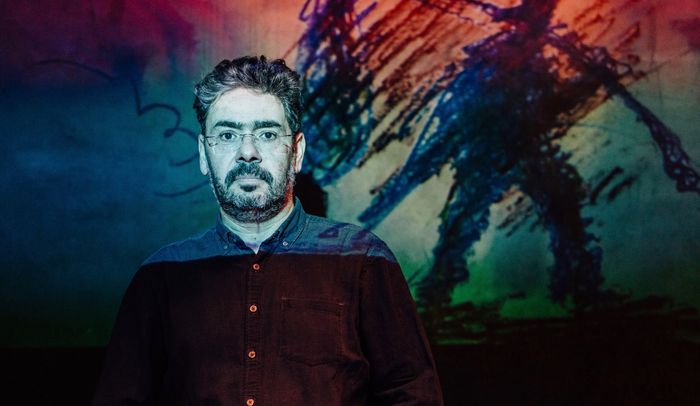
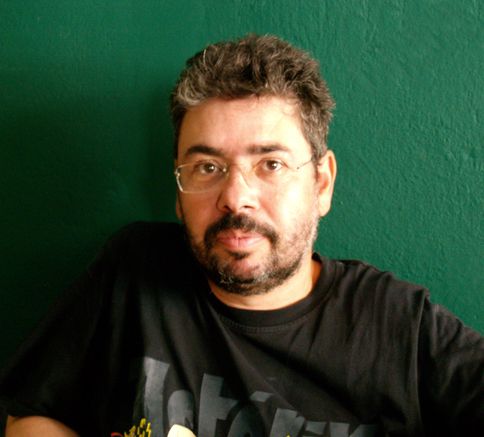
To mark the publication of his new graphic novel *The Collector: Six Stories About a Bad Wolf*, Soloúp gave an extremely interesting interview to Maria Pappa for LIFO. You can read it below:Following the award-winning ‘Aivali’, a graphic novel that caused quite a stir four years ago and landed its creator in legal trouble, Soloúp has returned with ‘The Collector’, a bittersweet comic about the breakdown of a marriage and parental alienation as seen through the eyes of outside observers. Often, Antonis Nikolopoulos, as he is known in real life, blurs the lines between reality and fantasy to address more ‘serious’, existential themes. With years of experience in cartooning and as a sketch artist, Soloúp has gone through all the stages faced by creators attempting to make comics in Greece. One of his major works, ‘Greek Comics’, was the most detailed study ever undertaken of the domestic comics scene. He is currently preparing a major exhibition at the Benaki Museum featuring original drawings from his new work, prints, canvases, videos and installations, as well as numerous parallel events. The opening is on 23 January. — Is it better to use a pseudonym? I started signing as ‘Soloúp’ in 1986, when I was a student at Panteion University. I had the impression that most cartoonists used a pseudonym, so I did the same. This decision was probably also influenced by a fear of the public that had been tormenting me since then, and I thought that this way I would avoid exposure. In the end, I didn’t escape my fear of the public, and I was left with Soloúp.— How did you come to write a social story? As you get older, you don’t really go looking for social stories and social issues; they come and find you. That’s how it happened with ‘Aivali’ and ‘The Collector’. These are things you can’t convey through caricature, humorous comics or comic strips; you can’t explore them in depth. So, because of my need to be able to give shape to these stories, I turned to the form of comics which, rightly or wrongly, we now call graphic novels.— Are the characters real? I think that the basis of most narratives in art—in film scripts, for example, or in literature—is that the primary material in the writers’ minds consists of images from their own lives, whether they experienced them themselves or witnessed them happening around them. This raw material, drawn from real life and transformed into a source of inspiration, is present even in science fiction films featuring aliens. However, from reality to the heroes of a fictional narrative, there is a vast journey through filters, social influences and subjective distortions that culminate in a self-contained world, in the closed universe of a book, a play or a film. In the case of ‘The Collector’, in the story of Dionysis and Fotinoula. — How did you come up with it? In the example I mentioned to you about science fiction scripts, if you notice, even the aliens have human passions. They fall in love, they die, they feel jealousy and hatred, they have weaknesses. Their writers are more likely to have drawn inspiration for such behaviours from a neighbour or their barber than from an actual alien. I would say, then, that the basis for most events in a script or text is things that the writers have at some point seen happen in their own lives. I don’t think the reader is so much concerned with whether the characters in *The Collector* are real or not, as with the fact that this book touches on an issue that is all around us and is entirely true. Cases of parental alienation between parents and children following a divorce are, unfortunately, in their thousands. — How autobiographical are you in your work? It depends. Back when I was drawing for the magazine ‘Babel’—in the stories of Anthropolyko and Mitsos Kyklaminos, that is—you’ll find quite a few autobiographical elements. Mitsos’s jokes and blunders were largely self-deprecating – my own blunders. In the more mature ‘Aivali’, on the other hand, there are chapters that are entirely autobiographical, with real events and details, such as the references to my grandparents who hailed from Asia Minor. In ‘The Collector’, again, as a writer I find myself in the position of the observer. I watch Dionysis and his surroundings. But let’s not forget that the observer, every observer, from the moment they record their thoughts, captures their own ideas, their own perception of things. And this, to some extent, has elements of self-reference.— Generally speaking, do you like symbolism? How much of it is needed in stories of this kind? I tend to refer to other works. To other texts, music, paintings, films. We live in a globalised culture of ideas. Many works, rightly or wrongly, have become identified with broader concepts. Thus, for example, a reference to another text, as occurs in ‘The Collector’ with Kafka’s ‘The Trial’, to other images, such as that of the Hatter and the Rabbit from ‘Alice in Wonderland’, or to other references, such as Plato’s allegory of the cave, add another layer of depth to the reader’s understanding. They simultaneously open up windows of concepts and thoughts. — Is there a need for such stories? Do you mean stories about problems, such as parental alienation? I think the readers’ initial reactions and the way they have embraced *The Collector* say it all. We cannot speak only of distant stories from the past. We live in the present, in a daily life full of difficult, ‘hidden’ problems. Putting these concerns through the mill of thought helps, above all, us.— Why did you choose the fairy tale of Little Red Riding Hood? Little Red Riding Hood is one of the best-known fairy tales in the world, with countless different versions. The strange thing about the Brothers Grimm’s collection of fairy tales is that we find two variations of the story. The first is the best known and most frequently illustrated. The second, however, states that it was Little Red Riding Hood herself who killed the big bad wolf, by drowning him in the well. It was precisely this version, then, that I needed narratively, and so the fairy tale became the key that unlocks the whole of *The Collector* and the book’s other five stories.— The central theme of *The Collector* is alienation. What alienates people? There are countless excuses. ‘It’s your fault’, ‘no, it’s not your fault’ and the usual lot. What happens, however, in human relationships that lead to alienation—and I’m talking about romantic relationships, friendships, relatives, parents and children—is that from a certain point onwards, one person no longer cares what the other is doing. They aren’t interested in trying to put themselves in the other’s shoes.— Why did you leave the interpretation of the couple’s break-up so open? The point isn’t to assign blame to one person or the other. In these cases, after all, everyone is, to a greater or lesser extent, a victim of the circumstances. Mainly the children, but also the parents, especially if they are unaware of their own problems. This is where we say that psychologists are needed too, otherwise we become at the mercy of our emotions and egos. The aim of the book, therefore, was to capture the pain and the silent violence that people endure when they find themselves in such difficult situations. A social and institutional framework, such as a justice system that is obsolete in such matters, which is indifferent to human suffering. Trials that drag on for years, absurdly favouring only one side and disregarding the psychological and emotional toll on the litigants. A justice system which, instead of offering solutions, becomes part of the problem. — From cartoons to graphic novels, which is the more difficult genre and what are the differences between them for a creator? Each genre serves different expressive needs. In political caricature, you literally have to say ‘a thousand words in a picture’, which is roughly the equivalent of the text on a newspaper page. You have to convey the report and the editor’s opinion with very few or no words in the speech bubbles of the sketch. On the other hand, in the medium of comics and their specific form, graphic novels, you have to contend with other things: the script and the unfolding of the narrative, the characters, the artistic rendering, and so on. Each has its difficulties and, of course, its rewards. You realise, of course, that the volume of work involved in a graphic novel is enormous. You might even spend years working on it to complete it. That in itself adds an extra degree of difficulty.— How difficult is it to make comics in Greece? The difficult part is making a living from comics in Greece, not making them. That’s why we have so many excellent but impoverished comic creators who, in order to survive, are increasingly turning to collaborations abroad. Making comics in Greece today is synonymous with making comics on planet Earth. It is now a global subculture, with its own devoted audience and its own references. — I read that you had legal problems with ‘Aivali’. Were they eventually resolved? Yes. There was a misunderstanding on the part of Fotis Kontoglou’s heirs, who thought I was exploiting his work. However, the public reaction was extremely strong, from readers, artists and academics, as the issue essentially concerns the use of art within art. At the same time, there was also the unreserved support of other copyright heirs. Ultimately, the charges were dropped in court. Subsequently, we met with the heirs, friendly explanations were given, and the matter was resolved. I believe that the work of the great author Fotis Kontoglou had everything to gain from ‘Aivali’ rather than lose. In the Mytilene library, for example, following its publication by Kedros, Kontoglou’s books were constantly on loan for months on end. — Which of your works do you consider the most demanding to date, and why? And which the best? All works—and this applies to every creator—are nurtured, painstakingly crafted and, at the same time, cherished. Each one is a part of one’s personal life, one’s thoughts and everything that happened to them during the years they were working on it. The ‘most difficult’ project, then, wasn’t exactly a comic book, but my seven-year research into comics. A demanding research project that successfully culminated in a PhD and a book, ‘Greek Comics’, published by Topos. The best is always, and subjectively, the most recent one, ‘The Collector’, to which I now live my life, a typographically superb book that was edited with particular care by Ikaros Publications, and I thank them for that.— Do you think things have improved recently for the comics scene? Is there a scene? Of course there is. It’s limited, with a dedicated circle of readers, which, however, is constantly growing. We have excellent creators and things are happening.— What do you think is missing from Greek comics? Confidence in the medium itself and its potential. It is not possible, when we have such an expressive medium at our disposal, to seek crutches in literary and other classic works. Comics cannot be popular and accepted as art solely through literary adaptations. They can stand on their own two feet, make the most of their potential and do truly great things.— Do you read in general? Have you enjoyed any books recently? I read a lot, all the time. It’s one of the most wonderful things that happens to me in life. One of the books I’ve recently finished was the ‘brick’ that is ‘4321’ by my favourite author, Paul Auster. But at the moment I’m running around like a madman preparing for the ‘Collector’ exhibition at the Benaki Museum. There’s no time left for reading. I do, however, sneak away some evenings for the cinema or the theatre. — Is there a person or artist who has influenced you most deeply, and why? Of those I’ve met, Yannis Kalaitzis. Yannis managed to combine in his life the inspired artist with the self-deprecating humorist, the substantive teacher with the humble man and the conscientious friend. His lesson? It’s not just what you do, but how you do it and how you offer it.— Do you think the current political situation provides material for cartoonists? Politics and politicians have always provided material for cartoonists. However, I no longer see the public as being so relaxed and ready to accept satire and political humour. There is a fanaticism and a prejudice among readers which I think is greater than in other periods. Perhaps, of course, we cartoonists sometimes contribute to this, by becoming mirrors of that prejudice.— Do you believe in hope? ‘If you do not hope, you will not find the unexpected, which is unexplored and inaccessible,’ as Heraclitus says.— What do you fear most? Do you want the whole list? Instead, I’d say I’m really happy when I’m offered some of life’s little pleasures by chance.Learn more
-
Interviews
Sebastian Barry: ‘What we call a historical novel doesn’t exist.’
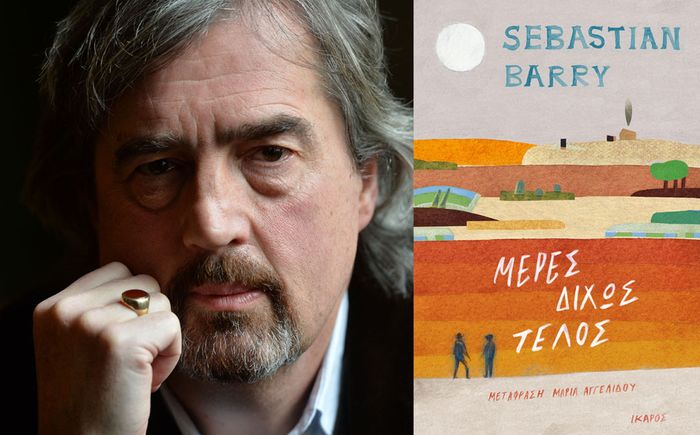
Read the interview Sebastian Barry gave to Maro Vassiliadou for *Kathimerini* on the occasion of the publication of his latest novel, *Days Without End* (translated by Maria Angelidou). The Irish author Sebastian Barry is so popular and has won so many awards that his work needs no introduction. Critics consistently highlight his mature literary style, his skill in creating an evocative atmosphere, and his talent for crafting authentic characters. In February, he was honoured with the highest distinction in Irish literature (Laureate for Irish Fiction), and his latest novel, Days Without End, has already enjoyed a highly acclaimed international reception. Clearly, then, an interview with him, on the occasion of the recent publication in Greece of Days Without End by Ikaros Publications in Maria Angelidou’s marvellous translation, is a must.However, this was not the main reason for speaking with him. It was, first and foremost, the desire of the captivated reader to ‘meet’ their author and ask the questions that unlock the secrets of his art. Sebastián Barri has the makings and the power of a great storyteller. His stories, often written in the first person, do not merely describe places, lives, passions and the adventures of people. They become the very eyes and ears of an eyewitness. They become his voice which, as if distant time and an unknown place were not intervening, speaks to you as you read.In 1850s America: This time, in his latest novel, Barry’s commitment to telling the story of two Irish families, the Duns and the McNaldys, across different time periods, takes him all the way to America. His heroes enlist in the US Army in the 1850s and take part in the wars that tore the country apart during that decade. For the author, this journey into the unknown becomes a means of speaking once again of the difficult lives of people who must always struggle and carve out their own destiny. With clarity and sensitivity, with cries and silences, violent yet tender, this novel is a journey towards maturity. And at the same time, a search into the past of a nation that contains fragments of the memories of other peoples and other continents. History is reconstructed as the protagonists seek their personal identity. Those who left, driven by necessity, find in their new home an opportunity to put down roots. And if they manage to survive, then they will be able to share scattered moments of happiness.Your earlier novel, Far, Far Away, is the story of the Irishman Willie Dun, as told from the front lines of the First World War. What inspired you to write another novel related to war, *Days Without End*, which is, however, set in America during the era of the Indian Wars and the Civil War?The character of William Dan in *Far, Far Away* has its roots in the ghost of a son in a work of mine called *The Steward of Christendom*, which dealt with the last days of his father’s life. He was, however, merely a shadow, a passing figure. That work referred in some way to my great-great-grandfather and essentially revealed that in ‘real life’ this man, my distant ancestor, had three sons who went to war. So, in essence, the novel was an attempt to find that uncle of mine who was a soldier during the First World War. Similarly, the root of his character in Days Without End lies in my grandfather, who, shortly before he died, revealed to me that he had a distant uncle who fought in the war against the Indians. I was only ten years old when he told me. We used to share the same bed during the long, cold Irish winters, and he had told me many stories from his life. But that was the only clue I had: a brief mention of that uncle, not even his name. It was enough, however, for me to ‘search’ for him 50 years later. How do you manage to describe the experiences, feelings and thoughts of a soldier as an eyewitness, without ever having been forced to fight?I never went to war, but I shared a bed with someone who did! Grandad O’Hara, whose novel is called The Temporary Gentleman, was a radio operator in the British Merchant Navy, and during the Second World War he served as an officer in the Royal Engineers, specialising in bomb disposal. He did two tours of duty in England and also travelled as far as North Africa and India. He loved to recount vivid stories of all this to me. But beyond that, I like to believe that our ancestors lie in wait within us, wrapped up in the coils of our DNA and our molecular structure. They are somewhere in the signals of the brain’s synapses. So, although I never took part in the Indian wars or the American Civil War, perhaps my distant uncle was there. And so I may have access to his life and to what he saw. After all, what we call a historical novel does not exist. You cannot return to the past as if the future had never existed, or as if what we now know so well were unknown. You simply make an effort to recreate that ‘innocent’ present, just as it was back then. Obviously, to achieve this, you have to read hundreds of books and then try to forget them, so that the necessary details emerge in your writing as if they were your own experiences.I believe that Thomas McNulty is one of the most authentic and daring contemporary literary characters. What inspired you to create him? Well, I’d been thinking about Thomas McNulty for a long time. Basically, I was concerned because he was Irish, and his people had endured 700 years of colonial rule, at times in an atmosphere akin to ethnic cleansing and the displacement of the local population. So this character had to find himself in America and, to a greater or lesser extent, become embroiled in a situation that was almost familiar to him. Furthermore, I was for a short time friends with Peter Mathiesen, the American writer, who worked extensively on the subject of Native Americans. However, the final impetus for creating Thomas came from my beloved and wonderful son Toby, who, at the age of 16, revealed to us that he is gay. He thus became my inspiration, the guide to Thomas’s heart. For this reason, the book is dedicated to him. The greater the pain, the more invisible it makes you. *Days Without End* is a hard-hitting book, set in the American West. Nevertheless, the reader never feels for a moment that this distant story – a foreign place, a foreign time – does not concern them. In recent years, your country, like Greece, has faced a very difficult economic and social situation. However, you choose to draw your themes from the past rather than the present. Why? I lived in Greece, on Paros, from 1980 to 1981. The country was just recovering from years of political oppression and was preparing to join the European Union. It was poor, but it was beginning to regain its strength. The people welcomed us warmly, just like the Irish! The tranquil beauty of the island was heart-wrenching. It was a place that became, for me, even more familiar than my own home. So I have been deeply disturbed in recent years, during the economic crisis, by the way Greece has been spoken of in the European Parliament and elsewhere. The anguish caused by this new poverty must be immense. But the greater the pain, the more invisible it makes you. You begin to disappear, even though you are still breathing. There is something of this in Days Without End, which is the story of two boys, and later two men, who have nothing of their own. And like little gods, they must create a world out of nothing. Apart from that, however, I do not possess the kind of imagination that responds to what we might call ‘the present moment’. That is the domain, the ability and the necessity of journalism. I must say, however, that without journalism and, paradoxically for the time, the photography of the 1860s in America, I could not have written Days Without End. Nevertheless, the present remains a mystery to me, and as unknown as the future. It has not yet become clear; it is not visible. In your books, you always speak of Ireland and the Irish with great tenderness but also honesty, without ever flattering them. How do they treat you? The Irish are self-critical, paradoxically. Perhaps it is a new trait of ours, or at least a recent one. For far too long we saw ourselves as victims of history, and blamed the English. However, over the last twenty years we have reassessed our own role in our misfortunes. I am referring to our behaviour towards women, homosexuals, the poor, and children. So, I have never encountered any hostility in Ireland because of my novels. On the contrary, they have been warmly embraced. Perhaps I ought to be concerned about that. Indeed, I was recently taken aback when I was honoured with the highest distinction in Irish literature (Laureate for Irish Fiction), awarded by the President of the country. On the other hand, of course, we have a wonderful President, who is also a poet. Come to think of it, when you meet him, he gives you a very warm hug!What is your routine when you’re writing? I work and read for about a year, trying to stay calm. Some very strange things happen whilst I’m writing. The need to connect with the era I’m describing is so great that my sole purpose is to be there. The means by which I travel there are syntax, grammar, language, songs. These are my own time machine. Everything I see and hear on these journeys is my story. Doesn’t that seem a bit silly, a bit childish? I think so. And yet, I’m grateful for it.Learn more
-
Interviews
Little Red Riding Hood in Plato’s Cave | Interview with Soloúp in the Journalists’ Newspaper.
Soloúp, to mark the publication of his new graphic novel *The Collector: Six Stories About a Bad Wolf*, gave an interview to Yannis Koukoulas for *Efimerida ton Syntakton*. You can read it below: I’ve just finished reading your book and I won’t hide the fact that I went through a lot of tissues wiping away my tears. Was it your intention to evoke such emotion? When you try to tell such an emotionally charged story, it overwhelms you, the writer, first and foremost. You don’t think about whether this particular narrative will move others. You wish for it and hope for it, of course, but at that moment it doesn’t really concern you that much. The overriding concern is to clearly articulate the questions that ‘gnaw’ at your protagonist and then to confront him with them. What preoccupied me whilst working on *The Collector* was what stance Dionysis would take in the face of the absurd situations arising in his life, as well as the bureaucratic, almost Kafkaesque, justice system that regards fathers as ‘guilty until proven innocent’ from the outset. The hero’s struggle to stand tall without simultaneously distancing himself from his child, Fotinoula, is probably what really tugs at the heartstrings. Let’s see. You’re one of the first readers of ‘The Collector’, so you give me hope that the graphic novel ‘works’. I’m eagerly awaiting readers’ reactions.How did it come about, particularly after ‘Aivali’ and your unconventional take on the turbulent history of Greek-Turkish relations, that you’d write a book about family and separation? I have several scripts in the pipeline that engage with history. One of them, in fact, has been ready since the time I was working on ‘Aivali’ and is set in the same period. I hope one day you’ll see it in its finished form. For the time being, I deliberately wanted to avoid the well-known trap that writers fall into when, after a successful work, they try to repeat themselves.It was therefore a challenge to tackle something completely different, let alone a burning social issue such as the psychological – and not only psychological – ‘abuse’ of those involved in a divorce.What connection does Antonis Nikolopoulos have with Dionysis in the story? Does the book contain autobiographical elements or is it a work of fiction? Just as you put it, my name is Antonis, and the protagonist is Dionysis. Life is always something different from a book. The story of a book constitutes a closed universe. Life, on the other hand, is open. Uncharted, subversive and unpredictable. It is precisely these absurd – as Camus describes them – characteristics of ‘reality’ that are, at the same time, what feed fiction and artistic creation: in novels, screenplays, music and paintings.I would therefore say that it matters little to a reader whether the story of a book, such as *The Collector*, concerns the author, so long as the problems it addresses exist everywhere out there. Stories that are often far more traumatic and painful than Dionysis’s, and which poison the lives of thousands of people.There are problematic divorces that alienate children from their parents, with no meaningful support from the institutions (psychologists, social workers, etc.) and a justice system that ends up being part of the problem rather than the solution. It is an issue that all the relevant bodies are aware of, but nobody speaks openly about it.So the heroes may be fictional, but the situations experienced by thousands of people like Dionysis – and, sadly, all over the world – can hardly be described as mere fiction. I know I’ll be prying if I ask who Little Red Riding Hood’s daughter is, to whom you’ve dedicated the book. But I’ll do so, since you’ve devoted an entire chapter to her. The fifth chapter of the graphic novel reinterprets the fairy tale of Little Red Riding Hood. There are countless variations of the fairy tale, from the earliest folk narratives and Perrault’s version right up to the present day. The most widely known and illustrated version is that of the Brothers Grimm. What is interesting is that in the Grimm brothers’ version – they themselves being ‘collectors’ of fairy tales – they also include a second variation, in which it is Little Red Riding Hood herself who kills the big bad wolf.This second ‘Little Red Riding Hood’ forms the basis in the graphic novel for a new interpretation of the fairy tale aimed at a contemporary audience, namely Little Red Riding Hood’s daughter. She is the one who, with the necessary distance from the tensions, could understand that modern fairy tales do not only feature good and evil characters.Why do you use the term ‘big bad wolf’ for your protagonist in the subtitle? Things in life aren’t black and white. Likewise, the people around us aren’t just good or just bad. Every character harbours many personalities and emotions. On the other hand, how we describe things depends on where we stand and how we view them. A wolf is ‘bad’ because someone wants to see it that way. Someone else might see it differently. That is why, across the six chapters of the graphic novel, I have tried to follow Dionysis’s story from different perspectives: that of the neighbour, a canary, the grandfather and grandmother, the hare, and finally, of course, to present Dionysis’s own subjective view of what he is experiencing. In your book, reality and fantasy are inextricably intertwined. Little Red Riding Hood, Alice in Wonderland, a refugee struggling to save a little bird, a huge cage atop the Acropolis, and Little Loulou all become elements of a multi-layered narrative. How would you describe your book in 100 words? You don’t need that many words. Just two are enough to describe the feelings of the book’s main character, in the rain under an umbrella: ‘Silent scream’.And what about Plato’s cave? Are we all chained and seeing only shadows? And who are those who show them to us, misleading us? In Plato’s ‘Republic’ there is the remarkable allegory of the cave. A text written almost 2,500 years ago that describes with chilling clarity – one might say prophetically – the ‘isms’ that subsequently swept through human societies. ‘Isms’ that, over time, nourish people and are nourished by their minds and bodies. Religions and ideologies which, through dogmas, aphorisms, slogans and absolute truths, mask the anxieties of the masses by offering them idealised solutions or redemptions.It does not matter so much, then, according to Plato himself, who the ‘deceivers’ are on any given occasion, as the fact that what gives rise to and perpetuates this particular condition is the inability of human societies to face the truth of existence head-on.In the foreword, you use a phrase from Kafka’s *The Trial*: ‘And now I advise you to go to your room, sit quietly and wait to see what they decide about you’. How did you come to choose this? When I first read Kafka at a younger age, he seemed exaggerated to me. As I’ve grown older, however, I’ve realised more and more often just how ‘Kafkaesque’ many situations in real life can turn out to be. A father, for example, like Dionysis, who, for no justifiable reason, is unable to communicate with his child, whilst at the same time being caught up in an absurd saga of court adjournments, is not dissimilar to Josef K. in Kafka’s *The Trial*, as we watch him march towards his predetermined doom.Among other things, there are reservations and a harsh, bitter critique of the Greek justice system and the police. How much can a citizen trust these institutions today? It depends on whose perspective you take, that of the perpetrator or the victim. Although both are clearly institutional manifestations of the ruling power, we perceive them differently as individuals when, say, ‘100’ and rush to the police officer to protect you from an injustice, and differently when a ‘cop’ beats you up at a demonstration. On the other hand, the conventions, the theatrics and the conventional lies played out in courtrooms, with legal tricks, lawyers’ tactics, coached false witnesses and bureaucracy.What is certain, however, regarding this specific issue, is that the Greek justice system lags considerably behind developments in Europe and the rest of the world.‘Parental alienation’ syndrome, for example, was recently classified as a disease by the World Health Organisation (WHO). Here, nobody cares. Trapped in pre-packaged decisions, ignoring the concept of joint custody that is gaining ground everywhere and readily placing the burden on fathers, the justice system not only fails to offer solutions but remains, rather, part of the problem.You have been an experienced political cartoonist and creator of humorous comics for almost 30 years. Suddenly ‘Aivali’ appeared, and now ‘The Collector’. Did you realise that you’re getting older and want to make sure you say other things besides just making readers laugh? Life is unpredictable and has room for everything, both comedies and dramas. Every new situation we encounter challenges us in a different way and requires a different approach. After so many years, sketching has probably become an instinctive way of thinking and reacting in my mind.I would therefore describe it as a happy coincidence to be able to sketch using different approaches – humour, political satire, graphic novels – for issues that concern us all. A situation that allows you to think and express yourself whilst simultaneously distancing you from the situations. Are comics a suitable medium and tool for telling such difficult stories, ranging from political and historical issues to traumatic personal experiences?To my surprise, through what I am gradually discovering in my work, but also through what I see, enjoy and admire in the work of so many cartoonists all over the world, yes! Comics, now fully mature, are a wonderful art form that continues to evolve, combining words with images and constantly discovering new narrative paths.In Greece, in fact, we are currently witnessing a remarkable boom in comics, owing their strong roots to the years of ‘Vavel’ and ‘Para Pente’.After ‘The Collector’, what can we expect: Have you started work on your next project? ‘The Collector’ has only just begun and ‘Aivali’ still has a long way to go. There are exciting things in the pipeline for both. On the other hand, you need some time to understand what will come next. That doesn’t mean there aren’t already many different scripts at a fairly advanced stage waiting in the wings.Learn more