Contents: Daedalus in Crete, Christ in Rome
Author:
Aggelos Sikelianos
Edited by:
G.P. Savvidis
Pages:
208
Dimensions:
20,5 x 13,5
ISBN:
978-960-7721-18-1
Publication:
1971
Categories:
Literature, Books, Θέατρο
Aggelos Sikelianos
Angelos Sikelianos (1884–1951) was born in Lefkada, the son of educator Ioannis Sikelianos and Hariklia Stefanitsi. He received his early education from his father and completed primary, middle, and high school in Lefkada. During his adolescence, he began his first ventures into poetry.
In 1901, he moved to Athens to study at the Law School. While there, he came into contact with Konstantinos Christomanos’ "Nea Skini," where he participated as an actor. In 1902, he published his first poems in literary journals of the era, such as Dionysos, Akritas, Panathinaia, and Noumas.
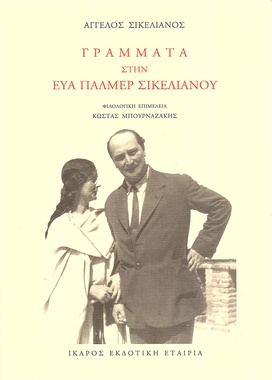
In 1906, he met the American Eva Palmer in Athens, whom he married in 1907 in the United States. That same year, he left for Libya, where he wrote The Light-Shadowed (Alafroiskiotos). He recognized this work as the starting point of his poetic path; it was presented in a luxurious, private edition in 1909, immediately establishing the twenty-five-year-old poet in Greek Letters.
Following their marriage, the couple settled in Athens and became acquainted with literary circles. Their son, Glafkos, was born the following year. In 1910, Sikelianos participated in the founding of the Educational Association (Ekpaideftikos Omilos). The following year, he published the "Delphic Hymn" and traveled with his wife to Paris, where they attended a performance of ancient drama by the Duncan couple. His father passed away the same year.
In early 1912, he visited Paris again, and that same year, he enlisted for the Balkan Wars. In early November 1914, he met Nikos Kazantzakis, with whom he formed a deep friendship, and they traveled together to Mount Athos for a 40-day pilgrimage. In 1915, they toured Greece in search of the "consciousness of their land." During 1915–1917, he published his Prologue to Life in four volumes as a private edition.
In 1917, his sister Penelope died (which served as the catalyst for the publication of Mother of God). That summer, he visited Prastova in Mani with Kazantzakis, and in 1919, he visited Olympia and Epidaurus. During those years, he wrote The Easter of the Greeks and many lyrical poems.
In 1920, he lived with his wife in Sykia, Corinth, and in 1921, he embarked on a pilgrimage to the Holy Land. He returned to Sykia, and that same year, he turned toward a comprehensive conception of the "Delphic Idea," influenced by the Asia Minor Campaign, the aftermath of World War I, and the outbreak of the Russian Revolution.
In the summer of 1922, he went to Agoriani on Mount Parnassus, where he studied the practical application of the "Delphic Idea" and learned of the Asia Minor Catastrophe. The following year, he gave lectures at the Law School on the idea of world peace and brotherhood through the ages.
In 1924, he and his wife settled in Delphi to continue preparations for the realization of the "Delphic Idea." His mother, who died in 1925, was buried in Delphi. Sikelianos had previously invited intellectuals from around the world to the future International Center of Delphi. In June 1925, he recited his "Ode to Valaoritis" during the centennial celebration of the poet's birth in Lefkada.
In May 1927, the "Delphic Festivals" were inaugurated, achieving great success in Greece and resonating abroad. Two years later, an article in the Ionian Anthology proposed Sikelianos for the Nobel Prize, and the Academy of Athens honored the Sikelianos couple for the revival of the "Delphic Festivals."
In 1930, the second "Delphic Festivals" took place with success equal to the first. Over the next two years, the "Delphic Union" was founded with state support. Sikelianos was invited to Paris, where he met Paul Goncourt and Paul Valéry; upon his return to Greece, he issued an educational manifesto for the "Delphic Union" and the book Delphic Idea: A Prelude.
In 1933, two performances of Sikelianos’ tragedy The Dithyramb of the Rose were held, directed by him with the collaboration of Eva. The following year, state efforts were made to establish a "Delphic Center," though they were not completed. In Paris, Louis Roussel promoted Sikelianos' name through a series of articles in the magazine Libre.
Starting in 1935, Sikelianos returned to poetry, beginning with "The Sacred Way." From then on, he collaborated intensively with the magazine of the Generation of the '30s, Ta Nea Grammata.
In 1938, he met Anna Karamani, whom he married in Eleusis in 1940. That same year, he wrote the tragedy Sibylla. His Akritika, which circulated in manuscript form in 1942, consisted of high-quality resistance poetry that encouraged the Greeks during the occupation years. In 1943, he recited his poem "Sound the Trumpets" during the funeral of Kostis Palamas. That same year, he began to suffer from serious health problems.
In 1946, he was proposed for the Nobel Prize by the Society of Greek Writers, and a second time that same year alongside Kazantzakis. Together with Kazantzakis, he addressed Paul Éluard during his honorary reception in Athens. That year and the next, his poetic work was published in three volumes titled Lyrical Life (Lyrikos Vios).
In 1947, he was elected president of the Society of Greek Writers and was proposed again—this time by a group of European writers—for the Nobel Prize, a candidacy that continued until his death. Despite his deteriorating health in those final years, he continued to create until he passed away on June 19, 1951.
Sikelianos’ literary work served his grand worldview regarding the role of the poet as a devotee and missionary of a religious ideology, which, incorporating the tradition of the world’s journey through the centuries, envisions the reconnection of man with the archetypal Myth of a unified psychosomatic existence. To this theoretical contemplation, Sikelianos subordinated his expressive means. He adopted a pre- and anti-logical expression in both his poetry and tragedies, assimilating diverse intellectual influences. His texts contain elements that echo the currents of Romanticism, Aestheticism, and Symbolism, as well as the ancient Greek classics, Orphic traditions, and Pre-Socratic philosophers.
His poetic work was collected in Lyrical Life (6 volumes, Ikaros, 1965–1969), his tragedies in Thymeli (3 volumes, Ikaros, 1971–1975), his prose in Prose (5 volumes, Ikaros, 1978–1985), and his correspondence in Letters (1902–1951) (2 volumes, Ikaros, 2000). His biography and bibliography are presented in the volume: Kostas Bournazakis, Chronography of Angelos Sikelianos (1884–1951) (Ikaros, 2006).