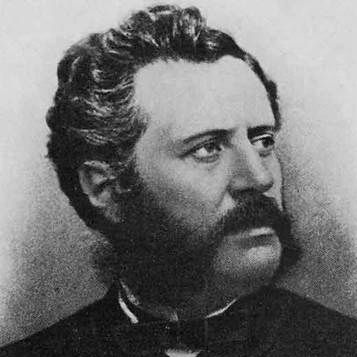
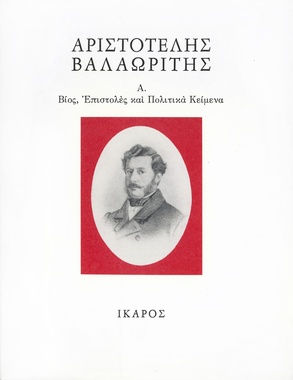
Aristotelis Valaoritis
AuthorAristotelis Valaoritis (1824–1879) was born in Lefkada. He studied in Geneva, where he obtained a Bachelor of Arts and Sciences degree from the local college, then studied law in Paris, and finally in Pisa, where he was awarded a doctorate in law from the university there.This was followed by travels in Italy and Austria, where, at the risk of his life, he took part in activities in support of Greek liberation.At the same time, he studied German philosophy and by 1847 had already published his first collection of poetry, entitled ‘Poems’, in Corfu. This was followed by a period of wandering in Italy, mainly in Venice. There he took part in student protests and met the daughter of Aimilios Typaldos, Eloisia, whom he married in 1852. He returned to Lefkada and bolstered the revolutionary movement in Epirus with men and money, thereby provoking the displeasure of the then British commissioner and being forced to flee to Italy once more.In 1857, he published his second collection of poetry, entitled Mnimossyna, for which he was honoured by Otto with the Golden Cross of the Saviour, and was elected as a member of parliament for Lefkada in the Ionian Parliament, a position he held from 1857 to 1864.In 1864, he visited Athens together with the President of the Ionian Parliament and other prominent politicians and drafted the resolution for the Union. His appearance at the National Assembly was a great success. He was elected twice as a member of parliament in the Koumoundouros government (1865 and 1868), but refused to take up ministerial duties.After the 1868 elections, disillusioned with politics, he retired and withdrew to Madouri, a small island near Lefkada. There he composed the poems Diakos and Astrapogiannos, works which he published together in 1867. Shortly before his death, he wrote the first three cantos of Fotinos, a work that remained unfinished due to his death. Fotinos was included in the second collected volume of his works, published posthumously in 1891.He also produced a number of translations (Lamarine’s The Lake, the thirty-third canto of Dante’s Inferno, etc.) and published articles on political and historical issues.The epic nature of his works, as well as his struggles for his homeland, earned him the honorary title of national poet whilst he was still alive. Critical opinion was divided in the case of Valaoritis, ranging from complete acceptance to outright rejection.