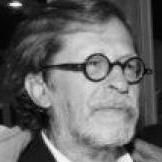
Antonis Kyriakoulis
AuthorAntonis Kyriakoulis was born in Athens in 1938. He began his general education at the Anargyrios and Korialeneios School in Spetses. From 1960 to 1964, he studied graphic arts at the Doxiadis School, alongside the engraver A. Tassos. In 1964–65 and from 1966 until April 1967, he completed his studies at the London College of Printing in London. Upon his return to Greece, he turned his professional focus to painting. In 1971, he held his first solo exhibition at the Fondazione Europa in Milan, to which the magazine Mondo Giovine dedicated a special issue. During the 1970s and 1980s, his works were published in the magazines: Zygos, Tachydromos, Chronicle by A. Baharian, Rodi, Vavel, and in the publications: ‘Tourism in Greece’, 1971, ‘Boundary 2. A Journal of Post Modern Literature’, State University of New York, 1973 (which includes a special multi-page article), Open Theatre "Monthly Review of Political Theatre", 1973 by G. Michailidis, M. Harlow, "Events. Greece 1967–1974", Athens, 1974, "Greek Prose", Athens, 1976.
From 1972 onwards, he devoted himself systematically to set and costume design. He has created sets and costumes for plays from the classical repertoire, Cretan and Renaissance theatre, as well as numerous revues. He has collaborated with all the state theatres and the Greek National Opera, of which he was a member of the Board of Directors from 1983 to 1985, as well as with independent theatre companies. In cinema, he has worked on the films "Arkhontes" by Manousos Manousakis (Best Set Design Award, Thessaloniki Film Festival, 1977) and "Sweet Country" by Michalis Kakogiannis in 1984. He has held 38 exhibitions and has released series of functional art objects. In 2000, he created a monumental 16-metre mural for the restaurant-café of the renovated Benaki Museum.
His writing career began with comic-tragic librettos for well-known operas, such as ‘The Lady of the Camellias’, "Othello", "Romeo and Juliet", which he wrote in London for his friends, as well as "nonsensical" limericks.
His first professional works were based on titles selected by Manos Hadjidakis: “The Four Voices”, “Les Lettres Amoureux”, “The Megaphones”, "The Trout and the Gardener", "Hermaphrodite or Paola", which were broadcast in 1981 on the Third Programme and narrated by the author himself. At the same time, he wrote – for the Third Programme – two radio series: "Little Nikitas Conte Kiki Diaboli Goes to Meet Catherine the Great", in 16 episodes read by Lefteris Vogiatzis with the addition of an improvised prologue to each episode, as well as the series "Othon and Amalia", also narrated by Lefteris Vogiatzis. In 1982, he wrote two pieces on Manos Hadjidakis’s “Pornography”, titled “The Lecture on Memories” and “The 9 Muses” (the music for the latter is included on the “Pornography” album under the title "Eric Satie Paints the 9 Muses"). He also wrote a thriller for Roussos Koundouros’s Channel 15.
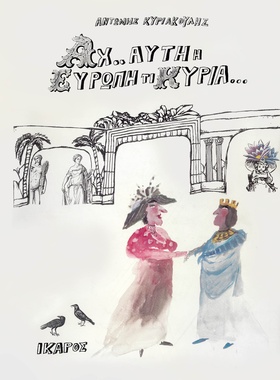
In 1986, the "Unbalanced Stories" were published in the magazine Tachydromos – accompanied by relevant illustrations – with the titles: "The Reconstruction of Josephine", "Litsa Konstantinidi Barbarossa", "A Hot Tear Rolled Down", "In a Basket and in the Middle of the Sea", "Historical Cities: Alexis/Alexandria – Swallows/Sarajevo", "The Secret World of Cockroaches", "The Noses of the Medici". His satirical, illustrated pieces were also published in Eleftherotypia under the title "Timeless Tales of Madness". At the same time, he created a series of comics for Figaro magazine, featuring “Mrs Surlinga, descendant of Mme Sousou”, and recently he has produced various illustrations for Athens Voice and Lifo. In 1995, he wrote a play entitled "The Two Little Hunchbacks", which was performed at the M. Rialdi Theatre. In 1993, the album "Antonis Kyriakoulis. Drawings and Texts" (Irina Publications). In 2001, Ikaros published the book "Ah, This Europe, What a Lady", featuring his short writings and quirky recipes. His text entitled "Parallel Lives" is included in the publication "For the Sake of Children" (Ikaros, 2001).